Telescopes
The best telescope for a 7 or 8 year old
The age where they start wanting to find things themselves. Buy for that.

By Scooter M. · published September 1, 2026
I'm not an astronomer and I don't have a lab. I'm someone who's genuinely into this — I read the manuals, compile the published specs, and do the arithmetic the box doesn't do for you. No lab coat. How we pick.
How this is funded. Lens & Lightyear earns a commission when you buy through a link on this page, at no extra cost to you. It does not change which products we pick or what we say about them — every card below carries a real reason to skip it. Prices are pulled live and were last verified October 18, 2026. Full disclosure.
The short answer
At seven and eight, the specification that decides success is weight, not aperture. Pick something the child can carry, set up and aim without an adult holding it steady. A 70mm refractor at around three pounds, or a 76mm tabletop, both work. Advertised magnification is irrelevant.
This is the biggest age band in the whole category by search volume, and it is also the one where the most money gets wasted. Seven and eight is when children start genuinely wanting to do it themselves — and when a telescope that is too heavy, too fiddly or too hard to aim converts that enthusiasm straight into frustration.
What a 7 or 8 year old can actually do unaided
- Carry the telescope, if it is under about four pounds including the tripod. Above that they will ask for help, and asking for help is friction.
- Point it roughly at a bright object and find that object at low magnification. At high magnification, no.
- Use a red dot finder, once shown. An optical finderscope is still a stretch, and an unaligned one is worse than none.
- Focus, and over-focus, and find sharp again. They will do this repeatedly. It is fine.
- Stay interested for twenty to thirty minutes on a night when things are going well, and about four minutes on a night when they are not.
That last point is why the finding problem matters so much. A child of this age has roughly one shot at a good evening. If the first fifteen minutes are spent hunting for Jupiter and failing, the session is over before it started.
How to spend the money
There are three places extra money goes at this price level, and they are not equally worth it for a seven-year-old.
| Spend it on | Worth it at 7-8? | Why |
|---|---|---|
| Lower weight | Yes, first priority | Decides whether the child operates it or an adult does. Nothing else changes the experience as much. |
| Help finding things | Yes, if no adult knows the sky | Removes the main failure mode. If a parent already knows where Jupiter is, this is money you do not need to spend. |
| More aperture | Not yet | A 102mm shows more than a 70mm, but at 14 lbs a seven-year-old cannot use it independently. Save this for ages 9-10. |
| More eyepieces | No | Two eyepieces is plenty. A child of this age will use the wide one almost exclusively, and a drawer of extras is a drawer of extras. |
Quick picks
Telescopes for a 7 or 8 year old
| # | Product | Best for | Price |
|---|---|---|---|
| 1 | 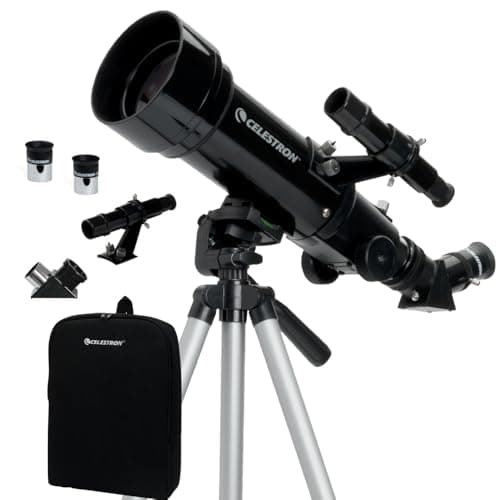 Celestron Travel Scope 70 3.3 lbs for the whole kit including tripod, in a backpack they can wear. | The child who wants to carry it themselves | |
| 2 | 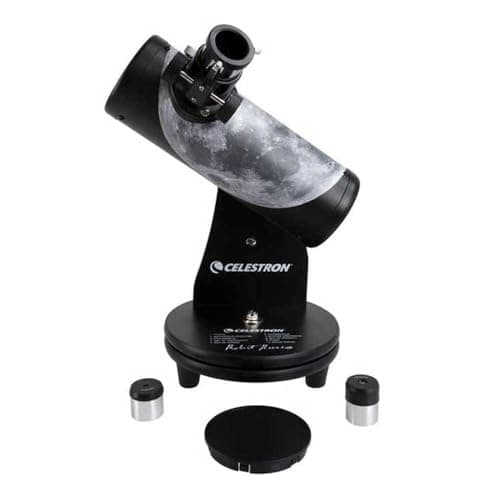 Celestron FirstScope 76mm Tabletop Still the easiest telescope in the category to actually use. | The lowest-friction option, if you have a table | |
| 3 | 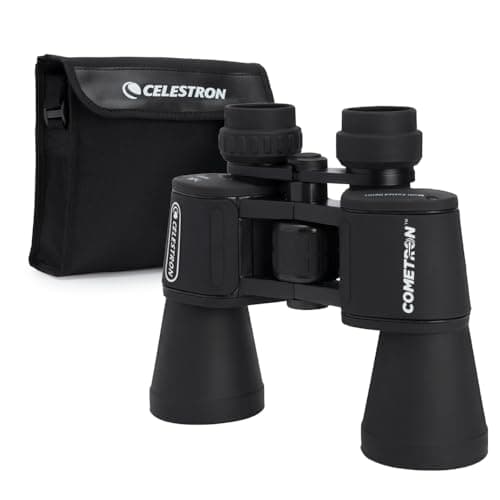 Celestron Cometron 7x50 7.1mm exit pupil — the brightest view here, and it works the second it is unpacked. | The honest alternative to a telescope | |
| 4 | No image Celestron StarSense Explorer LT 70AZ The phone finds things for you, which removes the main reason first telescopes fail. | Households where no adult knows the sky |
Rows link to the full write-up further down this page. Prices come from the live price layer only; where there is no live figure the button reads “Check price” rather than showing a number we remembered.
The finder is the whole ballgame
If you take one practical thing from this page, take this. A telescope at 40x shows about one degree of sky — roughly two Moon widths. Finding anything in that on the first try is essentially impossible, which is why every telescope has a finder: a low-power sight bolted to the side, aligned so that what is centered in the finder is centered in the eyepiece.
Out of the box, that alignment is wrong on every telescope ever sold. Nobody mentions this. The finder gets bumped in shipping and it needs setting up, in daylight, on a distant chimney or a pylon, before the first night. It takes ten minutes and it is the difference between a working telescope and a broken-seeming one.
Managing what they expect to see
Seven and eight-year-olds have usually seen a great deal of space imagery, all of it taken by orbiting observatories with mirrors measured in meters. What their telescope will show is different and, framed properly, still thrilling.
The Moon is the star of the show and always will be — craters, mountain ranges, long shadows along the terminator. Jupiter is a small bright disc with up to four moons strung out beside it, and those moons visibly move night to night. Saturn's rings are unmistakable from about 50x. The Orion Nebula is a faint gray smudge with stars in it, which sounds underwhelming until you say out loud that it is a cloud of gas where stars are being born, four hundred light years away, and the light hit their eye a moment ago.
The framing is doing the work there, and it is honest framing. Full detail on what you can actually see.
What about the child who is between bands?
A patient, careful eight-year-old who already knows a few constellations is often better served by the ages 9-10 picks, where the aperture jump starts to pay off. A seven-year-old who is enthusiastic in bursts and has never been outside after dark is better served by the ages 5-6 page and its lower-friction options.
The bands overlap on purpose. Buy for the child's patience, not their birthday — what age for a telescope has a readiness table that is more useful than a number.
The picks in full
Pick 1
Celestron Travel Scope 70
The child who wants to carry it themselves
The arithmetic
400mm focal length over the two supplied eyepieces gives 20x and 40x. Celestron's published ceiling for a 70mm objective is 168x, so both eyepieces are comfortably inside it — the box is not overselling. The 3.3 lb total is the number that matters for a gift: a child can carry the whole kit themselves, which is most of why it gets used more than once.
Seven and eight is the age where a child stops being a passenger. They want to carry it, set it up, and point it — and the specification that decides whether they can is not aperture, it is weight.
3.3 lbs for the optical tube, mount and tripod together is the number that makes this work. A child of seven can carry the backpack to the end of the garden, put it down, and open it up, and that sense of ownership is most of why a telescope gets used more than twice.
Optically it is a straightforward 70mm f/5.7 refractor. The 20mm eyepiece gives 20x and the 10mm gives 40x, both well inside Celestron's published 168x ceiling. The wide 20x view is genuinely useful for a child learning to find things: sweep it roughly at the Moon and the Moon appears.
The 5x24 finderscope is the weakest part of the package and worth aligning carefully in daylight before the first night — our setup checklist covers exactly how. The 45 degree erect-image diagonal is built for daytime terrestrial use, which is a genuine bonus for a child who will also point this at birds and hills.
Skip it if
You are buying it for a garden and it will never move. The whole premium here is portability, and if the telescope is going to live in one place a heavier scope on a steadier tripod is better value. The 1.8 lb tripod is the compromise you are making, and it does wobble.
| Optical design | Refractor |
|---|---|
| Aperture | 70mm (2.8") |
| Focal length | 400mm (15.74") |
| Focal ratio | f/5.7 |
| Eyepieces supplied | 20mm (20x) and 10mm (40x) |
| Finderscope | 5x24 |
| Diagonal | 45 degree erect image, 1.25" |
| Mount | Manual alt-azimuth on aluminum tripod |
| Highest useful magnification | 168x |
| Limiting stellar magnitude | 11.7 |
| Total kit weight | 3.3 lbs (1.5 kg), tripod 1.8 lbs (0.81 kg) |
| Included | Custom backpack, Starry Night Basic software, SkyPortal app access |
| What the box does not do | The tripod is the weak part. At 1.8 lbs it is light enough to carry and light enough to wobble, and a child nudging the eyepiece will lose the target. The 45 degree erect-image diagonal is built for daytime use and costs you a little light at night. |
Specifications from Celestron — Travel Scope 70 specifications. We have not handled this one — everything above is the published spec sheet plus our own arithmetic on it.
Pick 2
Celestron FirstScope 76mm Tabletop
The lowest-friction option, if you have a table
The arithmetic
The 20mm eyepiece gives 300 / 20 = 15x, and the 4mm gives 300 / 4 = 75x. Celestron's own published ceiling is 180x, so the 4mm sits well inside what the optics support — unusual honesty at this price. There is no tripod: it needs a table, a wall, a car roof or a stack of books at roughly chest height for the child using it.
Everything that makes the FirstScope right for a five-year-old still applies at seven, and a seven-year-old can now do it all themselves: place it, aim it, focus it, swap the eyepiece.
76mm of aperture is more than the 70mm refractors here, and at f/3.95 the views are wide and bright. The 20mm eyepiece gives 15x, which is the most forgiving magnification on this page for a child hunting for a target.
The catch is the table. It needs a solid surface at roughly the child's chest height, outdoors, in the dark, and that is a genuinely awkward requirement in a lot of gardens. A garden table works. A plastic chair does not.
If you have that surface, this is the pick that produces the fewest bad evenings. If you do not, buy the Travel Scope above and accept the wobblier tripod.
Skip it if
The child wants a telescope that looks like a telescope. At seven or eight this matters more than adults expect — a tabletop tube on a small base does not match the mental image, and some children are visibly disappointed by it even though it is the better instrument at the price.
| Optical design | Newtonian reflector, spherical primary mirror |
|---|---|
| Aperture | 76mm (2.99") |
| Focal length | 300mm (12") |
| Focal ratio | f/3.95 |
| Eyepieces supplied | 20mm (15x) and 4mm (75x) |
| Highest useful magnification | 180x |
| Lowest useful magnification | 11x |
| Limiting stellar magnitude | 11.9 |
| Light gathering vs the eye | 118x |
| Mount | Dobsonian-style tabletop base |
| What the box does not do | No tripod, no finderscope, and no way to track an object as the sky moves — you nudge the tube by hand. The 4mm eyepiece is usable but tight; most children get on better with the 20mm all evening. |
Specifications from Celestron — FirstScope specifications. We have not handled this one — everything above is the published spec sheet plus our own arithmetic on it.
Pick 3
Celestron Cometron 7x50
The honest alternative to a telescope
The arithmetic
Exit pupil is objective divided by magnification: 50 / 7 = 7.1mm, which matches Celestron's published figure. That is the single most useful number here. A fully dark-adapted young pupil opens to around 7mm, so a child uses nearly all of that 7.1mm cone and the view is as bright as the optics can make it. An adult over about forty typically dilates to 5mm or less and simply cannot use the extra — this is one of the rare cases where a child gets more out of the hardware than the grown-up does.
We earn less recommending this and we are recommending it anyway, because for a lot of seven-year-olds it is the better buy.
The exit pupil is 50 divided by 7, which is 7.1mm — matching Celestron's published figure and, more importantly, matching a dark-adapted child's pupil almost exactly. A seven-year-old gets the full brightness these deliver. Most of the adults buying them cannot, because adult pupils narrow with age.
At 7x with a 6.6 degree field, finding things is trivial. Point them at the Moon and the Moon is there. That removes the single biggest cause of first-telescope failure, and it is why astronomy clubs recommend binoculars to beginners far more often than the internet does.
The one real problem is 27.3 ounces of weight held above your head. Solve it by lying on a blanket, leaning on a wall, or using the tripod thread. Any of the three turns a frustrating five minutes into a comfortable half hour.
Skip it if
The child specifically asked for a telescope. Binoculars are optically the better first instrument, but a seven-year-old who wanted a telescope and unwrapped binoculars is having a different experience from the one you intended, and no amount of exit-pupil arithmetic fixes that.
| Magnification | 7x |
|---|---|
| Objective lens | 50mm (1.97") |
| Prism glass | BK7 porro |
| Lens coatings | Multi-coated |
| Angular field of view | 6.6 degrees |
| Linear field at 1000 yds | 344 ft (105 m) |
| Exit pupil | 7.1mm (.28") |
| Eye relief | 13mm (.51") |
| Close focus | 26.2 ft (8 m) |
| Weight | 27.3 oz (774 g) |
| Tripod adaptable | Yes |
| Environmental | Water resistant |
| What the box does not do | 27.3 oz is heavy for small arms held up at the sky — plan on leaning against a wall or lying on a blanket, or add the tripod adapter. BK7 prisms are the cheaper glass and show slight softening at the edge of the field. Water resistant is not waterproof. |
Specifications from Celestron — Cometron 7x50mm specifications. We have not handled this one — everything above is the published spec sheet plus our own arithmetic on it.
Pick 4
Celestron StarSense Explorer LT 70AZ
Households where no adult knows the sky
The arithmetic
700mm over 25mm and 10mm gives 28x and 70x; the 2x Barlow doubles those to 56x and 140x. Celestron's published ceiling is 165x, so even the Barlowed 10mm stays legal — a rare box where every supplied combination is inside the optics' honest limit. At f/10 the images are contrasty and easy to focus, which is exactly what an inexperienced pair of hands needs.
The honest case for spending more at this age is not aperture, it is finding things. A seven-year-old with a telescope they cannot aim gives up. A seven-year-old who can put a phone in a cradle and follow an arrow to Saturn does not.
The system works by photographing the sky through the phone camera and matching the star pattern against a database — the same approach satellites use to work out which way they are pointing. Once aligned, the app shows you where to push the telescope and turns the target green when you are on it.
The optics underneath are a 70mm f/10 refractor: 700mm focal length, 28x with the 25mm eyepiece, 70x with the 10mm, and 56x and 140x with the supplied 2x Barlow. Celestron's published ceiling is 165x, so every supplied combination is inside the honest limit — worth noting, because that is rare.
At 7.4 lbs assembled, a seven-year-old will need help carrying it out but can operate it once it is standing. Check the phone requirement before you buy: it is the difference between this being the best pick on the page and an expensive mistake.
Skip it if
There is no compatible phone in the house. The requirement is Android 12 or later, or iOS 18 on an iPhone XR or newer — an older hand-me-down will not run it, and without the app you have paid a premium for an ordinary 70mm refractor.
| Optical design | Refractor |
|---|---|
| Aperture | 70mm (2.76") |
| Focal length | 700mm (27.56") |
| Focal ratio | f/10 |
| Eyepieces supplied | 25mm (28x) and 10mm (70x) |
| Barlow | 2x (1.25") |
| Finderscope | StarPointer red dot |
| Mount | Manual alt-azimuth |
| Tripod | Aluminum, 1320.8mm (52") max height |
| Highest useful magnification | 165x |
| Limiting stellar magnitude | 11.7 |
| Total kit weight | 7.4 lbs (3.35 kg) |
| Phone requirement | Android 12 and later; iOS 18 and newer, iPhone XR and newer |
| What the box does not do | The phone requirement is a real constraint, not fine print: Android 12+ or iOS 18+ on an iPhone XR or newer. An older hand-me-down phone will not run it, and without the app this is an ordinary 70mm refractor at the price of a guided one. |
Specifications from Celestron — StarSense Explorer LT 70AZ specifications. We have not handled this one — everything above is the published spec sheet plus our own arithmetic on it.
Questions people actually ask
- What is the best telescope for an 8 year old?
- A 70mm refractor light enough for them to carry, or a 76mm tabletop reflector. The Travel Scope 70 above is the usual answer at around 3.3 lbs for the whole kit; the FirstScope is easier still if you have a solid outdoor table.
- What is the best telescope for a 7 year old?
- The same picks. Seven and eight sit in one band because the deciding factors — carry weight and how easily they can find things — are identical at both ages.
- Is a 70mm telescope good enough for a child?
- Yes. A 70mm objective shows lunar craters in detail, Jupiter's four bright moons, Saturn's rings and the brighter star clusters. Published limiting magnitudes for the 70mm scopes here are around 11.7, which is far fainter than anything a child will hunt for.
- Should an 8 year old get binoculars instead?
- Often, yes — they are cheaper, easier and work on night one. The counter-argument is that a child who asked for a telescope and got binoculars may feel short-changed. The Cometron 7x50 above is the pick if you go that way.
- Do smartphone-guided telescopes work for kids?
- They work well and they remove the main reason first telescopes fail. Check the phone requirement first: Android 12 or later, or iOS 18 on an iPhone XR or newer. Without a compatible phone the feature is dead weight.
Sources
Read next
Where to go from here
- The best telescope for a 5 or 6 year old
What a five or six year old can actually do with a telescope, and the two picks built around that rather than around a spec sheet.
- The best telescope for a 9 or 10 year old
Nine and ten is the first band where a bigger, heavier telescope is a better telescope. Four picks and the arithmetic behind the jump.
- The best beginner telescopes under $200
Between $100 and $200 you can buy a steady mount, real aperture, or phone-guided finding. What each of those is worth, with the arithmetic.
- Binoculars for kids, by age
What a child can physically hold at each age, and which published weight and eye-relief figures to check before buying.
- Why can't I see anything through my telescope?
The ranked causes of a telescope that shows nothing, most common first, each with a fix you can do tonight without tools.
- Your first night with a telescope
Do these eight things in this order and night one works. Most first nights fail on sequence, not on equipment.