Telescopes
The best kids' telescopes under $100
A real price gate, honestly policed. Including what to walk past.
By Scooter M. · published September 1, 2026
I'm not an astronomer and I don't have a lab. I'm someone who's genuinely into this — I read the manuals, compile the published specs, and do the arithmetic the box doesn't do for you. No lab coat. How we pick.
How this is funded. Lens & Lightyear earns a commission when you buy through a link on this page, at no extra cost to you. It does not change which products we pick or what we say about them — every card below carries a real reason to skip it. Prices are pulled live and were last verified October 18, 2026. Full disclosure.
The short answer
Under $100 you can buy genuinely usable optics, but only if you ignore the magnification claims. A 76mm tabletop reflector or a 70mm refractor both work. Below about $60, buy binoculars instead — the telescopes at that price are sold on numbers their optics cannot deliver.
What $100 actually buys
It buys aperture in the 70mm to 76mm range, two eyepieces, a basic mount, and honest optics. It does not buy a steady tripod, a good finderscope, or anything to help you locate objects. Knowing which of those you are getting is most of what this page is for.
| Price band | What you get | Our honest advice |
|---|---|---|
| Under $40 | Plastic optics, cartoon branding, magnification claims in the hundreds | Do not. These teach a child that telescopes do not work. |
| $40 - $60 | Small glass objective, poor mount, oversold eyepiece set | Buy binoculars instead. Better view, less frustration, same money. |
| $60 - $100 | 70mm to 76mm real optics, workable mount, honest specs from the better brands | This is where a first telescope starts working. Both top picks here sit in this band. |
| $100 - $200 | Steadier mounts, more aperture, phone-guided finding | The sweet spot if you can stretch. See under $200. |
Quick picks
Kids' telescopes under $100
| # | Product | Best for | Price |
|---|---|---|---|
| 1 | 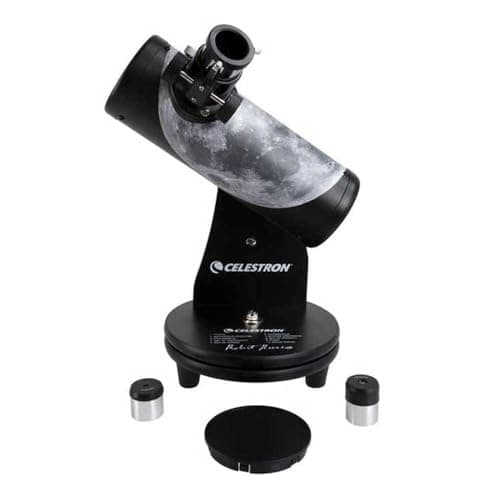 Celestron FirstScope 76mm Tabletop 76mm of aperture, zero assembly, and no oversold magnification anywhere on the box. | The most usable optics at the price | |
| 2 | 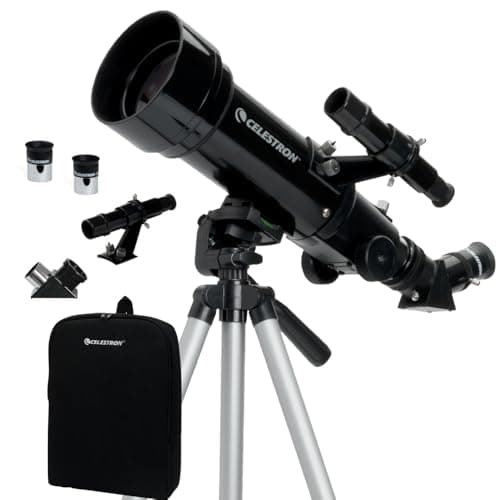 Celestron Travel Scope 70 The whole kit is 3.3 lbs and fits in a backpack a child can wear. | If it needs a tripod and needs to travel | |
| 3 | 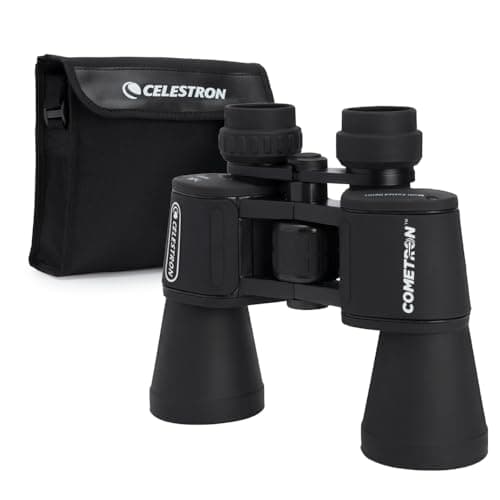 Celestron Cometron 7x50 7.1mm exit pupil, no setup, and a 6.6 degree field that makes finding things trivial. | More astronomy per dollar than any telescope here | |
| ! | 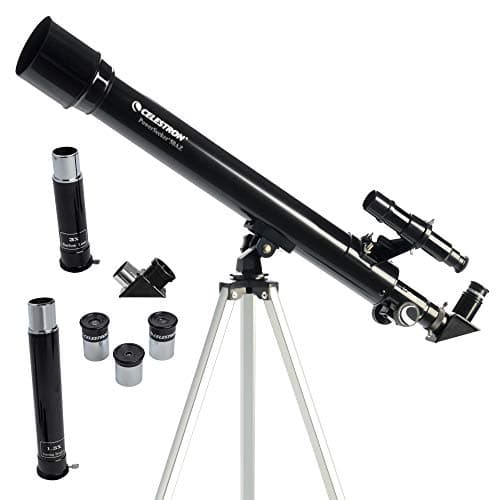 Celestron PowerSeeker 50AZ Published ceiling 118x. Supplied eyepieces and Barlow reach roughly 450x. Skip this one — see why below | The shape of the trap on this shelf | Not recommended |
Rows link to the full write-up further down this page. Prices come from the live price layer only; where there is no live figure the button reads “Check price” rather than showing a number we remembered.
How to read a sub-$100 telescope box
Three checks, in order. Any one of them will filter out most of the shelf in about ten seconds.
- Find the aperture, in millimeters. If the packaging leads with magnification instead and buries the aperture, that tells you which number the manufacturer thinks is more impressive. Under 60mm at this price is not worth buying.
- Multiply the aperture by two. That is roughly the highest magnification the optics can usefully deliver. If the box advertises more than that, the extra is marketing.
- Look for the diagonal size. 1.25 inches is standard and means the whole world of aftermarket eyepieces fits. 0.96 inches is a dead end.
The case for spending nothing on a telescope at all
If your budget is genuinely at the bottom of this range, here is the honest allocation: a pair of 7x50 binoculars, a free planetarium app, and a red torch. That combination costs less than the cheapest telescope on this page and produces a better first three months.
Binoculars show more on night one than a $50 telescope will, because they are easier to point and their optics are not compromised by having to hit a price with an eyepiece set. The app teaches the child where things are, which is the skill that makes a telescope worth owning later. And the torch preserves the dark adaptation that everything else depends on.
Then, if the interest sticks through a winter, buy a real telescope with real aperture. That sequence produces far more young astronomers than a cheap telescope at Christmas does. We lay it out fully on are kids' telescopes worth it.
The picks in full
Pick 1
Celestron FirstScope 76mm Tabletop
The most usable optics at the price
The arithmetic
The 20mm eyepiece gives 300 / 20 = 15x, and the 4mm gives 300 / 4 = 75x. Celestron's own published ceiling is 180x, so the 4mm sits well inside what the optics support — unusual honesty at this price. There is no tripod: it needs a table, a wall, a car roof or a stack of books at roughly chest height for the child using it.
The reason this leads the page is not that it is the biggest or the most featured. It is that Celestron does not oversell it. The published highest useful magnification is 180x, and the supplied eyepieces give 15x and 75x. Both are inside the ceiling. On this shelf, that is genuinely unusual.
76mm is also more aperture than most of the refractors at this price, because a mirror is cheaper to make than a lens. You are getting more light for your money by choosing the reflector.
At f/3.95 with the 20mm eyepiece you get a wide, bright, forgiving view. For a child hunting for the Moon without a finderscope, that width is what makes the difference between finding it and not.
It has no finderscope at all, which sounds like a flaw and mostly is not at 15x — you sight along the tube. It also has no tripod, which is the real constraint. Decide where it will stand before you buy it.
Skip it if
You have no solid outdoor surface. This is the recurring caveat with tabletop telescopes and it is not a minor one — a 76mm tube needs a garden table or a low wall at roughly the child's chest height, and without one the telescope simply cannot be used properly.
| Optical design | Newtonian reflector, spherical primary mirror |
|---|---|
| Aperture | 76mm (2.99") |
| Focal length | 300mm (12") |
| Focal ratio | f/3.95 |
| Eyepieces supplied | 20mm (15x) and 4mm (75x) |
| Highest useful magnification | 180x |
| Lowest useful magnification | 11x |
| Limiting stellar magnitude | 11.9 |
| Light gathering vs the eye | 118x |
| Mount | Dobsonian-style tabletop base |
| What the box does not do | No tripod, no finderscope, and no way to track an object as the sky moves — you nudge the tube by hand. The 4mm eyepiece is usable but tight; most children get on better with the 20mm all evening. |
Specifications from Celestron — FirstScope specifications. We have not handled this one — everything above is the published spec sheet plus our own arithmetic on it.
Pick 2
Celestron Travel Scope 70
If it needs a tripod and needs to travel
The arithmetic
400mm focal length over the two supplied eyepieces gives 20x and 40x. Celestron's published ceiling for a 70mm objective is 168x, so both eyepieces are comfortably inside it — the box is not overselling. The 3.3 lb total is the number that matters for a gift: a child can carry the whole kit themselves, which is most of why it gets used more than once.
The trade against the FirstScope is straightforward: slightly less aperture, in exchange for a tripod and genuine portability.
70mm at f/5.7 with 20mm and 10mm eyepieces gives 20x and 40x, both well inside Celestron's published 168x ceiling. Again, no overselling.
The backpack matters more than it sounds. A telescope a child can pick up and carry to the end of the garden gets used on a whim, and used-on-a-whim is the entire game with a first telescope.
The 45 degree erect-image diagonal is designed for daytime terrestrial viewing, which costs a little light at night but makes this genuinely dual-purpose — hills, birds, ships. For a child who will be indoors on most clear nights anyway, that is worth having.
Skip it if
The child is heavy-handed. The 1.8 lb tripod is the price of the portability and it does wobble — every touch of the focuser moves the view, and it takes a couple of seconds to settle. A steadier mount at this price does not exist.
| Optical design | Refractor |
|---|---|
| Aperture | 70mm (2.8") |
| Focal length | 400mm (15.74") |
| Focal ratio | f/5.7 |
| Eyepieces supplied | 20mm (20x) and 10mm (40x) |
| Finderscope | 5x24 |
| Diagonal | 45 degree erect image, 1.25" |
| Mount | Manual alt-azimuth on aluminum tripod |
| Highest useful magnification | 168x |
| Limiting stellar magnitude | 11.7 |
| Total kit weight | 3.3 lbs (1.5 kg), tripod 1.8 lbs (0.81 kg) |
| Included | Custom backpack, Starry Night Basic software, SkyPortal app access |
| What the box does not do | The tripod is the weak part. At 1.8 lbs it is light enough to carry and light enough to wobble, and a child nudging the eyepiece will lose the target. The 45 degree erect-image diagonal is built for daytime use and costs you a little light at night. |
Specifications from Celestron — Travel Scope 70 specifications. We have not handled this one — everything above is the published spec sheet plus our own arithmetic on it.
Pick 3
Celestron Cometron 7x50
More astronomy per dollar than any telescope here
The arithmetic
Exit pupil is objective divided by magnification: 50 / 7 = 7.1mm, which matches Celestron's published figure. That is the single most useful number here. A fully dark-adapted young pupil opens to around 7mm, so a child uses nearly all of that 7.1mm cone and the view is as bright as the optics can make it. An adult over about forty typically dilates to 5mm or less and simply cannot use the extra — this is one of the rare cases where a child gets more out of the hardware than the grown-up does.
Under $100 is exactly the budget where binoculars beat a telescope, and we would be doing you a disservice not to say so on this page.
50mm of aperture per side, a 7.1mm exit pupil that matches a child's dark-adapted eye, no assembly, no alignment, and a 6.6 degree field of view. Point them at the Moon and the Moon is there.
What they show on night one: lunar craters along the terminator, four of Jupiter's moons as a line of pinpricks, the Pleiades as a cluster of blue-white stars filling the view, and on a dark night the Andromeda galaxy as an oval smudge. That is a genuinely good first night, achieved with zero setup.
The 27.3 oz weight is the honest problem and it is solvable for free: lie down, lean on something, or use the tripod thread. We cover the practical fixes on binoculars for stargazing.
Skip it if
The word telescope was specifically requested. This is optically the better buy under $100 and it is still the wrong present for a child who has been imagining a telescope on a tripod.
| Magnification | 7x |
|---|---|
| Objective lens | 50mm (1.97") |
| Prism glass | BK7 porro |
| Lens coatings | Multi-coated |
| Angular field of view | 6.6 degrees |
| Linear field at 1000 yds | 344 ft (105 m) |
| Exit pupil | 7.1mm (.28") |
| Eye relief | 13mm (.51") |
| Close focus | 26.2 ft (8 m) |
| Weight | 27.3 oz (774 g) |
| Tripod adaptable | Yes |
| Environmental | Water resistant |
| What the box does not do | 27.3 oz is heavy for small arms held up at the sky — plan on leaning against a wall or lying on a blanket, or add the tripod adapter. BK7 prisms are the cheaper glass and show slight softening at the edge of the field. Water resistant is not waterproof. |
Specifications from Celestron — Cometron 7x50mm specifications. We have not handled this one — everything above is the published spec sheet plus our own arithmetic on it.
Skip this
Celestron PowerSeeker 50AZ
The shape of the trap on this shelf
The arithmetic
This is the arithmetic that explains the whole category. Celestron publishes a highest useful magnification of 118x for this 50mm objective. The box also supplies a 4mm eyepiece — 600 / 4 = 150x, already past the ceiling — and a 3x Barlow, which takes that combination to 450x. Roughly four times more magnification than the manufacturer's own spec sheet says the optics can deliver. At 450x you are magnifying a blur.
This is on the page as a worked example, because understanding it protects you against every other telescope on this shelf that works the same way.
The arithmetic is public and it is Celestron's own. Highest useful magnification: 118x. Focal length: 600mm. Supplied eyepieces: 20mm, 12mm, 4mm, plus a 3x Barlow. 600 divided by 4 is 150x, already past the ceiling. Times three for the Barlow is 450x.
That is not a defect in manufacturing, it is a decision about what to print on a box. And it is a decision the whole sub-$60 category makes, which is why our advice on that shelf is to buy binoculars instead of a telescope.
The 0.96 inch diagonal seals it. Standard eyepieces are 1.25 inches, so the upgrade path that would rescue this telescope does not exist.
Skip it if
Always. Not because Celestron is a bad brand — it is not, and three of our picks are theirs — but because this particular configuration sets a child up to fail, and the 0.96 inch diagonal means you cannot fix it with better eyepieces later.
| Optical design | Refractor |
|---|---|
| Aperture | 50mm (1.97") |
| Focal length | 600mm (24") |
| Focal ratio | f/12 |
| Eyepieces supplied | 20mm (30x), 12mm (50x), 4mm (150x) |
| Also supplied | 3x Barlow lens, 1.5x erecting eyepiece |
| Finderscope | 5x24 |
| Diagonal | 0.96" |
| Highest useful magnification | 118x |
| Limiting stellar magnitude | 11 |
| Total kit weight | 2.31 lbs (1.05 kg) |
| What the box does not do | The 0.96" diagonal is a legacy size, so almost no aftermarket eyepiece will fit it. The high-power combinations in the box are effectively unusable, which means the "three eyepieces and a Barlow" on the packaging is really one usable eyepiece and some cardboard filler. |
Specifications from Celestron — PowerSeeker 50AZ specifications. We have not handled this one — everything above is the published spec sheet plus our own arithmetic on it.
Questions people actually ask
- What is the best telescope for kids under $100?
- A 76mm tabletop reflector if you have a solid outdoor surface, or a 70mm refractor with a tripod if you do not. Both give you honest optics with no oversold magnification, which is the main thing to look for at this price.
- Are cheap telescopes worth it?
- Between roughly $60 and $100, yes. Below about $60, no — that shelf is built around magnification claims the optics cannot support. Full reasoning on are kids' telescopes worth it.
- Can you see Saturn's rings with a telescope under $100?
- Yes. Saturn's rings resolve at around 50x, which every telescope on this page reaches with its supplied eyepieces. They appear as a small sharp oval with a clear gap of sky either side of the planet.
- What is better under $100, a telescope or binoculars?
- Optically, binoculars — a 7x50 pair shows more on the first night than any sub-$100 telescope, with no setup. The counter-argument is purely about expectations if a telescope is what was asked for.
Sources
Read next
Where to go from here
- The best space gifts for kids under $100
Binoculars, telescope, projector or accessory — the cross-category view of one budget, and why the best answer is usually not the telescope.
- The best beginner telescopes under $200
Between $100 and $200 you can buy a steady mount, real aperture, or phone-guided finding. What each of those is worth, with the arithmetic.
- Toy telescopes versus real optics: how to tell in thirty seconds
The arithmetic that exposes a 525x claim on a 70mm box, worked through on a real product using its own manufacturer's published numbers.
- Binoculars
Cheaper, easier, and they work on night one. The case for starting here.
- How much should you spend on a telescope for a child?
Band by band, what the money buys and where it stops helping. The jump from $60 to $150 matters more than the one above it.
- Are kids' telescopes worth it?
A direct verdict with the honest nuance: where the money starts working, where it does not, and what to buy instead below the line.
- Space gifts for kids under $50
Under $50 you can buy genuinely good optics — just not a telescope. What the money actually buys, and the allocation we would make ourselves.