Binoculars
The best binoculars for stargazing with kids
Exit pupil is the number that decides it. Here is how to work it out.
By Scooter M. · published September 1, 2026
I'm not an astronomer and I don't have a lab. I'm someone who's genuinely into this — I read the manuals, compile the published specs, and do the arithmetic the box doesn't do for you. No lab coat. How we pick.
How this is funded. Lens & Lightyear earns a commission when you buy through a link on this page, at no extra cost to you. It does not change which products we pick or what we say about them — every card below carries a real reason to skip it. Prices are pulled live and were last verified October 18, 2026. Full disclosure.
The short answer
For stargazing with a child, a 7x50 is the right answer. Divide the objective size by the magnification to get the exit pupil: 50 divided by 7 is 7.1mm, which matches a young dark-adapted pupil almost exactly. That is the brightest possible view for their eyes, and the wide field makes finding things easy.
What the two numbers mean
Every pair is labeled something like 7x50 or 10x42. The first number is magnification — how many times closer things appear. The second is the diameter of the front lenses in millimeters, which sets how much light gets collected.
Bigger front lenses mean brighter images and more weight. More magnification means more detail and more visible shake. Those are the only two trades, and everything else on this page follows from them.
Exit pupil: the number nobody explains
This is the calculation that actually answers *which binoculars for a child*, and it takes one division.
If the exit pupil is wider than your pupil, the extra light is wasted — it lands on your iris rather than going in. If it is narrower, you are not using the full aperture and the view is dimmer than the objective could deliver.
And here is why it matters for children specifically. Pupil dilation decreases with age. A fully dark-adapted child's pupil opens to around 7mm; a typical adult in their forties or fifties reaches around 5mm. So a 7x50, with its 7.1mm exit pupil, is close to perfectly matched to a child and genuinely over-specified for the adult buying it.
| Spec | Exit pupil | Weight | Best for |
|---|---|---|---|
| 7x50 | 7.1mm | Around 27 oz | Stargazing with a child. The brightest match to a young eye. |
| 10x50 | 5.0mm | Around 27 oz | Moon detail, for an older child who can hold steady. |
| 8x42 | 5.3mm | Medium | A good adult all-rounder. Slightly dim for a child at night. |
| 8x32 | 4.0mm | Around 18 oz | Daytime and casual use. Light enough to actually get used. |
| 10x42 | 4.2mm | Medium | Birding first, astronomy second. See 7x50 vs 10x42. |
| 4x30 | 7.5mm | Under 5 oz | Very small children. Bright, but very low magnification. |
Exit pupil figures are our arithmetic on the published objective and magnification. Weights are the manufacturers' published figures where we have quoted a specific product.
Quick picks
Binoculars for stargazing with children
| # | Product | Best for | Price |
|---|---|---|---|
| 1 | 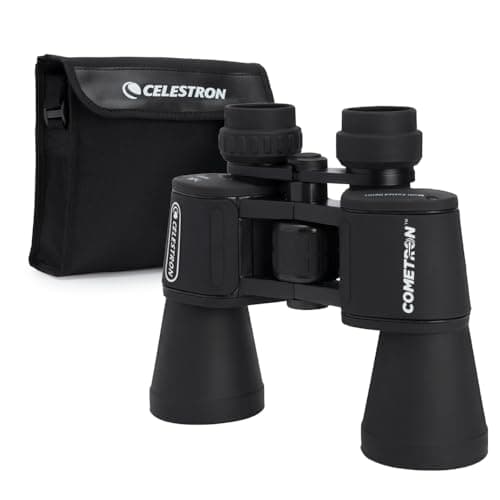 Celestron Cometron 7x50 7.1mm exit pupil — a match for a young dark-adapted eye, and the brightest view here. | The classic astronomy pair, and the right one for a child | |
| 2 | 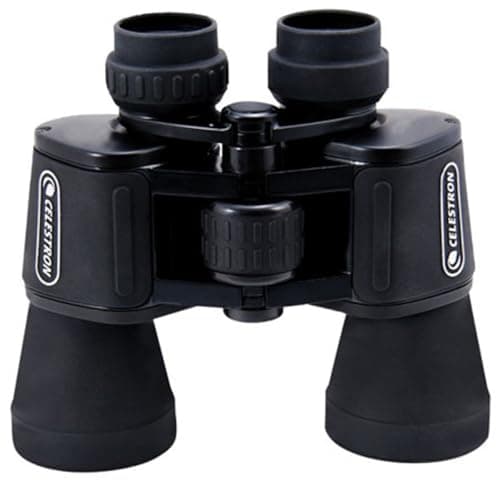 Celestron UpClose G2 10x50 Same 50mm objectives, 10x instead of 7x, and a 5mm exit pupil. | More detail on the Moon, if they can hold steady | $64.53 on Amazon #ad How we’re funded · price as of October 18, 2026 |
| 3 | 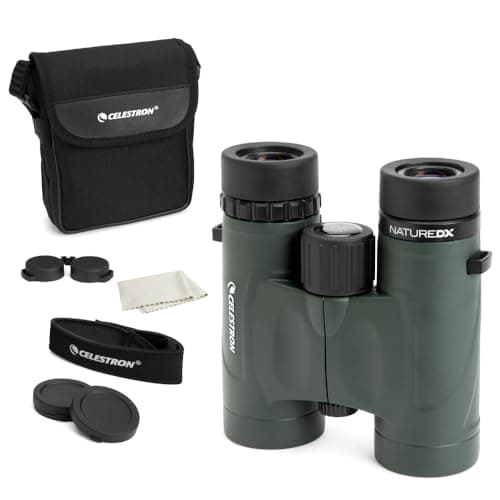 Celestron Nature DX 8x32 18 oz, 17.5mm eye relief, waterproof, and 6.5 ft close focus. | The pair that gets used on Tuesday afternoon too | $90.97 on Amazon #ad How we’re funded · price as of October 18, 2026 |
Rows link to the full write-up further down this page. Prices come from the live price layer only; where there is no live figure the button reads “Check price” rather than showing a number we remembered.
What you will actually see
This is the section that surprises people, because binoculars are usually presented as a consolation prize and they are not.
| Object | Through 7x50 binoculars |
|---|---|
| The Moon | Craters along the terminator, the dark maria clearly separated, mountain ranges. Genuinely detailed. |
| Jupiter | A bright point with up to four moons in a line beside it. The moons move visibly night to night. |
| The Pleiades | The single best binocular object in the sky. A cluster of blue-white stars that fills the field. |
| The Orion Nebula | A distinct gray patch with stars embedded in it, clearly not a star. |
| The Andromeda Galaxy | An oval smudge. Unimpressive until you say it is 2.5 million light years away. |
| The Milky Way | Sweeping through it slowly on a dark night resolves it into countless individual stars. |
| Double stars | The wider pairs split cleanly. Mizar and Alcor in the Big Dipper is the easy one to start with. |
| Comets | When there is one, binoculars are usually the best instrument for it. |
None of this needs a dark-sky site, though the Milky Way and Andromeda both improve enormously away from streetlights.
The weight problem, and three free fixes
A 7x50 weighs around 27 ounces — a pound and three quarters, held above your head, looking up. An adult manages a couple of minutes before their arms start shaking. A seven-year-old manages considerably less.
Every one of these fixes costs nothing and each turns a frustrating five minutes into a comfortable half hour.
- Lie on a blanket. Flat on your back on the lawn, elbows on the ground, binoculars supported. This is both the most comfortable way to use binoculars and the most comfortable way to look up, and children love it.
- Lean against something. A wall, a doorframe, a fence post, a car. Bracing your elbows against anything solid removes most of the shake instantly.
- Use the tripod thread. Almost every astronomy binocular has one, including both 50mm pairs here, and almost nobody uses it. A cheap tripod and adapter turn binoculars into a completely steady instrument.
The one safety rule
Where to go next
If you are choosing between specifications, 7x50 versus 10x42 works the trade-off through properly. If the question is what suits a particular age, binoculars by age has the weight thresholds. And if the pair also needs to work on birds, birds and stars covers the genuine dual-purpose options.
The picks in full
Pick 1
Celestron Cometron 7x50
The classic astronomy pair, and the right one for a child
The arithmetic
Exit pupil is objective divided by magnification: 50 / 7 = 7.1mm, which matches Celestron's published figure. That is the single most useful number here. A fully dark-adapted young pupil opens to around 7mm, so a child uses nearly all of that 7.1mm cone and the view is as bright as the optics can make it. An adult over about forty typically dilates to 5mm or less and simply cannot use the extra — this is one of the rare cases where a child gets more out of the hardware than the grown-up does.
The specification that puts this at the top is the exit pupil: 50 divided by 7 gives 7.1mm, matching Celestron's published figure exactly. The same sum is what separates 8x42 from 10x42, and it is why the giant 20x80 and 25x100 both land on 4mm.
That number matters because a fully dark-adapted young pupil opens to roughly 7mm. A child using these receives essentially all the light the objective lenses collect. An adult over about forty typically dilates to 5mm or less and simply cannot use the extra — which makes this one of the rare cases where the child genuinely gets more from the hardware than the person buying it.
The 6.6 degree field of view is about thirteen Moon widths. That makes finding things trivial: point them roughly at a target and the target is in view. This is the entire reason astronomy clubs recommend binoculars to beginners rather than telescopes.
BK7 prisms are the cheaper glass and soften slightly at the field edge. Multi-coated rather than fully multi-coated. Water resistant, not waterproof. At this price those are honest compromises rather than corner-cutting.
Skip it if
A small child has to hold them unsupported. 27.3 oz above your head is a lot for a seven-year-old, and without a wall to lean on or a blanket to lie on, the view will shake more than it shows.
| Magnification | 7x |
|---|---|
| Objective lens | 50mm (1.97") |
| Prism glass | BK7 porro |
| Lens coatings | Multi-coated |
| Angular field of view | 6.6 degrees |
| Linear field at 1000 yds | 344 ft (105 m) |
| Exit pupil | 7.1mm (.28") |
| Eye relief | 13mm (.51") |
| Close focus | 26.2 ft (8 m) |
| Weight | 27.3 oz (774 g) |
| Tripod adaptable | Yes |
| Environmental | Water resistant |
| What the box does not do | 27.3 oz is heavy for small arms held up at the sky — plan on leaning against a wall or lying on a blanket, or add the tripod adapter. BK7 prisms are the cheaper glass and show slight softening at the edge of the field. Water resistant is not waterproof. |
Specifications from Celestron — Cometron 7x50mm specifications. We have not handled this one — everything above is the published spec sheet plus our own arithmetic on it.
Pick 2
Celestron UpClose G2 10x50
More detail on the Moon, if they can hold steady
The arithmetic
50 / 10 = 5mm exit pupil, against 7.1mm for the 7x50. Same front lens, 30 percent less light reaching the eye, because the extra magnification spreads it over a wider image. The trade you are buying is more detail on the Moon and a shakier view of everything: at 10x, a hand tremor is magnified 10 times too, and children shake more than adults do.
The same front lenses as the Cometron with more magnification, which sounds like a straight upgrade and is not.
Exit pupil is 50 divided by 10, which is 5mm against the Cometron's 7.1mm. Same objective, same light collected, spread across a bigger image — so about 30 percent less light reaching a dark-adapted young eye.
What you get for it: more detail on the Moon, and slightly better separation on double stars and tight clusters. What you give up is brightness and stability, and stability is the one that bites with children.
12mm of eye relief is short. A child who wears glasses will not see the full field with them on, and removing them changes the focus setting. Worth knowing before buying for a spectacle-wearing child.
Skip it if
The child is under about ten, or is using them without support. At 10x, every tremor is magnified 10 times, and children shake more than adults. The extra magnification is wasted if the image will not sit still.
| Magnification | 10x |
|---|---|
| Objective lens | 50mm (1.96") |
| Prism glass | BK7 porro |
| Lens coatings | Multi-coated |
| Angular field of view | 6.8 degrees |
| Linear field at 1000 yds | 354 ft (118 m) |
| Exit pupil | 5mm (.19") |
| Eye relief | 12mm (.47") |
| Close focus | 23 ft (7 m) |
| Weight | 27 oz (765 g) |
| Tripod adaptable | Yes |
| Environmental | Water resistant |
| What the box does not do | 12mm of eye relief is short. A child who wears glasses will not see the whole field with them on, and taking them off changes the focus. Water resistant, not waterproof. |
Specifications from Celestron — UpClose G2 10x50mm specifications. We have not handled this one — everything above is the published spec sheet plus our own arithmetic on it.
#ad How we’re funded · price as of October 18, 2026
Pick 3
Celestron Nature DX 8x32
The pair that gets used on Tuesday afternoon too
The arithmetic
32 / 8 = 4mm exit pupil — dimmer at night than either 50mm pair above, and that is the honest trade. What you get for it: 18 oz instead of 27, which a seven-year-old can actually hold steady; 17.5mm of eye relief, so a child in glasses sees the full field; 6.5 ft close focus, so it works on a ladybird in the garden as well as the Moon; and genuinely waterproof rather than water resistant. This is the pair that gets used on Tuesday afternoon, not just on a clear Saturday night.
The honest all-rounder, and for a lot of children the pair that actually gets used.
18 oz against 27 oz is the headline. That is the difference between a seven-year-old holding them steady for a minute and holding them steady for ten. Weight is the most under-considered specification in this category.
17.5mm of eye relief means a child in glasses sees the entire field, which neither 50mm pair here manages. 6.5 ft close focus means they work on an insect in the garden. Genuinely waterproof, not merely water resistant. Phase-coated BaK-4 roof prisms and fully multi-coated optics — better glass than either porro pair above.
The cost is the 4mm exit pupil. At night these are noticeably dimmer than a 7x50. If the purpose is purely stargazing, take the Cometron. If the purpose is a child having a pair of binoculars, take these.
Skip it if
Faint objects are the point. The 4mm exit pupil is meaningfully dimmer than a 50mm pair at night — the Milky Way will not leap out of these. You are trading night-sky brightness for daytime usability and comfort.
| Magnification | 8x |
|---|---|
| Objective lens | 32mm (1.26") |
| Prism glass | BaK-4 roof, phase coated |
| Lens coatings | Fully multi-coated |
| Angular field of view | 7.4 degrees |
| Linear field at 1000 yds | 388 ft (129 m) |
| Exit pupil | 4mm (.157") |
| Eye relief | 17.5mm (.69") |
| Close focus | 6.5 ft (2 m) |
| Weight | 18 oz (510 g) |
| Tripod adaptable | Yes |
| Environmental | Waterproof |
| What the box does not do | A 4mm exit pupil means noticeably dimmer star fields than a 7x50 — the Milky Way will not leap out of it. It costs meaningfully more than the porro pairs above, and none of that money is buying you light. |
Specifications from Celestron — Nature DX 8x32mm specifications. We have not handled this one — everything above is the published spec sheet plus our own arithmetic on it.
#ad How we’re funded · price as of October 18, 2026
Questions people actually ask
- What size binoculars are best for stargazing?
- 7x50 for a child. The 7.1mm exit pupil matches a young dark-adapted eye almost exactly, so they receive all the light the 50mm objectives collect. 10x50 shows more Moon detail but is dimmer and shakier.
- Can binoculars be used for stargazing?
- Yes, and most astronomy clubs recommend them to beginners over a telescope. The Moon, Jupiter's four bright moons, the Pleiades, the Orion Nebula and the Andromeda galaxy are all comfortably binocular objects.
- Are 10x42 binoculars good for astronomy?
- They work, but they are not ideal. The 4.2mm exit pupil means a noticeably dimmer view than a 7x50, and 10x magnifies hand tremor. For a child, 7x50 is the better choice — full comparison on 7x50 versus 10x42.
- How do you hold binoculars steady for stargazing?
- Lie on your back on a blanket with your elbows on the ground, lean against a wall or a car, or use the tripod thread most astronomy binoculars have. All three are free and any of them transforms the experience.
- Do you need special binoculars for stargazing?
- No, but the specification matters. Larger objectives gather more light and lower magnification gives a wider, steadier, brighter view. That combination is why 7x50 is the traditional astronomy pair.
Sources
Read next
Where to go from here
- Celestron SkyMaster 15x70 review
The big-binocular option, reviewed honestly: 70mm objectives that deliver less light to a dark-adapted child's eye than a 7x50, and 48 oz that demand a tripod.
- The best stargazing binoculars under $50
Under $50 binoculars outperform every telescope at the price. What the money buys in coatings and exit pupil, and the honest limits of the budget.
- Celestron Nature DX 8x32 review
A third lighter than a 7x50, waterproof, and it focuses down to 6.5 feet. What that buys by day, and exactly what it costs you at night.
- 7x50 versus 10x42: which for a child, and why
The exit pupil arithmetic that settles the classic binocular argument, and why the answer is different for a child than for an adult.
- Binoculars for kids, by age
What a child can physically hold at each age, and which published weight and eye-relief figures to check before buying.
- Celestron Cometron 7x50: the beginner astronomy binocular
Why 7x50 is the standard beginner astronomy specification, what this particular pair publishes, and the one thing to plan around.
- What you can actually see with a kids' telescope
The honest target-by-target list for 70mm, 76mm and 114mm telescopes, so nobody is disappointed on night one.
- Telescope, binoculars or star projector?
Three completely different gifts sold to the same buyer. Which one fits your child, your sky and your household, with a winner named for each.
- The stargazing night kit
A red torch does more for what a child sees than doubling the aperture. The full kit, in order of how much it changes.
- Putting binoculars on a tripod: adapter, tripod, and the height nobody checks
The cheapest fix for the most common binocular disappointment. Which binoculars accept an adapter, what tripod height actually matters for looking up, and what this will not fix.
- The best stargazing binoculars under $100
Three pairs under $100, judged on exit pupil, prism glass and steadiness rather than on magnification claims — plus the two corners this budget always cuts.
- Celestron SkyMaster Pro 20x80 review
80mm per side, waterproof and nitrogen filled, with XLT coatings and a detachable finder rail. Two-thirds the light of a 25x100 at 62 percent of the weight.
- Celestron Nature DX 8x42 review
A 5.25mm exit pupil, 17.5mm of eye relief, 388 ft at 1000 yards and a waterproof nitrogen-filled body. The Nature DX we would actually buy for a night sky, and why.