Binoculars
Celestron SkyMaster 15x70 review
More glass than a 7x50, less light to a young eye. Both are true, and the second surprises people.

By Scooter M. · published September 13, 2026
I'm not an astronomer and I don't have a lab. I'm someone who's genuinely into this — I read the manuals, compile the published specs, and do the arithmetic the box doesn't do for you. No lab coat. How we pick.
How this is funded. Lens & Lightyear earns a commission when you buy through a link on this page, at no extra cost to you. It does not change which products we pick or what we say about them — every card below carries a real reason to skip it. Prices are pulled live and were last verified October 18, 2026. Full disclosure.
The short answer
Buy it for an adult, on a tripod. Its 4.7mm exit pupil suits a grown-up eye well and a child's poorly, and at 48 oz with 15x magnification it cannot be held steady by anyone. Bought with a tripod it reaches further than any 50mm pair here; bought without one it disappoints immediately.
This is the most-searched astronomy binocular in the category and the one most often bought for the wrong person. The specification that explains why is on the box, and almost nobody divides it out.
The exit pupil inversion
Exit pupil is objective diameter divided by magnification — the width of the light cone leaving the eyepiece. If it is wider than your own pupil, the surplus light hits your iris and is wasted. If it is narrower, you are seeing a dimmer image than the objective could deliver.
| Pair | Arithmetic | Exit pupil | Into a 7mm young pupil | Into a 5mm adult pupil |
|---|---|---|---|---|
| Cometron 7x50 | 50 / 7 | 7.1mm | Baseline — all of it used | Much of it wasted |
| UpClose G2 10x50 | 50 / 10 | 5.0mm | about 50% | Fully used |
| SkyMaster 15x70 | 70 / 15 | 4.7mm | about 44% | Fully used |
| Nature DX 8x32 | 32 / 8 | 4.0mm | about 32% | Fully used |
Exit pupils are each manufacturer's published figure. The delivery columns are our arithmetic — the ratio of exit-pupil areas, capped at the eye's own pupil. A dark-adapted young pupil reaches about 7mm; an adult over forty typically 5mm or less.
Read the two right-hand columns together and the buying advice writes itself. For a child the 7x50 delivers more than twice the light of the SkyMaster. For their parent, the SkyMaster's larger objectives finally pay, because the eye can use the whole cone.
Quick picks
The SkyMaster and what it is really competing with
| # | Product | Best for | Price |
|---|---|---|---|
| 1 | 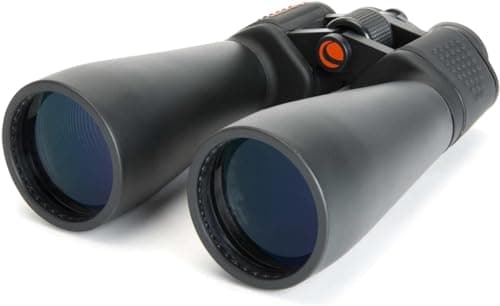 Celestron SkyMaster 15x70 70mm and 15x — real reach, and 48 oz that no one holds steady. The 20x80 and 25x100 go further still, and all seven models are ranked side by side on which SkyMaster should you buy. There is also a sealed, ED-glass version of this same 15x70 format — the Pro ED 15x70 — which gathers the same light for 25.7 oz more. | An adult on a tripod, reaching further than any 50mm | |
| 2 | 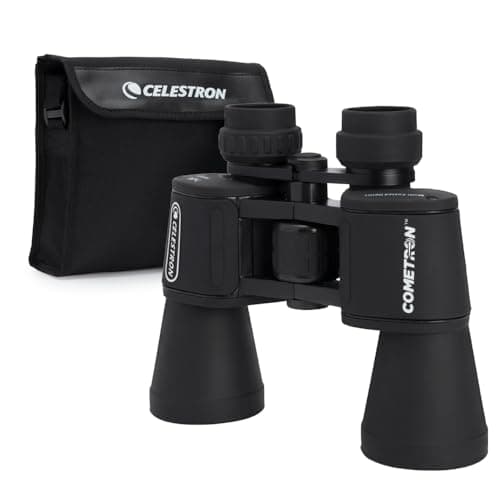 Celestron Cometron 7x50 7.1mm exit pupil, 27.3 oz, and a 6.6 degree field that makes aiming trivial. | The child's pair, and the better astronomy buy for young eyes | |
| 3 | 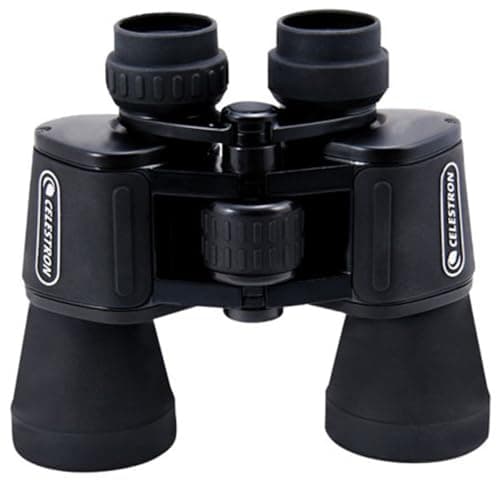 Celestron UpClose G2 10x50 10x50 — a 5mm exit pupil and 27 oz, reachable without a tripod. | The middle ground, handheld | $64.53 on Amazon #ad How we’re funded · price as of October 18, 2026 |
Rows link to the full write-up further down this page. Prices come from the live price layer only; where there is no live figure the button reads “Check price” rather than showing a number we remembered.
48 ounces, and why the tripod is not optional
The published weight is 48 oz — three pounds — against 27.3 oz for a 7x50. That alone would make it a two-handed instrument. Combined with 15x it becomes a mounted one.
Magnification multiplies movement as well as image. At 7x a small tremor is a slight wobble; at 15x the same tremor throws the field around enough that fine detail never resolves. The irony is exact: the extra magnification you paid for is what prevents you seeing the extra detail you paid for, unless the binocular is held still by something that is not a person.
- It is tripod adaptable, which Celestron publishes — but no tripod and no adapter are in the box. Budget for both.
- A photo tripod plus an L-adapter is the cheapest path and transforms the instrument. This is the upgrade to make before considering any better binocular.
- Lying down works for a 7x50 and not for this. Three pounds on your face is not a viewing position.
- 18mm of eye relief is genuinely generous, so it is comfortable over glasses — one clear advantage over the 12-13mm porro pairs.
What the narrow field costs
4.4 degrees of true field, or 231 ft at 1000 yards, against the 7x50's 6.6 degrees and 344 ft. That is a meaningfully smaller piece of sky, and it has two consequences.
Finding things is harder — sweeping for a target takes longer when the window is smaller, and without a finder of any kind that is the main practical friction. And large objects no longer fit: the Pleiades, which fill a 7x50 beautifully, become a partial view. What you gain is everything small — globulars, doubles, lunar detail, and the brighter galaxies as more than smudges.
Who this is for
| Situation | Verdict |
|---|---|
| An adult wants more reach and will buy a tripod | Buy it. This is exactly its use case. |
| It is for a child to hold | Do not. Buy the 7x50 — more light to their eye, and holdable. |
| You want one pair for the whole family, handheld | The 10x50 is the compromise. |
| You want it for daytime too | No. A 43 ft close focus rules out garden use entirely. |
| You will not buy a tripod | Skip it. Every advantage here depends on the tripod you are not buying. |
We have not handled this pair. Every specification is from Celestron's own published page, linked below and checked on the date at the top of this page; the delivery arithmetic is ours and reproducible. Our method is on the methodology page.
The picks in full
Pick 1
Celestron SkyMaster 15x70
An adult on a tripod, reaching further than any 50mm
The arithmetic
The counter-intuitive number: 70 / 15 = 4.7mm exit pupil, against 7.1mm for a 7x50. More objective glass, but spread across more magnification — so into a child's fully dark-adapted 7mm pupil this delivers roughly (4.7 / 7.1) squared, about 44 percent of the light the cheaper 7x50 does. The 70mm advantage is real only for an adult eye that no longer dilates past 5mm, or on a tripod where the extra reach pays. At 48 oz it is 1.76 times the weight of a 7x50 and 15x magnifies hand tremor fifteen times: this is a tripod instrument, not a handheld one.
Start with the number that decides who this is for. Exit pupil is 70 / 15 = 4.7mm, which Celestron publishes. A 7x50 gives 7.1mm.
Into a fully dark-adapted young pupil of about 7mm, this therefore delivers roughly (4.7 / 7.1) squared — about 44 percent of the light the cheaper, lighter 7x50 does. More objective glass, spread over more magnification, landing in a smaller cone than the eye could have used.
That inverts for an adult. An eye over about forty typically dilates to 5mm or less, so the 7x50's extra cone is wasted anyway and the 15x70's 4.7mm is a near-perfect match. This is, genuinely, an adult's binocular.
What 15x buys when it is steady: globular clusters start to look grainy rather than smooth, the Moon shows crater detail no 7x reaches, and double stars split that a 7x merges. On a tripod it is a serious instrument. Handheld it is a blurry, heavy disappointment.
Skip it if
This is for a child to hold. 48 oz is 1.76 times a 7x50, 15x magnifies hand tremor fifteen times, and there is no tripod or adapter in the box. Without a tripod this is the wrong purchase at any age.
| Magnification | 15x |
|---|---|
| Objective lens | 70mm (2.75") |
| Prism glass | BaK-4 |
| Lens coatings | Multi-coated |
| Angular field of view | 4.4 degrees |
| Linear field at 1000 yds | 231 ft (77 m) |
| Exit pupil | 4.7mm (.18") |
| Eye relief | 18mm (.71") |
| Close focus | 43 ft (13 m) |
| Weight | 48 oz (1361 g) |
| Tripod adaptable | Yes |
| Environmental | Water resistant |
| What the box does not do | No tripod and no tripod adapter in the box, and it genuinely needs both — 48 oz at 15x cannot be held steady by anyone, let alone a child. Water resistant, not waterproof. A 43 ft close focus rules out any daytime use in a garden. |
Specifications from Celestron — SkyMaster 15x70 specifications. We have not handled this one — everything above is the published spec sheet plus our own arithmetic on it.
Pick 2
Celestron Cometron 7x50
The child's pair, and the better astronomy buy for young eyes
The arithmetic
Exit pupil is objective divided by magnification: 50 / 7 = 7.1mm, which matches Celestron's published figure. That is the single most useful number here. A fully dark-adapted young pupil opens to around 7mm, so a child uses nearly all of that 7.1mm cone and the view is as bright as the optics can make it. An adult over about forty typically dilates to 5mm or less and simply cannot use the extra — this is one of the rare cases where a child gets more out of the hardware than the grown-up does.
For anyone under about fifteen, this is the better instrument despite costing a fraction as much, and the exit pupil is why.
It is also 27.3 oz against 48 oz, and 7x magnifies tremor seven times rather than fifteen — roughly the boundary between a view a standing child can hold and one nobody can.
The field is 6.6 degrees against the SkyMaster's 4.4, so finding things is markedly easier and wide targets like the Pleiades fit whole.
Skip it if
You specifically want reach on tight targets. 7x will not split close doubles or resolve a globular cluster — that is exactly what the 15x70 is for.
| Magnification | 7x |
|---|---|
| Objective lens | 50mm (1.97") |
| Prism glass | BK7 porro |
| Lens coatings | Multi-coated |
| Angular field of view | 6.6 degrees |
| Linear field at 1000 yds | 344 ft (105 m) |
| Exit pupil | 7.1mm (.28") |
| Eye relief | 13mm (.51") |
| Close focus | 26.2 ft (8 m) |
| Weight | 27.3 oz (774 g) |
| Tripod adaptable | Yes |
| Environmental | Water resistant |
| What the box does not do | 27.3 oz is heavy for small arms held up at the sky — plan on leaning against a wall or lying on a blanket, or add the tripod adapter. BK7 prisms are the cheaper glass and show slight softening at the edge of the field. Water resistant is not waterproof. |
Specifications from Celestron — Cometron 7x50mm specifications. We have not handled this one — everything above is the published spec sheet plus our own arithmetic on it.
Pick 3
Celestron UpClose G2 10x50
The middle ground, handheld
The arithmetic
50 / 10 = 5mm exit pupil, against 7.1mm for the 7x50. Same front lens, 30 percent less light reaching the eye, because the extra magnification spreads it over a wider image. The trade you are buying is more detail on the Moon and a shakier view of everything: at 10x, a hand tremor is magnified 10 times too, and children shake more than adults do.
If the SkyMaster's reach appeals but the tripod requirement does not, this is the compromise: more magnification than a 7x50, still light enough to hold.
Same 50mm objectives as the Cometron, so the difference is purely the magnification: a 5mm exit pupil, about twice the light of the SkyMaster into a young eye and about half that of the 7x50.
Skip it if
It is a young child's only pair. At 10x a hand tremor is magnified ten times, and a shaky 10x view genuinely shows less than a steady 7x one.
| Magnification | 10x |
|---|---|
| Objective lens | 50mm (1.96") |
| Prism glass | BK7 porro |
| Lens coatings | Multi-coated |
| Angular field of view | 6.8 degrees |
| Linear field at 1000 yds | 354 ft (118 m) |
| Exit pupil | 5mm (.19") |
| Eye relief | 12mm (.47") |
| Close focus | 23 ft (7 m) |
| Weight | 27 oz (765 g) |
| Tripod adaptable | Yes |
| Environmental | Water resistant |
| What the box does not do | 12mm of eye relief is short. A child who wears glasses will not see the whole field with them on, and taking them off changes the focus. Water resistant, not waterproof. |
Specifications from Celestron — UpClose G2 10x50mm specifications. We have not handled this one — everything above is the published spec sheet plus our own arithmetic on it.
#ad How we’re funded · price as of October 18, 2026
Questions people actually ask
- Are the Celestron SkyMaster 15x70 good for astronomy?
- On a tripod, yes — they reach further than any 50mm pair, resolving globular clusters and splitting doubles a 7x cannot. Handheld they are 48 oz at 15x, which nobody holds steady.
- Are the SkyMaster 15x70 good for kids?
- No. Their 4.7mm exit pupil delivers only about 44 percent of the light a 7x50 puts into a child's dark-adapted eye, and the weight makes them unusable without a tripod.
- Do you need a tripod for 15x70 binoculars?
- Yes, in practice. They are tripod adaptable but no tripod or adapter is included, and at 15x hand tremor prevents the fine detail the magnification exists to show.
- Why do 70mm binoculars give less light than 50mm ones?
- They do not collect less — they spread it over more magnification. 70/15 gives a 4.7mm exit pupil against 50/7's 7.1mm, so into a fully dark-adapted young eye the smaller cone delivers less.
- Is 15x70 better than 10x50 for stargazing?
- For an adult on a tripod, yes, on small targets. Handheld, or for a child, the 10x50 is easier to hold and delivers more light to a young eye.
Sources
Read next
Where to go from here
- Celestron Cometron 7x50: the beginner astronomy binocular
Why 7x50 is the standard beginner astronomy specification, what this particular pair publishes, and the one thing to plan around.
- Celestron UpClose G2 10x50 review
Same 50mm objectives as the Cometron, at 10x instead of 7x. More detail, less light, and a shake that children feel more than adults do.
- The best binoculars for stargazing with kids
The exit pupil calculation that decides which binoculars suit a child, and what a 7x50 actually shows on a first clear night.
- 7x50 versus 10x42: which for a child, and why
The exit pupil arithmetic that settles the classic binocular argument, and why the answer is different for a child than for an adult.
- The best telescope for kids and adults to share
A telescope bought for a child that an adult will also want to use. What shared ownership demands, and the three that genuinely deliver it.
- The best telescope for deep space
Galaxies and nebulae are won with aperture and dark skies, never magnification. What limiting magnitude means in practice, and the telescopes that reach deepest here.
- Putting binoculars on a tripod: adapter, tripod, and the height nobody checks
The cheapest fix for the most common binocular disappointment. Which binoculars accept an adapter, what tripod height actually matters for looking up, and what this will not fix.
- Celestron SkyMaster 25x100 review
100mm per side puts this in telescope territory, and 8.75 lbs at 25x puts it permanently on a tripod. The arithmetic on what that buys, and what it costs.
- Celestron SkyMaster Pro 20x80 review
80mm per side, waterproof and nitrogen filled, with XLT coatings and a detachable finder rail. Two-thirds the light of a 25x100 at 62 percent of the weight.
- Celestron SkyMaster Pro ED 15x70 review
The last SkyMaster we had not reviewed. It adds ED glass and a published limiting magnitude of 11.73, and it costs about 11 percent more than the non-ED Pro 15x70 while weighing 44 percent more and dropping both the tripod adapter and the reflex sight rail.
- Which Celestron SkyMaster should you buy?
12x60, 15x70, 25x70, 20x80, Pro 15x70, Pro 20x80 or 25x100? Compared on Celestron's own published figures, with the exit-pupil arithmetic that separates them.