Binoculars
Celestron Cometron 7x50: the beginner astronomy binocular
The specification a child's eye is built for, at the weight their arms are not.
By Scooter M. · published September 1, 2026
I'm not an astronomer and I don't have a lab. I'm someone who's genuinely into this — I read the manuals, compile the published specs, and do the arithmetic the box doesn't do for you. No lab coat. How we pick.
How this is funded. Lens & Lightyear earns a commission when you buy through a link on this page, at no extra cost to you. It does not change which products we pick or what we say about them — every card below carries a real reason to skip it. Prices are pulled live and were last verified October 18, 2026. Full disclosure.
The short answer
It is the right specification for a child at a fair price. The 7.1mm exit pupil matches a young dark-adapted eye almost exactly, and the 6.6 degree field makes finding things easy. The one thing to plan for is the weight: 27.3 oz is a lot for small arms held above the head.
The published specification
| Specification | Published figure | What it means |
|---|---|---|
| Magnification | 7x | Low enough to hand-hold steadily, even for a child. |
| Objective lens | 50mm | The light-gathering front lens. Bigger is brighter and heavier. |
| Exit pupil | 7.1mm | The key number. Matches a dark-adapted young pupil almost exactly. |
| Angular field of view | 6.6 degrees | About thirteen Moon widths. Very easy to aim. |
| Linear field at 1000 yds | 344 ft (105 m) | The same figure expressed for daytime use. |
| Eye relief | 13mm | Fine without glasses. Marginal with them. |
| Close focus | 26.2 ft (8 m) | Built for distance. Not a garden-wildlife binocular. |
| Weight | 27.3 oz (774 g) | The constraint. Plan a way to brace or mount them. |
| Prism glass | BK7 porro | The cheaper prism glass. Slight softening at the field edge. |
| Lens coatings | Multi-coated | Not fully multi-coated. Marginally less light through. |
| Tripod adaptable | Yes | Use it. It is the best free upgrade available. |
| Environmental | Water resistant | Not waterproof. Fine in dew, not fine in rain. |
| Warranty | Limited lifetime | Genuinely useful on an item a child will drop. |
All figures are Celestron's published specification. The exit pupil is also derivable as 50 divided by 7, which is how we check the ones manufacturers do not publish.
What the exit pupil actually buys
This is the reason to buy this format specifically, so it is worth the paragraph.
The exit pupil is the width of the light beam leaving the eyepiece. Light wider than your pupil hits your iris and is wasted. A dark-adapted child's pupil opens to roughly 7mm; a middle-aged adult's opens to about 5mm.
So a 7.1mm exit pupil is very close to a perfect match for a child and mildly wasted on the grown-up buying it. That is unusual and it is worth knowing, because it means a child using these at night genuinely sees a brighter image than the adult does — which is a lovely thing to be able to tell them.
Quick picks
The Cometron and its alternatives
| # | Product | Best for | Price |
|---|---|---|---|
| 1 | 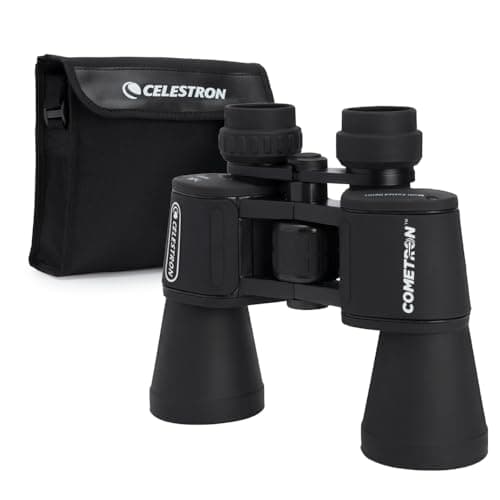 Celestron Cometron 7x50 7.1mm exit pupil, 6.6 degree field, 344 ft at 1000 yds, 27.3 oz. | A child's dedicated stargazing pair | |
| 2 | 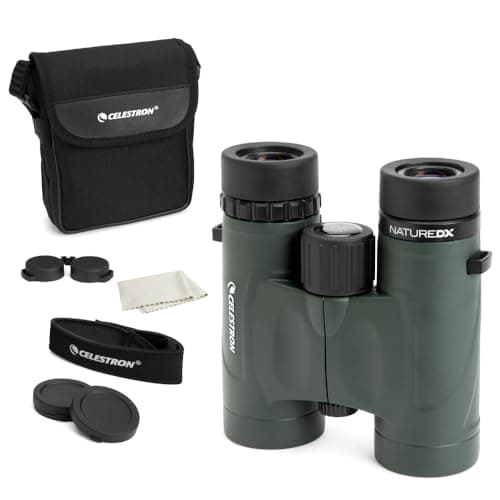 Celestron Nature DX 8x32 18 oz, 17.5mm eye relief, waterproof, better prisms and coatings. | If nine ounces matters more than brightness | $90.97 on Amazon #ad How we’re funded · price as of October 18, 2026 |
| 3 | 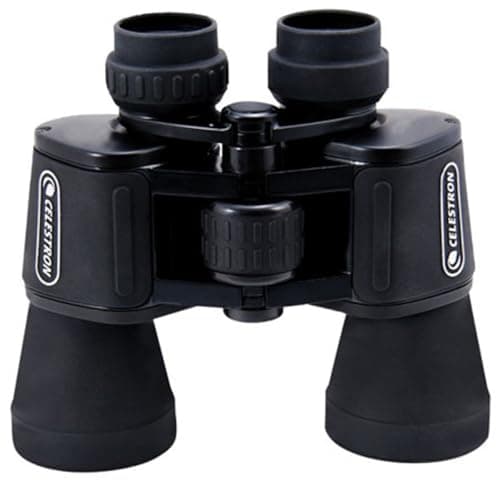 Celestron UpClose G2 10x50 10x on the same 50mm front lenses — more detail, 30 percent less light. | The same objectives with more reach | $64.53 on Amazon #ad How we’re funded · price as of October 18, 2026 |
Rows link to the full write-up further down this page. Prices come from the live price layer only; where there is no live figure the button reads “Check price” rather than showing a number we remembered.
Where the corners are cut, honestly
This is an inexpensive binocular and Celestron's own specification tells you where the money was saved. Celestron also sells the same 7x50 format with none of those savings made — BaK-4 prisms, XLT coatings, 20.8mm of eye relief and IPX7 sealing — in the SkyMaster Pro ED 7x50, at 17 oz heavier and several times the price.
- BK7 prisms rather than BaK-4. BK7 is a cheaper glass with a lower refractive index, which produces slight vignetting and softening toward the edge of the field. On the Moon, centered, you will not notice. On a wide star field you might.
- Multi-coated, not fully multi-coated. Fewer coated surfaces means marginally less light transmission and slightly lower contrast.
- Water resistant, not waterproof. Fine for dew on a clear night. Not fine for being left out in rain, and not nitrogen purged, so internal fogging is possible with sharp temperature changes.
- 13mm eye relief. Short enough that a child in glasses will see a reduced field.
- 26.2 ft close focus. These are useless on anything closer than about eight meters.
None of that stops them doing the job. The 50mm objectives and the 7.1mm exit pupil are what determine the night-time view, and those are not compromised at all.
The weight, and what to do about it
27.3 ounces is a pound and three quarters. Held above the head, arms up, for more than a minute or two, that is genuinely tiring for an adult and quickly impossible for a child.
Three fixes, all free or nearly so, and each one transforms the experience: lie on a blanket with your elbows on the ground; lean against a wall, doorframe or car; or use the tripod thread with a cheap adapter. The tripod is the best of the three by a distance, and it is the single most under-used feature in amateur astronomy.
What you will see
Craters and mountain shadows on the Moon. Up to four of Jupiter's moons in a line, changing position night to night. The Pleiades filling the field with blue-white stars — the best binocular object in the sky. The Orion Nebula as a distinct gray patch with stars in it. Andromeda as an oval smudge that is a galaxy two and a half million light years away. And on a genuinely dark night, sweeping slowly along the Milky Way resolves it into thousands of individual stars.
That is a serious night's observing from a pair of binoculars that cost less than a cheap telescope. Full honest list on what you can actually see.
The picks in full
Pick 1
Celestron Cometron 7x50
A child's dedicated stargazing pair
The arithmetic
Exit pupil is objective divided by magnification: 50 / 7 = 7.1mm, which matches Celestron's published figure. That is the single most useful number here. A fully dark-adapted young pupil opens to around 7mm, so a child uses nearly all of that 7.1mm cone and the view is as bright as the optics can make it. An adult over about forty typically dilates to 5mm or less and simply cannot use the extra — this is one of the rare cases where a child gets more out of the hardware than the grown-up does.
The 7x50 format has been the standard beginner astronomy binocular for decades, and this is the affordable version of it.
Celestron publishes a 7.1mm exit pupil, which is exactly 50 divided by 7 — no rounding games. The field is 6.6 degrees, or 344 ft at 1,000 yards, which is roughly thirteen Moon widths and makes locating targets almost effortless.
13mm of eye relief is workable without glasses and marginal with them. Close focus is 26.2 ft, which tells you these are built for distance rather than for looking at things in the garden.
BK7 porro prisms with multi-coated optics. BK7 is the cheaper prism glass and produces slight softening at the edge of the field; multi-coated rather than fully multi-coated means marginally less light transmission. At this price both are reasonable compromises, and neither is noticeable on the Moon.
Skip it if
It has to be held unsupported by a small child. The weight is the whole story here — plan for a blanket, a wall or a tripod, or accept that sessions will be short.
| Magnification | 7x |
|---|---|
| Objective lens | 50mm (1.97") |
| Prism glass | BK7 porro |
| Lens coatings | Multi-coated |
| Angular field of view | 6.6 degrees |
| Linear field at 1000 yds | 344 ft (105 m) |
| Exit pupil | 7.1mm (.28") |
| Eye relief | 13mm (.51") |
| Close focus | 26.2 ft (8 m) |
| Weight | 27.3 oz (774 g) |
| Tripod adaptable | Yes |
| Environmental | Water resistant |
| What the box does not do | 27.3 oz is heavy for small arms held up at the sky — plan on leaning against a wall or lying on a blanket, or add the tripod adapter. BK7 prisms are the cheaper glass and show slight softening at the edge of the field. Water resistant is not waterproof. |
Specifications from Celestron — Cometron 7x50mm specifications. We have not handled this one — everything above is the published spec sheet plus our own arithmetic on it.
Pick 2
Celestron Nature DX 8x32
If nine ounces matters more than brightness
The arithmetic
32 / 8 = 4mm exit pupil — dimmer at night than either 50mm pair above, and that is the honest trade. What you get for it: 18 oz instead of 27, which a seven-year-old can actually hold steady; 17.5mm of eye relief, so a child in glasses sees the full field; 6.5 ft close focus, so it works on a ladybird in the garden as well as the Moon; and genuinely waterproof rather than water resistant. This is the pair that gets used on Tuesday afternoon, not just on a clear Saturday night.
The direct alternative when the Cometron's weight is the problem rather than a footnote.
18 oz against 27.3 oz. That is a third less, and for a child it is often the difference between binoculars that get used and binoculars that live in a drawer.
The glass is better in every published respect: phase-coated BaK-4 roof prisms against BK7 porro, fully multi-coated against multi-coated, waterproof against water resistant. 17.5mm of eye relief instead of 13mm, and 6.5 ft close focus instead of 26.2 ft.
The one thing it loses is light, and it loses a lot of it: a 4mm exit pupil against 7.1mm. That is the entire trade, and which side of it you want depends on whether these are for the night sky specifically or for a child generally.
Skip it if
Faint objects are the point. The 4mm exit pupil is a real step down at night, and on the Milky Way or Andromeda the difference is obvious rather than subtle.
| Magnification | 8x |
|---|---|
| Objective lens | 32mm (1.26") |
| Prism glass | BaK-4 roof, phase coated |
| Lens coatings | Fully multi-coated |
| Angular field of view | 7.4 degrees |
| Linear field at 1000 yds | 388 ft (129 m) |
| Exit pupil | 4mm (.157") |
| Eye relief | 17.5mm (.69") |
| Close focus | 6.5 ft (2 m) |
| Weight | 18 oz (510 g) |
| Tripod adaptable | Yes |
| Environmental | Waterproof |
| What the box does not do | A 4mm exit pupil means noticeably dimmer star fields than a 7x50 — the Milky Way will not leap out of it. It costs meaningfully more than the porro pairs above, and none of that money is buying you light. |
Specifications from Celestron — Nature DX 8x32mm specifications. We have not handled this one — everything above is the published spec sheet plus our own arithmetic on it.
#ad How we’re funded · price as of October 18, 2026
Pick 3
Celestron UpClose G2 10x50
The same objectives with more reach
The arithmetic
50 / 10 = 5mm exit pupil, against 7.1mm for the 7x50. Same front lens, 30 percent less light reaching the eye, because the extra magnification spreads it over a wider image. The trade you are buying is more detail on the Moon and a shakier view of everything: at 10x, a hand tremor is magnified 10 times too, and children shake more than adults do.
The sideways move rather than the upgrade: same objectives, more magnification.
50 divided by 10 gives a 5mm exit pupil against the Cometron's 7.1mm. Same light collected, spread across a larger image, so a dark-adapted child receives noticeably less of it.
6.8 degrees of field, marginally wider than the Cometron despite the higher power, at 354 ft per 1,000 yards. Close focus 23 ft, weight 27 oz, eye relief 12mm.
Worth it for an older child who has demonstrated they can hold binoculars steady, or for anyone using a tripod. Not worth it for a seven-year-old standing in a garden.
Skip it if
The child is young or the binoculars will be hand-held. 10x magnifies tremor by 10, and a shaking image at high power shows less than a steady one at low power.
| Magnification | 10x |
|---|---|
| Objective lens | 50mm (1.96") |
| Prism glass | BK7 porro |
| Lens coatings | Multi-coated |
| Angular field of view | 6.8 degrees |
| Linear field at 1000 yds | 354 ft (118 m) |
| Exit pupil | 5mm (.19") |
| Eye relief | 12mm (.47") |
| Close focus | 23 ft (7 m) |
| Weight | 27 oz (765 g) |
| Tripod adaptable | Yes |
| Environmental | Water resistant |
| What the box does not do | 12mm of eye relief is short. A child who wears glasses will not see the whole field with them on, and taking them off changes the focus. Water resistant, not waterproof. |
Specifications from Celestron — UpClose G2 10x50mm specifications. We have not handled this one — everything above is the published spec sheet plus our own arithmetic on it.
#ad How we’re funded · price as of October 18, 2026
Questions people actually ask
- Are Celestron Cometron 7x50 binoculars good for beginners?
- Yes. The 7x50 format is the traditional beginner astronomy specification, and the 7.1mm exit pupil is close to a perfect match for a child's dark-adapted eye. The weight is the one thing to plan around.
- What can you see with 7x50 binoculars?
- Lunar craters, up to four of Jupiter's moons, the Pleiades, the Orion Nebula, the Andromeda galaxy, and the Milky Way resolved into individual stars on a dark night.
- What are the best astronomy binoculars for beginners?
- A 7x50 pair. Large objectives for light, low magnification for a wide steady field, and an exit pupil matched to a dark-adapted eye. That combination is why the format has been standard for decades.
- Are BK7 prisms bad?
- No, just cheaper. BK7 has a lower refractive index than BaK-4, producing slight vignetting and softening at the edge of the field. On a centered target it makes no practical difference.
- Can you mount Cometron 7x50 binoculars on a tripod?
- Yes — Celestron lists them as tripod adaptable. Using that thread with a cheap adapter is the single best free improvement available, particularly for a child.
Sources
Read next
Where to go from here
- Celestron UpClose G2 10x50 review
Same 50mm objectives as the Cometron, at 10x instead of 7x. More detail, less light, and a shake that children feel more than adults do.
- Celestron SkyMaster Pro ED 7x50 review
7x50 is the format we recommend more than any other, and this is the expensive version of it: 7.8 degrees of field, 20.8mm of eye relief, IPX7 sealing — and 62 percent more weight than the budget pick it has to beat.
- The best binoculars for stargazing with kids
The exit pupil calculation that decides which binoculars suit a child, and what a 7x50 actually shows on a first clear night.
- 7x50 versus 10x42: which for a child, and why
The exit pupil arithmetic that settles the classic binocular argument, and why the answer is different for a child than for an adult.
- Binoculars for kids, by age
What a child can physically hold at each age, and which published weight and eye-relief figures to check before buying.
- The best kids' telescopes under $100
The sub-$100 shelf is where the 525x claims live. What that money genuinely buys, and the one telescope here we tell you not to buy.
- The stargazing night kit
A red torch does more for what a child sees than doubling the aperture. The full kit, in order of how much it changes.
- What you can actually see with a kids' telescope
The honest target-by-target list for 70mm, 76mm and 114mm telescopes, so nobody is disappointed on night one.