Telescopes
The best telescope for an 11 or 12 year old
Old enough to be insulted by a toy. Buy the aperture.

By Scooter M. · published September 1, 2026
I'm not an astronomer and I don't have a lab. I'm someone who's genuinely into this — I read the manuals, compile the published specs, and do the arithmetic the box doesn't do for you. No lab coat. How we pick.
How this is funded. Lens & Lightyear earns a commission when you buy through a link on this page, at no extra cost to you. It does not change which products we pick or what we say about them — every card below carries a real reason to skip it. Prices are pulled live and were last verified October 18, 2026. Full disclosure.
The short answer
At eleven and twelve, buy aperture. The child can set up anything, stay out for hours, and read a star chart, so the only remaining limit is how much light the telescope collects. A 114mm to 130mm reflector, or a 102mm refractor, will still be in use in three years.
This band has a specific failure mode that the younger ones do not: buying something too small. An eleven-year-old given a telescope that is obviously aimed at small children reads the message loud and clear, and a 50mm scope with cartoon packaging will be politely ignored.
What changes at 11 and 12
- Nothing about the telescope is beyond them. Assembly, collimation, star charts, eyepiece choice — all learnable at this age and often enthusiastically.
- They will research it themselves. Expect them to know the model number and to have watched three videos about it. Buy something that survives that scrutiny.
- Their dark adaptation is better than yours. A young dark-adapted pupil opens wider than an adult's, so they genuinely see fainter objects through the same telescope.
- They will notice a cheap mount immediately, and they will be right to.
- They can be genuinely disappointed in a way a seven-year-old cannot. This is the age where getting it wrong costs the most.
Reflector or refractor?
This is the real decision at this level and it is a genuine trade rather than a right answer.
| Reflector (mirror) | Refractor (lens) | |
|---|---|---|
| Aperture per dollar | Much better — mirrors are cheaper to make | Worse. A 102mm refractor costs what a 130mm+ reflector does |
| Maintenance | Needs occasional collimation | None ever |
| Planetary contrast | Slightly reduced by the central obstruction | Crisper on the Moon and planets |
| Faint object performance | Better — it is an aperture game | Limited by the smaller lens |
| Robustness | Open tube collects dust; mirror can be knocked out of line | Sealed and forgiving |
| Best for | Someone who wants to see as much as possible | Someone who wants sharp planets and zero fuss |
For a child who is going to pursue this, we lean reflector, because aperture is the thing you cannot add later and collimation is a twenty-minute skill. For a child who wants a beautiful sharp Moon with no maintenance, refractor. Neither choice is wrong.
Quick picks
Telescopes for an 11 or 12 year old
| # | Product | Best for | Price |
|---|---|---|---|
| 1 | 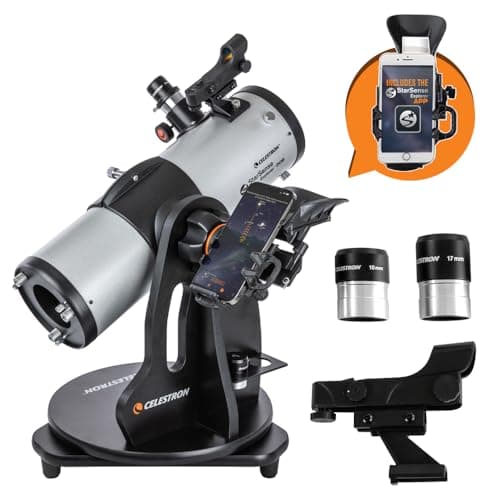 Celestron StarSense Explorer 114mm Tabletop Dobsonian 114mm parabolic mirror, 12.8 limiting magnitude, and it finds targets for you. | The best all-round pick at this age | |
| 2 | 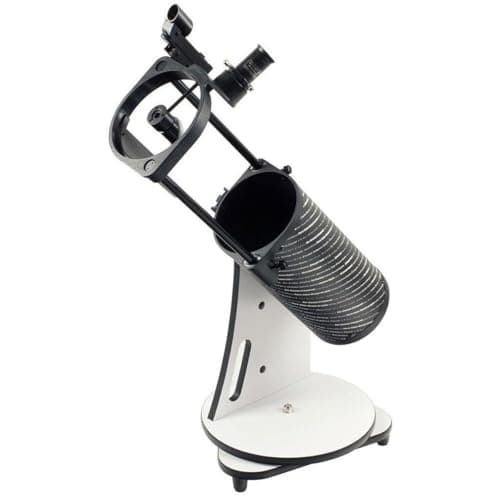 Sky-Watcher Heritage 130 Tabletop Dobsonian The biggest mirror here, with a proper parabolic primary and RAQ coatings. | Maximum aperture for the money | |
| 3 | No image Celestron StarSense Explorer DX 102AZ 102mm of refractor, a 240x ceiling, and no mirror to ever align. | Refractor sharpness with real aperture | |
| 4 | 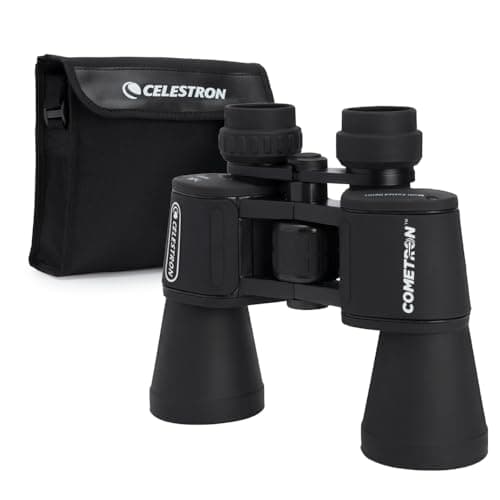 Celestron Cometron 7x50 Cheap, instant, and the widest true field of anything on this page. | The thing they will actually use most nights |
Rows link to the full write-up further down this page. Prices come from the live price layer only; where there is no live figure the button reads “Check price” rather than showing a number we remembered.
The eyepiece budget nobody mentions
Every telescope here ships with two eyepieces, and every one of them leaves most of its magnification range unused. This is not a scandal — it keeps the price down — but it does mean the box is not the finished instrument.
| Telescope | Supplied magnifications | Published ceiling | Gap |
|---|---|---|---|
| StarSense 114mm Dob | 26x and 45x | 269x | Large. A 6mm eyepiece would give 75x, a Barlow more |
| StarSense DX 102AZ | 26x and 66x | 240x | Large. Planetary work needs a shorter eyepiece |
| Heritage 130 | Not published | Around 260x by the aperture rule | Unknown until you have it |
Ceilings are the manufacturers' published figures where they exist. The Heritage figure is our arithmetic on the standard rule of roughly 2x aperture in millimeters, not a Sky-Watcher claim.
A single decent 6mm eyepiece or a 2x Barlow is the highest-value accessory purchase for a child at this age, and it costs a fraction of the telescope. Do not buy a set of ten cheap ones; buy one good one.
What they will actually see, at this aperture
This is where the honest answer starts getting genuinely exciting rather than merely defensible.
- Jupiter — two dark cloud belts clearly, more on a steady night, and the four Galilean moons in a line that visibly changes hour to hour.
- Saturn — rings unmistakable, and the Cassini division between them glimpsed on good nights at higher magnification.
- The Moon — at 100x and up, detail limited by the atmosphere rather than by the telescope. Mountain shadows, rilles, crater chains.
- Orion Nebula — real structure, four stars of the Trapezium resolved, wings of gray gas.
- Andromeda — a large oval glow, and its companion galaxy M32 as a small fuzzy star. Not the photograph, but a genuinely distant galaxy in real time.
- Double stars — Albireo's gold and blue pair is the one that converts skeptics.
What they will not see: color in nebulae, spiral arms, or anything resembling a long-exposure photograph. Human eyes do not accumulate light the way a camera sensor does. Say it once, early, and it stops being a disappointment. Full detail on what you can actually see.
The picks in full
Pick 1
Celestron StarSense Explorer 114mm Tabletop Dobsonian
The best all-round pick at this age
The arithmetic
A parabolic mirror rather than the spherical one in cheaper reflectors, which is what keeps a fast f/4 sharp at the edges. 114mm gathers roughly 2.7 times the light of a 70mm refractor, and the published limiting magnitude of 12.8 is the deepest on this site. The supplied eyepieces only reach 45x against a 269x ceiling, so the box gives you wide, bright, easy views and leaves the high-power ones to buy later.
At eleven and twelve, a child can do everything an adult beginner can, so the question becomes what will still be interesting in two years. This is our answer for most households.
114mm with a parabolic primary at f/4 gives wide, bright, genuinely deep views: Celestron publishes a limiting stellar magnitude of 12.8, which puts hundreds of clusters, nebulae and galaxies within reach on a dark night. The supplied 17mm and 10mm eyepieces give 26x and 45x against a 269x ceiling, so there is plenty of headroom to grow into with a couple of cheap eyepieces later.
The phone-guided finding earns its place differently at this age than it does at nine. A younger child needs it to avoid giving up. An eleven-year-old uses it to go deeper faster — you can work through twenty objects in an evening instead of two, which is how someone gets properly hooked. Celestron sells three telescopes with this system and they are not interchangeable: which StarSense Explorer is best for a kid sets out the weight and aperture trade.
12.6 lbs on a tabletop base. Solid surface required, same as every tabletop instrument on this site.
Skip it if
They already know the sky well. A twelve-year-old who can star-hop does not need the phone system, and the same money spent on plain aperture — the Heritage 130 below — buys a bigger mirror instead.
| Optical design | Newtonian reflector, parabolic primary mirror |
|---|---|
| Aperture | 114mm (4.48") |
| Focal length | 450mm (17.71") |
| Focal ratio | f/4 |
| Eyepieces supplied | 17mm (26x) and 10mm (45x) |
| Finderscope | StarPointer red dot |
| Mount | Alt-azimuth tabletop Dobsonian base |
| Highest useful magnification | 269x |
| Limiting stellar magnitude | 12.8 |
| Total kit weight | 12.6 lbs (5.71 kg) |
| What the box does not do | No tripod — it is a tabletop instrument and needs a solid surface at the right height, which is a real planning problem in a garden. A reflector's mirror can drift out of alignment; expect to learn collimation eventually. |
Specifications from Celestron — StarSense Explorer 114mm Dobsonian specifications. We have not handled this one — everything above is the published spec sheet plus our own arithmetic on it.
Pick 2
Sky-Watcher Heritage 130 Tabletop Dobsonian
Maximum aperture for the money
The arithmetic
130mm of aperture collects roughly 3.4 times the light of a 70mm refractor — the single biggest jump available at anything like gift money. At 650mm focal length, a common 25mm eyepiece gives 26x and a 10mm gives 65x. The rule of thumb astronomers use for a maximum useful magnification is about 2x the aperture in millimeters, which puts a sensible ceiling near 260x on a genuinely steady night.
If the child is genuinely into this and the budget is fixed, aperture is where the money should go, and 130mm is the most you can sensibly buy at gift level.
The primary is borosilicate, parabolic, and carries Sky-Watcher's Radiant Aluminum Quartz coating. Parabolic matters at f/5: a cheaper spherical mirror at that focal ratio would show visibly soft stars away from the center.
At 650mm focal length, a standard 25mm eyepiece gives 26x and a 10mm gives 65x. The usual astronomers' rule of thumb — roughly twice the aperture in millimeters — puts a sensible upper limit near 260x on a genuinely steady night, which is more magnification than the atmosphere usually allows anyway.
The collapsible tube is a real convenience for storage and Sky-Watcher states it holds collimation through the collapse. Being an open tube, it will collect dust, and a reflector at this aperture will need collimating occasionally. For an eleven-year-old, learning to collimate is a feature rather than a chore.
Skip it if
You want a complete package with no unknowns. Sky-Watcher does not publish the supplied eyepieces, the finderscope or the assembled weight for this model, and we will not fill those gaps with numbers we have not read.
| Optical design | Newtonian reflector, borosilicate parabolic primary mirror |
|---|---|
| Aperture | 130mm |
| Focal length | 650mm |
| Focal ratio | f/5 |
| Mirror coatings | Sky-Watcher Radiant Aluminum Quartz (RAQ) |
| Focuser | 1.25" helical |
| Mount | Tabletop Dobsonian base, Teflon bearings, altitude locking knob |
| Tube | Collapsible for storage, retains collimation |
| What the box does not do | Sky-Watcher's product page does not publish the supplied eyepieces, finderscope or assembled weight, so we do not state them. No tripod — this is a tabletop instrument. The collapsible tube is open to the air, so it collects dust and will need occasional mirror cleaning and collimation. |
Specifications from Sky-Watcher USA — Heritage 130 Tabletop Dobsonian. We have not handled this one — everything above is the published spec sheet plus our own arithmetic on it.
Pick 3
Celestron StarSense Explorer DX 102AZ
Refractor sharpness with real aperture
The arithmetic
The jump from 70mm to 102mm is the biggest single upgrade on this site: light-gathering scales with the square of aperture, so a 102mm objective collects about 2.1 times what a 70mm does. The published limiting magnitude moves from 11.7 to 12.5 and the useful ceiling from 165x to 240x. The cost is 14.2 lbs — this is a two-hands, one-trip-to-the-garden telescope, not a carry-it-yourself one.
A refractor at 102mm is a different instrument from a 102mm reflector: no central obstruction, so contrast on the Moon and planets is noticeably crisper, and nothing to collimate ever.
Celestron publishes a 240x ceiling and a 12.5 limiting magnitude. In practice that means Jupiter's cloud belts with detail in them, the Cassini division in Saturn's rings on a good night, and double stars split cleanly — refractors are the traditional choice for exactly this kind of work.
The supplied eyepieces give 26x and 66x, which leaves a lot of that 240x ceiling unused. Budget for a 6mm or a Barlow if planets are the interest; without one you are not using what you paid for.
14.2 lbs is the honest cost. This is a telescope that gets carried to the garden and set up, not one that gets grabbed on a whim. For a committed eleven or twelve-year-old that is fine. For a casual one it is a reason it stays indoors.
Skip it if
It has to be carried far. At 14.2 lbs assembled this is the heaviest thing we recommend at this age, and while a twelve-year-old can manage it, they will not be taking it to a friend's house or up a hill.
| Optical design | Refractor |
|---|---|
| Aperture | 102mm (4.01") |
| Focal length | 660mm (25.98") |
| Focal ratio | f/6.5 |
| Eyepieces supplied | 25mm (26x) and 10mm (66x) |
| Finderscope | StarPointer red dot |
| Mount | Manual alt-azimuth |
| Tripod | 1244.6mm (49") max height |
| Highest useful magnification | 240x |
| Limiting stellar magnitude | 12.5 |
| Total kit weight | 14.2 lbs (6.44 kg) |
| What the box does not do | No Barlow in the box, so the supplied top magnification is 66x against a 240x ceiling — you will want a shorter eyepiece eventually. At 14.2 lbs assembled, a child under about ten will not be setting this up alone. |
Specifications from Celestron — StarSense Explorer DX 102AZ specifications. We have not handled this one — everything above is the published spec sheet plus our own arithmetic on it.
Pick 4
Celestron Cometron 7x50
The thing they will actually use most nights
The arithmetic
Exit pupil is objective divided by magnification: 50 / 7 = 7.1mm, which matches Celestron's published figure. That is the single most useful number here. A fully dark-adapted young pupil opens to around 7mm, so a child uses nearly all of that 7.1mm cone and the view is as bright as the optics can make it. An adult over about forty typically dilates to 5mm or less and simply cannot use the extra — this is one of the rare cases where a child gets more out of the hardware than the grown-up does.
Every serious amateur astronomer owns binoculars, and they get used far more often than the telescope does. It is worth saying that plainly to an eleven-year-old, because it is genuinely true and it is not the message the hobby's marketing sends.
A 7x50 shows about 6.6 degrees of sky at once — thirteen Moon widths. That makes them the right tool for large objects a telescope cannot fit in its field: the Pleiades, the Hyades, the sweep of the Milky Way through Cygnus, big open clusters, and comets when there is one.
The 7.1mm exit pupil is a genuine advantage for someone this age. A dark-adapted pupil at eleven opens to roughly 7mm, so they use essentially all the light these deliver. Most adults cannot.
They also do the job the telescope cannot: finding things. Sweeping with binoculars to locate a target, then swinging the telescope onto it, is how experienced observers actually work.
Skip it if
This is the only gift. At eleven or twelve, binoculars alone will read as a consolation prize if a telescope was what they were hoping for. As a companion to a telescope they are close to essential.
| Magnification | 7x |
|---|---|
| Objective lens | 50mm (1.97") |
| Prism glass | BK7 porro |
| Lens coatings | Multi-coated |
| Angular field of view | 6.6 degrees |
| Linear field at 1000 yds | 344 ft (105 m) |
| Exit pupil | 7.1mm (.28") |
| Eye relief | 13mm (.51") |
| Close focus | 26.2 ft (8 m) |
| Weight | 27.3 oz (774 g) |
| Tripod adaptable | Yes |
| Environmental | Water resistant |
| What the box does not do | 27.3 oz is heavy for small arms held up at the sky — plan on leaning against a wall or lying on a blanket, or add the tripod adapter. BK7 prisms are the cheaper glass and show slight softening at the edge of the field. Water resistant is not waterproof. |
Specifications from Celestron — Cometron 7x50mm specifications. We have not handled this one — everything above is the published spec sheet plus our own arithmetic on it.
Questions people actually ask
- What is the best telescope for a 12 year old?
- A 114mm to 130mm reflector, or a 102mm refractor if sharp planetary views matter more than faint objects. Twelve is old enough that aperture, not simplicity, should drive the decision.
- What is the best telescope for a teenager?
- The same picks, and they scale into adult use. A 130mm reflector is a telescope a committed observer keeps for years rather than outgrows.
- Is a smart telescope worth it for a kid this age?
- Phone-guided finding is worth it if the child wants to see a lot of objects quickly. If they enjoy the hunt — and many at this age do — the same money buys more aperture instead.
- Do I need to buy extra eyepieces?
- Eventually, yes. Every telescope here ships with eyepieces that use only part of its magnification range. One good short eyepiece or a 2x Barlow is the best-value upgrade and costs a small fraction of the telescope.
- Will they outgrow it?
- Not at 114mm or above. A 130mm reflector is a serious instrument that adult amateurs use happily. A 50mm or 60mm starter scope, by contrast, is outgrown in a season.
Sources
Read next
Where to go from here
- Celestron StarSense Explorer DX 102AZ review
102mm of sealed refractor on the steadiest mount in the StarSense range. What dual-axis slow-motion controls are worth, and why a cheaper sibling out-apertures it.
- The best telescopes under $500
Between $200 and $500 you can have aperture, a parabolic mirror, or guided finding — but not all three. What each choice costs, and who should make which.
- Celestron StarSense Explorer 114mm review
114mm of parabolic mirror plus phone-guided finding — the telescope we recommend more than any other here. What that combination buys, and the one thing it demands.
- Sky-Watcher Heritage 130 review
130mm of parabolic mirror that collapses for storage. The biggest single jump in what a child can see, and the planning problem that comes with it.
- The best telescope for a 9 or 10 year old
Nine and ten is the first band where a bigger, heavier telescope is a better telescope. Four picks and the arithmetic behind the jump.
- Which Celestron StarSense Explorer is best for a kid?
LT 70AZ, DX 102AZ or the 114mm tabletop Dobsonian? Compared on published specs, weight, and what the box actually gives you against what it could.
- The best kids' telescope to see planets
Planets are the one thing every child asks about. Which telescopes show them properly, and what Jupiter and Saturn genuinely look like at this aperture.
- Tabletop or tripod? The choice your garden makes for you
A tabletop reflector buys more aperture for the money and needs a solid surface. A tripod telescope stands anywhere and costs you glass. Which one your garden allows.
- The best binoculars for stargazing with kids
The exit pupil calculation that decides which binoculars suit a child, and what a 7x50 actually shows on a first clear night.
- What you can actually see with a kids' telescope
The honest target-by-target list for 70mm, 76mm and 114mm telescopes, so nobody is disappointed on night one.
- The best telescope for teens
Above about 13 the weight limits and patience limits that shape our age pages stop applying. What to buy when the telescope has to keep up with the person for years.
- What to stand a tabletop Dobsonian on
Tabletop Dobsonians give the most aperture per dollar and arrive without anything to stand on. The dedicated Celestron tripod, what it fits, and the cheaper answers that work.