Telescopes
Celestron StarSense Explorer DX 102AZ review
The most expensive StarSense here, and the one its own siblings undercut on aperture.
By Scooter M. · published September 14, 2026
I'm not an astronomer and I don't have a lab. I'm someone who's genuinely into this — I read the manuals, compile the published specs, and do the arithmetic the box doesn't do for you. No lab coat. How we pick.
How this is funded. Lens & Lightyear earns a commission when you buy through a link on this page, at no extra cost to you. It does not change which products we pick or what we say about them — every card below carries a real reason to skip it. Prices are pulled live and were last verified October 18, 2026. Full disclosure.
The short answer
Buy it if you want a sealed refractor on the steadiest mount in the range and an adult will do the carrying. Its dual-axis slow-motion controls are genuinely useful at high power. But the cheaper LT 114AZ gives more aperture at less weight, and the DX ships without a Barlow at only 28 percent of its own ceiling.
Celestron also sells its optical near-twin without the app — the Inspire 100AZ, same 660mm and f/6.5, 1.8 lbs lighter. This is the telescope five other pages on this site already recommend as a pick, so it has earned a page that sets out the full case — including the two places where its own siblings beat it.
What the DX badge actually buys
Celestron's LT and DX lines share the same app, the same phone requirement and the same red dot finder. The difference is the mount and the tube, and it is worth being precise about it.
- Dual-axis slow-motion controls. Geared knobs that creep the telescope along in altitude and azimuth instead of pushing the tube by hand. The single most useful mechanical feature here, and it matters more the higher you magnify.
- A sturdier tripod and head. Published max height 49 inches, slightly shorter than the LT models' 52 inches but carrying a heavier tube more solidly. Settling time after a nudge is what you are buying.
- 102mm of aperture, the largest refractor objective on this site.
- Not a Barlow. The LT 80AZ and LT 114AZ both include one. The DX, the most expensive of the three, does not — which is the single oddest thing about the package.
The published ceiling is a formula
Celestron publishes 240x as the highest useful magnification. That is not a measurement — it is 60x per inch of aperture: 4.01 inches times 60 is 240.6, published as 240x. The same formula produces 189x for the 80mm, 269x for the 114mm models and 118x for a 50mm.
The metric rule of thumb we use elsewhere — twice the aperture in millimeters — gives 204x here, so treat the realistic ceiling as somewhere in the low 200s on a genuinely steady night. Either way it is a ceiling, not a target: most good views through this telescope will happen between 26x and about 130x.
How much of the telescope is in the box
| Model | Top magnification supplied | Published ceiling | Share in the box | Kit weight |
|---|---|---|---|---|
| DX 102AZ (this one) | 66x (10mm, no Barlow) | 240x | about 28% | 14.2 lbs |
| LT 114AZ | 200x (10mm + 2x Barlow) | 269x | about 74% | 10.4 lbs |
| LT 80AZ | 180x (10mm + 2x Barlow) | 189x | about 95% | 9.2 lbs |
| 114mm Tabletop Dob | 45x (10mm, no Barlow) | 269x | about 17% | 12.6 lbs |
Our arithmetic on Celestron's published figures: focal length divided by eyepiece focal length, against the maker's own stated ceiling. Weights are Celestron's published total kit weights.
A low share is not automatically a fault — the tabletop Dobsonian's 17 percent reflects real aperture waiting behind a cheap eyepiece. But the DX is the most expensive telescope in that table, and it is the one that most needs a purchase you were not told about. Budget for one good mid-range eyepiece: something around 6mm would give 110x here, comfortably inside the ceiling.
Quick picks
The DX 102AZ and the siblings that undercut it
| # | Product | Best for | Price |
|---|---|---|---|
| 1 | No image Celestron StarSense Explorer DX 102AZ 102mm sealed refractor, dual-axis slow-motion controls, and a published 240x ceiling. | The steadiest mount and a tube that never needs aligning | |
| 2 | 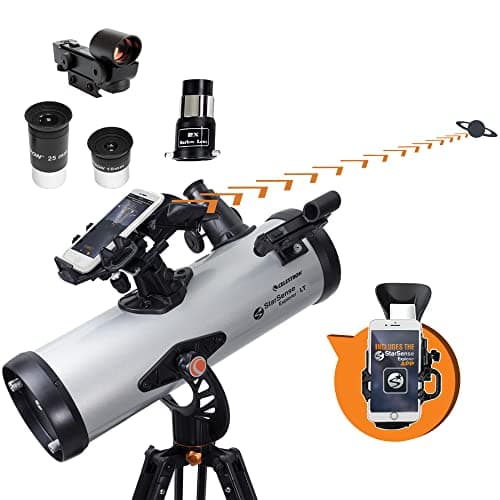 Celestron StarSense Explorer LT 114AZ 114mm and a 12.8 limiting magnitude at 10.4 lbs — it beats the DX on both. | More aperture, less weight, less money | |
| 3 | 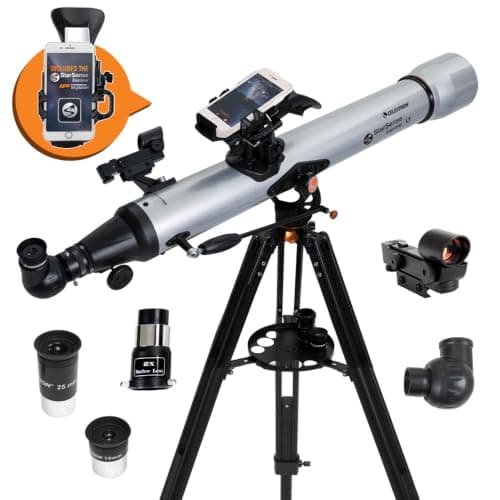 Celestron StarSense Explorer LT 80AZ 80mm at f/11 — less light, less color fringing, and 95 percent of its ceiling supplied. | Cleaner optics and a finished box, for less |
Rows link to the full write-up further down this page. Prices come from the live price layer only; where there is no live figure the button reads “Check price” rather than showing a number we remembered.
Aperture per pound, where the DX loses
For a telescope a child might use, the useful ratio is how much aperture you get for each pound somebody has to carry. The DX comes last on this site.
| Model | Aperture | Kit weight | Aperture per pound |
|---|---|---|---|
| LT 114AZ | 114mm | 10.4 lbs | about 11.0 mm/lb |
| 114mm Tabletop Dob | 114mm | 12.6 lbs | about 9.0 mm/lb |
| LT 80AZ | 80mm | 9.2 lbs | about 8.7 mm/lb |
| DX 102AZ | 102mm | 14.2 lbs | about 7.2 mm/lb |
Our arithmetic on published apertures and published total kit weights. The tabletop figure flatters itself slightly — its weight excludes the table it requires.
That is the honest headline of this review: the DX 102AZ is the heaviest telescope in that table and delivers the least aperture for that weight. It buys back steadiness and a maintenance-free tube, which for some households is exactly the right trade — but it is a trade, not a straightforward upgrade.
f/6.5, and the color question
A two-element achromatic lens cannot bring every wavelength to the same focus, and the residual error grows as the optic gets faster and larger. The conventional guideline for a doublet is roughly f/3 per inch of aperture before color becomes negligible — which for a 4-inch objective points at about f/12.
This telescope is f/6.5. By design, then, expect some violet fringing on the Moon's limb and around bright planets: not ruinous, entirely normal for a fast achromat, and the direct cost of keeping a 102mm tube short enough to sit on a 49-inch tripod. The slower LT 80AZ at f/11 shows noticeably less of it, and gathers less light in exchange.
The phone requirement is a hard gate
Android 12 and later, or iOS 18 and newer on an iPhone XR or newer — the same requirement Celestron publishes across the StarSense range. Check the phone that will actually be in the garden, not the newest one in the house.
Without a compatible phone the dock is dead weight and this becomes an ordinary 102mm refractor bought at a guided price. All the guided models are set against each other on which StarSense Explorer is best for a kid.
A note on availability
At the time of writing this model is out of stock at both Celestron and the retailer we link, while remaining a current product in Celestron's line — item 22460 is still listed alongside the rest of the StarSense Explorer range. It is a stock gap, not a discontinuation.
While that lasts, our buy button goes to a retailer search for this exact model rather than to a fixed product page, so it finds whichever seller has stock instead of landing you on an unbuyable listing. If you would rather not wait, the DX 130AZ shares the same mount and app with a larger mirror, and the LT 80AZ is the cheaper refractor in the same range.
Who this is for
| Situation | Verdict |
|---|---|
| An adult sets it up and wants zero maintenance | Buy it. Sealed tube, steadiest mount, dual-axis controls. |
| You want the most aperture for the money | The LT 114AZ — more light, 3.8 lbs lighter, and it includes a Barlow. |
| The child must carry and set up alone | Not this one. 14.2 lbs is an adult's telescope. See ages 9-10. |
| Clean lunar and planetary views matter most | The LT 80AZ at f/11 shows less false color. |
| You have a solid garden table | The 114mm tabletop Dob gives a parabolic mirror and more aperture for less. |
| The available phone is older than an iPhone XR | Do not buy it. Buy a plain refractor and spend the difference on aperture. |
What we did and did not do
We have not handled this telescope. Every specification above was read from Celestron's own published page, linked below and re-checked on the date at the top of this page; everything else is arithmetic on those published figures, shown so you can repeat it. The note on false color is what the achromatic design and published focal ratio imply, not a measurement we made.
No price appears in this prose. Live figures come only from our price feed with the date they were checked, and where there is no live figure the button reads *check price*. Our full method is on the methodology page.
The picks in full
Pick 1
Celestron StarSense Explorer DX 102AZ
The steadiest mount and a tube that never needs aligning
The arithmetic
The jump from 70mm to 102mm is the biggest single upgrade on this site: light-gathering scales with the square of aperture, so a 102mm objective collects about 2.1 times what a 70mm does. The published limiting magnitude moves from 11.7 to 12.5 and the useful ceiling from 165x to 240x. The cost is 14.2 lbs — this is a two-hands, one-trip-to-the-garden telescope, not a carry-it-yourself one.
The DX badge buys two things over the cheaper LT models, and only two: a sturdier mount with dual-axis slow-motion controls, and a larger refractor objective.
The slow-motion controls are the part worth paying for and the part nobody explains. On a plain alt-azimuth mount you nudge the tube by hand, which at 66x means overshooting and hunting. Two geared knobs let you creep the telescope along in each axis instead, and at higher magnifications that is the difference between tracking Jupiter across a field and losing it every thirty seconds.
102mm collects about 2.1 times the light of a 70mm and about 1.6 times an 80mm, with a published limiting stellar magnitude of 12.5. It is a sealed refractor, so there is no mirror to collimate — ever.
Two honest problems, and they are both real. The supplied 25mm and 10mm give 26x and 66x, and there is no Barlow in the box — so the kit reaches about 28 percent of its own 240x ceiling, the lowest share of any tripod-mounted StarSense. And at f/6.5 this is a relatively fast achromatic doublet, which by design shows more violet fringing on the Moon's limb and on bright planets than the slower f/10 and f/11 models do.
Skip it if
A child has to carry or set it up. At 14.2 lbs only the DX 130AZ is heavier on this site, and this delivers the least aperture per pound of anything we recommend — an adult is doing the carrying, every session.
| Optical design | Refractor |
|---|---|
| Aperture | 102mm (4.01") |
| Focal length | 660mm (25.98") |
| Focal ratio | f/6.5 |
| Eyepieces supplied | 25mm (26x) and 10mm (66x) |
| Finderscope | StarPointer red dot |
| Mount | Manual alt-azimuth |
| Tripod | 1244.6mm (49") max height |
| Highest useful magnification | 240x |
| Limiting stellar magnitude | 12.5 |
| Total kit weight | 14.2 lbs (6.44 kg) |
| What the box does not do | No Barlow in the box, so the supplied top magnification is 66x against a 240x ceiling — you will want a shorter eyepiece eventually. At 14.2 lbs assembled, a child under about ten will not be setting this up alone. |
Specifications from Celestron — StarSense Explorer DX 102AZ specifications. We have not handled this one — everything above is the published spec sheet plus our own arithmetic on it.
Pick 2
Celestron StarSense Explorer LT 114AZ
More aperture, less weight, less money
The arithmetic
The same 114mm aperture as the tabletop Dobsonian, the same published 269x ceiling and the same 12.8 limiting magnitude — but a completely different instrument: 1000mm at f/9 on its own full-height tripod, against 450mm at f/4 on a base that needs a table. The mirror here is SPHERICAL rather than parabolic, and at f/9 that is a legitimate engineering choice rather than a corner cut: spherical aberration only becomes visible at fast focal ratios. 1000mm over the supplied eyepieces gives 40x and 100x, or 80x and 200x with the Barlow — about 74 percent of the ceiling in the box.
This is the comparison that decides the page, and it is uncomfortable for the DX.
The LT 114AZ has more aperture (114mm against 102mm — about 1.25 times the light), a deeper published limiting magnitude (12.8 against 12.5), a higher published ceiling (269x against 240x), and it weighs 3.8 lbs less. It also includes the 2x Barlow the DX omits, so it ships at about 74 percent of its ceiling rather than 28.
What the DX keeps is the sealed tube and the dual-axis slow-motion controls. If you never want to collimate anything, that is a real answer. If you want the most telescope, this is.
Skip it if
You want a sealed tube. This is a Newtonian: the mirrors drift out of alignment eventually, and on an alt-azimuth mount the eyepiece reaches awkward angles near the zenith.
| Optical design | Newtonian reflector, spherical primary mirror |
|---|---|
| Aperture | 114mm (4.5") |
| Focal length | 1000mm (39.3") |
| Focal ratio | f/9 |
| Eyepieces supplied | 25mm (40x) and 10mm (100x) |
| Barlow | 2x (1.25") |
| Finderscope | StarPointer red dot |
| Mount | Manual alt-azimuth |
| Tripod | 1320.8mm (52") max height |
| Highest useful magnification | 269x |
| Limiting stellar magnitude | 12.8 |
| Total kit weight | 10.4 lbs (4.71 kg) |
| Phone requirement | Android 12 and later; iOS 18 and newer, iPhone XR and newer |
| What the box does not do | No case. The long tube on an alt-azimuth mount means the eyepiece ends up in awkward positions near the zenith, which is the standard Newtonian-on-a-tripod compromise. Being a reflector it will eventually need collimation, which the refractors in this range never do. |
Specifications from Celestron — StarSense Explorer LT 114AZ specifications. We have not handled this one — everything above is the published spec sheet plus our own arithmetic on it.
Pick 3
Celestron StarSense Explorer LT 80AZ
Cleaner optics and a finished box, for less
The arithmetic
900mm over the supplied 25mm and 10mm gives 36x and 90x, and the included 2x Barlow doubles those to 72x and 180x against a published 189x ceiling. That is about 95 percent of the telescope in the box — the highest share of any StarSense on this site, and unusual at any price. At f/11 this is among the slowest, most color-corrected refractors we list (only the f/13 AstroMaster 70AZ is slower): false color on a bright Moon is minimal and focus is forgiving. 80mm collects about 1.3 times the light of a 70mm. The cost is length and weight — 9.2 lbs and a long tube that a breeze will find.
The other direction: give up aperture and gain optical refinement plus a complete kit.
At f/11 the 80AZ is a slow achromat, which is precisely the condition under which false color becomes negligible. Against the DX's f/6.5, the 80AZ gives a visibly cleaner white limb on the Moon — the trade being about 1.6 times less light gathered.
It also arrives finished: 36x and 90x from the supplied eyepieces, doubled to 72x and 180x by the included Barlow, against a 189x ceiling. That is about 95 percent of the telescope in the box against the DX's 28 percent.
And it is 9.2 lbs against 14.2. Full review.
Skip it if
Faint objects matter. 80mm reaches a published limiting magnitude of 12 against the DX's 12.5, and no eyepiece closes an aperture gap.
| Optical design | Refractor |
|---|---|
| Aperture | 80mm (3.1") |
| Focal length | 900mm (35.43") |
| Focal ratio | f/11 |
| Eyepieces supplied | 25mm (36x) and 10mm (90x) |
| Barlow | 2x (1.25") |
| Finderscope | StarPointer red dot |
| Mount | Manual alt-azimuth with altitude slow-motion adjustment |
| Tripod | 1320.8mm (52") max height |
| Highest useful magnification | 189x |
| Limiting stellar magnitude | 12 |
| Total kit weight | 9.2 lbs (4.17 kg) |
| Phone requirement | Android 12 and later; iOS 18 and newer, iPhone XR and newer |
| What the box does not do | No case, and the tube's length makes it awkward for a small child to carry assembled. The phone requirement is a hard gate: Android 12+ or iOS 18+ on an iPhone XR or newer, and without the app this is an ordinary 80mm refractor bought at a guided price. |
Specifications from Celestron — StarSense Explorer LT 80AZ specifications. We have not handled this one — everything above is the published spec sheet plus our own arithmetic on it.
Questions people actually ask
- Is the Celestron StarSense Explorer DX 102AZ worth it?
- If you want a sealed refractor on the steadiest mount in the range and an adult will carry it, yes. If you want the most aperture for the money, the cheaper LT 114AZ gives more light at 3.8 lbs less weight.
- What is the difference between the StarSense Explorer DX and LT?
- The DX adds a sturdier mount with dual-axis slow-motion controls and a larger objective. Both lines share the same app, phone requirement and red dot finder. Oddly, the DX 102AZ omits the 2x Barlow that both LT models include.
- What magnification does the DX 102AZ give?
- 26x with the supplied 25mm eyepiece and 66x with the 10mm, from its 660mm focal length. Celestron publishes a 240x ceiling, so the box reaches about 28 percent of the telescope's stated limit.
- Does the StarSense Explorer DX 102AZ come with a Barlow lens?
- No, and that is the package's main gap. Both the LT 80AZ and LT 114AZ include a 2x Barlow; the more expensive DX does not, so one good mid-range eyepiece belongs in the budget.
- Does a 102mm f/6.5 refractor show false color?
- Some, by design. An achromatic doublet needs roughly f/3 per inch of aperture before color becomes negligible, which for a 4-inch objective points at about f/12. At f/6.5 expect a violet edge on the Moon's limb and bright planets.
- Does the DX 102AZ track objects automatically?
- No. The app shows arrows to push by and confirms when the target is centered, and the dual-axis slow-motion knobs let you creep it along by hand — but there is no motor.
- How heavy is the StarSense Explorer DX 102AZ?
- Celestron publishes 14.2 lbs for the total kit. Only the 18 lb DX 130AZ is heavier on this site, and the 102AZ delivers fractionally the least aperture per pound of anything we recommend. It is an adult-carries-it instrument.
Sources
Read next
Where to go from here
- Which Celestron StarSense Explorer is best for a kid?
LT 70AZ, DX 102AZ or the 114mm tabletop Dobsonian? Compared on published specs, weight, and what the box actually gives you against what it could.
- Celestron StarSense Explorer DX 130AZ review
130mm f/5 parabolic optics with phone guidance and dual-axis slow-motion controls, at 18 lbs. The arithmetic on what the box reaches, and the two cheaper routes to the same mirror.
- Celestron StarSense Explorer LT 114AZ review
114mm of aperture that brings its own tripod. Same published ceiling as the tabletop Dobsonian, a spherical mirror instead of parabolic, and why f/9 makes that fine.
- Celestron StarSense Explorer LT 80AZ review
80mm of slow, color-corrected glass with phone-guided finding — and the supplied eyepieces reach 95 percent of its published ceiling, which nothing else here does.
- The best telescopes under $500
Between $200 and $500 you can have aperture, a parabolic mirror, or guided finding — but not all three. What each choice costs, and who should make which.
- The best telescope for kids and adults to share
A telescope bought for a child that an adult will also want to use. What shared ownership demands, and the three that genuinely deliver it.
- Refractor or reflector for a child?
Mirrors are cheaper per millimeter of aperture; lenses never need aligning. Which trade suits which child, with the arithmetic on both.
- Celestron Inspire 100AZ review
100mm at 660mm f/6.5 with an integrated phone adapter, an erect image diagonal and a red flashlight in the box. The same optics as the DX 102AZ without the guidance app — and 1.8 lbs lighter.