Telescopes
Refractor or reflector for a child?
Lens or mirror. One is cheaper per millimeter, one never needs adjusting.
By Scooter M. · published September 6, 2026
I'm not an astronomer and I don't have a lab. I'm someone who's genuinely into this — I read the manuals, compile the published specs, and do the arithmetic the box doesn't do for you. No lab coat. How we pick.
How this is funded. Lens & Lightyear earns a commission when you buy through a link on this page, at no extra cost to you. It does not change which products we pick or what we say about them — every card below carries a real reason to skip it. Prices are pulled live and were last verified October 20, 2026. Full disclosure.
The short answer
Refractor for a younger child or a household that wants nothing to maintain: sealed, no alignment, no dust. Reflector when aperture matters more than upkeep, because a mirror costs far less per millimeter — which is why every telescope over about 100mm at gift prices is a reflector.
This is the second question most people ask after price, and most answers to it are written for adults choosing their own telescope. The variables are different when a child is involved: who maintains it, who carries it, and how forgiving it is of being handled badly.
How each design actually works
- A refractor uses a lens at the front to bend light to a focus at the back, where the eyepiece sits. This is the shape everybody draws when they draw a telescope. The tube is sealed at both ends.
- A reflector uses a curved mirror at the *back* to bounce light forward to a small flat mirror, which sends it out of the side of the tube near the front. That is why the eyepiece is in a surprising place, and why people occasionally report a reflector as faulty when it is not.
The eyepiece position genuinely matters for a child. On a tabletop reflector the eyepiece is near the top, at a comfortable height for a standing child. On a tripod refractor it is at the bottom, which is why a diagonal is supplied to turn the light through 90 degrees so nobody has to crouch under it.
The trade, line by line
| Refractor (lens) | Reflector (mirror) | |
|---|---|---|
| Cost per mm of aperture | Higher | Lower — often much lower |
| Maintenance | None. Sealed tube. | Occasional collimation and cleaning |
| Aperture at gift prices | About 70-102mm | 76-130mm |
| Tube open to dust | No | Yes, on open-tube designs |
| Robust to knocks | Very | Alignment can drift |
| False color on bright objects | Slight on cheap fast ones; minimal at f/10 | None — mirrors do not disperse light |
| Eyepiece position for a child | Low; needs a diagonal | Near the top of the tube |
| Typical mount at this price | Full tripod | Tabletop base — needs a surface |
| Best for | Younger children, low upkeep, planets and the Moon | Older children, faint objects, maximum light |
Bold marks the advantage in each row. Neither column wins outright, which is the actual finding — they are different purchases, not better and worse ones.
Why mirrors are cheaper, in one paragraph
A telescope mirror is a single piece of glass with one precisely curved surface that is then coated. Light never passes through it, so the glass behind that surface does not have to be optically pure.
A refractor's objective is usually two lens elements of different glass types, cemented or spaced, with four surfaces that all need shaping and polishing — and every one of those elements must be flawless all the way through, because the light goes through them. That is more glass, more surfaces, more rejects, and more money for the same diameter.
Quick picks
One pick for each design
| # | Product | Best for | Price |
|---|---|---|---|
| 1 | No image Celestron StarSense Explorer LT 70AZ 70mm sealed tube at f/10: nothing to align, nothing to clean, contrasty and forgiving. | Refractor — the no-maintenance choice | |
| 2 | 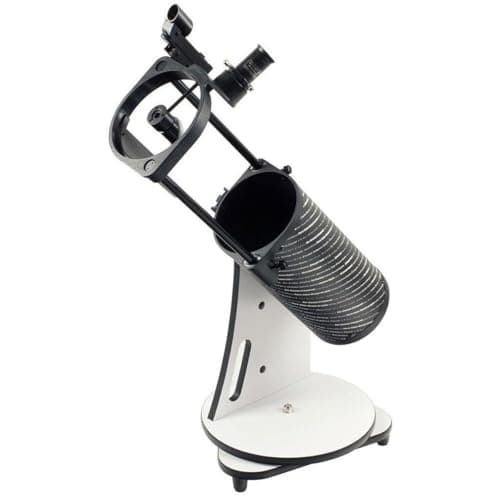 Sky-Watcher Heritage 130 Tabletop Dobsonian 130mm of parabolic mirror, roughly 3.4 times the light of a 70mm refractor. | Reflector — the most aperture for the money | |
| 3 | 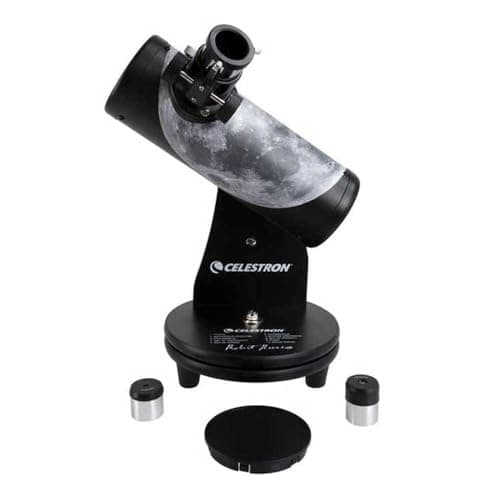 Celestron FirstScope 76mm Tabletop 76mm of mirror at the very bottom of the range, with no assembly at all. | The cheapest honest reflector |
Rows link to the full write-up further down this page. Prices come from the live price layer only; where there is no live figure the button reads “Check price” rather than showing a number we remembered.
Collimation, honestly
This is the word that scares people away from reflectors, so here is a straight account of it. Collimation means keeping the two mirrors aimed correctly at each other. Knocks and travel gradually put them out.
- How often: rarely, on a telescope that lives in one house. After a fall, or after months of use.
- How hard: a ten-minute job with thumbscrews and a bit of patience the first time, five minutes after that. There are free guides and inexpensive tools.
- What happens if you ignore it: stars go slightly soft and the telescope quietly under-performs. Nothing breaks.
- Who can do it: a careful eleven or twelve-year-old, genuinely, and it is one of the more satisfying things to hand over to them.
If that sounds like something your household will never do, that is a legitimate reason to buy a refractor and we would rather you chose one knowingly than bought a reflector and let it drift.
Which to buy at which age
| Age | Design we would choose | Why |
|---|---|---|
| 5-6 | Either, but small | Weight and simplicity decide it, not optics. A 76mm tabletop reflector or nothing at all — see ages 5-6. |
| 7-8 | Refractor | Sealed, robust, nothing to knock out of alignment, and light enough to carry. See ages 7-8. |
| 9-10 | Either | The age the decision becomes genuinely open. Aperture starts to pay off; so does a steady tripod. See ages 9-10. |
| 11-12 | Reflector | Aperture is the limiting factor now, and collimation is a skill they can own. See ages 11-12. |
The third design you will meet on the shelf
Refractor and reflector are not the only two. A third family — variously called catadioptric, compound, Maksutov-Cassegrain or Schmidt-Cassegrain — puts a lens at the front *and* mirrors inside, folding a long focal length into a short tube.
You will meet these in the gift aisle as small, stubby, surprisingly heavy telescopes carrying a big price for their size. What you are paying for is compactness: a long focal length in a short tube. What you give up is aperture per dollar — a compound telescope at gift money will have less light gathering than a reflector at the same price, and often less than a refractor too.
For a child we would generally take the aperture. Compactness matters when a telescope has to travel, and for that specific job a light 70mm refractor like the Travel Scope 70 does it more cheaply. Nothing on this site is a compound design, and that is a deliberate choice rather than an oversight.
How to tell which one you are looking at
Product listings do not always say, and the photographs are small. Three tells, in order of reliability:
- Where is the eyepiece? At the back of the tube and in line with it means refractor. Sticking out of the side near the front means reflector. At the back of a short, fat tube means compound.
- Is the focal ratio fast or slow? f/4 to f/6 at gift prices almost always means a mirror. f/9 to f/12 usually means a lens. A strong hint rather than a rule.
- Does the aperture look too large for the price? A 130mm at the price of a 70mm is a mirror. That is manufacturing economics, not a bargain.
And one non-tell: the word *reflector* appearing nowhere on the box does not mean it is a refractor. The cheapest listings frequently describe neither, which is itself a signal about how much the rest of the specifications deserve to be trusted — see the space gifts not to buy.
The option that beats both under $100
Under about $100, the honest answer is often neither. A pair of 7x50 binoculars uses two small refractors side by side, needs no setup, no alignment and no surface, and shows more on night one than any telescope at that price. We make that case in full on are kids' telescopes worth it and compare all three formats on telescope, binoculars or projector.
Questions people actually ask
- Is a refractor or reflector better for a child?
- A refractor for a younger child or a household that wants zero maintenance — it is sealed and never needs aligning. A reflector once aperture matters more, because a mirror costs far less per millimeter of aperture.
- Why are reflector telescopes cheaper?
- A mirror has one precisely shaped surface and light never passes through the glass. A refractor objective is usually two elements with four surfaces, and every element must be optically pure throughout. More glass and more surfaces means more money for the same diameter.
- Do reflector telescopes need collimation?
- Occasionally. It means realigning the two mirrors, it takes about ten minutes the first time, and neglecting it makes stars slightly soft rather than breaking anything. A careful eleven-year-old can learn it.
- Do refractors show more detail on planets?
- A slow refractor gives crisp, contrasty planetary views with no diffraction spikes, which many people prefer. But a larger reflector at the same price collects more light, and aperture usually wins on detail once the atmosphere is steady.
- Why is the eyepiece on the side of a reflector?
- Because the main mirror sits at the back and bounces light forward to a small flat mirror, which sends it out of the side near the front. It looks wrong if you are expecting a refractor, but nothing is broken.
Sources
Read next
Where to go from here
- Tabletop or tripod? The choice your garden makes for you
A tabletop reflector buys more aperture for the money and needs a solid surface. A tripod telescope stands anywhere and costs you glass. Which one your garden allows.
- Sky-Watcher Heritage 130 review
130mm of parabolic mirror that collapses for storage. The biggest single jump in what a child can see, and the planning problem that comes with it.
- Celestron AstroMaster LT 70AZ review
Optically the same telescope as our phone-guided pick, without the app and on steel legs. When that is the smarter buy, and when it is not.
- The best beginner telescopes under $200
Between $100 and $200 you can buy a steady mount, real aperture, or phone-guided finding. What each of those is worth, with the arithmetic.
- How much should you spend on a telescope for a child?
Band by band, what the money buys and where it stops helping. The jump from $60 to $150 matters more than the one above it.
- Telescope brands for kids, and which ones mean anything
The difference between a telescope brand and a licensed name, and which of the ones you will see in search results actually design what they sell.
- Celestron AstroMaster 70AZ review
70mm at 900mm focal length — f/13, the slowest refractor on this site, with 45x and 90x in the box against a 165x ceiling. Excellent on the Moon, heavy for what it gathers.
- Celestron Inspire 100AZ review
100mm at 660mm f/6.5 with an integrated phone adapter, an erect image diagonal and a red flashlight in the box. The same optics as the DX 102AZ without the guidance app — and 1.8 lbs lighter.