Telescopes
Telescope brands for kids, and which ones mean anything
Some brands make telescopes. Some rent their name to one.
By Scooter M. · published September 1, 2026
I'm not an astronomer and I don't have a lab. I'm someone who's genuinely into this — I read the manuals, compile the published specs, and do the arithmetic the box doesn't do for you. No lab coat. How we pick.
How this is funded. Lens & Lightyear earns a commission when you buy through a link on this page, at no extra cost to you. It does not change which products we pick or what we say about them — every card below carries a real reason to skip it. Prices are pulled live and were last verified October 18, 2026. Full disclosure.
The short answer
Three brands genuinely design and publish specifications for beginner telescopes: Celestron, Sky-Watcher and Bresser. Most other names you will see in search results are licensed badges on other people's optics. And even a good brand makes bad models, so check the specification, not the logo.
How to tell a real brand from a badge
The test takes about thirty seconds and works on any product page.
- Is the aperture published, in millimeters? Real optics companies lead with it. Badge products bury it or omit it, because it is the least impressive number they have.
- Is there a published highest useful magnification? Only companies confident their box is not overselling print this. Its absence is not proof of anything, but its presence is a strong positive signal.
- Does the advertised magnification exceed roughly twice the aperture? If a 50mm telescope claims 525x, you now know exactly what you are dealing with.
- Can you find who actually manufactures it? Licensed names are fine when a real optics company is behind them. They are not fine when the manufacturer is a toy company and nobody will say so.
What the brands actually make
| Brand | Who they are | Best for | Watch out for |
|---|---|---|---|
| Celestron | A genuine optics manufacturer with the broadest beginner range | Phone-guided telescopes and honest mid-range refractors | The bottom of the range is sold on magnification claims |
| Sky-Watcher | A genuine manufacturer, strongest on Dobsonian reflectors | Maximum aperture per dollar for a committed child | Publishes less specification detail than Celestron |
| Bresser | A German optics company, also makes the National Geographic line | Planetariums and entry telescopes with published specs | US product pages can be hard to find and sometimes move |
| National Geographic | A licensed name. The optics are Bresser | Perfectly good products; the badge just is not the maker | Assuming the name implies anything about the design |
| Toy and character brands | Licensed names on plastic optics, usually unattributed | Nothing we would recommend for astronomy | Cartoon packaging, no published aperture, huge magnification claims |
This table covers the brands that appear repeatedly in searches for kids' telescopes. We have not listed brands we could not find published specifications for, because we would only be repeating hearsay.
Quick picks
The brand picks
| # | Product | Best for | Price |
|---|---|---|---|
| 1 | No image Celestron StarSense Explorer LT 70AZ Publishes full specs including the useful-magnification ceiling on every model. | Celestron: the broadest honest range | |
| 2 | 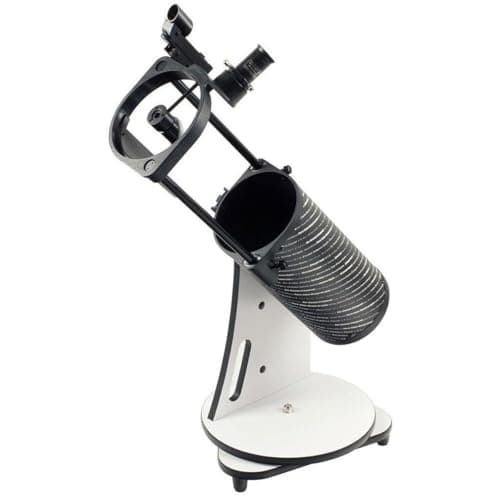 Sky-Watcher Heritage 130 Tabletop Dobsonian The best glass-for-money in the category, with less published detail than we would like. | Sky-Watcher: aperture per dollar | |
| 3 | No image National Geographic Astro Planetarium Real optics under a licensed brand — the specs come from Bresser, and they are published. | National Geographic: a licensed name, made by Bresser | |
| ! | 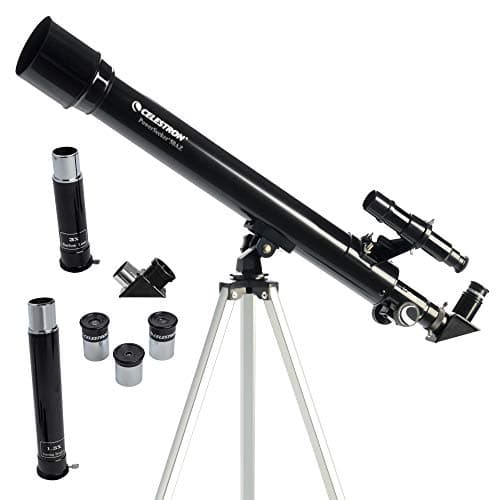 Celestron PowerSeeker 50AZ Same manufacturer as our top pick, sold on numbers its own spec sheet contradicts. Skip this one — see why below | The reminder that a good brand is not a guarantee | Not recommended |
Rows link to the full write-up further down this page. Prices come from the live price layer only; where there is no live figure the button reads “Check price” rather than showing a number we remembered.
Why brand matters less than you would expect
The telescope market at this price point has a lot of shared manufacturing. Optical tubes, mounts and tripods come from a small number of factories and get badged by many companies, which means two telescopes with different names can be substantially the same instrument.
What that means practically: the specification is more informative than the badge. A 70mm f/10 refractor on a steel tripod behaves like a 70mm f/10 refractor on a steel tripod, whoever put their name on it. The brands that earn a premium do so through published specifications, warranty, accessory ecosystems and, in Celestron's case, genuinely proprietary software.
So use the brand as a prior, not as a decision. Then check aperture, check the supplied eyepiece magnifications against the aperture rule, and check what the mount is made of. That process is on toy brands versus real optics in full.
The picks in full
Pick 1
Celestron StarSense Explorer LT 70AZ
Celestron: the broadest honest range
The arithmetic
700mm over 25mm and 10mm gives 28x and 70x; the 2x Barlow doubles those to 56x and 140x. Celestron's published ceiling is 165x, so even the Barlowed 10mm stays legal — a rare box where every supplied combination is inside the optics' honest limit. At f/10 the images are contrasty and easy to focus, which is exactly what an inexperienced pair of hands needs.
Celestron is the brand you will encounter most, and for beginner telescopes it is generally the safe choice — with one caveat we come back to below.
What earns them the top spot here is transparency. Every Celestron product page publishes aperture, focal length, focal ratio, supplied eyepiece magnifications, highest useful magnification and limiting stellar magnitude. That last pair is what lets you check whether the box is overselling itself, and most brands do not give you it.
This particular model shows them at their best: 70mm f/10, published 165x ceiling, and every supplied eyepiece and Barlow combination sitting inside it.
The caveat is that the same company publishes a 118x ceiling for the PowerSeeker 50AZ and ships it with eyepieces reaching 450x, and the bigger PowerSeeker 127EQ reaches 750x against a published 300x. Judge the model, not the badge.
Skip it if
You are buying at the very bottom of their range. Celestron makes excellent telescopes and it also makes the PowerSeeker line, which is sold on eyepiece combinations the optics cannot support. The brand is not a guarantee at every price.
| Optical design | Refractor |
|---|---|
| Aperture | 70mm (2.76") |
| Focal length | 700mm (27.56") |
| Focal ratio | f/10 |
| Eyepieces supplied | 25mm (28x) and 10mm (70x) |
| Barlow | 2x (1.25") |
| Finderscope | StarPointer red dot |
| Mount | Manual alt-azimuth |
| Tripod | Aluminum, 1320.8mm (52") max height |
| Highest useful magnification | 165x |
| Limiting stellar magnitude | 11.7 |
| Total kit weight | 7.4 lbs (3.35 kg) |
| Phone requirement | Android 12 and later; iOS 18 and newer, iPhone XR and newer |
| What the box does not do | The phone requirement is a real constraint, not fine print: Android 12+ or iOS 18+ on an iPhone XR or newer. An older hand-me-down phone will not run it, and without the app this is an ordinary 70mm refractor at the price of a guided one. |
Specifications from Celestron — StarSense Explorer LT 70AZ specifications. We have not handled this one — everything above is the published spec sheet plus our own arithmetic on it.
Pick 2
Sky-Watcher Heritage 130 Tabletop Dobsonian
Sky-Watcher: aperture per dollar
The arithmetic
130mm of aperture collects roughly 3.4 times the light of a 70mm refractor — the single biggest jump available at anything like gift money. At 650mm focal length, a common 25mm eyepiece gives 26x and a 10mm gives 65x. The rule of thumb astronomers use for a maximum useful magnification is about 2x the aperture in millimeters, which puts a sensible ceiling near 260x on a genuinely steady night.
Sky-Watcher is the brand serious beginners get recommended by people who already own telescopes, and the reason is straightforward: more aperture per dollar than anyone else at this level.
The Heritage line specifically is the reference tabletop Dobsonian. Borosilicate parabolic mirror, RAQ coatings, collapsible tube that holds collimation. Those are the specifications of a proper instrument, not a gift item.
Where they fall short of Celestron is published detail. There is no highest-useful-magnification figure, no limiting magnitude, and no eyepiece list on the product page for this model. We have not filled those gaps with numbers from elsewhere, so this page states less about the Heritage than about the Celestrons — that is a reporting limit, not a quality judgment.
For a child who is genuinely into astronomy and has an adult who can help, this is arguably the best telescope on this site.
Skip it if
You need the full specification before buying. Sky-Watcher publishes aperture, focal length, ratio and mirror type but not the supplied eyepieces, the finder or the assembled weight for this model. That is a real gap.
| Optical design | Newtonian reflector, borosilicate parabolic primary mirror |
|---|---|
| Aperture | 130mm |
| Focal length | 650mm |
| Focal ratio | f/5 |
| Mirror coatings | Sky-Watcher Radiant Aluminum Quartz (RAQ) |
| Focuser | 1.25" helical |
| Mount | Tabletop Dobsonian base, Teflon bearings, altitude locking knob |
| Tube | Collapsible for storage, retains collimation |
| What the box does not do | Sky-Watcher's product page does not publish the supplied eyepieces, finderscope or assembled weight, so we do not state them. No tripod — this is a tabletop instrument. The collapsible tube is open to the air, so it collects dust and will need occasional mirror cleaning and collimation. |
Specifications from Sky-Watcher USA — Heritage 130 Tabletop Dobsonian. We have not handled this one — everything above is the published spec sheet plus our own arithmetic on it.
Pick 3
National Geographic Astro Planetarium
National Geographic: a licensed name, made by Bresser
The arithmetic
8,000 real stars and 61 named constellations, adjustable to a specific date and time — so you can set it to the sky outside tonight and then go and find the same thing. That is the useful trick. Note the manufacturer's own age guidance of 14 and up: this is a mechanism with small parts and fiddly discs, not a nursery night light, whatever the shelf it sits on suggests.
This one is on the page to make a general point about licensed brands, using an example where the licensing works out well.
National Geographic does not manufacture optics. The astronomy products carrying the name are made by Bresser, a German optics company, and Bresser publishes proper specifications for them: 8,000 stars, 61 constellations, 1.6 x 2.1 m projection at 2 m, 3 m maximum throw, and an explicit age guidance of 14 and up.
That is what a good licensing arrangement looks like — a real manufacturer behind the name, with published numbers you can check.
The bad version is a toy company licensing an educational-sounding brand and putting it on plastic optics. The test is simple: find out who actually makes it, and see whether they publish a specification you can verify. If nobody will tell you the aperture, that is your answer.
Skip it if
You assume the National Geographic name means National Geographic designed it. It does not. Bresser makes these. That is fine — Bresser is a real optics company — but the badge is marketing rather than engineering.
| Stars projected | Over 8,000 |
|---|---|
| Constellations | 61 named |
| Discs | 2 projection discs included |
| Projection area | 1.6 x 2.1 m at 2 m distance |
| Maximum projection distance | 3 m |
| Motion | Dual motors, 6 speeds |
| Timer | Auto shut-off at 30, 60 or 120 minutes |
| Power | 3 x AA (supplied) or 5 V DC cable (not supplied) |
| Manufacturer age guidance | 14 and up |
| Included | 2 projection discs, 3 AA batteries, instruction manual |
| What the box does not do | The 3 m maximum throw means it needs a reasonably close ceiling. The DC cable is not supplied, so on batteries alone it is an occasional-use device. No app, no speaker, no color. |
Specifications from Bresser — National Geographic Astro Planetarium; Space.com — National Geographic Astro Planetarium review. We have not handled this one — everything above is the published spec sheet plus our own arithmetic on it.
Skip this
Celestron PowerSeeker 50AZ
The reminder that a good brand is not a guarantee
The arithmetic
This is the arithmetic that explains the whole category. Celestron publishes a highest useful magnification of 118x for this 50mm objective. The box also supplies a 4mm eyepiece — 600 / 4 = 150x, already past the ceiling — and a 3x Barlow, which takes that combination to 450x. Roughly four times more magnification than the manufacturer's own spec sheet says the optics can deliver. At 450x you are magnifying a blur.
The most useful thing on this page is that this telescope and our top pick are made by the same company.
Celestron publishes a highest useful magnification of 118x for this model. The box contains a 4mm eyepiece and a 3x Barlow, which on a 600mm focal length reach roughly 450x. Both facts come from Celestron.
That tells you the brand is not the unit of analysis. A company can make honest instruments at $150 and magnification-claim products at $50, because those are different markets bought by differently informed people.
So the rule is: check the model. Aperture times two is the honest ceiling. If the supplied eyepieces go past it, you know what you are looking at, whoever made it.
Skip it if
Always, for a child. We include it here specifically because it carries a brand we otherwise recommend, which is the point of the whole page.
| Optical design | Refractor |
|---|---|
| Aperture | 50mm (1.97") |
| Focal length | 600mm (24") |
| Focal ratio | f/12 |
| Eyepieces supplied | 20mm (30x), 12mm (50x), 4mm (150x) |
| Also supplied | 3x Barlow lens, 1.5x erecting eyepiece |
| Finderscope | 5x24 |
| Diagonal | 0.96" |
| Highest useful magnification | 118x |
| Limiting stellar magnitude | 11 |
| Total kit weight | 2.31 lbs (1.05 kg) |
| What the box does not do | The 0.96" diagonal is a legacy size, so almost no aftermarket eyepiece will fit it. The high-power combinations in the box are effectively unusable, which means the "three eyepieces and a Barlow" on the packaging is really one usable eyepiece and some cardboard filler. |
Specifications from Celestron — PowerSeeker 50AZ specifications. We have not handled this one — everything above is the published spec sheet plus our own arithmetic on it.
Questions people actually ask
- What is the best telescope brand for kids?
- Celestron for range and published specifications, Sky-Watcher for aperture per dollar, Bresser for entry-level optics with real numbers behind them. All three publish enough detail to check their own claims.
- Are National Geographic telescopes any good?
- The name is licensed and the products are made by Bresser, a real German optics company that publishes proper specifications. That makes them a reasonable buy — just do not read the badge as an engineering credential.
- Is Celestron a good brand for a kid's telescope?
- Generally yes, with one caveat: their entry-level PowerSeeker line ships eyepiece combinations well past its own published magnification ceiling. Judge the model rather than the brand.
- Are toy-brand telescopes worth buying?
- No. Character-branded telescopes typically use plastic optics, publish no aperture, and advertise magnification numbers the optics cannot support. A real 76mm tabletop reflector often costs about the same.
Sources
Read next
Where to go from here
- Refractor or reflector for a child?
Mirrors are cheaper per millimeter of aperture; lenses never need aligning. Which trade suits which child, with the arithmetic on both.
- Toy telescopes versus real optics: how to tell in thirty seconds
The arithmetic that exposes a 525x claim on a 70mm box, worked through on a real product using its own manufacturer's published numbers.
- The best kids' telescopes under $100
The sub-$100 shelf is where the 525x claims live. What that money genuinely buys, and the one telescope here we tell you not to buy.
- Is the Celestron FirstScope any good?
The most-bought first telescope in the category. What its published specs actually mean, and the one household constraint that decides whether it works.
- Celestron StarSense Explorer LT: how it works and whether it is worth it
Phone-guided finding removes the main reason first telescopes fail. How the system works, what it costs, and the phone requirement that is easy to miss.
- Our methodology
What we compile, what arithmetic we run, and what we do not do.
- Are kids' telescopes worth it?
A direct verdict with the honest nuance: where the money starts working, where it does not, and what to buy instead below the line.