Telescopes
Celestron StarSense Explorer LT: how it works and whether it is worth it
The phone finds things for you. Here is what that is actually worth.

By Scooter M. · published September 1, 2026
I'm not an astronomer and I don't have a lab. I'm someone who's genuinely into this — I read the manuals, compile the published specs, and do the arithmetic the box doesn't do for you. No lab coat. How we pick.
How this is funded. Lens & Lightyear earns a commission when you buy through a link on this page, at no extra cost to you. It does not change which products we pick or what we say about them — every card below carries a real reason to skip it. Prices are pulled live and were last verified October 18, 2026. Full disclosure.
The short answer
It works, and it solves the single most common reason a first telescope is abandoned. Whether it is worth the premium depends entirely on one question: can anybody in your house already point at Jupiter? If yes, buy aperture instead. If no, this is the best money on the page.
How StarSense Explorer actually works
It is worth understanding, because the way it works explains both why it is reliable and where it fails.
- You clamp your phone into a dock on the telescope, positioned so the phone's camera looks at the sky through a mirror.
- The app photographs the sky and identifies the star pattern. Celestron describes this as a Lost In Space Algorithm, the same class of technique satellites use in orbit to work out which way they are facing. It compares what the camera sees against a star catalog and calculates exactly where the telescope is pointing.
- You pick a target from a list the app generates for tonight, from where you are.
- The screen shows arrows. Push the telescope the way they point. As you get close, a bullseye appears, and when the target is centered in the eyepiece the bullseye turns green.
Crucially, there is no motor and no GPS-dependent alignment routine. It is not a computerized telescope in the traditional sense — you are still pushing it by hand, which keeps the price down and keeps a child physically involved rather than watching a machine work.
The phone requirement, which is easy to miss
This is the most common way people are disappointed by these telescopes, and it has nothing to do with optics. The dock is also sized for a phone — a tablet does not fit — and the phone needs enough battery for a full session outdoors in the cold, which drains it faster than usual.
The published specification
| Specification | Published figure | What it means |
|---|---|---|
| Aperture | 70mm | Lunar detail, Jupiter's moons, Saturn's rings. Not deep-sky. |
| Focal length | 700mm | Long, giving more magnification per eyepiece than a short scope. |
| Focal ratio | f/10 | Slow. High contrast and very forgiving focus — good for beginners. |
| Eyepieces | 25mm (28x) and 10mm (70x) | Plus a 2x Barlow, so 56x and 140x are also available. |
| Highest useful magnification | 165x | All four supplied combinations are inside it. |
| Limiting stellar magnitude | 11.7 | Comfortably beyond anything a beginner hunts for. |
| Finderscope | StarPointer red dot | Backup for when you are not using the phone. |
| Tripod | 52" max height, 1.75" steel legs | Full standing height. A real improvement over tabletop kit. |
| Total kit weight | 7.4 lbs | Carryable by an adult, awkward for a small child. |
| Phone requirement | Android 12+, iOS 18+, iPhone XR+ | Check this first. It is the deal-breaker. |
All figures are Celestron's published specification for the StarSense Explorer LT 70AZ.
Quick picks
StarSense Explorer, and what it is worth against
| # | Product | Best for | Price |
|---|---|---|---|
| 1 | No image Celestron StarSense Explorer LT 70AZ 70mm f/10 optics, and every supplied eyepiece combination sits inside the 165x ceiling. | Households where nobody knows the night sky | |
| 2 | No image Celestron AstroMaster LT 70AZ Identical 70mm f/10, identical 165x ceiling, steel tripod legs, no phone dock. | The same optics without the app premium | |
| 3 | 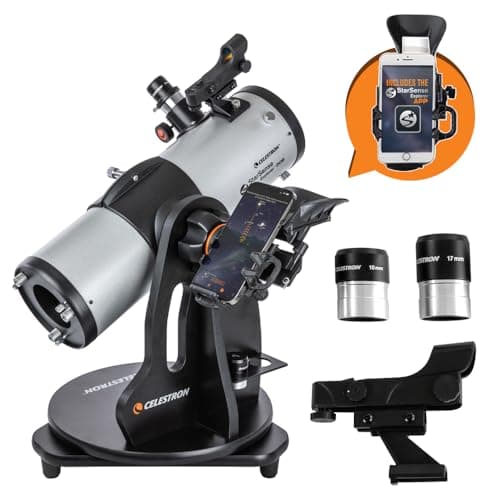 Celestron StarSense Explorer 114mm Tabletop Dobsonian 114mm parabolic mirror, 12.8 limiting magnitude, and the same phone guidance. | The same system with much more aperture |
Rows link to the full write-up further down this page. Prices come from the live price layer only; where there is no live figure the button reads “Check price” rather than showing a number we remembered.
Is it worth the premium?
Here is the clean way to think about it, using two telescopes from the same manufacturer with identical optics.
| StarSense Explorer LT 70AZ | AstroMaster LT 70AZ | |
|---|---|---|
| Aperture | 70mm | 70mm |
| Focal length / ratio | 700mm, f/10 | 700mm, f/10 |
| Published ceiling | 165x | 165x |
| Limiting magnitude | 11.7 | 11.7 |
| Eyepieces | 25mm, 10mm, plus 2x Barlow | 20mm, 10mm |
| Tripod legs | Aluminum | Steel — stiffer, settles faster |
| Finding help | Phone-guided | Red dot finder only |
| Total weight | 7.4 lbs | 7.2 lbs |
Both specifications are Celestron's own. The comparison is ours.
So the premium buys exactly one thing: the app. Everything else is a wash, and the AstroMaster arguably has the better tripod.
That makes the decision unusually clean. If nobody in your household can find things in the sky, the app is the difference between a telescope that gets used and one that does not, and it is worth every penny. If a parent can already point at Saturn, you are paying for something you have for free — put the money into aperture instead.
What it does not do
- It does not track. Once you are on target, the sky keeps moving and you keep nudging. At 140x an object drifts out of view in well under a minute.
- It does not make the telescope bigger. 70mm is 70mm. The app finds a faint galaxy for you and then you look at a faint smudge, because that is what 70mm shows.
- It does not work indoors or through a window. The camera needs a clear view of real sky to match the star pattern.
- It does not replace dark adaptation. A bright phone screen beside a telescope ruins night vision. Turn the brightness down and use the app's night mode.
The picks in full
Pick 1
Celestron StarSense Explorer LT 70AZ
Households where nobody knows the night sky
The arithmetic
700mm over 25mm and 10mm gives 28x and 70x; the 2x Barlow doubles those to 56x and 140x. Celestron's published ceiling is 165x, so even the Barlowed 10mm stays legal — a rare box where every supplied combination is inside the optics' honest limit. At f/10 the images are contrasty and easy to focus, which is exactly what an inexperienced pair of hands needs.
The premise is that finding things is the hard part of amateur astronomy, and for a beginner it plainly is. This telescope removes that problem rather than teaching around it.
The optics are a 70mm f/10 refractor at 700mm focal length. The 25mm eyepiece gives 28x, the 10mm gives 70x, and the included 2x Barlow doubles both to 56x and 140x. Celestron publishes a 165x ceiling, so every combination in the box is honest.
f/10 is slow, and for a beginner that is a genuine advantage: high contrast, forgiving focus, and inexpensive eyepieces perform better than they do in a fast telescope. This is an easy telescope to get a sharp image from.
The tripod is aluminum with 1.75 inch steel legs and reaches 52 inches, and the whole kit is 7.4 lbs. That is a real telescope at a child's standing height rather than a tabletop compromise.
Skip it if
There is no compatible phone. Android 12 or later, or iOS 18 on an iPhone XR or newer. An older hand-me-down will not run it, and without the app you have paid a guided-telescope price for an ordinary refractor.
| Optical design | Refractor |
|---|---|
| Aperture | 70mm (2.76") |
| Focal length | 700mm (27.56") |
| Focal ratio | f/10 |
| Eyepieces supplied | 25mm (28x) and 10mm (70x) |
| Barlow | 2x (1.25") |
| Finderscope | StarPointer red dot |
| Mount | Manual alt-azimuth |
| Tripod | Aluminum, 1320.8mm (52") max height |
| Highest useful magnification | 165x |
| Limiting stellar magnitude | 11.7 |
| Total kit weight | 7.4 lbs (3.35 kg) |
| Phone requirement | Android 12 and later; iOS 18 and newer, iPhone XR and newer |
| What the box does not do | The phone requirement is a real constraint, not fine print: Android 12+ or iOS 18+ on an iPhone XR or newer. An older hand-me-down phone will not run it, and without the app this is an ordinary 70mm refractor at the price of a guided one. |
Specifications from Celestron — StarSense Explorer LT 70AZ specifications. We have not handled this one — everything above is the published spec sheet plus our own arithmetic on it.
Pick 2
Celestron AstroMaster LT 70AZ
The same optics without the app premium
The arithmetic
Optically this is the same 70mm f/10 as the StarSense LT 70AZ — same aperture, same 700mm focal length, same 165x ceiling, same 11.7 limiting magnitude — without the phone dock and app. If the child has no compatible phone, you are paying for the identical optics and skipping a feature they cannot use. Steel legs rather than aluminum is the other quiet difference, and it is the one that stops a nudge from ending the view.
This is the honest comparison that tells you what StarSense actually costs, because optically these two are the same telescope.
Same 70mm aperture. Same 700mm focal length. Same f/10. Same published 165x ceiling and 11.7 limiting magnitude. Same manufacturer.
The differences: 20mm and 10mm eyepieces giving 35x and 70x rather than a 25mm, 10mm and Barlow; steel tripod legs rather than aluminum; and no phone dock or app.
Steel legs are quietly better than aluminum at damping the vibration that follows every touch of the focuser. If an adult in the house already knows where Jupiter is, this is the better telescope of the two and it costs less.
Skip it if
Nobody in the house can find a planet. Without the app there is a red dot finder and nothing else, and the first two evenings are a real learning curve that not every family gets through.
| Optical design | Refractor |
|---|---|
| Aperture | 70mm (2.76") |
| Focal length | 700mm (28") |
| Focal ratio | f/10 |
| Eyepieces supplied | 20mm (35x) and 10mm (70x) |
| Finderscope | Built-on StarPointer red dot |
| Mount | Manual alt-azimuth |
| Tripod | 31.75mm (1.25") steel tube legs, pre-assembled |
| Highest useful magnification | 165x |
| Limiting stellar magnitude | 11.7 |
| Total kit weight | 7.2 lbs (3.27 kg) |
| What the box does not do | No Barlow and no app: finding things is entirely on you and a red dot finder. That is a genuine learning curve on the first two evenings, and it is why we send people to the first-night guide before they open the box. |
Specifications from Celestron — AstroMaster LT 70AZ specifications. We have not handled this one — everything above is the published spec sheet plus our own arithmetic on it.
Pick 3
Celestron StarSense Explorer 114mm Tabletop Dobsonian
The same system with much more aperture
The arithmetic
A parabolic mirror rather than the spherical one in cheaper reflectors, which is what keeps a fast f/4 sharp at the edges. 114mm gathers roughly 2.7 times the light of a 70mm refractor, and the published limiting magnitude of 12.8 is the deepest on this site. The supplied eyepieces only reach 45x against a 269x ceiling, so the box gives you wide, bright, easy views and leaves the high-power ones to buy later.
If the phone guidance is what sold you, this is where it gets interesting: the same system on 114mm of parabolic mirror instead of 70mm of lens. All three StarSense models are compared side by side on which StarSense Explorer is best for a kid.
114mm gathers roughly 2.7 times the light of a 70mm, and Celestron publishes a limiting stellar magnitude of 12.8 — the deepest figure of any telescope we recommend. Guidance plus aperture is the combination that lets a child work through twenty objects in an evening rather than two.
The supplied 17mm and 10mm eyepieces give 26x and 45x against a 269x ceiling, so the box is set up for wide bright views and leaves planetary magnification to a later purchase.
No tripod. That is the constraint, and it is the same one that applies to every tabletop telescope on this site.
Skip it if
You have no solid outdoor surface. It is a tabletop instrument at 12.6 lbs, and a big tube on a small base needs somewhere genuinely stable to stand.
| Optical design | Newtonian reflector, parabolic primary mirror |
|---|---|
| Aperture | 114mm (4.48") |
| Focal length | 450mm (17.71") |
| Focal ratio | f/4 |
| Eyepieces supplied | 17mm (26x) and 10mm (45x) |
| Finderscope | StarPointer red dot |
| Mount | Alt-azimuth tabletop Dobsonian base |
| Highest useful magnification | 269x |
| Limiting stellar magnitude | 12.8 |
| Total kit weight | 12.6 lbs (5.71 kg) |
| What the box does not do | No tripod — it is a tabletop instrument and needs a solid surface at the right height, which is a real planning problem in a garden. A reflector's mirror can drift out of alignment; expect to learn collimation eventually. |
Specifications from Celestron — StarSense Explorer 114mm Dobsonian specifications. We have not handled this one — everything above is the published spec sheet plus our own arithmetic on it.
Questions people actually ask
- Is the Celestron StarSense Explorer LT a good telescope?
- Yes, and it is the right choice specifically when nobody in the household knows the night sky. The optics are a straightforward 70mm f/10 refractor; the value is in the phone-guided finding.
- How does Celestron StarSense Explorer work?
- Your phone photographs the sky through a mirror on the dock, matches the star pattern against a catalog to work out where the telescope is pointing, and then shows arrows guiding you to a target. The bullseye turns green when it is centered.
- What phone do you need for StarSense Explorer?
- Celestron states Android 12 and later, or iOS 18 and newer including iPhone XR and newer. Older devices may keep an existing install but cannot reinstall the app. Check this before buying.
- Which Celestron StarSense Explorer is the best?
- For a child, the 114mm tabletop Dobsonian gives far more aperture for a modest step up in price, if you have a solid surface. The LT 70AZ is the pick when you need a tripod.
- Does StarSense Explorer track objects automatically?
- No. It helps you find things; it does not follow them. There is no motor, so you re-center by hand as the sky moves, which at high magnification is every 30 to 60 seconds.
Sources
Read next
Where to go from here
- Celestron StarSense Explorer LT 80AZ review
80mm of slow, color-corrected glass with phone-guided finding — and the supplied eyepieces reach 95 percent of its published ceiling, which nothing else here does.
- Celestron AstroMaster LT 70AZ review
Optically the same telescope as our phone-guided pick, without the app and on steel legs. When that is the smarter buy, and when it is not.
- Which Celestron StarSense Explorer is best for a kid?
LT 70AZ, DX 102AZ or the 114mm tabletop Dobsonian? Compared on published specs, weight, and what the box actually gives you against what it could.
- The best telescope for a 9 or 10 year old
Nine and ten is the first band where a bigger, heavier telescope is a better telescope. Four picks and the arithmetic behind the jump.
- The best beginner telescopes under $200
Between $100 and $200 you can buy a steady mount, real aperture, or phone-guided finding. What each of those is worth, with the arithmetic.
- The best telescope for an 11 or 12 year old
At eleven and twelve the child is the limiting factor no longer. Picks chosen on aperture and on what they will not outgrow in a year.
- Telescope brands for kids, and which ones mean anything
The difference between a telescope brand and a licensed name, and which of the ones you will see in search results actually design what they sell.
- Why can't I see anything through my telescope?
The ranked causes of a telescope that shows nothing, most common first, each with a fix you can do tonight without tools.