Telescopes
The best telescope for a 9 or 10 year old
Old enough to set it up alone. Now aperture is worth paying for.

By Scooter M. · published September 1, 2026
I'm not an astronomer and I don't have a lab. I'm someone who's genuinely into this — I read the manuals, compile the published specs, and do the arithmetic the box doesn't do for you. No lab coat. How we pick.
How this is funded. Lens & Lightyear earns a commission when you buy through a link on this page, at no extra cost to you. It does not change which products we pick or what we say about them — every card below carries a real reason to skip it. Prices are pulled live and were last verified October 18, 2026. Full disclosure.
The short answer
Nine and ten is the first band where aperture beats portability. A child this age can set up a full tripod alone and stay out for an hour, so the limiting factor stops being weight and starts being how much light the telescope collects. Buy glass, not features.
Everything on the younger pages was a compromise around what a small child could physically manage. That constraint largely lifts here, and it changes the answer completely.
What changes at 9 and 10
- They can set up alone. A tripod, a tube and a diagonal is no longer an obstacle, which opens up telescopes that need assembling.
- They can stay out for an hour, and will, on a night when things are working.
- They can learn to star-hop — using bright stars as stepping stones to fainter targets. This is the skill that turns a telescope owner into an observer.
- They notice the difference more aperture makes. A younger child sees a smudge either way. A ten-year-old sees the structure in it.
- They will be annoyed by a wobbly tripod, where a seven-year-old would just assume telescopes are like that.
The aperture arithmetic, in one table
This is the single most useful calculation in telescope buying and almost nobody publishes it. Light gathering scales with the square of aperture, so the differences are much larger than the numbers on the box suggest.
| Aperture | Light vs a 70mm | Published limiting magnitude | What that means |
|---|---|---|---|
| 70mm | 1.0x (baseline) | 11.7 | Lunar craters, Jupiter's moons, Saturn's rings |
| 102mm | 2.1x | 12.5 | The above, plus structure in brighter nebulae |
| 114mm | 2.7x | 12.8 | Noticeably better on faint fuzzy objects |
| 130mm | 3.4x | Not published by Sky-Watcher | The biggest step available at gift money |
Limiting magnitudes are the manufacturers' own published figures. Sky-Watcher does not publish one for the Heritage 130, so we do not state one. Ratios are ours: aperture squared, divided by 70 squared.
Note what that table does not say. It says nothing about magnification, because magnification is set by the eyepiece and can be changed for twenty dollars. Aperture cannot be changed at all. It is the one specification you are permanently buying.
Quick picks
Telescopes for a 9 or 10 year old
| # | Product | Best for | Price |
|---|---|---|---|
| 1 | No image Celestron StarSense Explorer LT 70AZ Every supplied eyepiece combination sits inside the published 165x ceiling. | The balanced first real telescope | |
| 2 | 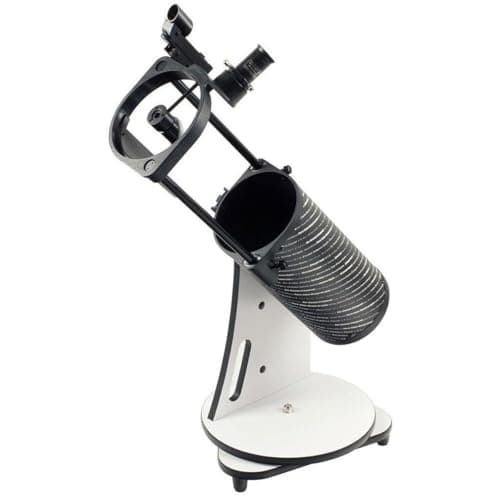 Sky-Watcher Heritage 130 Tabletop Dobsonian 130mm collects roughly 3.4 times the light of a 70mm refractor. | The most aperture per dollar on this page | |
| 3 | 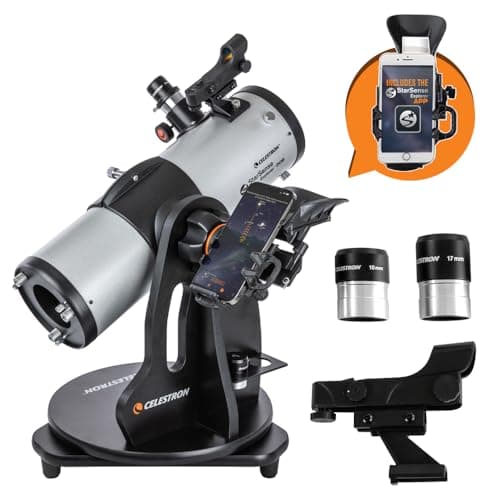 Celestron StarSense Explorer 114mm Tabletop Dobsonian 114mm parabolic mirror, 12.8 limiting magnitude, and the phone finds things for you. | Aperture plus phone guidance, without a tripod | |
| 4 | No image Celestron AstroMaster LT 70AZ Identical 70mm f/10 optics to the StarSense LT, on steel legs, without the phone dock. | The same optics for less, if you skip the app |
Rows link to the full write-up further down this page. Prices come from the live price layer only; where there is no live figure the button reads “Check price” rather than showing a number we remembered.
Tripod or tabletop?
This is the real fork at this age, and it is decided by your garden rather than by your child.
A tabletop reflector gives more aperture for the money — that is the whole reason the design exists. But it needs a solid surface at roughly chest height, outdoors, in the dark. If you have a garden table, a low wall or a car roof, a tabletop reflector is the better instrument. If your observing spot is the middle of a lawn, it is not, and no amount of aperture advantage fixes that.
A tripod telescope carries less aperture per dollar but stands anywhere and adjusts to the child's height. We work the trade through properly on tabletop versus tripod.
Is a phone-guided telescope worth it at this age?
It depends entirely on one thing: whether anybody in the house can already find things in the sky.
If yes, skip it. A parent who can point at Jupiter and say *that one* removes the entire problem for free, and the money is better spent on aperture. The AstroMaster LT 70AZ below is the same optics without the premium.
If no, it is probably the best money on this page. The most common way a first telescope dies is that nobody can find anything with it, the child gets bored of failing, and it goes in a cupboard. Our StarSense Explorer LT review covers how the system actually works and where it falls down.
What a 9 or 10 year old will actually see
More than a younger child will, and not because their eyes are better — because they will stay out long enough to get dark-adapted, and because they will be patient enough to wait for a moment of steady air.
With a 114mm or 130mm mirror on a decent night, realistically: lunar craters at the resolution limit of the atmosphere, Jupiter's cloud belts as two visible stripes, Saturn's rings with the Cassini gap occasionally glimpsed, Mars as a small orange disc, the Orion Nebula with visible structure, the Andromeda galaxy as an oval glow, and a dozen open clusters that genuinely look like scattered jewels.
None of that looks like the photographs, and all of it is real light that left those objects and landed on their retina. That framing is worth having ready — see what you can actually see for the honest per-object list.
The picks in full
Pick 1
Celestron StarSense Explorer LT 70AZ
The balanced first real telescope
The arithmetic
700mm over 25mm and 10mm gives 28x and 70x; the 2x Barlow doubles those to 56x and 140x. Celestron's published ceiling is 165x, so even the Barlowed 10mm stays legal — a rare box where every supplied combination is inside the optics' honest limit. At f/10 the images are contrasty and easy to focus, which is exactly what an inexperienced pair of hands needs.
At nine and ten, a child can genuinely operate a full-height tripod telescope alone, and this is the one we would put in most households at this age.
The optics are a 70mm f/10 refractor at 700mm focal length. The 25mm eyepiece gives 28x, the 10mm gives 70x, and the supplied 2x Barlow doubles both to 56x and 140x. Celestron publishes a 165x ceiling for this aperture, so every combination in the box is legitimate — which sounds like a low bar until you compare it with what the sub-$60 shelf puts in its boxes.
f/10 is a slow focal ratio and that is a virtue for a beginner: the images are contrasty, the focus is forgiving, and cheap eyepieces perform better than they do in a fast telescope. A nine-year-old will find it easier to get a sharp image out of this than out of something faster and more expensive.
The phone-guided finding is what you are paying extra for. It works, it is genuinely fun, and it turns a frustrating hunt into a two-minute walk to the target. Check the requirement first: Android 12 or later, iOS 18 on an iPhone XR or newer.
Skip it if
The child already knows their way around the sky, or an adult in the house does. You are paying a premium for the finding system; if nobody needs it, an equivalent telescope without it costs meaningfully less and the money is better spent on aperture.
| Optical design | Refractor |
|---|---|
| Aperture | 70mm (2.76") |
| Focal length | 700mm (27.56") |
| Focal ratio | f/10 |
| Eyepieces supplied | 25mm (28x) and 10mm (70x) |
| Barlow | 2x (1.25") |
| Finderscope | StarPointer red dot |
| Mount | Manual alt-azimuth |
| Tripod | Aluminum, 1320.8mm (52") max height |
| Highest useful magnification | 165x |
| Limiting stellar magnitude | 11.7 |
| Total kit weight | 7.4 lbs (3.35 kg) |
| Phone requirement | Android 12 and later; iOS 18 and newer, iPhone XR and newer |
| What the box does not do | The phone requirement is a real constraint, not fine print: Android 12+ or iOS 18+ on an iPhone XR or newer. An older hand-me-down phone will not run it, and without the app this is an ordinary 70mm refractor at the price of a guided one. |
Specifications from Celestron — StarSense Explorer LT 70AZ specifications. We have not handled this one — everything above is the published spec sheet plus our own arithmetic on it.
Pick 2
Sky-Watcher Heritage 130 Tabletop Dobsonian
The most aperture per dollar on this page
The arithmetic
130mm of aperture collects roughly 3.4 times the light of a 70mm refractor — the single biggest jump available at anything like gift money. At 650mm focal length, a common 25mm eyepiece gives 26x and a 10mm gives 65x. The rule of thumb astronomers use for a maximum useful magnification is about 2x the aperture in millimeters, which puts a sensible ceiling near 260x on a genuinely steady night.
If what you want is the most that can actually be seen, this is the pick. Light gathering scales with the square of aperture: 130 squared over 70 squared is about 3.4, so this collects roughly three and a half times what a 70mm refractor does.
In practice that is the difference between the Orion Nebula as a faint smudge and the Orion Nebula as a structured gray cloud with four stars visible in its heart. It is a genuine step change, not a marginal one.
The mirror is borosilicate and parabolic rather than the cheaper spherical type, which is what keeps a fast f/5 sharp across the field. The tube collapses for storage and Sky-Watcher states it retains collimation when it does, which matters if it is going to live in a cupboard.
Two honest cautions. First, no tripod: this needs a solid surface at the right height. Second, a reflector's mirror drifts out of alignment over time and you will eventually have to learn collimation. It is a twenty-minute skill, not a crisis, but it is a thing that exists.
Skip it if
You have nowhere solid to stand it. It is a tabletop instrument with no tripod, and 130mm of tube on a garden table is a real balancing problem. Sky-Watcher also does not publish the supplied eyepieces or the assembled weight, so you are buying with less information than we would like.
| Optical design | Newtonian reflector, borosilicate parabolic primary mirror |
|---|---|
| Aperture | 130mm |
| Focal length | 650mm |
| Focal ratio | f/5 |
| Mirror coatings | Sky-Watcher Radiant Aluminum Quartz (RAQ) |
| Focuser | 1.25" helical |
| Mount | Tabletop Dobsonian base, Teflon bearings, altitude locking knob |
| Tube | Collapsible for storage, retains collimation |
| What the box does not do | Sky-Watcher's product page does not publish the supplied eyepieces, finderscope or assembled weight, so we do not state them. No tripod — this is a tabletop instrument. The collapsible tube is open to the air, so it collects dust and will need occasional mirror cleaning and collimation. |
Specifications from Sky-Watcher USA — Heritage 130 Tabletop Dobsonian. We have not handled this one — everything above is the published spec sheet plus our own arithmetic on it.
Pick 3
Celestron StarSense Explorer 114mm Tabletop Dobsonian
Aperture plus phone guidance, without a tripod
The arithmetic
A parabolic mirror rather than the spherical one in cheaper reflectors, which is what keeps a fast f/4 sharp at the edges. 114mm gathers roughly 2.7 times the light of a 70mm refractor, and the published limiting magnitude of 12.8 is the deepest on this site. The supplied eyepieces only reach 45x against a 269x ceiling, so the box gives you wide, bright, easy views and leaves the high-power ones to buy later.
This is the combination that solves both of the problems on this page at once: real aperture, and something that finds targets for a child who does not know the sky.
114mm gathers roughly 2.7 times what a 70mm refractor does, and Celestron publishes a limiting stellar magnitude of 12.8 — the deepest figure of any telescope we recommend. The primary mirror is parabolic, which is what a fast f/4 needs to stay sharp at the edges.
The supplied 17mm and 10mm eyepieces give 26x and 45x. That is deliberately wide and bright rather than high-powered, and it is the right choice for a beginner: at 26x on a 114mm mirror the Orion Nebula and the Pleiades look genuinely good, and finding things is easy.
At 12.6 lbs and with no tripod, this needs a solid table. If you have one, it is the strongest all-round pick here. If you do not, take the StarSense LT above and accept the smaller aperture.
Skip it if
You want high magnification out of the box. The supplied eyepieces top out at 45x against a published 269x ceiling, so the box gives you wide bright views and leaves the planetary magnification to a purchase you make later.
| Optical design | Newtonian reflector, parabolic primary mirror |
|---|---|
| Aperture | 114mm (4.48") |
| Focal length | 450mm (17.71") |
| Focal ratio | f/4 |
| Eyepieces supplied | 17mm (26x) and 10mm (45x) |
| Finderscope | StarPointer red dot |
| Mount | Alt-azimuth tabletop Dobsonian base |
| Highest useful magnification | 269x |
| Limiting stellar magnitude | 12.8 |
| Total kit weight | 12.6 lbs (5.71 kg) |
| What the box does not do | No tripod — it is a tabletop instrument and needs a solid surface at the right height, which is a real planning problem in a garden. A reflector's mirror can drift out of alignment; expect to learn collimation eventually. |
Specifications from Celestron — StarSense Explorer 114mm Dobsonian specifications. We have not handled this one — everything above is the published spec sheet plus our own arithmetic on it.
Pick 4
Celestron AstroMaster LT 70AZ
The same optics for less, if you skip the app
The arithmetic
Optically this is the same 70mm f/10 as the StarSense LT 70AZ — same aperture, same 700mm focal length, same 165x ceiling, same 11.7 limiting magnitude — without the phone dock and app. If the child has no compatible phone, you are paying for the identical optics and skipping a feature they cannot use. Steel legs rather than aluminum is the other quiet difference, and it is the one that stops a nudge from ending the view.
Worth putting side by side with the StarSense LT above, because the comparison is unusually clean. Same 70mm aperture, same 700mm focal length, same f/10, same published 165x ceiling, same 11.7 limiting magnitude. Optically these are the same telescope.
What differs: no phone dock and no app, a 20mm and 10mm eyepiece pair giving 35x and 70x rather than 28x and 70x plus a Barlow, and steel tripod legs rather than aluminum.
Those steel legs are quietly the better feature. The most common complaint about beginner telescopes is that touching the focuser makes the image jump and the target disappear. A heavier, stiffer tripod damps that out faster, and a nine-year-old adjusting focus notices the difference immediately.
Buy this if an adult in the house already knows where Jupiter is, or if the child is the sort who would rather learn to find things than be shown. Buy the StarSense if neither of those is true.
Skip it if
Nobody in the house can find anything in the sky. This has a red dot finder and nothing else, which means the first two evenings are a genuine learning curve. If that curve is going to end the experiment, pay for the guided version instead.
| Optical design | Refractor |
|---|---|
| Aperture | 70mm (2.76") |
| Focal length | 700mm (28") |
| Focal ratio | f/10 |
| Eyepieces supplied | 20mm (35x) and 10mm (70x) |
| Finderscope | Built-on StarPointer red dot |
| Mount | Manual alt-azimuth |
| Tripod | 31.75mm (1.25") steel tube legs, pre-assembled |
| Highest useful magnification | 165x |
| Limiting stellar magnitude | 11.7 |
| Total kit weight | 7.2 lbs (3.27 kg) |
| What the box does not do | No Barlow and no app: finding things is entirely on you and a red dot finder. That is a genuine learning curve on the first two evenings, and it is why we send people to the first-night guide before they open the box. |
Specifications from Celestron — AstroMaster LT 70AZ specifications. We have not handled this one — everything above is the published spec sheet plus our own arithmetic on it.
Questions people actually ask
- What is the best telescope for a 10 year old?
- A 70mm refractor on a full tripod if you want simplicity, or a 114mm to 130mm tabletop reflector if you want the most that can actually be seen. Ten is the age where the bigger, heavier option starts being the better one.
- What is the best telescope for a 9 year old?
- The same picks. Nine and ten share a band because both can set up a tripod telescope alone and stay out long enough for aperture to matter.
- How much aperture does a 10 year old need?
- 70mm is genuinely enough for the Moon, Jupiter's moons and Saturn's rings. 114mm or 130mm is where faint objects start showing structure. Beyond that you are buying weight a child cannot manage alone.
- Is a 130mm telescope too big for a kid?
- Not optically, and not usually physically at nine or ten — but a 130mm tabletop needs a solid outdoor surface, which is the real constraint. Check where it will actually stand before you buy.
- What is the best telescope for the whole family?
- A 114mm or 130mm tabletop reflector, if you have somewhere to put it. It shows enough to keep an adult interested and is simple enough for a child to use, which is a rare combination.
Sources
Read next
Where to go from here
- Refractor or reflector for a child?
Mirrors are cheaper per millimeter of aperture; lenses never need aligning. Which trade suits which child, with the arithmetic on both.
- The best telescope for a 7 or 8 year old
Seven and eight is where independence starts. The picks here are chosen on carry weight and how easy it is to find something, not on aperture.
- The best telescope for an 11 or 12 year old
At eleven and twelve the child is the limiting factor no longer. Picks chosen on aperture and on what they will not outgrow in a year.
- Tabletop or tripod? The choice your garden makes for you
A tabletop reflector buys more aperture for the money and needs a solid surface. A tripod telescope stands anywhere and costs you glass. Which one your garden allows.
- Celestron StarSense Explorer LT: how it works and whether it is worth it
Phone-guided finding removes the main reason first telescopes fail. How the system works, what it costs, and the phone requirement that is easy to miss.
- Why can't I see anything through my telescope?
The ranked causes of a telescope that shows nothing, most common first, each with a fix you can do tonight without tools.
- What you can actually see with a kids' telescope
The honest target-by-target list for 70mm, 76mm and 114mm telescopes, so nobody is disappointed on night one.