Telescopes
The best beginner telescopes under $200
The band where a first telescope stops being a compromise.
By Scooter M. · published September 1, 2026
I'm not an astronomer and I don't have a lab. I'm someone who's genuinely into this — I read the manuals, compile the published specs, and do the arithmetic the box doesn't do for you. No lab coat. How we pick.
How this is funded. Lens & Lightyear earns a commission when you buy through a link on this page, at no extra cost to you. It does not change which products we pick or what we say about them — every card below carries a real reason to skip it. Prices are pulled live and were last verified October 18, 2026. Full disclosure.
The short answer
Between $100 and $200 you can buy exactly one of three upgrades: real aperture, a steady mount, or phone-guided finding. You cannot have all three. Which one is right depends on whether anyone in your house already knows the night sky.
Pick the upgrade that matches your household
This is the most useful decision framework we can give you, and it takes one question to run.
| Your situation | Buy | Why |
|---|---|---|
| Nobody in the house knows the sky | Phone-guided finding | The single biggest cause of abandoned first telescopes is that nobody can locate anything. This removes it outright. |
| An adult can point at Jupiter | Aperture | The finding problem is already solved for free. Put every dollar into the mirror. |
| The child is heavy-handed or young | A steadier mount | A wobbly tripod reads as a broken telescope to a child. Steel legs fix it and cost little. |
| It has to be carried or travel | Portability | A telescope that goes places gets used. Accept the lighter tripod as the price. |
Quick picks
Beginner telescopes under $200
| # | Product | Best for | Price |
|---|---|---|---|
| 1 | No image Celestron StarSense Explorer LT 70AZ Phone-guided finding, and every supplied eyepiece stays inside the 165x ceiling. | Removing the reason first telescopes fail | |
| 2 | 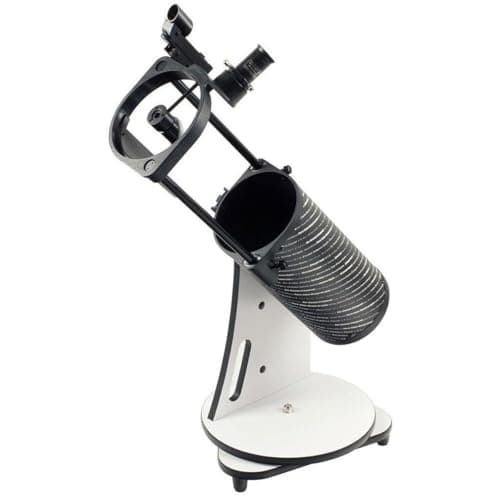 Sky-Watcher Heritage 130 Tabletop Dobsonian 130mm parabolic mirror — roughly 3.4 times the light of a 70mm refractor. | Buying aperture instead of features | |
| 3 | No image Celestron AstroMaster LT 70AZ Same 70mm f/10 optics as the StarSense LT, on steel legs, for less. Full review. | The steadiest mount at the price | |
| 4 | 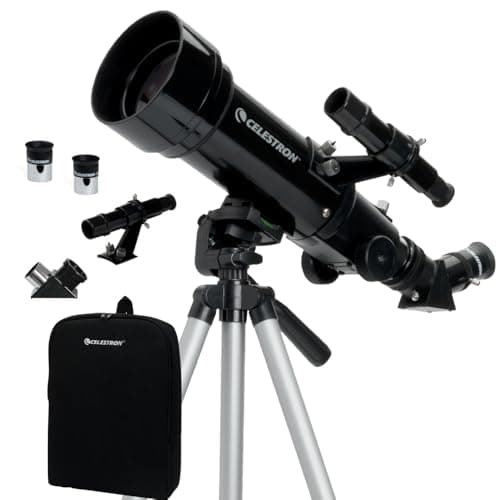 Celestron Travel Scope 70 3.3 lbs including tripod, in a backpack — the only genuinely portable pick here. | When it has to travel |
Rows link to the full write-up further down this page. Prices come from the live price layer only; where there is no live figure the button reads “Check price” rather than showing a number we remembered.
Why aperture is the only thing you cannot add later
Everything else about a telescope is upgradeable. Eyepieces are cheap. A better diagonal is cheap. A finder is cheap. Even a mount can be replaced. Aperture cannot be changed at all — it is fixed the day you buy, and it sets the ceiling on everything the telescope will ever show.
That argues for putting the money in glass. The counter-argument is real too: a bigger telescope nobody can aim shows nothing at all, and a 70mm that finds Saturn beats a 130mm that finds nothing. Both arguments are correct, which is why the table above asks about your household rather than telling you a number.
What not to spend it on in this band
- Eyepiece sets. Ten cheap eyepieces are worse than the two good ones already in the box. One quality short eyepiece later is a better purchase than a kit now.
- Motor drives at this price. A cheap motorized mount tracks poorly and adds batteries, weight and failure modes. Manual is better at this level.
- Smartphone camera adapters. Photographing through a beginner telescope is genuinely difficult and produces disappointing results. The interest is real; the equipment to satisfy it is not in this price band.
- Filters. Color planetary filters do very little on a small aperture. A Moon filter is occasionally useful and costs almost nothing, but it is not an upgrade.
Who should stretch past $200
If the child is eleven or twelve and has already used a smaller telescope, past $200 buys 114mm to 130mm of aperture with phone guidance included rather than instead. That is a genuinely different instrument and it will not be outgrown. See telescopes for ages 11-12, and which StarSense Explorer is best for a kid if the phone-guided route is the one you are taking.
If the child is seven and this is their first telescope, do not stretch. The extra money buys weight and complexity they cannot use, and the difference between a good first year and a bad one is almost entirely about setup and expectations rather than aperture.
The picks in full
Pick 1
Celestron StarSense Explorer LT 70AZ
Removing the reason first telescopes fail
The arithmetic
700mm over 25mm and 10mm gives 28x and 70x; the 2x Barlow doubles those to 56x and 140x. Celestron's published ceiling is 165x, so even the Barlowed 10mm stays legal — a rare box where every supplied combination is inside the optics' honest limit. At f/10 the images are contrasty and easy to focus, which is exactly what an inexperienced pair of hands needs.
In this band you can buy help finding things, and for most families that is the single best use of the money.
The system photographs the sky through the phone camera and matches the pattern against a catalog — the same technique satellites use to work out their own orientation. Once aligned, it draws arrows telling you which way to push, and turns the target marker green when you are on it.
The optics are a 70mm f/10 refractor. 700mm focal length gives 28x with the 25mm eyepiece and 70x with the 10mm; the supplied 2x Barlow makes those 56x and 140x. Celestron's published ceiling is 165x, so all four combinations are legitimate.
f/10 is slow, which for a beginner is a feature. Focus is forgiving, contrast is high, and cheap eyepieces behave better than they would in a fast telescope. This is an easy telescope to get a good image out of.
Skip it if
There is no compatible phone, or somebody in the house already knows the sky. The requirement is Android 12+ or iOS 18 on an iPhone XR or newer, and without a phone this is a 70mm refractor at a guided-telescope price.
| Optical design | Refractor |
|---|---|
| Aperture | 70mm (2.76") |
| Focal length | 700mm (27.56") |
| Focal ratio | f/10 |
| Eyepieces supplied | 25mm (28x) and 10mm (70x) |
| Barlow | 2x (1.25") |
| Finderscope | StarPointer red dot |
| Mount | Manual alt-azimuth |
| Tripod | Aluminum, 1320.8mm (52") max height |
| Highest useful magnification | 165x |
| Limiting stellar magnitude | 11.7 |
| Total kit weight | 7.4 lbs (3.35 kg) |
| Phone requirement | Android 12 and later; iOS 18 and newer, iPhone XR and newer |
| What the box does not do | The phone requirement is a real constraint, not fine print: Android 12+ or iOS 18+ on an iPhone XR or newer. An older hand-me-down phone will not run it, and without the app this is an ordinary 70mm refractor at the price of a guided one. |
Specifications from Celestron — StarSense Explorer LT 70AZ specifications. We have not handled this one — everything above is the published spec sheet plus our own arithmetic on it.
Pick 2
Sky-Watcher Heritage 130 Tabletop Dobsonian
Buying aperture instead of features
The arithmetic
130mm of aperture collects roughly 3.4 times the light of a 70mm refractor — the single biggest jump available at anything like gift money. At 650mm focal length, a common 25mm eyepiece gives 26x and a 10mm gives 65x. The rule of thumb astronomers use for a maximum useful magnification is about 2x the aperture in millimeters, which puts a sensible ceiling near 260x on a genuinely steady night.
The alternative use of the same money: put all of it into glass.
130mm against 70mm is a light-gathering ratio of 130 squared over 70 squared, which is about 3.4. That is the difference between the Orion Nebula as a faint patch and the Orion Nebula as a structured cloud with the Trapezium stars visible inside it.
The mirror is borosilicate and parabolic with Sky-Watcher's RAQ coating. Parabolic matters here: at f/5, a cheaper spherical mirror would show visibly soft stars away from the field center.
The tube collapses for storage and Sky-Watcher states it keeps collimation through the collapse. It is a tabletop instrument, so the surface question applies. And an open-tube reflector will eventually need collimating — a real, learnable, twenty-minute job rather than a disaster.
Skip it if
You want a fully specified package. Sky-Watcher does not publish the eyepieces, finderscope or assembled weight for this model, and we are not going to invent them. If you need to know exactly what is in the box before you buy, this is not the pick.
| Optical design | Newtonian reflector, borosilicate parabolic primary mirror |
|---|---|
| Aperture | 130mm |
| Focal length | 650mm |
| Focal ratio | f/5 |
| Mirror coatings | Sky-Watcher Radiant Aluminum Quartz (RAQ) |
| Focuser | 1.25" helical |
| Mount | Tabletop Dobsonian base, Teflon bearings, altitude locking knob |
| Tube | Collapsible for storage, retains collimation |
| What the box does not do | Sky-Watcher's product page does not publish the supplied eyepieces, finderscope or assembled weight, so we do not state them. No tripod — this is a tabletop instrument. The collapsible tube is open to the air, so it collects dust and will need occasional mirror cleaning and collimation. |
Specifications from Sky-Watcher USA — Heritage 130 Tabletop Dobsonian. We have not handled this one — everything above is the published spec sheet plus our own arithmetic on it.
Pick 3
Celestron AstroMaster LT 70AZ
The steadiest mount at the price
The arithmetic
Optically this is the same 70mm f/10 as the StarSense LT 70AZ — same aperture, same 700mm focal length, same 165x ceiling, same 11.7 limiting magnitude — without the phone dock and app. If the child has no compatible phone, you are paying for the identical optics and skipping a feature they cannot use. Steel legs rather than aluminum is the other quiet difference, and it is the one that stops a nudge from ending the view.
This is the clean comparison that shows what the phone system actually costs. Identical aperture, identical 700mm focal length, identical f/10, identical published 165x ceiling and 11.7 limiting magnitude. Optically the same telescope as the StarSense LT.
The differences: 20mm and 10mm eyepieces giving 35x and 70x rather than a 25mm, 10mm and Barlow; no phone dock; and steel tripod legs instead of aluminum.
Those steel legs are the quiet win. The most common complaint about beginner telescopes is that touching the focuser sends the target out of view. A stiffer tripod settles faster, and a child adjusting focus feels the difference on the first night.
Buy this if an adult in the house can point at Jupiter, or if the child would genuinely rather learn to find things than be told where they are. Both are common, and both are good reasons to keep the money in the mount instead of the app.
Skip it if
Nobody can find anything in the sky. There is a red dot finder and that is it, so the first two evenings are a genuine learning curve. If that curve is going to end the experiment, buy the guided version instead.
| Optical design | Refractor |
|---|---|
| Aperture | 70mm (2.76") |
| Focal length | 700mm (28") |
| Focal ratio | f/10 |
| Eyepieces supplied | 20mm (35x) and 10mm (70x) |
| Finderscope | Built-on StarPointer red dot |
| Mount | Manual alt-azimuth |
| Tripod | 31.75mm (1.25") steel tube legs, pre-assembled |
| Highest useful magnification | 165x |
| Limiting stellar magnitude | 11.7 |
| Total kit weight | 7.2 lbs (3.27 kg) |
| What the box does not do | No Barlow and no app: finding things is entirely on you and a red dot finder. That is a genuine learning curve on the first two evenings, and it is why we send people to the first-night guide before they open the box. |
Specifications from Celestron — AstroMaster LT 70AZ specifications. We have not handled this one — everything above is the published spec sheet plus our own arithmetic on it.
Pick 4
Celestron Travel Scope 70
When it has to travel
The arithmetic
400mm focal length over the two supplied eyepieces gives 20x and 40x. Celestron's published ceiling for a 70mm objective is 168x, so both eyepieces are comfortably inside it — the box is not overselling. The 3.3 lb total is the number that matters for a gift: a child can carry the whole kit themselves, which is most of why it gets used more than once.
The one pick here that is about where a telescope can go rather than what it can see.
3.3 lbs for tube, mount and tripod together, in a supplied backpack. That is a telescope that goes camping, goes to a grandparent's house, and goes to the end of the garden without an adult carrying it.
70mm at f/5.7 with 20mm and 10mm eyepieces gives 20x and 40x, inside the published 168x ceiling. The 20x view is wide and easy to aim, which suits a younger child.
The cost is the mount. 1.8 lbs of tripod is light enough to wobble, and it takes a moment to settle after every touch. That is a real, daily annoyance — and it is the direct price of the thing that makes this pick worth buying.
Skip it if
It is going to live in one garden. Everything you pay for here is portability, and if the telescope never moves you are better off with the AstroMaster's steel tripod or the Heritage's mirror for the same money.
| Optical design | Refractor |
|---|---|
| Aperture | 70mm (2.8") |
| Focal length | 400mm (15.74") |
| Focal ratio | f/5.7 |
| Eyepieces supplied | 20mm (20x) and 10mm (40x) |
| Finderscope | 5x24 |
| Diagonal | 45 degree erect image, 1.25" |
| Mount | Manual alt-azimuth on aluminum tripod |
| Highest useful magnification | 168x |
| Limiting stellar magnitude | 11.7 |
| Total kit weight | 3.3 lbs (1.5 kg), tripod 1.8 lbs (0.81 kg) |
| Included | Custom backpack, Starry Night Basic software, SkyPortal app access |
| What the box does not do | The tripod is the weak part. At 1.8 lbs it is light enough to carry and light enough to wobble, and a child nudging the eyepiece will lose the target. The 45 degree erect-image diagonal is built for daytime use and costs you a little light at night. |
Specifications from Celestron — Travel Scope 70 specifications. We have not handled this one — everything above is the published spec sheet plus our own arithmetic on it.
Questions people actually ask
- What is the best beginner telescope under $200?
- A phone-guided 70mm refractor if nobody in the house knows the sky, or a 130mm tabletop reflector if somebody does. The right answer depends on your household rather than on the specs.
- Is $200 enough for a good telescope?
- Yes. At this price you can buy either genuine aperture in the 114mm to 130mm range or a well-mounted 70mm with phone-guided finding. Both are real instruments rather than compromises. If your ceiling is a little higher, the next band up is on telescopes under $300.
- Should I buy a bigger telescope or a better mount?
- A better mount, if the child is young or the telescope will be handled roughly. Aperture, if an adult can already find things. A big telescope on a bad mount is the worst combination in this hobby.
- Do I need to buy extra eyepieces straight away?
- No. Two eyepieces cover a beginner's first year comfortably. When you do upgrade, buy one good short eyepiece rather than a set of ten cheap ones.
Sources
Read next
Where to go from here
- The best telescopes under $500
Between $200 and $500 you can have aperture, a parabolic mirror, or guided finding — but not all three. What each choice costs, and who should make which.
- Best telescopes under $300
Under $300 buys 130mm — nearly three times the light of the best telescope on our under-$100 page. Which of the four to buy depends on mirror figure, mount, and how much of the ceiling is actually in the box.
- The best beginner telescope
The four things that actually decide whether a first telescope gets used twice, and the picks that satisfy them. Including the case for buying binoculars instead.
- Celestron AstroMaster LT 70AZ review
Optically the same telescope as our phone-guided pick, without the app and on steel legs. When that is the smarter buy, and when it is not.
- Sky-Watcher Heritage 130 review
130mm of parabolic mirror that collapses for storage. The biggest single jump in what a child can see, and the planning problem that comes with it.
- The best kids' telescopes under $100
The sub-$100 shelf is where the 525x claims live. What that money genuinely buys, and the one telescope here we tell you not to buy.
- The best telescope for a 9 or 10 year old
Nine and ten is the first band where a bigger, heavier telescope is a better telescope. Four picks and the arithmetic behind the jump.
- The best telescope for an 11 or 12 year old
At eleven and twelve the child is the limiting factor no longer. Picks chosen on aperture and on what they will not outgrow in a year.
- Which Celestron StarSense Explorer is best for a kid?
LT 70AZ, DX 102AZ or the 114mm tabletop Dobsonian? Compared on published specs, weight, and what the box actually gives you against what it could.
- How much should you spend on a telescope for a child?
Band by band, what the money buys and where it stops helping. The jump from $60 to $150 matters more than the one above it.
- Celestron StarSense Explorer LT: how it works and whether it is worth it
Phone-guided finding removes the main reason first telescopes fail. How the system works, what it costs, and the phone requirement that is easy to miss.
- Celestron AstroMaster 70AZ review
70mm at 900mm focal length — f/13, the slowest refractor on this site, with 45x and 90x in the box against a 165x ceiling. Excellent on the Moon, heavy for what it gathers.
- Celestron PowerSeeker 114EQ review
900mm in an 875mm tube and a 22 percent obstruction — genuinely clean optics for the money. The box then supplies 675x against Celestron's own 269x limit.