Telescopes
Celestron PowerSeeker 114EQ review
Optically the honest PowerSeeker. Then you open the eyepiece case.
By Scooter M. · published September 27, 2026
I'm not an astronomer and I don't have a lab. I'm someone who's genuinely into this — I read the manuals, compile the published specs, and do the arithmetic the box doesn't do for you. No lab coat. How we pick.
How this is funded. Lens & Lightyear earns a commission when you buy through a link on this page, at no extra cost to you. It does not change which products we pick or what we say about them — every card below carries a real reason to skip it. Prices are pulled live and were last verified October 18, 2026. Full disclosure.
The short answer
The optics are better than the family name suggests: a full-length tube, a small 22 percent obstruction and a 269x published ceiling. The box is not — its 4mm eyepiece with the 3x Barlow reaches 675x, two and a half times that limit. Buy it for an adult who will use the 20mm, or buy the LT 114AZ for a child.
We have been hard on the PowerSeeker line twice, so it is worth being precise about what is actually wrong here — because on this model it is the accessories, not the telescope.
The tube length test, which this one passes
In a Newtonian the light folds inside the tube, so the tube runs close to the focal length. A tube much shorter than the focal length means an optical element is stretching it — which is the flag we raise on two other telescopes we review.
| Model | Focal length | Optical tube length | Tube as a share of focal length |
|---|---|---|---|
| PowerSeeker 114EQ | 900mm | 875mm | 97% — a plain Newtonian |
| AstroMaster 130EQ | 650mm | 552mm | 85% — normal |
| StarSense Explorer LT 114AZ | 1000mm | 609.6mm | 61% — an element is extending it |
| PowerSeeker 127EQ | 1000mm | 436mm | 44% — a corrector in the focuser |
Our arithmetic on Celestron's published figures. This test applies to reflectors only — in a refractor the focuser and diagonal legitimately carry part of the focal length, as we explain on the Inspire 100AZ.
The obstruction figure points the same way. Celestron publishes 22 percent by diameter and 4.96 percent by area for this telescope, against 32 percent and 10 percent for the 127EQ. A smaller secondary mirror scatters less light and preserves more fine contrast, which is exactly what planetary detail is made of.
How much of the telescope is in the box
| Combination | Magnification | Against the 269x ceiling | Verdict |
|---|---|---|---|
| 20mm | 45x | about 17% | The finding eyepiece |
| 20mm + 3x Barlow | 135x | about 50% | The one to use on planets |
| 4mm | 225x | about 84% | Inside the limit, on a very steady night |
| 4mm + 3x Barlow | 675x | 251% | Past the limit — leave it in the case |
Our arithmetic on Celestron's published 900mm focal length, supplied eyepieces and 269x highest useful magnification.
This is the same shape of problem we set out on toy brands versus real optics: the number on the carton comes from the eyepiece case, not from the mirror. The difference here is that the mirror behind it is genuinely decent.
Quick picks
The 114EQ, its oversold sibling, and the easier alternative
| # | Product | Best for | Price |
|---|---|---|---|
| 1 | 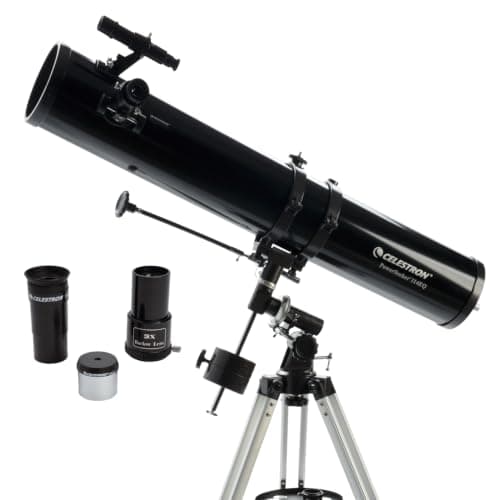 Celestron PowerSeeker 114EQ 114mm at f/7.89 in a full-length tube, with a published 22 percent central obstruction. | An adult who wants a real Newtonian cheaply and will ignore two of the eyepieces | |
| 2 | 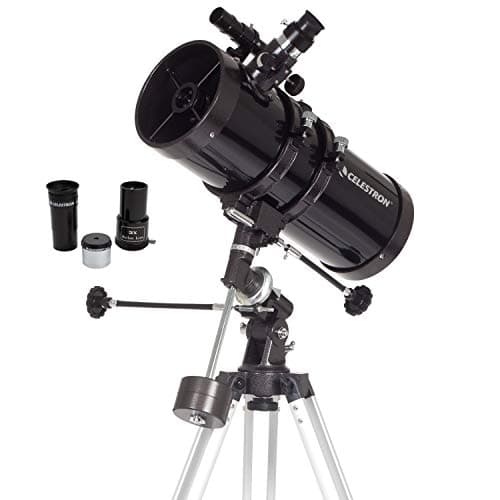 Celestron PowerSeeker 127EQ 127mm and a 300x ceiling — with 1000mm of focal length in a 436mm tube. | More aperture, if you accept the design question | |
| 3 | 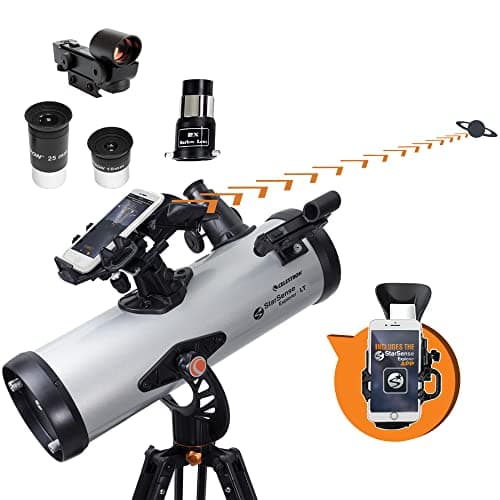 Celestron StarSense Explorer LT 114AZ 114mm on a plain alt-azimuth tripod with phone guidance and a sane Barlow. | The same aperture without the equatorial mount |
Rows link to the full write-up further down this page. Prices come from the live price layer only; where there is no live figure the button reads “Check price” rather than showing a number we remembered.
The equatorial mount, again
Everything our PowerSeeker 127EQ review says about the mount applies here: a counterweight to fit, balancing in right ascension and declination, a latitude setting, and a polar axis pointed north before the mount does anything useful.
None of it is hard for an adult who wants to learn it, and once learned an equatorial mount follows the sky with one knob. It is simply the wrong first mount for a child, which is why our age pages send you to alt-azimuth telescopes instead.
Who this is for
| Situation | Verdict |
|---|---|
| An adult who wants cheap, honest Newtonian optics | A fair buy. Use the 20mm and the 20mm with the Barlow. |
| A child's own telescope | Not this one. The LT 114AZ instead. |
| You want the most aperture in this family | The 127EQ — more light, more design questions. |
| Deep sky is the goal | A 130mm or 150mm Dobsonian gathers far more. |
| You were sold on the 675x figure | Read the space gifts not to buy first. |
What we did and did not do
We have not handled this telescope. Every specification above was read from Celestron's published page for item 21045, linked below and checked on the date at the top of this page, and every magnification and share is arithmetic on those figures, shown so you can repeat it.
No price appears in this prose. Live figures come only from our price feed with the date they were checked. Our full method is on the methodology page.
The picks in full
Pick 1
Celestron PowerSeeker 114EQ
An adult who wants a real Newtonian cheaply and will ignore two of the eyepieces
The arithmetic
This is the PowerSeeker that does not hide anything in its focuser. Celestron lists 900mm of focal length in an 875mm tube — 97 percent, which is what a plain Newtonian looks like — where the PowerSeeker 127EQ lists 1000mm in a 436mm tube. Its published central obstruction is 22 percent by diameter against the 127EQ's 32 percent, so on paper this is the cleaner optical system of the two. The box then undoes much of that: 900 over the 4mm eyepiece is 225x, and the supplied 3x Barlow takes it to 675x against Celestron's own published 269x ceiling — about 251 percent of the stated limit. The 20mm gives 45x, and with the Barlow 135x, which is the pairing worth using.
Start with the genuine good news, because this telescope gets tarred with its family's reputation. Celestron lists 900mm of focal length in an 875mm tube — 97 percent, which is what a plain Newtonian looks like.
Compare that with the PowerSeeker 127EQ, which lists 1000mm in a 436mm tube and needs an optical element in the light path to get there. This one does not. Its published central obstruction is 22 percent by diameter against the 127EQ's 32 percent, so on paper it is the cleaner optical system of the two — and the cheaper one.
Then the box. The supplied 4mm eyepiece gives 225x, and the 3x Barlow takes that to 675x against Celestron's own published 269x ceiling — about 251 percent of the stated limit, the same pattern we name on the 127EQ and the PowerSeeker 50AZ.
The pairing worth using is the 20mm: 45x alone, 135x with the Barlow, both comfortably inside the ceiling. Two of the four combinations in this box are usable and two are decoration.
Skip it if
A child is the user. The equatorial mount needs a counterweight, balancing in two axes and a latitude setting before the first look, and the supplied high-power combination will ruin the first night if anyone reaches for it.
| Item number | 21045 |
|---|---|
| Optical design | Newtonian reflector, spherical primary mirror |
| Aperture | 114mm (4.49") |
| Focal length | 900mm (35") |
| Focal ratio | f/7.89 |
| Optical tube length | 875mm (34.4") |
| Eyepieces supplied | 20mm (45x) and 4mm (225x) |
| Barlow | 3x |
| Finderscope | 5x24 |
| Mount | Manual equatorial with setting circles |
| Tripod | 1.25" steel legs, adjustable, accessory tray |
| Secondary mirror obstruction | 22% by diameter, 4.96% by area |
| Highest useful magnification | 269x |
| Lowest useful magnification | 16x |
| Limiting stellar magnitude | 12.8 |
| Light gathering power | 265x the human eye |
| Total kit weight | 12.3 lbs (5.58 kg) |
| What the box does not do | No erect image diagonal and no app: finding things is a 5x24 finderscope and a star chart. The equatorial mount needs its counterweight fitted, balancing in two axes and a latitude setting before the first look. As a Newtonian it will need occasional collimation, and the 4mm eyepiece with the 3x Barlow is a combination to leave in the box. |
Specifications from Celestron — PowerSeeker 114EQ specifications. We have not handled this one — everything above is the published spec sheet plus our own arithmetic on it.
Pick 2
Celestron PowerSeeker 127EQ
More aperture, if you accept the design question
The arithmetic
1000mm over the supplied eyepieces gives 50x and 250x. The included 3x Barlow turns those into 150x and 750x — and 750x is two and a half times the 300x highest useful magnification Celestron publishes for this telescope. Celestron's own manual puts most observing at 20 to 35 power per inch of aperture, which for 5 inches is 100x to 175x: of the four combinations in the box, only the 20mm with the Barlow (150x) lands in that range. The other number worth doing is the tube: 1000mm of focal length in a 436mm tube means something in the light path is extending the focal length, because a plain Newtonian's tube runs close to its focal length.
The bigger sibling, and the more complicated purchase. 127mm gathers about 24 percent more light than 114mm, which is a real gain.
What it costs is optical simplicity: a hands-on reviewer identifies a Barlow-type corrector in the focuser drawtube, and collimating it means removing that element first.
Its box oversells itself by a similar margin — 750x supplied against a 300x published ceiling.
Skip it if
You want the simplest light path for the money. Its tube is 44 percent of its focal length, so an element is extending it, and its published obstruction is 32 percent against this telescope's 22.
| Optical design | Newtonian reflector, spherical primary mirror |
|---|---|
| Aperture | 127mm (5") |
| Focal length | 1000mm (39") |
| Focal ratio | f/7.87 |
| Optical tube length | 436mm (17.2") |
| Eyepieces supplied | 20mm (50x, erect image) and 4mm (250x) |
| Barlow | 3x |
| Finderscope | 5x24 |
| Mount | Manual German equatorial, setting circles, R.A. and Dec. slow-motion controls |
| Tripod | 812.8mm-1295.4mm (32"-51") height range, steel legs |
| Secondary mirror obstruction | 32% by diameter, 10% by area |
| Highest useful magnification | 300x |
| Limiting stellar magnitude | 13 |
| Total kit weight | 13 lbs (5.9 kg) |
| What the box does not do | No motor — tracking needs Celestron's optional single-axis motor drive, and only works once the mount is polar aligned. No phone guidance or red dot finder; finding things is the 5x24 finderscope and a star chart. Before the first look, the mount needs its counterweight fitted, two slow-motion cables attached, balancing in both axes and a latitude setting — steps an alt-azimuth telescope does not have. As a reflector it will need collimation eventually. |
Specifications from Celestron — PowerSeeker 127EQ specifications; Celestron — PowerSeeker 60, 70, 80, 114 and 127EQ instruction manual (PDF). We have not handled this one — everything above is the published spec sheet plus our own arithmetic on it.
Pick 3
Celestron StarSense Explorer LT 114AZ
The same aperture without the equatorial mount
The arithmetic
The same 114mm aperture as the tabletop Dobsonian, the same published 269x ceiling and the same 12.8 limiting magnitude — but a completely different instrument: 1000mm at f/9 on its own full-height tripod, against 450mm at f/4 on a base that needs a table. The mirror here is SPHERICAL rather than parabolic, and at f/9 that is a legitimate engineering choice rather than a corner cut: spherical aberration only becomes visible at fast focal ratios. 1000mm over the supplied eyepieces gives 40x and 100x, or 80x and 200x with the Barlow — about 74 percent of the ceiling in the box.
The same 114mm aperture and the same 1000mm-class focal length, on a mount a child can point and with an app that finds the target.
Its box is the opposite of this one: 40x, 80x, 100x and 200x against a 269x ceiling — about 74 percent of the telescope, with nothing past the limit.
It is also 10.4 lbs against 12.3, and it needs Android 12 or iOS 18 on an iPhone XR or newer.
Skip it if
You want the tracking an equatorial mount gives once it is aligned, or you have no compatible phone.
| Optical design | Newtonian reflector, spherical primary mirror |
|---|---|
| Aperture | 114mm (4.5") |
| Focal length | 1000mm (39.3") |
| Focal ratio | f/9 |
| Eyepieces supplied | 25mm (40x) and 10mm (100x) |
| Barlow | 2x (1.25") |
| Finderscope | StarPointer red dot |
| Mount | Manual alt-azimuth |
| Tripod | 1320.8mm (52") max height |
| Highest useful magnification | 269x |
| Limiting stellar magnitude | 12.8 |
| Total kit weight | 10.4 lbs (4.71 kg) |
| Phone requirement | Android 12 and later; iOS 18 and newer, iPhone XR and newer |
| What the box does not do | No case. The long tube on an alt-azimuth mount means the eyepiece ends up in awkward positions near the zenith, which is the standard Newtonian-on-a-tripod compromise. Being a reflector it will eventually need collimation, which the refractors in this range never do. |
Specifications from Celestron — StarSense Explorer LT 114AZ specifications. We have not handled this one — everything above is the published spec sheet plus our own arithmetic on it.
Questions people actually ask
- Is the Celestron PowerSeeker 114EQ any good?
- The optics are better than the PowerSeeker name suggests: a full-length 875mm tube for a 900mm focal length, a small 22 percent central obstruction and a published 269x ceiling. The supplied 4mm eyepiece with the 3x Barlow reaches 675x, which is the part to ignore.
- What is the difference between the PowerSeeker 114EQ and the 127EQ?
- Aperture and optical design. The 127EQ gathers about 24 percent more light but lists 1000mm of focal length in a 436mm tube, meaning an element extends it, with a 32 percent obstruction. The 114EQ is a plain Newtonian — 900mm in an 875mm tube — with a 22 percent obstruction.
- What magnification should you use on the PowerSeeker 114EQ?
- 45x with the 20mm eyepiece for finding things, and 135x with the 20mm plus the 3x Barlow for the Moon and planets. The 4mm alone gives 225x on a very steady night. The 4mm with the Barlow gives 675x, two and a half times Celestron's own published limit.
- Is the PowerSeeker 114EQ good for kids?
- Not as a child's own telescope. The equatorial mount needs a counterweight, balancing in two axes and a latitude setting before the first look. For a child we would buy the StarSense Explorer LT 114AZ — same aperture, simpler mount, app guidance.
- Does the PowerSeeker 114EQ need collimation?
- Eventually, like every Newtonian. Unlike the PowerSeeker 127EQ there is no corrector element in the focuser to remove first, which makes the job the standard one described in Celestron's manual.
Sources
Read next
Where to go from here
- Celestron PowerSeeker 127EQ review
The most aperture of any tripod telescope on this site, on an equatorial mount that needs balancing and polar alignment, with a Barlow that reaches two and a half times its own ceiling.
- Celestron StarSense Explorer LT 114AZ review
114mm of aperture that brings its own tripod. Same published ceiling as the tabletop Dobsonian, a spherical mirror instead of parabolic, and why f/9 makes that fine.
- Toy telescopes versus real optics: how to tell in thirty seconds
The arithmetic that exposes a 525x claim on a 70mm box, worked through on a real product using its own manufacturer's published numbers.
- Celestron AstroMaster 130EQ review
130mm at f/5 on a German equatorial mount, with a spherical primary where its siblings are parabolic. The one spec that differs, what it implies, and the honest case for buying it anyway.
- The space gifts not to buy — and what to buy instead
The four ways the kids astronomy aisle disappoints, each with the arithmetic that exposes it and the honest alternative at the same money.
- The best beginner telescopes under $200
Between $100 and $200 you can buy a steady mount, real aperture, or phone-guided finding. What each of those is worth, with the arithmetic.