Gifts
The space gifts not to buy — and what to buy instead
Four traps, one worked example, and the alternative at the same money each time.

By Scooter M. · published September 6, 2026
I'm not an astronomer and I don't have a lab. I'm someone who's genuinely into this — I read the manuals, compile the published specs, and do the arithmetic the box doesn't do for you. No lab coat. How we pick.
How this is funded. Lens & Lightyear earns a commission when you buy through a link on this page, at no extra cost to you. It does not change which products we pick or what we say about them — every card below carries a real reason to skip it. Prices are pulled live and were last verified October 20, 2026. Full disclosure.
The short answer
Avoid any telescope advertising magnification in the hundreds, anything with a 0.96 inch diagonal, decorative light projectors sold as astronomy, and multi-eyepiece accessory kits. In every case the money buys a number on a box rather than something the child can see through.
This page exists because the failure mode in this category is not wasted money. It is a child who opens a present, looks through it, sees nothing, and quietly decides that real space is disappointing. That is considerably more expensive than the gift was.
Trap 1 — magnification printed in the hundreds
Every telescope has a ceiling set by its aperture. Past it you are not resolving more detail, you are magnifying blur. Two conventions describe that ceiling and they agree closely: roughly twice the aperture in millimeters, or 60x per inch of aperture.
So a 50mm telescope tops out near 100 to 118x, and a 70mm near 140 to 165x. When a box advertises 525x, it is describing the eyepieces in the box rather than the optics — and those two things are unrelated.
| Aperture | Realistic ceiling | What the cheap shelf claims |
|---|---|---|
| 50mm | about 100-118x | Frequently 450-600x |
| 70mm | about 140-165x | Frequently 525x |
| 76mm | about 152-180x | Usually honest from the better brands |
| 130mm | about 260-307x | Usually honest — the aperture speaks for itself |
Ceiling column: our arithmetic using both industry conventions — twice the aperture in millimeters, and 60x per inch. Where a manufacturer publishes its own figure, it lands inside this range.
Trap 2 — the 0.96 inch diagonal
This one is invisible unless you know to look, and it is the difference between a telescope you can improve and one you cannot.
The standard eyepiece barrel is 1.25 inches. A telescope with a 1.25 inch diagonal accepts the entire aftermarket — every eyepiece, every filter, everything a child might be given for a birthday two years later. A 0.96 inch diagonal is a legacy size that almost nothing fits, so the telescope is permanently as good as it was in the box.
Check it before you buy. It is usually in the specification list rather than on the front of the carton, which tells you something in itself.
Quick picks
One to avoid, two to buy instead
| # | Product | Best for | Price |
|---|---|---|---|
| ! | 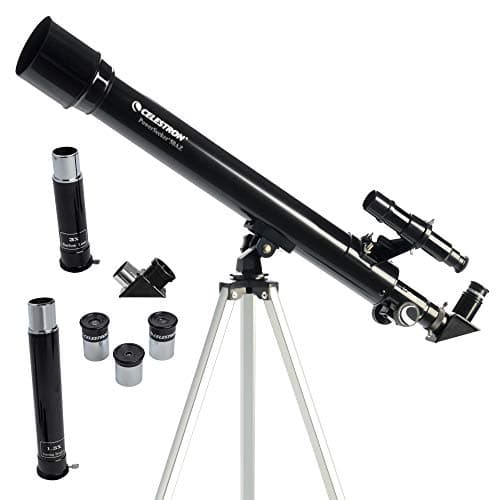 Celestron PowerSeeker 50AZ Published ceiling 118x. Supplied eyepieces and Barlow reach roughly 450x. Skip this one — see why below | The shape of the trap, made concrete | Not recommended |
| 2 | 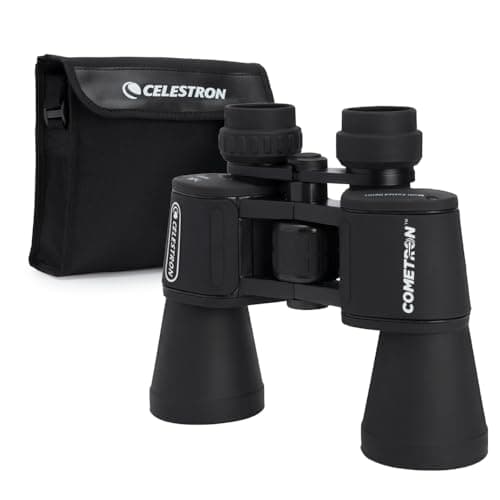 Celestron Cometron 7x50 7.1mm exit pupil, zero setup, and a genuinely good first night. | The honest alternative at the bottom of the budget | |
| 3 | 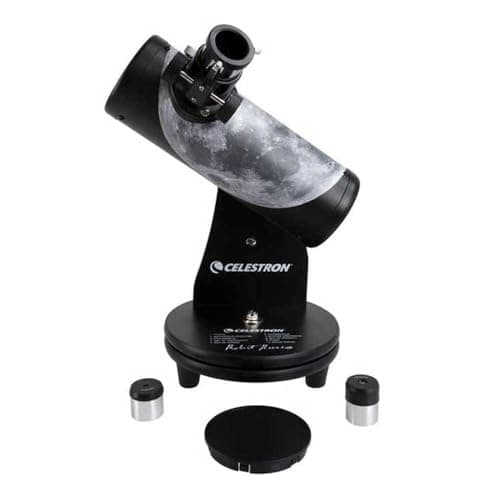 Celestron FirstScope 76mm Tabletop 76mm of real aperture and a box that does not oversell its own optics. | If it genuinely has to be a telescope |
Rows link to the full write-up further down this page. Prices come from the live price layer only; where there is no live figure the button reads “Check price” rather than showing a number we remembered.
Trap 3 — a decorative light sold as astronomy
Star projectors split into two genuinely different products that share a shelf and a search term: accurate planetariums that show the real sky, and nebula-and-laser light shows that do not.
There is nothing wrong with the second kind — bought knowingly, a decorative projector is a lovely thing in a bedroom. The trap is buying one for a child who asked to learn the constellations, because it cannot do that at any price. The distinction, and how to tell them apart on a product page, is on accurate vs decorative star projectors.
Trap 4 — the accessory kit
A case containing five eyepieces, several colored filters and a Barlow looks like tremendous value and is usually the opposite.
- The eyepieces are cheap because there are five of them. One decent eyepiece beats five poor ones, and a beginner uses two focal lengths in practice.
- The colored planetary filters do very little in a small telescope, and they are one more thing to drop in the dark.
- The Barlow is the problem, not the bonus. On beginner telescopes it is what pushes the supplied set past the aperture's ceiling in the first place.
- A smartphone camera adapter turns an observing session into a photography session that will not go well in the cold. Later, maybe.
What to buy instead with the same money: a red torch, and eventually one good eyepiece. We set out the full kit, in order of how much difference each item makes, on the stargazing night kit.
How to check any listing in 60 seconds
The traps above are patterns rather than products, so the useful skill is reading a listing yourself rather than memorizing a blacklist. This is the order we would go in.
- Find the aperture in millimeters. If it is not stated anywhere, stop — that omission is the answer. If it sits three lines below a magnification claim, that tells you which number the manufacturer is proud of.
- Double it. That is the realistic ceiling. Compare it against the largest number on the front of the box.
- Find the eyepiece focal lengths and divide. Telescope focal length divided by eyepiece focal length is the magnification each one actually gives. If the shortest eyepiece plus a Barlow lands past the ceiling, the box is oversold.
- Look for the diagonal size. 1.25 inch means the aftermarket fits. 0.96 inch means it never will.
- Search the manufacturer's own site for the model. Real manufacturers publish a specification table including a highest useful magnification. If the brand has no site, or the site has no specifications, you have learned something.
Trap 5 — buying for the wrong child
This one is not about the product, and it is the most common way a perfectly good gift still fails.
- Buying the telescope you wanted at that age, rather than the one this child can carry and set up alone. Enthusiasm does not transfer through equipment.
- Buying ahead — a serious instrument for a five-year-old on the theory that they will grow into it. They tend to grow out of the interest first, because everything about it is frustrating for three years.
- Buying a telescope when the child asked about rockets, or the Moon landings, or living on Mars. Not every space interest is an observing interest, and a projector or a book often serves it better. See gifts for a space-obsessed kid.
- Buying optics for a household where nobody will go outside in the cold. This is the honest one. A telescope needs a willing adult in January, and if that person does not exist, a star projector is the right answer rather than the consolation prize.
The pattern behind all of them
Each trap works the same way: it sells a number or a quantity that is cheap to add, in place of a quality that is expensive to build. Magnification is cheap; aperture is not. Five eyepieces are cheap; one good one is not. A color-changing LED is cheap; an accurate optical star field is not.
Once you can see that pattern you do not need our list — you can walk any shelf in this category and read it yourself, which is a better outcome than trusting a review site. Our own reasoning and what we refuse to publish is on the methodology page.
What to buy instead, by budget
| Budget | Do not buy | Buy instead |
|---|---|---|
| Under $40 | Any telescope at all | A red torch and a free planetarium app, then save. See the night kit. |
| $40-$60 | A 50mm telescope with a 450x claim | 7x50 binoculars. Better first night, same money, nothing to align. |
| $60-$100 | A multi-eyepiece accessory bundle | A 70-76mm telescope with honest published specs. See under $100. |
| $100-$200 | More magnification | A steadier mount, or phone-guided finding. See under $200. |
And if you are still deciding between the three kinds of space gift entirely, telescope, binoculars or projector makes that call first.
Questions people actually ask
- What should you avoid when buying a telescope for a child?
- Magnification claims in the hundreds, a 0.96 inch diagonal that blocks any future eyepiece upgrade, decorative light projectors sold as astronomy, and multi-eyepiece accessory kits. Each sells a cheap number in place of expensive optics.
- Why are cheap telescopes bad for kids?
- Not because the glass is always poor, but because the eyepieces supplied push magnification far past what the aperture can resolve. The child sees a dim wobbling blur and concludes the telescope is broken.
- What magnification is too much for a beginner telescope?
- Anything beyond roughly twice the aperture in millimeters. A 50mm telescope tops out near 100-118x and a 70mm near 140-165x, whatever the box advertises.
- Are telescope accessory kits worth buying?
- Usually not. Five cheap eyepieces beat nothing but lose to one good one, colored filters do little in a small telescope, and the included Barlow is often what pushes the set past the optics' useful limit.
- What is a 0.96 inch diagonal and why does it matter?
- It is a legacy eyepiece fitting size. The standard is 1.25 inches, which accepts the entire aftermarket. A 0.96 inch fitting means the telescope can never be improved with better eyepieces.
Sources
Read next
Where to go from here
- Toy telescopes versus real optics: how to tell in thirty seconds
The arithmetic that exposes a 525x claim on a 70mm box, worked through on a real product using its own manufacturer's published numbers.
- Are kids' telescopes worth it?
A direct verdict with the honest nuance: where the money starts working, where it does not, and what to buy instead below the line.
- The best kids' telescopes under $100
The sub-$100 shelf is where the 525x claims live. What that money genuinely buys, and the one telescope here we tell you not to buy.
- Accurate or decorative? The star projector split nobody explains
The single distinction that decides whether a star projector supports a child's interest in astronomy or is simply a very nice bedroom light.
- The best space gifts for kids under $100
Binoculars, telescope, projector or accessory — the cross-category view of one budget, and why the best answer is usually not the telescope.
- How much should you spend on a telescope for a child?
Band by band, what the money buys and where it stops helping. The jump from $60 to $150 matters more than the one above it.
- Barlow lens for a telescope: the arithmetic before the purchase
One number decides whether a Barlow helps or hurts: your shortest eyepiece, multiplied, against the telescope's published ceiling. Work it out first, then buy.