Guides
Telescope, binoculars or star projector?
The decision most gift buyers make by accident. Here it is made on purpose.
By Scooter M. · published September 1, 2026
I'm not an astronomer and I don't have a lab. I'm someone who's genuinely into this — I read the manuals, compile the published specs, and do the arithmetic the box doesn't do for you. No lab coat. How we pick.
How this is funded. Lens & Lightyear earns a commission when you buy through a link on this page, at no extra cost to you. It does not change which products we pick or what we say about them — every card below carries a real reason to skip it. Prices are pulled live and were last verified October 18, 2026. Full disclosure.
The short answer
Binoculars for the best first night with the least that can go wrong. A telescope when the child specifically wants one and there is an adult prepared to stand outside in the cold. A star projector for under-sixes, bad weather, small flats and bedtimes. They are three different gifts that happen to share a shelf.
This is the decision that gets made by accident more than any other in the category, usually by whichever product had the best photograph. It is worth two minutes of thought, because the three options fail in completely different ways.
The comparison
| Binoculars | Telescope | Star projector | |
|---|---|---|---|
| Setup time | Five seconds | 10-30 minutes the first time | Under a minute |
| Can go wrong | Almost nothing | Finder, focus, mount, eyepiece choice | Almost nothing |
| Shows real sky | Yes | Yes, in the most detail | No — it shows a model of it |
| Weather-proof | No | No | Yes, entirely indoors |
| Works from a city | Moon and planets only | Moon and planets only | Yes, unaffected |
| Useful by day | Yes — birds, hills, sport | Some models, with an erect diagonal | No |
| Youngest realistic age | About 3 with a light pair | About 5, with an adult driving | Any age |
| Teaches the sky | A little | A little | Yes, if it is an accurate one |
| Typical spend | $40-$120 | $60-$250 | $30-$200 |
Bold marks the winner in each row. Note that no column wins more than four rows — that is the actual finding of this page.
Pick by scenario, not by product
- "They love space but they are four." Projector. Nothing at an eyepiece will hold a four-year-old, and a projector at bedtime gets used every single night rather than twice a year.
- "They asked for a telescope." Telescope. The wanting is part of the gift, and substituting something optically superior will read as a substitution. Buy the right one for the age.
- "We live in a city with a small balcony." Binoculars, or a projector. The Moon and planets are bright enough to punch through light pollution; faint objects will not, whatever you spend.
- "Nobody here knows anything about the sky." Binoculars plus a free planetarium app, or a phone-guided telescope if the budget stretches.
- "They are nine and genuinely obsessed." Telescope, and buy aperture. See ages 9-10 and the space-obsessed kid.
- "It rains here constantly." Projector, honestly. A telescope that waits three weeks for a clear night loses a child's attention entirely.
Quick picks
The winner in each category
| # | Product | Best for | Price |
|---|---|---|---|
| 1 | 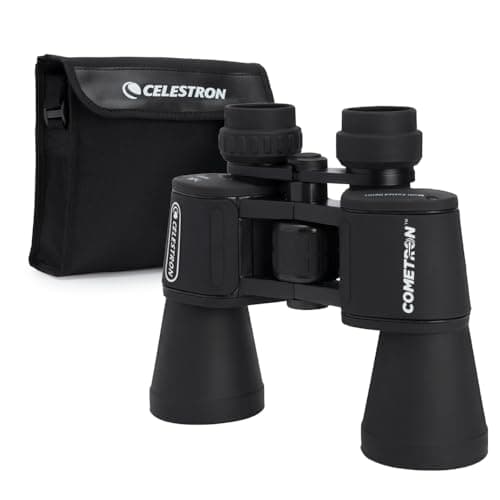 Celestron Cometron 7x50 The highest chance of a good night one, and the lowest chance of anything going wrong. | Binoculars — the safest bet of the three | |
| 2 | 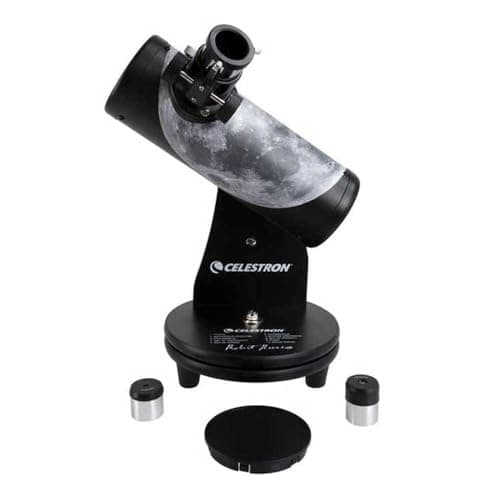 Celestron FirstScope 76mm Tabletop The cheapest telescope we would defend, and the simplest to actually use. | Telescope — when only a telescope will do | |
| 3 | No image National Geographic Astro Planetarium 8,000 real stars and 61 named constellations, settable to the sky outside tonight. | Projector — for indoors, and for genuinely learning the sky |
Rows link to the full write-up further down this page. Prices come from the live price layer only; where there is no live figure the button reads “Check price” rather than showing a number we remembered.
The case against each one
Every recommendation on this site carries a reason to skip it, and the same applies at the category level.
- Against binoculars: they do not look like a space gift. No tripod, no eyepiece, nothing to assemble — for a child expecting a telescope, unwrapping binoculars can land as a disappointment however good the optics are.
- Against a telescope: it needs an adult. Someone has to align the finder, carry it outside, and stand in a cold garden. If that person is not enthusiastic, the telescope will not be used, and no amount of aperture fixes that.
- Against a projector: it is not the real sky. A good one teaches constellations genuinely, but a child who wants to *see space* may find it hollow. The compromise is the accurate kind, set to tonight's actual sky, then going outside to find the same thing.
The combination we would actually give
If the budget allows one gift plus a small extra, the strongest pairing is not one instrument. It is binoculars plus a red torch, or a telescope plus a red torch and a planetarium app.
The reason is dark adaptation: eyes take twenty minutes to adapt and one white phone screen resets them. Fifteen dollars spent on red light does more for what a child sees than fifty dollars of extra aperture. That argument, in full, is on the stargazing night kit — and if you want the same decision framed as a shopping list, gifts by age is the place to start.
Questions people actually ask
- Are binoculars or a telescope better for a child?
- Under $100, binoculars — no setup, a wider field, a brighter image and less that can go wrong. Above that, a telescope shows planetary detail binoculars cannot reach.
- Is a star projector a good gift for a space-obsessed kid?
- For under-sixes, in bad weather, or in a flat with no view, yes. Choose an astronomically accurate one rather than a decorative light show if the goal is learning the sky.
- What is the best first space gift for a child?
- For most families, 7x50 binoculars. They have the smallest gap between what is promised and what is delivered, and the shortest distance from opening the box to seeing something real.
- Can you see the same things with binoculars as with a telescope?
- Partly. Binoculars win on wide targets like the Pleiades and the Milky Way. A telescope wins on Saturn's rings and Jupiter's cloud belts, which need magnification binoculars do not have.
Sources
Read next
Where to go from here
- Telescopes
Four age bands, two budget gates, and the honest arithmetic behind every pick.
- Binoculars
Cheaper, easier, and they work on night one. The case for starting here.
- Star Projectors
The split nobody explains: real star fields versus colored light shows.
- Astronomy gifts for kids, by age
The whole site re-sorted for someone who knows the child's age and nothing else about telescopes. One pick per band.
- Star projector or telescope? A clear answer either way
The two gifts overlap in price and are completely different in what they do. Which one is right for a given child, with a winner named for each scenario.
- How much should you spend on a telescope for a child?
Band by band, what the money buys and where it stops helping. The jump from $60 to $150 matters more than the one above it.
- The best star projector for kids, by age
Age decides this purchase more than any specification. What changes between four, eight and twelve, four picks matched to those bands, and the point where a telescope is the better gift.
- Are star projectors worth it?
Worth it as room atmosphere and a bedtime ritual; not worth it as astronomy teaching. The honest answer on boredom, plus four picks matched to what you actually want from it.