Gifts
Astronomy gifts for kids, by age
One good answer per age band, and why it changes.

By Scooter M. · published September 1, 2026
I'm not an astronomer and I don't have a lab. I'm someone who's genuinely into this — I read the manuals, compile the published specs, and do the arithmetic the box doesn't do for you. No lab coat. How we pick.
How this is funded. Lens & Lightyear earns a commission when you buy through a link on this page, at no extra cost to you. It does not change which products we pick or what we say about them — every card below carries a real reason to skip it. Prices are pulled live and were last verified October 18, 2026. Full disclosure.
The short answer
Under six, buy a projector — it works every night regardless of weather or bedtime. Five to eight, a tabletop telescope with no assembly. Seven to ten, binoculars are the safest present in the category. Ten to twelve, real aperture that will not be outgrown.
Age is a rough proxy, not a rule. What it is really standing in for is three things: how much the child can physically manage, how much patience they have on a cold evening, and whether they can find anything without an adult. Those are the actual constraints.
The whole thing in one table
| Age | What they can do | Buy | Avoid |
|---|---|---|---|
| 3-4 | Look at a ceiling. Very little else. | A quiet, dimmable projector with a timer | Anything with a tripod. Anything with small parts. |
| 5-6 | Look through an eyepiece an adult has aimed | A tabletop telescope, or a projector, or both | Tripod telescopes. Finderscopes. Anything needing reading. |
| 7-8 | Carry it, aim it roughly, focus it, lose interest in 20 minutes | Binoculars, or a light 70mm refractor they can carry | Anything over about 4 lbs. Anything they cannot aim alone. |
| 9-10 | Set up alone, stay out an hour, learn to star-hop | Real aperture. A 70mm on a tripod or a 114mm tabletop | Toy branding. They will notice and be insulted. |
| 11-12 | Everything an adult beginner can, plus more patience than you expect | The biggest honest aperture the budget allows | Anything under about 70mm. It will be outgrown in a season. |
Quick picks
One pick per age band
| # | Product | Best for | Price |
|---|---|---|---|
| 1 | No image National Geographic Astro Planetarium 8,000 real stars and 61 constellations, with an auto shut-off timer. | Ages 3-6: the sky, indoors, at bedtime | |
| 2 | 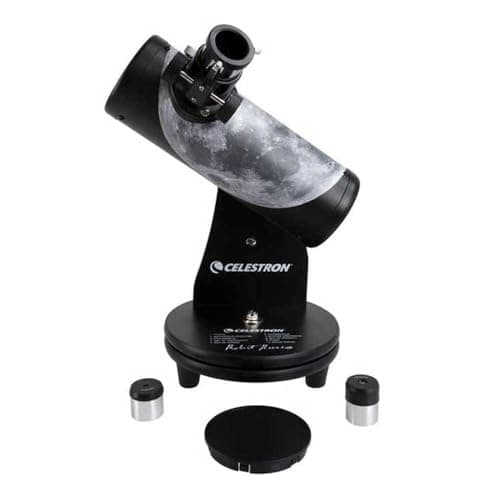 Celestron FirstScope 76mm Tabletop 76mm of aperture, no assembly, and no oversold magnification. | Ages 5-8: the realistic first telescope | |
| 3 | 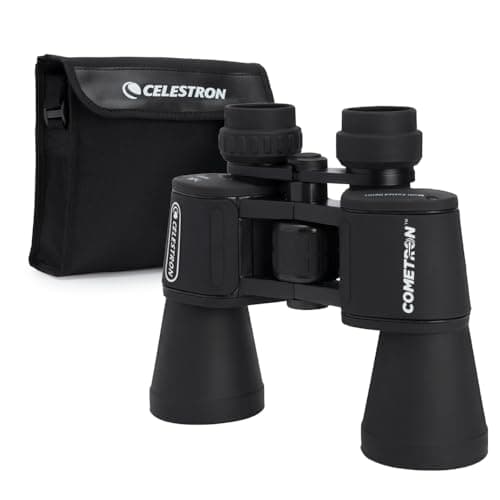 Celestron Cometron 7x50 7.1mm exit pupil, works instantly, and works in daylight too. | Ages 7-10: the safest present in the category | |
| 4 | 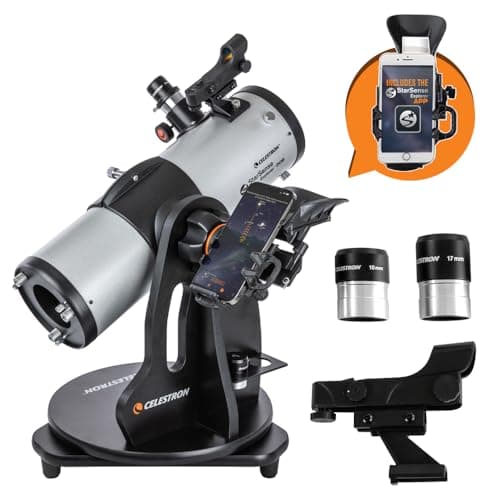 Celestron StarSense Explorer 114mm Tabletop Dobsonian 114mm parabolic mirror, 12.8 limiting magnitude, and the phone finds targets. | Ages 10-12: the one they will not outgrow |
Rows link to the full write-up further down this page. Prices come from the live price layer only; where there is no live figure the button reads “Check price” rather than showing a number we remembered.
The question that beats age
If you only ask one thing before buying, ask this: is the child interested in space, or interested in the idea of space?
Both are completely real and both deserve a good present, but they want opposite gifts. Genuine curiosity — asking how far away things are, wanting to know what a planet looks like — is served by optics that show real things. Aesthetic love of space imagery is served by a projector, a poster, a book, something that makes their room feel like the thing they love.
Get this wrong in either direction and a good present lands badly. A child who loves the *look* of space unwraps a telescope, sees a small gray Moon, and quietly decides real space is worse than the pictures. A child with genuine curiosity unwraps a color-changing galaxy light and works out within a day that it is showing them nothing.
What we will not do here
- No gendered picks. *Best telescope for a 10 year old boy* is a real search and we are deliberately not building for it. A telescope has no gender, and splitting the recommendations by one would be dishonest merchandising rather than helpful.
- No urgency. No stock warnings, no countdown timers, no *only three left*. We are a publisher rather than a store, and manufactured pressure is exactly the posture we are competing against.
- No stale prices. Where our live price layer has a figure you see it with the date it was checked. Where it does not, the button reads *Check price* and takes you to the retailer.
- No pretending a toy is a telescope. If the honest answer for a budget is binoculars or nothing, that is what we will say.
If you are buying for a sibling pair
The common case, and the usual mistake is buying for the older one and assuming the younger will share.
In practice a telescope aimed at a ten-year-old is unusable by a five-year-old without constant help, and that help is exactly what will not be available on a cold evening when the older child is absorbed. The pairing that works is a telescope for the older child and a projector for the younger — the projector runs indoors at bedtime while the telescope goes out when the sky clears.
The other combination that works is one pair of binoculars each. They cost less than one telescope, both children can use them at once, and nobody is waiting for a turn at an eyepiece in the dark.
The picks in full
Pick 1
National Geographic Astro Planetarium
Ages 3-6: the sky, indoors, at bedtime
The arithmetic
8,000 real stars and 61 named constellations, adjustable to a specific date and time — so you can set it to the sky outside tonight and then go and find the same thing. That is the useful trick. Note the manufacturer's own age guidance of 14 and up: this is a mechanism with small parts and fiddly discs, not a nursery night light, whatever the shelf it sits on suggests.
Under about six, a telescope needs an adult driving it and clear weather, and neither is reliable. A planetarium projector works every night regardless.
8,000 cataloged stars and 61 named constellations, with a date-and-time setting so the ceiling can match the sky outside. That is genuinely educational rather than merely pretty, and a five-year-old will learn Orion from it.
Auto shut-off at 30, 60 or 120 minutes means it runs through the settling period and turns itself off. Dual motors give six speeds and there is a shooting-star function.
Maximum throw is 3 m, so it needs a fairly close ceiling. Three AA batteries are supplied; the 5 V cable is not, so plan for that if it will run nightly.
Skip it if
The child will handle it alone. Bresser's own guidance is 14 and up, entirely because of the small projection discs. This lives on a high shelf and an adult changes the discs.
| Stars projected | Over 8,000 |
|---|---|
| Constellations | 61 named |
| Discs | 2 projection discs included |
| Projection area | 1.6 x 2.1 m at 2 m distance |
| Maximum projection distance | 3 m |
| Motion | Dual motors, 6 speeds |
| Timer | Auto shut-off at 30, 60 or 120 minutes |
| Power | 3 x AA (supplied) or 5 V DC cable (not supplied) |
| Manufacturer age guidance | 14 and up |
| Included | 2 projection discs, 3 AA batteries, instruction manual |
| What the box does not do | The 3 m maximum throw means it needs a reasonably close ceiling. The DC cable is not supplied, so on batteries alone it is an occasional-use device. No app, no speaker, no color. |
Specifications from Bresser — National Geographic Astro Planetarium; Space.com — National Geographic Astro Planetarium review. We have not handled this one — everything above is the published spec sheet plus our own arithmetic on it.
Pick 2
Celestron FirstScope 76mm Tabletop
Ages 5-8: the realistic first telescope
The arithmetic
The 20mm eyepiece gives 300 / 20 = 15x, and the 4mm gives 300 / 4 = 75x. Celestron's own published ceiling is 180x, so the 4mm sits well inside what the optics support — unusual honesty at this price. There is no tripod: it needs a table, a wall, a car roof or a stack of books at roughly chest height for the child using it.
The first telescope that works, and it works because there is almost nothing to get wrong.
It arrives assembled. No tripod to level, no finder to align, no diagonal to fit. You put it on a table, point the tube, and look. For a five to eight-year-old that is the whole ballgame.
76mm at 300mm focal length, f/3.95. The 20mm eyepiece gives 15x and the 4mm gives 75x, both inside Celestron's published 180x ceiling. Limiting magnitude 11.9, and 118 times the light-gathering of the naked eye.
It is an open-tube reflector, so small fingers will find the mirror. One calm sentence before it goes outside handles that permanently.
Skip it if
You have no solid outdoor surface at roughly the child's chest height. This is a tabletop telescope with no tripod, and without somewhere to stand it, it cannot be used properly at any age.
| Optical design | Newtonian reflector, spherical primary mirror |
|---|---|
| Aperture | 76mm (2.99") |
| Focal length | 300mm (12") |
| Focal ratio | f/3.95 |
| Eyepieces supplied | 20mm (15x) and 4mm (75x) |
| Highest useful magnification | 180x |
| Lowest useful magnification | 11x |
| Limiting stellar magnitude | 11.9 |
| Light gathering vs the eye | 118x |
| Mount | Dobsonian-style tabletop base |
| What the box does not do | No tripod, no finderscope, and no way to track an object as the sky moves — you nudge the tube by hand. The 4mm eyepiece is usable but tight; most children get on better with the 20mm all evening. |
Specifications from Celestron — FirstScope specifications. We have not handled this one — everything above is the published spec sheet plus our own arithmetic on it.
Pick 3
Celestron Cometron 7x50
Ages 7-10: the safest present in the category
The arithmetic
Exit pupil is objective divided by magnification: 50 / 7 = 7.1mm, which matches Celestron's published figure. That is the single most useful number here. A fully dark-adapted young pupil opens to around 7mm, so a child uses nearly all of that 7.1mm cone and the view is as bright as the optics can make it. An adult over about forty typically dilates to 5mm or less and simply cannot use the extra — this is one of the rare cases where a child gets more out of the hardware than the grown-up does.
If you do not know the child well, or you do not know whether the interest is real, this is the pick with the lowest chance of disappointing.
The exit pupil is 50 divided by 7, which is 7.1mm, matching a dark-adapted young eye. On night one they will see lunar craters, four of Jupiter's moons, and the Pleiades filling the field.
No assembly, no alignment, no learning curve. Point them at something and that something is in view. That immediacy is why astronomy clubs recommend binoculars to beginners far more often than the internet does.
27.3 oz is heavy for small arms. Lie on a blanket, lean on a wall, or use the tripod thread — any of the three, and the problem is gone.
Skip it if
A telescope was specifically asked for. These are optically the better buy at the price and they are still not the thing a child imagining a telescope was hoping to unwrap.
| Magnification | 7x |
|---|---|
| Objective lens | 50mm (1.97") |
| Prism glass | BK7 porro |
| Lens coatings | Multi-coated |
| Angular field of view | 6.6 degrees |
| Linear field at 1000 yds | 344 ft (105 m) |
| Exit pupil | 7.1mm (.28") |
| Eye relief | 13mm (.51") |
| Close focus | 26.2 ft (8 m) |
| Weight | 27.3 oz (774 g) |
| Tripod adaptable | Yes |
| Environmental | Water resistant |
| What the box does not do | 27.3 oz is heavy for small arms held up at the sky — plan on leaning against a wall or lying on a blanket, or add the tripod adapter. BK7 prisms are the cheaper glass and show slight softening at the edge of the field. Water resistant is not waterproof. |
Specifications from Celestron — Cometron 7x50mm specifications. We have not handled this one — everything above is the published spec sheet plus our own arithmetic on it.
Pick 4
Celestron StarSense Explorer 114mm Tabletop Dobsonian
Ages 10-12: the one they will not outgrow
The arithmetic
A parabolic mirror rather than the spherical one in cheaper reflectors, which is what keeps a fast f/4 sharp at the edges. 114mm gathers roughly 2.7 times the light of a 70mm refractor, and the published limiting magnitude of 12.8 is the deepest on this site. The supplied eyepieces only reach 45x against a 269x ceiling, so the box gives you wide, bright, easy views and leaves the high-power ones to buy later.
At ten to twelve a child can do everything an adult beginner can, so the question becomes what will still be interesting in three years.
114mm gathers roughly 2.7 times the light of a 70mm refractor, on a parabolic mirror at f/4, with a published limiting stellar magnitude of 12.8 — the deepest figure on this site.
The phone guidance matters differently at this age than at seven. A younger child needs it to avoid giving up; an eleven-year-old uses it to work through twenty objects in an evening instead of two, which is how someone gets properly hooked.
The supplied 17mm and 10mm eyepieces give 26x and 45x against a 269x ceiling, so the box is set up for wide bright views and leaves planetary magnification to a cheap eyepiece later.
Skip it if
The budget is tight or there is no table. This is the most expensive thing on this page, it is a tabletop instrument at 12.6 lbs, and it needs a genuinely solid surface.
| Optical design | Newtonian reflector, parabolic primary mirror |
|---|---|
| Aperture | 114mm (4.48") |
| Focal length | 450mm (17.71") |
| Focal ratio | f/4 |
| Eyepieces supplied | 17mm (26x) and 10mm (45x) |
| Finderscope | StarPointer red dot |
| Mount | Alt-azimuth tabletop Dobsonian base |
| Highest useful magnification | 269x |
| Limiting stellar magnitude | 12.8 |
| Total kit weight | 12.6 lbs (5.71 kg) |
| What the box does not do | No tripod — it is a tabletop instrument and needs a solid surface at the right height, which is a real planning problem in a garden. A reflector's mirror can drift out of alignment; expect to learn collimation eventually. |
Specifications from Celestron — StarSense Explorer 114mm Dobsonian specifications. We have not handled this one — everything above is the published spec sheet plus our own arithmetic on it.
Questions people actually ask
- What is a good astronomy gift for a 5 year old?
- A planetarium projector, or a tabletop telescope with an adult to aim it. At five a child cannot find things themselves, so a gift that assumes independence will fail.
- What is a good space gift for an 8 year old?
- Binoculars are the safest choice — they work instantly, work in daylight, and cost less than a usable telescope. If a telescope is specifically wanted, a light 70mm refractor they can carry themselves.
- Is a telescope a good gift for a 10 year old?
- Yes. Ten is roughly where a child can set one up alone and stay out long enough for aperture to matter. Buy real aperture rather than features — see telescopes for ages 9-10.
- What do you buy a kid who loves space but is too young for a telescope?
- A planetarium projector that shows real constellations. It works indoors, every night, regardless of weather or bedtime, and it teaches the patterns they will later find in the sky.
- What is the best astronomy gift for a 12 year old?
- The largest honest aperture the budget allows, ideally 114mm or more. At twelve, a small starter telescope will be outgrown within a season and may read as a gift for a younger child.
Sources
Read next
Where to go from here
- The best gifts for space lovers
Space gifts sorted by recipient rather than budget — the small child, the serious kid, the teenager, the adult who never got one. With the honest downside on each.
- The best telescope for kids and adults to share
A telescope bought for a child that an adult will also want to use. What shared ownership demands, and the three that genuinely deliver it.
- The best telescope for a 7 or 8 year old
Seven and eight is where independence starts. The picks here are chosen on carry weight and how easy it is to find something, not on aperture.
- The best telescope for a 9 or 10 year old
Nine and ten is the first band where a bigger, heavier telescope is a better telescope. Four picks and the arithmetic behind the jump.
- The best star projector for a toddler's room
For a very young child the useful specifications are noise level, dimming and cable placement. Star count barely matters. What to actually look for.
- Binoculars for kids, by age
What a child can physically hold at each age, and which published weight and eye-relief figures to check before buying.
- What age is a telescope right for?
What a child can genuinely do at five, seven, nine and eleven, and what to buy at each stage instead of guessing.
- The best first telescope for a kid
A first telescope has one job: produce a good first night. Which specifications serve that, and which are irrelevant to it.
- The best star projector for kids, by age
Age decides this purchase more than any specification. What changes between four, eight and twelve, four picks matched to those bands, and the point where a telescope is the better gift.