Star Projectors
The best star projector for a toddler's room
At this age the specs that matter are noise, brightness and where the cable runs.
By Scooter M. · published September 1, 2026
I'm not an astronomer and I don't have a lab. I'm someone who's genuinely into this — I read the manuals, compile the published specs, and do the arithmetic the box doesn't do for you. No lab coat. How we pick.
How this is funded. Lens & Lightyear earns a commission when you buy through a link on this page, at no extra cost to you. It does not change which products we pick or what we say about them — every card below carries a real reason to skip it. Prices are pulled live and were last verified October 18, 2026. Full disclosure.
The short answer
For a toddler, ignore star count entirely. The specifications that decide whether a projector works in a very young child's room are noise level, how far it dims, whether it turns itself off, and where the cable runs. A quiet, dimmable, self-timing unit on a high shelf is the brief.
The four things that actually matter
- Noise. A projector with a motor or a fan makes a sound, and in a silent nursery that sound is enormous. Look for a published decibel figure — under about 30 dB is genuinely quiet. Most manufacturers do not publish one at all, which is its own kind of answer.
- Dimming range. A projector that only runs bright will keep a toddler awake. The useful range is much dimmer than the marketing photographs suggest.
- Auto shut-off. You want it to run through the settling period and then stop, without anyone opening the door. A 30 or 60 minute timer is ideal.
- Where the cable goes. A mains cable trailing near a cot is a hazard. Battery units, or units that can sit across the room on a shelf with the cable behind furniture, remove the problem entirely.
Safety notes, stated plainly
- Lasers. Many decorative projectors use a laser for the star layer. Any laser device should be positioned so a child cannot look directly into the aperture, and should sit out of reach. The optical planetariums on this page use LEDs through a lens rather than lasers.
- Small parts. Projection discs are thin, small and exactly the size a toddler puts in their mouth. Bresser's 14-and-up guidance on the National Geographic unit is largely about this. Discs live with an adult.
- Placement. High shelf, out of reach, cable secured behind furniture. A projector that gets pulled off a low surface is both a hazard and a broken projector.
- Heat. These run cool at 1.5 W to 5 W, but they should not be covered or placed against fabric.
Quick picks
Star projectors for a toddler's room
| # | Product | Best for | Price |
|---|---|---|---|
| 1 | 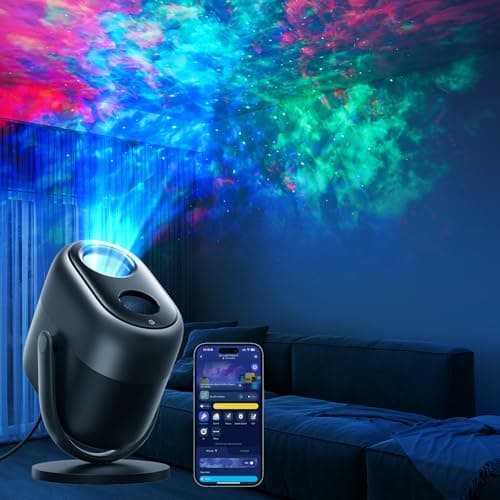 Govee Star Light Projector with Nebula Effect 25 dB — about library quiet, so it can run while a toddler falls asleep. | The quietest option here | |
| 2 | 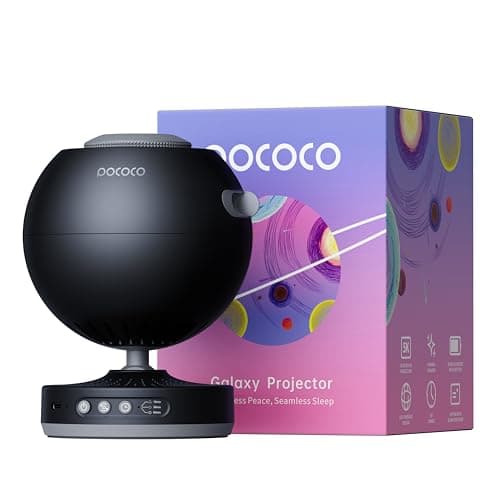 Pococo Galaxy Projector USB-C with an internal battery, and a focus wheel a small child can turn. | Battery power, so no cable near the cot | $104.99 on Amazon #ad How we’re funded · price as of October 18, 2026 |
| 3 | No image National Geographic Astro Planetarium Real stars with a 30, 60 or 120 minute auto shut-off. | When there is an older sibling too |
Rows link to the full write-up further down this page. Prices come from the live price layer only; where there is no live figure the button reads “Check price” rather than showing a number we remembered.
Is a toddler too young for this to be worth it?
No, and this is the one place in the whole category where we would say buy the decorative version without hesitation.
A two-year-old cannot use a telescope in any meaningful sense — they cannot aim it, focus it, or stay still at an eyepiece. But they can absolutely lie under a ceiling full of drifting light and be delighted by it, and there is real value in a child associating the night sky with something calm and lovely long before they can understand any of it.
What we would not do is buy an expensive optical planetarium for a two-year-old and expect it to teach them constellations. It will not, because they are two. If the household also contains a six-year-old, that calculation changes completely — which is why the National Geographic unit is on this page.
When to switch to the accurate kind
Roughly when the child starts asking *what is that one called*. That question is the signal that a decorative pattern has stopped being enough, and it usually arrives somewhere around four or five — what to buy at each age from there picks up where this page stops.
At that point an optical planetarium with a date-and-time setting starts earning its price, because the ceiling can be made to match the sky outside. From there, the next step is usually binoculars rather than a telescope — see what age for a telescope for the honest progression.
The picks in full
Pick 1
Govee Star Light Projector with Nebula Effect
The quietest option here
The arithmetic
25 dB is the specification that matters in a child's bedroom and the one nobody checks — roughly the level of a quiet library, which is quiet enough to fall asleep next to. 540 sq ft of coverage will fill an ordinary bedroom ceiling with room to spare, and is in fact 79 percent more area than the far more expensive Galaxy 2 Pro covers.
For a toddler, the specification that decides everything is noise, and this is the only projector on the site where the manufacturer publishes a figure.
25 dB is roughly the level of a quiet library. That is quiet enough to leave running through the falling-asleep window, which is the entire use case at this age. A projector that hums gets switched off at bedtime and then never gets used.
540 square feet of coverage fills an ordinary bedroom ceiling comfortably, and the 7-zone nebula rendering produces the layered drifting effect that very small children find genuinely mesmerizing.
It is app-controlled, which means a parent adjusts it from the doorway rather than fumbling by the cot — a real convenience. It also means an account and a phone, which some households will not want.
Full review of the Govee Star Nebula, including the published noise and coverage figures.
Skip it if
You want it to teach them anything about the sky. The star field is decorative, not real. For a toddler that is a perfectly reasonable trade; for a five-year-old asking about constellations it is not.
| Model | H6095 |
|---|---|
| Nebula rendering | 7 independent light zones, 7 RGBW lamp beads with 7 independent IC chips |
| Coverage area | 540 square feet |
| Noise level | Less than 25 dB |
| Scene modes | 50+ |
| White noise options | 18 |
| Control | Function button, Govee Home app, voice, Matter |
| Connectivity | 2.4GHz Wi-Fi and Bluetooth |
| Voice assistants | Alexa and Google Assistant |
| Power | 10 W; 5 V DC 3 A input, 100-240 V adapter |
| Dimensions | 5.51 x 6.18 x 8.94" |
| Weight | 1.6 kg |
| What the box does not do | Decorative only: the star field is a pattern, not a sky. No optical discs, so what you see on night one is what you see on night two hundred. Needs the app for most of its features. |
Specifications from Govee — Star Light Projector with Nebula Effect. We have not handled this one — everything above is the published spec sheet plus our own arithmetic on it.
Pick 2
Pococo Galaxy Projector
Battery power, so no cable near the cot
The arithmetic
A middle path between an accurate planetarium and a decorative light. The disc system means you can run a real star field one night and a nebula the next, and the focus wheel is large enough for a child to work themselves — which matters more than it sounds, because a projector nobody can focus gets switched off. No speaker and no app is a feature in a bedroom, not a gap.
The cable is the thing nobody thinks about until they are standing in a nursery working out where the plug is.
This runs from an internal battery over USB-C, which means it can sit on a shelf across the room with no cable trailing anywhere near a cot. For a toddler's room that is a genuine safety advantage over a mains-only unit, and it is the main reason it is on this page.
1.63 lb and 157 x 120 x 120 mm, so it is small enough to sit on a shelf and heavy enough not to be pulled down easily. The focus wheel is large — Space.com's reviewers noted it is workable by children or by anyone with limited hand mobility — which matters if an older sibling will be operating it.
It is disc-based, so it grows with the child: nebula discs now, real star fields when they start asking questions. That makes it the least likely purchase here to be outgrown.
Skip it if
You want it left running all night. It is a battery device at about 1.5 W, which suits a wind-down period rather than continuous overnight use, and charging is one more nightly job.
| Projection type | Optical disc projection, LED (no laser) |
|---|---|
| Disc resolution | 5K discs through a 2 megapixel lens |
| Stars projected | Around 40,326 on the star disc |
| Projection area | Approximately 12 square meters |
| Dimensions | 157 x 120 x 120 mm |
| Weight | 1.63 lb |
| Power | 5 V USB-C, internal battery, about 1.5 W |
| Controls | Focus wheel, on-body rotation, sleep timer, 60 degree tilt |
| Discs | Two included; further sets sold separately |
| What the box does not do | No speaker, no app control, no aurora effects. Extra discs are an ongoing cost. The battery is convenient but it is one more thing to charge. |
Specifications from Space.com — Pococo Galaxy star projector review; Live Science — Pococo Galaxy star projector review. We have not handled this one — everything above is the published spec sheet plus our own arithmetic on it.
#ad How we’re funded · price as of October 18, 2026
Pick 3
National Geographic Astro Planetarium
When there is an older sibling too
The arithmetic
8,000 real stars and 61 named constellations, adjustable to a specific date and time — so you can set it to the sky outside tonight and then go and find the same thing. That is the useful trick. Note the manufacturer's own age guidance of 14 and up: this is a mechanism with small parts and fiddly discs, not a nursery night light, whatever the shelf it sits on suggests.
The pick for a shared room, or for a household where the toddler has a brother or sister who has started asking where things are.
8,000 real stars and 61 named constellations, on two projection discs, with a date-and-time adjustment. The toddler gets a beautiful ceiling; the older child gets something that teaches them the actual sky.
The auto shut-off at 30, 60 or 120 minutes is the toddler-relevant feature. It runs through the falling-asleep period and turns itself off, which is what you want and what many decorative projectors do not offer.
Two constraints: the maximum throw is 3 m, so it needs to sit reasonably close to the ceiling it is lighting, and on the supplied AA batteries alone it is an occasional device — the 5 V DC cable is not included.
Skip it if
The toddler will handle it unsupervised. Bresser's own guidance is 14 and up, and the projection discs are small, thin and easy to damage or lose. This lives on a high shelf, operated by an adult.
| Stars projected | Over 8,000 |
|---|---|
| Constellations | 61 named |
| Discs | 2 projection discs included |
| Projection area | 1.6 x 2.1 m at 2 m distance |
| Maximum projection distance | 3 m |
| Motion | Dual motors, 6 speeds |
| Timer | Auto shut-off at 30, 60 or 120 minutes |
| Power | 3 x AA (supplied) or 5 V DC cable (not supplied) |
| Manufacturer age guidance | 14 and up |
| Included | 2 projection discs, 3 AA batteries, instruction manual |
| What the box does not do | The 3 m maximum throw means it needs a reasonably close ceiling. The DC cable is not supplied, so on batteries alone it is an occasional-use device. No app, no speaker, no color. |
Specifications from Bresser — National Geographic Astro Planetarium; Space.com — National Geographic Astro Planetarium review. We have not handled this one — everything above is the published spec sheet plus our own arithmetic on it.
Questions people actually ask
- Are star projectors good for babies?
- As a quiet, dim light in a nursery, they can be. Look for a published noise figure, a real dimming range and an auto shut-off, and keep the unit and any cable well out of reach. We have not found evidence we would cite for sleep benefits specifically, so we do not claim any.
- What is the best star projector for a toddler's room?
- A quiet, dimmable unit with a timer, placed on a high shelf. Noise level matters more than star count at this age — 25 dB is roughly library quiet and is the figure to look for.
- Are star projectors safe for children?
- The LED optical ones are, with sensible placement. Laser-based decorative projectors should be positioned so a child cannot look into the aperture. Projection discs are a small-parts hazard and should stay with an adult.
- Should a toddler have a real planetarium or a galaxy projector?
- A galaxy projector, honestly. A two-year-old cannot use the accuracy, and the decorative ones are quieter, cheaper and easier to dim. Switch to an accurate one when they start asking what things are called.
Sources
Read next
Where to go from here
- The best star projector for a bedroom
Throw distance, real darkness and a sleep timer decide whether a projector runs nightly or twice. The three that fit an actual bedroom, and what each gives up.
- Accurate or decorative? The star projector split nobody explains
The single distinction that decides whether a star projector supports a child's interest in astronomy or is simply a very nice bedroom light.
- The best star projector under $50
The sub-$50 shelf is where most of this category lives and where the specifications get least reliable. What to check and what to ignore.
- Binoculars for kids, by age
What a child can physically hold at each age, and which published weight and eye-relief figures to check before buying.
- The best telescope for a 5 or 6 year old
What a five or six year old can actually do with a telescope, and the two picks built around that rather than around a spec sheet.
- What age is a telescope right for?
What a child can genuinely do at five, seven, nine and eleven, and what to buy at each stage instead of guessing.
- Astronomy gifts for kids, by age
The whole site re-sorted for someone who knows the child's age and nothing else about telescopes. One pick per band.
- The best star projector for kids, by age
Age decides this purchase more than any specification. What changes between four, eight and twelve, four picks matched to those bands, and the point where a telescope is the better gift.