Star Projectors
The best star projector under $50
A crowded shelf of near-identical units. What the money really buys.
By Scooter M. · published September 1, 2026
I'm not an astronomer and I don't have a lab. I'm someone who's genuinely into this — I read the manuals, compile the published specs, and do the arithmetic the box doesn't do for you. No lab coat. How we pick.
How this is funded. Lens & Lightyear earns a commission when you buy through a link on this page, at no extra cost to you. It does not change which products we pick or what we say about them — every card below carries a real reason to skip it. Prices are pulled live and were last verified October 18, 2026. Full disclosure.
The short answer
Under $50 you are buying a decorative projector, and that is fine — they are genuinely lovely bedroom lights. What you cannot buy at this price is real star positions, because the etched optical disc that makes those possible is the expensive part and there is no cheap version of it.
Why this shelf is so hard to shop
The sub-$50 star projector market is dominated by near-identical units from manufacturers you have never heard of, with listings that describe experience rather than specification. That is not necessarily dishonest, but it does mean there is very little to compare.
The practical consequence: brand recognition is doing more work here than usual, not because established brands make better light patterns, but because they publish numbers. A projector with a stated noise level, a stated coverage area and a stated brightness is a projector somebody measured.
What to check, and what to ignore
| Claim | Worth checking? | Why |
|---|---|---|
| Noise level in dB | Yes — the most important | In a silent bedroom a motor hum is enormous. Under 30 dB is genuinely quiet. Most listings omit it. |
| Coverage area | Yes | Tells you whether it fills a ceiling or throws a small patch. Given in sq ft or sq m. |
| Timer / auto shut-off | Yes | You want it to stop by itself. Nobody wants to open a sleeping child's door. |
| Dimming range | Yes | Rarely published, but ask. Too bright is the most common complaint. |
| Number of "modes" | No | A count of color combinations. It says nothing about quality and everything about the marketing. |
| Star count, on a decorative unit | No | There are no cataloged stars to count. The number, where given, is not measuring anything. |
| "Scientifically accurate" | Only with a star count and named constellations | Without those two specifics, the phrase is decoration. |
| Bluetooth speaker | No | It is a small speaker in a projector. It is not why you are buying it. |
Quick picks
Star projectors under $50
| # | Product | Best for | Price |
|---|---|---|---|
| 1 | 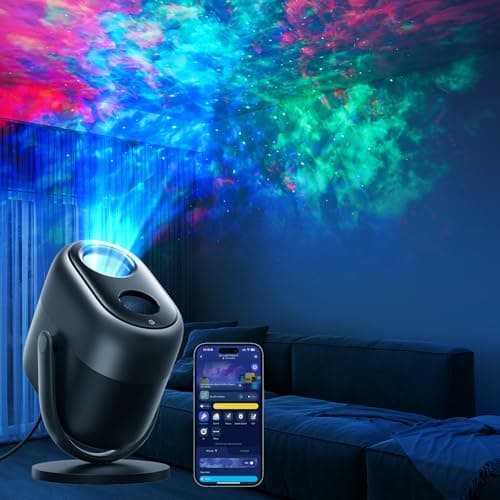 Govee Star Light Projector with Nebula Effect Actual published numbers: 540 sq ft coverage, 25 dB, 7-zone nebula. | The best-specified budget projector | |
| 2 | No image National Geographic Astro Planetarium 8,000 cataloged stars and 61 named constellations, from a real optics company. | Real stars, if you can stretch past the budget | |
| 3 | 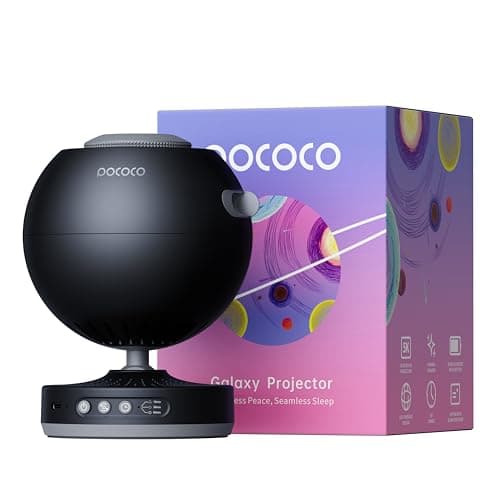 Pococo Galaxy Projector Disc-based, so the same unit does decoration and real star fields. | The upgrade path, if the interest sticks | $104.99 on Amazon #ad How we’re funded · price as of October 18, 2026 |
Rows link to the full write-up further down this page. Prices come from the live price layer only; where there is no live figure the button reads “Check price” rather than showing a number we remembered.
What $50 gets you, honestly
A quiet-ish LED projector that fills a bedroom ceiling with drifting colored light, usually with a laser star layer, app or remote control, a timer, and a set of color modes. Children love them. They are a good present.
What they are not is astronomy. There are no real constellations, nothing to learn, and no relationship between what is on the ceiling and what is outside the window. If the child's interest is genuine, that gap becomes obvious to them quite quickly.
When spending more is worth it
There is a real threshold in this category and it is worth naming. Below it you get light patterns; above it you get an optical disc system with cataloged stars. Nothing gradual happens in between, because the disc is either there or it is not.
So the decision is binary rather than incremental. Either buy the decorative one and enjoy it for what it is, or save until you can buy an optical planetarium. Spending $80 on a slightly better decorative unit buys you a slightly brighter pattern and nothing else.
The picks in full
Pick 1
Govee Star Light Projector with Nebula Effect
The best-specified budget projector
The arithmetic
25 dB is the specification that matters in a child's bedroom and the one nobody checks — roughly the level of a quiet library, which is quiet enough to fall asleep next to. 540 sq ft of coverage will fill an ordinary bedroom ceiling with room to spare, and is in fact 79 percent more area than the far more expensive Galaxy 2 Pro covers.
What earns this the top spot on a budget page is not that it is the prettiest. It is that Govee publishes figures you can check, which on this shelf is genuinely rare.
540 square feet of coverage, 25 dB of noise, a 7-zone nebula rendering, and app control. Compare that with a typical listing at this price, which will tell you it is amazing and nothing else.
The 25 dB figure is the one that matters most in a bedroom and the one almost nobody else states. Anything you cannot get a noise figure for is a gamble.
It is decorative and it does not pretend otherwise. Bought as a bedroom light it is a good buy. Bought as an astronomy gift it is the wrong half of the category — see accurate versus decorative.
Skip it if
You want real constellations. This is firmly in the decorative half of the category — beautiful, quiet, and teaching a child nothing about where anything is in the actual sky.
| Model | H6095 |
|---|---|
| Nebula rendering | 7 independent light zones, 7 RGBW lamp beads with 7 independent IC chips |
| Coverage area | 540 square feet |
| Noise level | Less than 25 dB |
| Scene modes | 50+ |
| White noise options | 18 |
| Control | Function button, Govee Home app, voice, Matter |
| Connectivity | 2.4GHz Wi-Fi and Bluetooth |
| Voice assistants | Alexa and Google Assistant |
| Power | 10 W; 5 V DC 3 A input, 100-240 V adapter |
| Dimensions | 5.51 x 6.18 x 8.94" |
| Weight | 1.6 kg |
| What the box does not do | Decorative only: the star field is a pattern, not a sky. No optical discs, so what you see on night one is what you see on night two hundred. Needs the app for most of its features. |
Specifications from Govee — Star Light Projector with Nebula Effect. We have not handled this one — everything above is the published spec sheet plus our own arithmetic on it.
Pick 2
National Geographic Astro Planetarium
Real stars, if you can stretch past the budget
The arithmetic
8,000 real stars and 61 named constellations, adjustable to a specific date and time — so you can set it to the sky outside tonight and then go and find the same thing. That is the useful trick. Note the manufacturer's own age guidance of 14 and up: this is a mechanism with small parts and fiddly discs, not a nursery night light, whatever the shelf it sits on suggests.
Included because the honest conclusion of a sub-$50 page is often *spend a bit more*, and it is worth showing exactly what the extra buys.
8,000 stars in real positions, 61 named constellations, two projection discs, a date-and-time setting and a shooting-star function. Dual motors give six speeds and there is auto shut-off at 30, 60 or 120 minutes.
Nothing under $50 does any of that, because the etched disc and the lens are the expensive part and there is no way to make them cheaply.
It is made by Bresser under a National Geographic license, and Bresser publishes a full specification — including a 14-and-up age guidance that is worth taking seriously for the disc handling.
Skip it if
Fifty dollars is a hard ceiling. This sits above the budget band this page covers, and we would rather say so than pretend otherwise. It is here as the answer to the question this page inevitably raises.
| Stars projected | Over 8,000 |
|---|---|
| Constellations | 61 named |
| Discs | 2 projection discs included |
| Projection area | 1.6 x 2.1 m at 2 m distance |
| Maximum projection distance | 3 m |
| Motion | Dual motors, 6 speeds |
| Timer | Auto shut-off at 30, 60 or 120 minutes |
| Power | 3 x AA (supplied) or 5 V DC cable (not supplied) |
| Manufacturer age guidance | 14 and up |
| Included | 2 projection discs, 3 AA batteries, instruction manual |
| What the box does not do | The 3 m maximum throw means it needs a reasonably close ceiling. The DC cable is not supplied, so on batteries alone it is an occasional-use device. No app, no speaker, no color. |
Specifications from Bresser — National Geographic Astro Planetarium; Space.com — National Geographic Astro Planetarium review. We have not handled this one — everything above is the published spec sheet plus our own arithmetic on it.
Pick 3
Pococo Galaxy Projector
The upgrade path, if the interest sticks
The arithmetic
A middle path between an accurate planetarium and a decorative light. The disc system means you can run a real star field one night and a nebula the next, and the focus wheel is large enough for a child to work themselves — which matters more than it sounds, because a projector nobody can focus gets switched off. No speaker and no app is a feature in a bedroom, not a gap.
The other thing worth knowing when you are looking at the budget shelf: what the category looks like one step up.
5K optical discs through a 2 megapixel lens, around 40,326 stars on the star disc, a 12 square meter projection area, and a focus wheel large enough for a child to use. USB-C with an internal battery.
The disc system is the reason this is worth mentioning here. It covers both halves of the category, so a child who starts with a nebula disc at five can be given a real star disc at seven without a new purchase.
Two discs are included; further sets are sold separately. Treat that as a subscription rather than a one-off if the child gets properly interested.
Skip it if
Budget is genuinely the constraint. This is comfortably above $50 and the disc library is an ongoing cost on top. On a tight budget the Govee is the sensible buy.
| Projection type | Optical disc projection, LED (no laser) |
|---|---|
| Disc resolution | 5K discs through a 2 megapixel lens |
| Stars projected | Around 40,326 on the star disc |
| Projection area | Approximately 12 square meters |
| Dimensions | 157 x 120 x 120 mm |
| Weight | 1.63 lb |
| Power | 5 V USB-C, internal battery, about 1.5 W |
| Controls | Focus wheel, on-body rotation, sleep timer, 60 degree tilt |
| Discs | Two included; further sets sold separately |
| What the box does not do | No speaker, no app control, no aurora effects. Extra discs are an ongoing cost. The battery is convenient but it is one more thing to charge. |
Specifications from Space.com — Pococo Galaxy star projector review; Live Science — Pococo Galaxy star projector review. We have not handled this one — everything above is the published spec sheet plus our own arithmetic on it.
#ad How we’re funded · price as of October 18, 2026
Questions people actually ask
- What is the best star projector under $50?
- A decorative unit from a manufacturer that publishes real figures — noise level, coverage area and timer options. On this shelf, published specifications are the main thing separating one product from another.
- What is the cheapest star projector for kids?
- Decorative galaxy projectors start well below $50 and go lower still. Below about $30 the specifications generally disappear entirely, which makes them a lottery.
- Can you get an accurate star projector under $50?
- No. Real star positions require an etched optical disc and a proper lens, and that is the expensive part. Accurate planetariums start meaningfully above this budget.
- How much does a planetarium projector cost?
- Optical planetariums that project cataloged stars start well above the budget shelf, and the flagship units with tens of thousands of stars cost several times that. The disc and lens are what you are paying for.
Sources
Read next
Where to go from here
- The best star projector for a bedroom
Throw distance, real darkness and a sleep timer decide whether a projector runs nightly or twice. The three that fit an actual bedroom, and what each gives up.
- Pococo Galaxy Projector review
Swappable optical discs, a focus wheel small hands can use, and deliberately no app. The middle option between an accurate planetarium and a light show.
- Accurate or decorative? The star projector split nobody explains
The single distinction that decides whether a star projector supports a child's interest in astronomy or is simply a very nice bedroom light.
- The best star projector for a toddler's room
For a very young child the useful specifications are noise level, dimming and cable placement. Star count barely matters. What to actually look for.
- Smart star projectors: what the app actually adds
App control, voice assistants and scene modes are what the money buys in the decorative half of the category. What that is genuinely worth in a child's room.
- Space gifts for kids under $50
Under $50 you can buy genuinely good optics — just not a telescope. What the money actually buys, and the allocation we would make ourselves.
- How much should you spend on a telescope for a child?
Band by band, what the money buys and where it stops helping. The jump from $60 to $150 matters more than the one above it.
- Sega Toys Homestar Flux: the serious one
The flagship optical planetarium. What over 60,000 cataloged stars looks like on a ceiling, and why some children find it disappointing.
- Are star projectors worth it?
Worth it as room atmosphere and a bedtime ritual; not worth it as astronomy teaching. The honest answer on boredom, plus four picks matched to what you actually want from it.