Star Projectors
Are star projectors worth it?
They are worth it for one job and a waste of money for another. The whole decision is knowing which job you are buying for.
By Scooter M. · published October 18, 2026
I'm not an astronomer and I don't have a lab. I'm someone who's genuinely into this — I read the manuals, compile the published specs, and do the arithmetic the box doesn't do for you. No lab coat. How we pick.
How this is funded. Lens & Lightyear earns a commission when you buy through a link on this page, at no extra cost to you. It does not change which products we pick or what we say about them — every card below carries a real reason to skip it. Prices are pulled live and were last verified October 18, 2026. Full disclosure.
The short answer
Yes if you are buying room atmosphere or a bedtime ritual — the Govee Star Nebula is the pick for most bedrooms. No if you are buying it to teach a child astronomy: decorative projectors show invented star patterns. If teaching is the goal, buy an optical planetarium like the Homestar Flux, or skip projectors and buy binoculars.
That is the entire decision, and almost every disappointed review of a star projector comes from buying one job and expecting the other. The rest of this page is how to tell which you are doing.
How we judged, before any ranking
Four criteria, in the order that decides whether the money was well spent.
- What it actually projects. A real star catalog in true positions, or a decorative pattern. This is the first question and it reorganizes every other answer.
- Whether it survives month three. The honest failure mode of this category is not breakage, it is boredom. Swappable discs and genuine optical quality both extend the life; a single fixed pattern does not.
- Noise. A bedroom device competes with silence. A published decibel figure is rare and tells you the maker thought about the room.
- Coverage against the actual room. Published square footage, checked against the ceiling you have — not the ceiling in the product photograph.
The boredom question, answered honestly
This is the real worth-it question, so it deserves a straight answer rather than reassurance. A decorative projector is wallpaper that moves. It is genuinely lovely for a few weeks, then it becomes part of the room — which is fine, because that is what a light fixture is supposed to do. Nobody complains that a lamp got boring.
The disappointment happens when a projector was bought as an interest rather than as furniture. An interest needs somewhere to go, and a fixed pattern of invented stars has nowhere to go. Three things measurably extend the useful life:
- Swappable discs. The Pococo and the Galaxy 2 Pro both change what they show when you change a disc. A fixed-pattern projector shows the same thing on night two hundred as on night one.
- Real star positions. An accurate projector can be used, as a tool: set it, find a constellation, then go outside and find the same one. That is a thing a child can get better at.
- A ritual rather than a switch. The households where these last are the ones where it marks bedtime, rather than running permanently in the background.
Worth it, or not, by what you actually want
| What you want | Worth it? | What to buy |
|---|---|---|
| A bedroom that looks good at night | Yes | Govee Star Nebula — quiet, wide, cheapest of the four |
| A calmer bedtime routine | Yes | Anything with a sleep timer and a low published noise level |
| A toddler's night light with more to it | Yes | See projectors for toddlers |
| A child to learn the constellations | Only the accurate kind | Homestar Flux or Pococo |
| A cheaper substitute for a telescope | No | See projector versus telescope |
| To see planets, the Moon or anything real | No | Binoculars or a first telescope |
| A gift for a space-obsessed child | Partly | Pair one with something that looks at the real sky |
Quick picks
Four projectors, matched to the reason you are buying
| # | Product | Best for | Price |
|---|---|---|---|
| 1 | 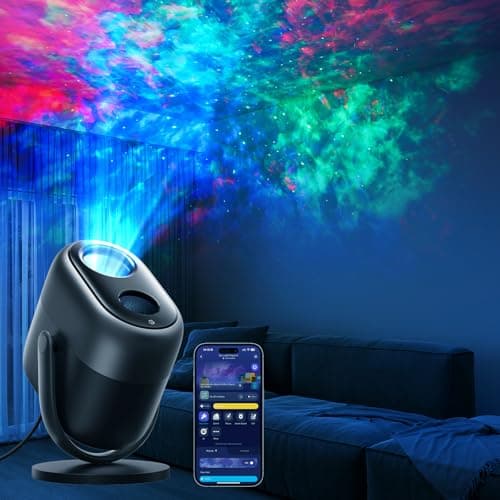 Govee Star Light Projector with Nebula Effect Under 25 dB and 540 sq ft of ceiling, at the lowest price of the four. | Most children's bedrooms — the default answer if you just want the room to look good | |
| 2 | 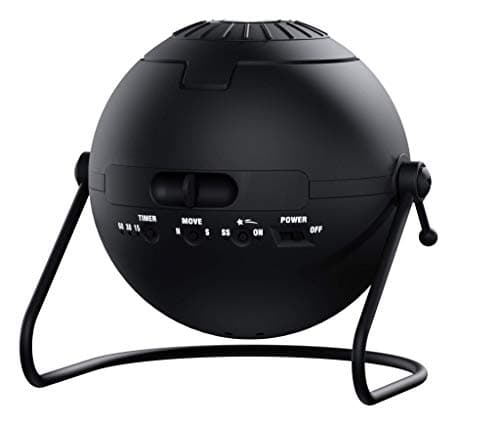 Sega Toys Homestar Flux Over 60,000 cataloged stars in their true positions, projected optically. | A household that wants the projector to lead somewhere real | $259.00 on Amazon #ad How we’re funded · price as of October 18, 2026 |
| 3 | 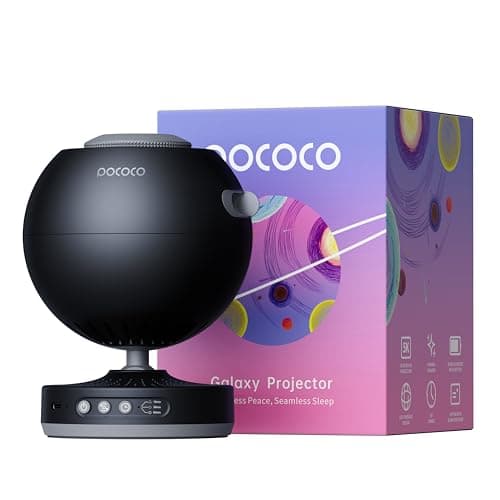 Pococo Galaxy Projector Optical discs through a 2 MP lens — around 40,326 stars on the star disc, nebula discs for other nights. | Buying one device and wanting both the real sky and the pretty one | $104.99 on Amazon #ad How we’re funded · price as of October 18, 2026 |
| 4 | 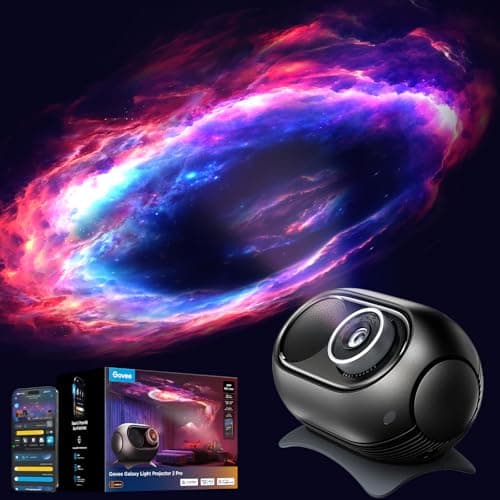 Govee Galaxy Light Projector 2 Pro A 4 MP lens, a published 230 lux, and eight swappable film discs. | A teenager's or an adult's room where image quality is the whole point |
Rows link to the full write-up further down this page. Prices come from the live price layer only; where there is no live figure the button reads “Check price” rather than showing a number we remembered.
The price question
Spending more in this category does not buy more astronomy. It buys lens quality, swappable imagery and build — and above a certain point it buys a genuine optical planetarium, which is a different device rather than a better version of the same one.
The one upgrade that changes the kind of thing you own, rather than its quality, is the move from a decorative projector to an optical one. Everything else is refinement. We set out where that line falls on accurate versus decorative, and the budget end on star projectors under $50.
When the answer is no
- When it is standing in for a telescope. It is not one, it cannot become one, and a child who wanted to see Saturn will know within a week.
- When the room cannot go dark. Every figure any maker publishes assumes a dark ceiling. A streetlight through thin curtains beats all of them.
- When nobody will swap the discs. If the disc system is the reason you are paying more, be honest about whether it will actually happen.
- When the child is old enough to want the real thing. Around nine or ten, a projector increasingly reads as a younger child's object. What age is a telescope right for covers the handover.
What we did and did not do
We have not tested these projectors. Every specification quoted — star counts, coverage areas, noise levels, lens and brightness figures — was read from the manufacturers' own published pages or from the named published reviews linked below, on the date at the top of this page.
No price appears in this prose and no rating appears anywhere, because we have measured nothing. Live figures come only from our price feed with the date they were checked. Our full method is on the methodology page.
The picks in full
Pick 1
Govee Star Light Projector with Nebula Effect
Most children's bedrooms — the default answer if you just want the room to look good
The arithmetic
25 dB is the specification that matters in a child's bedroom and the one nobody checks — roughly the level of a quiet library, which is quiet enough to fall asleep next to. 540 sq ft of coverage will fill an ordinary bedroom ceiling with room to spare, and is in fact 79 percent more area than the far more expensive Galaxy 2 Pro covers.
If the honest reason for the purchase is that a child asked for a galaxy projector and you want their room to look good, this is the one, and nothing more expensive improves on it at that job.
The published sub-25 dB noise figure is why it earns the slot over cheaper lookalikes: a bedroom device competes with silence, and a projector that hums gets unplugged.
540 sq ft of coverage fills an ordinary ceiling with room to spare — more, in fact, than the Govee that costs nearly twice as much.
Honest downside: one visual repertoire, forever. Full review.
Skip it if
You want it to teach the sky. There are no discs and no star catalog here, so it has exactly one look and interest in it plateaus faster than the disc projectors.
| Model | H6095 |
|---|---|
| Nebula rendering | 7 independent light zones, 7 RGBW lamp beads with 7 independent IC chips |
| Coverage area | 540 square feet |
| Noise level | Less than 25 dB |
| Scene modes | 50+ |
| White noise options | 18 |
| Control | Function button, Govee Home app, voice, Matter |
| Connectivity | 2.4GHz Wi-Fi and Bluetooth |
| Voice assistants | Alexa and Google Assistant |
| Power | 10 W; 5 V DC 3 A input, 100-240 V adapter |
| Dimensions | 5.51 x 6.18 x 8.94" |
| Weight | 1.6 kg |
| What the box does not do | Decorative only: the star field is a pattern, not a sky. No optical discs, so what you see on night one is what you see on night two hundred. Needs the app for most of its features. |
Specifications from Govee — Star Light Projector with Nebula Effect. We have not handled this one — everything above is the published spec sheet plus our own arithmetic on it.
Pick 2
Sega Toys Homestar Flux
A household that wants the projector to lead somewhere real
The arithmetic
The number that separates this from every colorful nebula projector is 60,000 — because those are cataloged stars in their real positions, not a decorative pattern. It means a child can find Orion on their ceiling and then find the same Orion out of the window, which is the only thing a projector can do that genuinely helps with a telescope.
This is the one that answers the boredom problem differently: it does not entertain, it teaches. Those 60,000 stars are cataloged and in true positions, so a child can find Orion on the ceiling and then find the same Orion outside.
That transfer is the only thing a projector does that genuinely helps a telescope, and no decorative unit at any price does it.
Honest downside: children who have seen swirling purple galaxies online are sometimes let down by how restrained it is. Full review.
Skip it if
The child wants color and movement. This is white stars on a dark ceiling, nothing else, and it costs several times the Govee.
| Projection type | Optical disc projection through a glass lens |
|---|---|
| Stars projected | Over 60,000 |
| Projection diameter | Approximately 290 cm |
| Projection distance | 140 to 270 cm |
| Light source | 5 W LED |
| Dimensions | 160 x 160 x 150 mm |
| Features | Rotation, sleep timer, interchangeable discs |
| What the box does not do | It projects white stars on a dark ceiling and nothing else — no color washes, no aurora, no speaker, no app. Children expecting the swirling purple galaxy they have seen on social media are sometimes disappointed by how quiet and accurate it is. It also costs several times what those projectors do. |
Specifications from Space.com — Sega Toys Homestar Flux review (star count, projection figures); Live Science — Sega Toys Homestar Flux review. We have not handled this one — everything above is the published spec sheet plus our own arithmetic on it.
#ad How we’re funded · price as of October 18, 2026
Pick 3
Pococo Galaxy Projector
Buying one device and wanting both the real sky and the pretty one
The arithmetic
A middle path between an accurate planetarium and a decorative light. The disc system means you can run a real star field one night and a nebula the next, and the focus wheel is large enough for a child to work themselves — which matters more than it sounds, because a projector nobody can focus gets switched off. No speaker and no app is a feature in a bedroom, not a gap.
The compromise that is actually a compromise rather than a fudge: a genuine optical star field on one disc and decorative imagery on another.
The focus wheel is big enough for a child to operate, which matters more than it sounds — a projector nobody can focus gets switched off.
No speaker and no app, which in a bedroom is a feature. Honest downside: the discs are the cost model. Full review.
Skip it if
You want it hands-off. Swapping discs is a physical ritual, and further disc sets are an ongoing cost.
| Projection type | Optical disc projection, LED (no laser) |
|---|---|
| Disc resolution | 5K discs through a 2 megapixel lens |
| Stars projected | Around 40,326 on the star disc |
| Projection area | Approximately 12 square meters |
| Dimensions | 157 x 120 x 120 mm |
| Weight | 1.63 lb |
| Power | 5 V USB-C, internal battery, about 1.5 W |
| Controls | Focus wheel, on-body rotation, sleep timer, 60 degree tilt |
| Discs | Two included; further sets sold separately |
| What the box does not do | No speaker, no app control, no aurora effects. Extra discs are an ongoing cost. The battery is convenient but it is one more thing to charge. |
Specifications from Space.com — Pococo Galaxy star projector review; Live Science — Pococo Galaxy star projector review. We have not handled this one — everything above is the published spec sheet plus our own arithmetic on it.
#ad How we’re funded · price as of October 18, 2026
Pick 4
Govee Galaxy Light Projector 2 Pro
A teenager's or an adult's room where image quality is the whole point
The arithmetic
This is a lighting product, not an astronomy one, and judging it as an astronomy one is the mistake most gift buyers make. 230 lux across a 90 degree throw is genuinely bright and genuinely impressive on a ceiling; none of the star positions mean anything. Buy it for the room, not for the sky.
The sharpest decorative projector on this site, and the one where the eight physical discs genuinely extend its life — eight repertoires rather than one.
Worth the money in a teenager's room or an adult space, where image quality is being bought deliberately rather than assumed.
Honest downside: paying more buys sharpness, not ceiling, and none of its stars are real either. Full review.
Skip it if
It is for a small child, or the room is large. It covers 301 sq ft against the cheaper Govee's 540, and publishes no noise figure.
| Model | H609D |
|---|---|
| Lens | Ultra 4MP HD lens |
| Projection angle | 90 degrees wide |
| Projection area | Up to 301 square feet |
| Brightness | 230 lux |
| Film discs | 8 included |
| Scene modes | 20+ presets, 3,200+ scene combinations |
| Starlight motion modes | 2 |
| White noise options | 21 |
| Control | Govee Home app over Wi-Fi and Bluetooth, Matter |
| Voice | Alexa and Google Assistant |
| Scheduling | Timer, wake-up and sleep routines in-app |
| Power | 15 W, 5 V input |
| Dimensions | 9.37 x 6.41 x 5.82" |
| What the box does not do | The stars are decorative — they do not correspond to real constellations, so it teaches nothing about the actual night sky. Wi-Fi setup needs a parent's phone and an account. Not a substitute for a telescope or a real planetarium, and we would not pair it with a stargazing gift and call the job done. |
Specifications from Govee — Galaxy Light Projector 2 Pro. We have not handled this one — everything above is the published spec sheet plus our own arithmetic on it.
Questions people actually ask
- Are star projectors worth the money?
- As bedroom atmosphere or part of a bedtime routine, yes — a good one is quiet, covers the ceiling and costs less than most toys that last as long. As a way to teach a child astronomy, only the optical disc planetariums are worth it, because decorative projectors show invented star patterns rather than the real sky.
- Do kids get bored of star projectors?
- Decorative ones, usually yes, in the sense that they stop being an event and become part of the room. Projectors with swappable discs and real star positions last longer because there is something to do with them: set the sky, then go outside and find the same constellation.
- Can a star projector replace a telescope?
- No. A projector puts a picture on your ceiling; a telescope collects light from a real object. A child who wants to see the Moon's craters or Saturn's rings needs binoculars or a telescope, not a projector.
- Do star projectors teach kids about space?
- Only the accurate ones. A planetarium projecting cataloged stars in true positions lets a child learn a constellation indoors and then recognize it outdoors. A decorative nebula projector shows patterns that do not exist in the sky, so there is nothing to transfer.
- What age is a star projector good for?
- Decorative projectors suit toddlers through about nine, where the appeal is the room rather than the astronomy. Accurate planetariums suit about seven upward, when a child can connect the ceiling to the sky outside. Above about ten, most children want the real thing instead.
- Are expensive star projectors better?
- They are sharper and usually have swappable discs, which does extend how long they stay interesting. But spending more does not make the stars real: the most expensive decorative projector still shows invented patterns, while a cheaper optical planetarium shows the actual sky.
Sources
Read next
Where to go from here
- Govee Star Light Projector with Nebula Effect review
Under 25 dB, 540 sq ft of ceiling and seven independently controlled nebula zones. The best decorative bedroom projector we recommend — and honestly not an astronomy instrument.
- Accurate or decorative? The star projector split nobody explains
The single distinction that decides whether a star projector supports a child's interest in astronomy or is simply a very nice bedroom light.
- Star projector or telescope? A clear answer either way
The two gifts overlap in price and are completely different in what they do. Which one is right for a given child, with a winner named for each scenario.
- The best star projector for kids, by age
Age decides this purchase more than any specification. What changes between four, eight and twelve, four picks matched to those bands, and the point where a telescope is the better gift.
- Telescope, binoculars or star projector?
Three completely different gifts sold to the same buyer. Which one fits your child, your sky and your household, with a winner named for each.
- Govee Galaxy Light Projector 2 Pro review
A 4 MP lens, a published 230 lux and eight physical film discs — the sharpest decorative projector on this site. It covers less ceiling than the cheaper Govee, and projects no real stars.