Gifts
The best first telescope for a kid
The first one has one job: work on night one. Everything else is secondary.
By Scooter M. · published September 1, 2026
I'm not an astronomer and I don't have a lab. I'm someone who's genuinely into this — I read the manuals, compile the published specs, and do the arithmetic the box doesn't do for you. No lab coat. How we pick.
How this is funded. Lens & Lightyear earns a commission when you buy through a link on this page, at no extra cost to you. It does not change which products we pick or what we say about them — every card below carries a real reason to skip it. Prices are pulled live and were last verified October 18, 2026. Full disclosure.
The short answer
A first telescope has exactly one job: produce a good first night. That means the fewest possible things to assemble, align or get wrong, and a low-power eyepiece that makes finding things easy. Aperture, magnification and features all matter less than that.
What actually decides whether it gets used twice
Not aperture. Not brand. Not the number of eyepieces. Three things, in this order.
- Can they find anything with it? This is the big one. A telescope at 40x shows about one degree of sky — two Moon widths. Finding a target in that on the first attempt is essentially impossible, which is why every telescope has a finder and why an unaligned finder makes a telescope seem broken.
- Is the first thing they see impressive? The Moon is, always, at any aperture. Point it there first and the evening is a success regardless of what happens next.
- Is it easy enough to bother with? A telescope that takes fifteen minutes to set up gets used on planned occasions. One that takes thirty seconds gets used on a whim, and whims are far more frequent than plans.
The step everyone skips
If you can, do more than that: assemble the whole telescope, check every part is present, work out how the diagonal fits, and leave it standing. A child who unwraps a working telescope has a completely different evening from one who unwraps a box of parts. Our full setup checklist takes about twenty minutes.
Quick picks
First telescopes worth giving
| # | Product | Best for | Price |
|---|---|---|---|
| 1 | 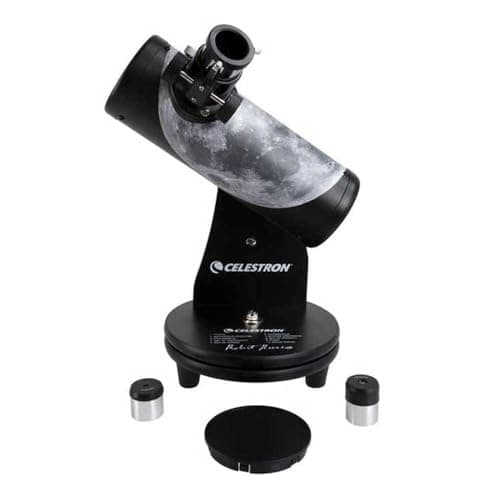 Celestron FirstScope 76mm Tabletop Arrives assembled. No tripod, no finder, no diagonal, nothing to misalign. | The fewest ways to go wrong | |
| 2 | No image Celestron StarSense Explorer LT 70AZ The phone guides you to targets, which removes the main first-telescope failure. | When nobody in the house knows the sky | |
| 3 | 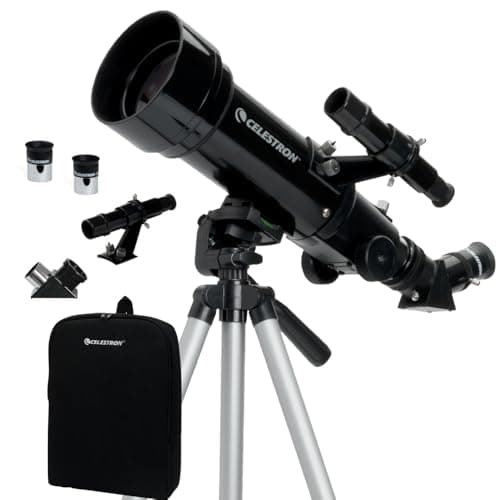 Celestron Travel Scope 70 3.3 lbs for the whole kit, in a backpack they can wear themselves. | A telescope the child owns and carries | |
| 4 | 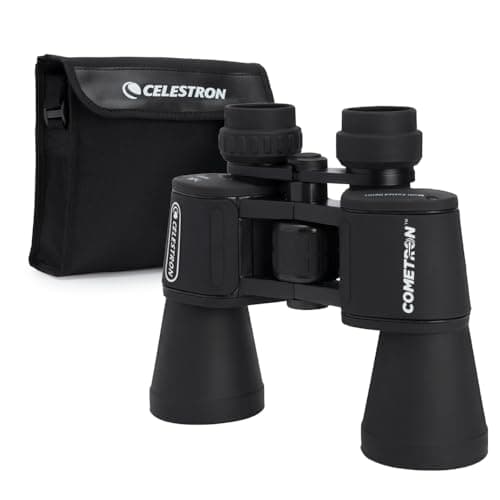 Celestron Cometron 7x50 Costs less, works instantly, and shows the same objects with none of the setup. | The first instrument that is not a telescope |
Rows link to the full write-up further down this page. Prices come from the live price layer only; where there is no live figure the button reads “Check price” rather than showing a number we remembered.
Set the expectation before it is opened
The second most common way a first telescope fails is not technical. The child expects the photographs.
What a first telescope shows is genuinely wonderful and it looks nothing like a poster. The Moon shows craters, mountain shadows and dark plains, in sharp gray detail. Jupiter is a small bright disc with up to four moons in a line beside it, and those moons move night to night. Saturn is a small oval with rings clearly separated from the planet — the object that makes people gasp. The Orion Nebula is a gray cloud with stars inside it.
Say all of that out loud beforehand, cheerfully, and it becomes part of the wonder rather than a disappointment. Our full honest list is on what you can actually see, and the ten minutes spent reading it is the highest-value thing you can do for a first telescope.
The first-night sequence that works
- Go out before it is fully dark. Setting up in twilight is much easier than setting up in the dark, and the Moon is often already visible.
- Point at the Moon first. Always. It is bright, easy to find, and spectacular at any aperture.
- Use the longest eyepiece — the biggest number in millimeters. It gives the widest, brightest, most forgiving view.
- Let them find something themselves, even if it takes a while. Finding it is most of the reward.
- Stop while they still want more. Twenty brilliant minutes beats an hour that ends in cold and frustration.
And if it has already gone wrong, why can't I see anything through my telescope is the page to open. Nine times out of ten nothing is broken.
The picks in full
Pick 1
Celestron FirstScope 76mm Tabletop
The fewest ways to go wrong
The arithmetic
The 20mm eyepiece gives 300 / 20 = 15x, and the 4mm gives 300 / 4 = 75x. Celestron's own published ceiling is 180x, so the 4mm sits well inside what the optics support — unusual honesty at this price. There is no tripod: it needs a table, a wall, a car roof or a stack of books at roughly chest height for the child using it.
For a first telescope, the number of things that can go wrong on night one matters more than any optical specification, and this has almost none of them.
It arrives assembled. There is no tripod to level, no finderscope to align, no diagonal to fit the wrong way round, and no eyepiece combination that produces a black circle. You put it on a table, point it, and look.
76mm at 300mm focal length gives 15x with the supplied 20mm eyepiece — a wide, bright, forgiving view where pointing roughly at the Moon actually puts the Moon in the eyepiece. Celestron's published ceiling is 180x and the 4mm eyepiece reaches 75x, so nothing in the box is overselling.
The absence of a finderscope sounds like a flaw and mostly is not at 15x. At 75x it is a real limitation, which is why most families use the 20mm all evening — and that is fine.
Skip it if
You have nowhere solid to stand it. A tabletop telescope with no surface is not a telescope, and this is the most common reason people are disappointed by an otherwise excellent instrument.
| Optical design | Newtonian reflector, spherical primary mirror |
|---|---|
| Aperture | 76mm (2.99") |
| Focal length | 300mm (12") |
| Focal ratio | f/3.95 |
| Eyepieces supplied | 20mm (15x) and 4mm (75x) |
| Highest useful magnification | 180x |
| Lowest useful magnification | 11x |
| Limiting stellar magnitude | 11.9 |
| Light gathering vs the eye | 118x |
| Mount | Dobsonian-style tabletop base |
| What the box does not do | No tripod, no finderscope, and no way to track an object as the sky moves — you nudge the tube by hand. The 4mm eyepiece is usable but tight; most children get on better with the 20mm all evening. |
Specifications from Celestron — FirstScope specifications. We have not handled this one — everything above is the published spec sheet plus our own arithmetic on it.
Pick 2
Celestron StarSense Explorer LT 70AZ
When nobody in the house knows the sky
The arithmetic
700mm over 25mm and 10mm gives 28x and 70x; the 2x Barlow doubles those to 56x and 140x. Celestron's published ceiling is 165x, so even the Barlowed 10mm stays legal — a rare box where every supplied combination is inside the optics' honest limit. At f/10 the images are contrasty and easy to focus, which is exactly what an inexperienced pair of hands needs.
The most common way a first telescope dies is that nobody can find anything with it. This removes that outright.
The app photographs the sky through the phone camera, matches the star pattern against a catalog, and then shows arrows telling you which way to push. The marker turns green when the target is in the eyepiece.
The optics are a 70mm f/10 refractor at 700mm. The 25mm eyepiece gives 28x, the 10mm gives 70x, and the supplied 2x Barlow makes those 56x and 140x, all inside a published 165x ceiling. f/10 is slow, which means forgiving focus and high contrast — good properties for inexperienced hands.
7.4 lbs on a 52 inch aluminum tripod. An adult carries it out; a child operates it once it is standing.
Skip it if
There is no compatible phone. Android 12 or later, or iOS 18 on an iPhone XR or newer. Without one you have paid a guided-telescope price for an ordinary 70mm refractor.
| Optical design | Refractor |
|---|---|
| Aperture | 70mm (2.76") |
| Focal length | 700mm (27.56") |
| Focal ratio | f/10 |
| Eyepieces supplied | 25mm (28x) and 10mm (70x) |
| Barlow | 2x (1.25") |
| Finderscope | StarPointer red dot |
| Mount | Manual alt-azimuth |
| Tripod | Aluminum, 1320.8mm (52") max height |
| Highest useful magnification | 165x |
| Limiting stellar magnitude | 11.7 |
| Total kit weight | 7.4 lbs (3.35 kg) |
| Phone requirement | Android 12 and later; iOS 18 and newer, iPhone XR and newer |
| What the box does not do | The phone requirement is a real constraint, not fine print: Android 12+ or iOS 18+ on an iPhone XR or newer. An older hand-me-down phone will not run it, and without the app this is an ordinary 70mm refractor at the price of a guided one. |
Specifications from Celestron — StarSense Explorer LT 70AZ specifications. We have not handled this one — everything above is the published spec sheet plus our own arithmetic on it.
Pick 3
Celestron Travel Scope 70
A telescope the child owns and carries
The arithmetic
400mm focal length over the two supplied eyepieces gives 20x and 40x. Celestron's published ceiling for a 70mm objective is 168x, so both eyepieces are comfortably inside it — the box is not overselling. The 3.3 lb total is the number that matters for a gift: a child can carry the whole kit themselves, which is most of why it gets used more than once.
There is a psychological argument for this one that has nothing to do with optics: a telescope a child carries themselves is a telescope they own.
3.3 lbs total, in a supplied backpack. A seven-year-old can take it to the end of the garden, set it up, and use it without an adult carrying anything. That sense of ownership is a real driver of how often it gets used.
70mm at f/5.7, with 20mm and 10mm eyepieces giving 20x and 40x against a published 168x ceiling. There is a 5x24 finderscope, which must be aligned in daylight before the first night.
The 45 degree erect-image diagonal makes it work on birds and hills in daylight too, which for a first telescope is a genuine bonus — it gets picked up on ordinary afternoons.
Skip it if
Steadiness matters more than portability. The 1.8 lb tripod is the price of the weight, and it wobbles for a second or two after every touch of the focuser.
| Optical design | Refractor |
|---|---|
| Aperture | 70mm (2.8") |
| Focal length | 400mm (15.74") |
| Focal ratio | f/5.7 |
| Eyepieces supplied | 20mm (20x) and 10mm (40x) |
| Finderscope | 5x24 |
| Diagonal | 45 degree erect image, 1.25" |
| Mount | Manual alt-azimuth on aluminum tripod |
| Highest useful magnification | 168x |
| Limiting stellar magnitude | 11.7 |
| Total kit weight | 3.3 lbs (1.5 kg), tripod 1.8 lbs (0.81 kg) |
| Included | Custom backpack, Starry Night Basic software, SkyPortal app access |
| What the box does not do | The tripod is the weak part. At 1.8 lbs it is light enough to carry and light enough to wobble, and a child nudging the eyepiece will lose the target. The 45 degree erect-image diagonal is built for daytime use and costs you a little light at night. |
Specifications from Celestron — Travel Scope 70 specifications. We have not handled this one — everything above is the published spec sheet plus our own arithmetic on it.
Pick 4
Celestron Cometron 7x50
The first instrument that is not a telescope
The arithmetic
Exit pupil is objective divided by magnification: 50 / 7 = 7.1mm, which matches Celestron's published figure. That is the single most useful number here. A fully dark-adapted young pupil opens to around 7mm, so a child uses nearly all of that 7.1mm cone and the view is as bright as the optics can make it. An adult over about forty typically dilates to 5mm or less and simply cannot use the extra — this is one of the rare cases where a child gets more out of the hardware than the grown-up does.
We are on a page about first telescopes recommending something that is not one, because for a lot of children it is the honest answer.
The failure mode of a first telescope is specific: the child cannot find anything, because a telescope shows a tiny piece of sky at high magnification and finding things in it is a learned skill. Binoculars show a wide field at low power, so pointing them at something and seeing that thing is immediate.
50mm objectives, a 7.1mm exit pupil matched to a dark-adapted young eye, and a 6.6 degree field. Night one shows lunar craters, Jupiter's moons, the Pleiades and the Orion Nebula.
27.3 oz is the honest cost, and it is solvable for free with a blanket, a wall or the tripod thread.
Skip it if
A telescope is what was asked for. This is the better optical purchase and it is still not the present a child imagining a telescope was hoping to unwrap.
| Magnification | 7x |
|---|---|
| Objective lens | 50mm (1.97") |
| Prism glass | BK7 porro |
| Lens coatings | Multi-coated |
| Angular field of view | 6.6 degrees |
| Linear field at 1000 yds | 344 ft (105 m) |
| Exit pupil | 7.1mm (.28") |
| Eye relief | 13mm (.51") |
| Close focus | 26.2 ft (8 m) |
| Weight | 27.3 oz (774 g) |
| Tripod adaptable | Yes |
| Environmental | Water resistant |
| What the box does not do | 27.3 oz is heavy for small arms held up at the sky — plan on leaning against a wall or lying on a blanket, or add the tripod adapter. BK7 prisms are the cheaper glass and show slight softening at the edge of the field. Water resistant is not waterproof. |
Specifications from Celestron — Cometron 7x50mm specifications. We have not handled this one — everything above is the published spec sheet plus our own arithmetic on it.
Questions people actually ask
- What is the best first telescope for a kid?
- A tabletop reflector that arrives assembled, if you have somewhere solid to stand it, or a light 70mm refractor on a tripod if you do not. What matters most is how few things there are to get wrong on the first night.
- What should I look for in a first telescope?
- Minimal assembly, a low-power eyepiece for a wide forgiving view, an aligned finder, and honest specifications — supplied magnifications should sit well below roughly twice the aperture in millimeters.
- Should I set up a telescope before giving it as a gift?
- Yes, and it is the single most valuable thing you can do. Assemble it indoors in daylight and align the finder on a distant object. A child who unwraps a working telescope has a completely different first evening.
- What should you look at first with a new telescope?
- The Moon, without exception. It is bright, easy to find, spectacular at any aperture, and it works even from a city center with streetlights everywhere.
- Is a first telescope worth it, or should we start with binoculars?
- Binoculars are the easier first instrument and show a great deal on night one. A telescope shows more but demands more. If you are unsure whether the interest is real, binoculars are the lower-risk purchase.
Sources
Read next
Where to go from here
- The best beginner telescope
The four things that actually decide whether a first telescope gets used twice, and the picks that satisfy them. Including the case for buying binoculars instead.
- The space gifts not to buy — and what to buy instead
The four ways the kids astronomy aisle disappoints, each with the arithmetic that exposes it and the honest alternative at the same money.
- The best telescope for kids and adults to share
A telescope bought for a child that an adult will also want to use. What shared ownership demands, and the three that genuinely deliver it.
- The best telescope for a 7 or 8 year old
Seven and eight is where independence starts. The picks here are chosen on carry weight and how easy it is to find something, not on aperture.
- The best kids' telescopes under $100
The sub-$100 shelf is where the 525x claims live. What that money genuinely buys, and the one telescope here we tell you not to buy.
- Your first night with a telescope
Do these eight things in this order and night one works. Most first nights fail on sequence, not on equipment.
- The telescope setup checklist
The indoor, daylight pre-flight that removes the common first-night failures before anyone goes outside.
- Why can't I see anything through my telescope?
The ranked causes of a telescope that shows nothing, most common first, each with a fix you can do tonight without tools.
- What you can actually see with a kids' telescope
The honest target-by-target list for 70mm, 76mm and 114mm telescopes, so nobody is disappointed on night one.