Guides
What you can actually see with a kids' telescope
Target by target, with no photographic exaggeration. Read this before the box is opened.
By Scooter M. · published September 1, 2026
I'm not an astronomer and I don't have a lab. I'm someone who's genuinely into this — I read the manuals, compile the published specs, and do the arithmetic the box doesn't do for you. No lab coat. How we pick.
How this is funded. Lens & Lightyear earns a commission when you buy through a link on this page, at no extra cost to you. It does not change which products we pick or what we say about them — every card below carries a real reason to skip it. Prices are pulled live and were last verified October 18, 2026. Full disclosure.
The short answer
A beginner telescope shows the Moon in genuine detail, Jupiter as a disc with up to four moons, Saturn's rings as a small distinct oval, several star clusters, and one or two nebulae as faint gray patches. It does not show color in deep-sky objects, and nothing looks like a space-telescope photograph.
Managing this expectation before the gift is opened is the highest-value thing a parent can do, and almost nobody does it — the packaging is working against you, because the box has a Hubble image on it and a child will reasonably assume that is the plan.
Why photographs and eyepieces disagree
There is a physical reason, and it is worth explaining to the child rather than hiding. A camera accumulates light over minutes or hours. The human eye refreshes many times a second and cannot accumulate at all.
So a nebula that is a riot of red and blue in a photograph is a faint gray smudge to the eye — not because the telescope is poor, but because a thirty-second exposure and a tenth-of-a-second glance are different instruments. Color perception also fails at low light levels, which is why faint deep-sky objects look gray to everybody, through every telescope, at every price.
Target by target, by aperture
The table below is what we would tell a friend. The aperture bands are the ones our picks actually fall into.
| Target | 70mm refractor | 76mm - 114mm reflector |
|---|---|---|
| The Moon | Craters, mountains, long terminator shadows. Excellent at 28x-70x. | The same, brighter, with finer detail at higher power. The best target either way. |
| Jupiter | A small disc plus up to four moons in a line. Cloud belts on a steady night. | A larger disc, belts more reliably visible, moons obvious. |
| Saturn | Rings resolve as a distinct oval from about 50x. Small but unmistakable. | Rings clearly separated from the disc; the Cassini division is beyond both. |
| Mars | A small orange disc. Surface detail only near opposition, and not much then. | Slightly larger orange disc. Manage expectations here — Mars disappoints beginners. |
| Venus | A bright crescent phase. No surface detail — it is permanently clouded. | The same. The phase is the whole show, and it is genuinely interesting. |
| The Pleiades | Bright blue-white stars, but too wide for the field at most powers. | Same problem. [Binoculars](/binoculars/for-stargazing) win this one outright. |
| Orion Nebula | A faint gray patch with the four Trapezium stars inside it. | A structured gray cloud, clearly extended, with more stars resolved. |
| Andromeda Galaxy | An oval smudge, and only under a genuinely dark sky. | A larger oval smudge. No spiral arms — those need a camera. |
| Double stars | Excellent. Albireo splits into gold and blue at 30x and needs no dark sky. | Excellent, and closer pairs become possible. |
Everything above assumes a reasonable sky and a focused, correctly aligned telescope. From a bright city, the Moon and planets still work perfectly; the deep-sky rows do not.
Quick picks
The telescopes that show the most for the money
| # | Product | Best for | Price |
|---|---|---|---|
| 1 | No image Celestron StarSense Explorer LT 70AZ Aperture is not the limit on night one; knowing where to point is. This fixes that. | Seeing more by actually finding it | |
| 2 | 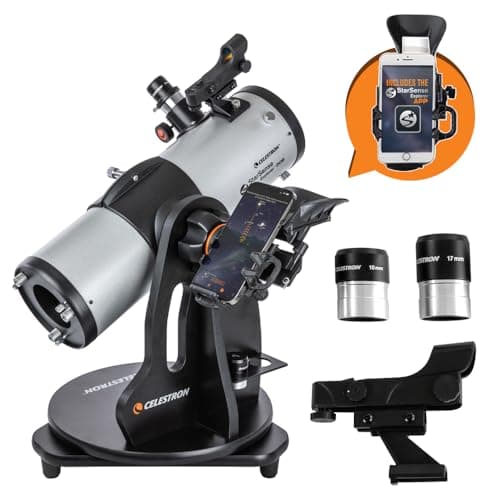 Celestron StarSense Explorer 114mm Tabletop Dobsonian 114mm of parabolic mirror gathers roughly 2.7 times the light of a 70mm refractor. | The deepest view on this site | |
| 3 | 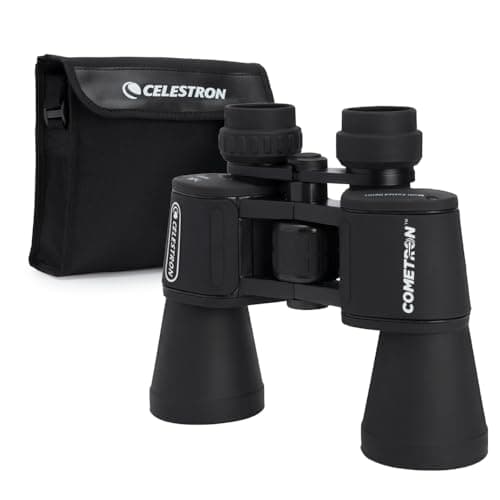 Celestron Cometron 7x50 A 6.6 degree field and a 7.1mm exit pupil — the whole Pleiades at once, no setup. | The widest, brightest view of all |
Rows link to the full write-up further down this page. Prices come from the live price layer only; where there is no live figure the button reads “Check price” rather than showing a number we remembered.
The four things that change what you see more than aperture
- Dark adaptation. Twenty minutes minimum, forty for the full effect, and one white phone screen resets it. This is worth more than doubling your aperture on faint targets.
- Altitude. Anything below about 30 degrees above the horizon is being viewed through a great deal more atmosphere. The same planet looks transformed an hour later when it has climbed.
- Steady air. Some nights the atmosphere is turbulent and high magnification simply will not hold. Nothing is wrong with the telescope. Drop to lower power and enjoy a sharp small image.
- Knowing where to point. The biggest one, and the reason a phone-guided telescope can genuinely show a beginner more than a larger telescope they cannot aim.
How to set expectations with the child, without deflating them
Do not oversell and do not undersell. The framing that works is: *we are going to see real things with our own eyes, and they will be small — and small and real beats big and printed.*
Then start with the Moon, which over-delivers on every telescope ever made, and let the first night do the persuading. If the first night has already gone wrong, why can't I see anything is the recovery plan, and your first night with a telescope is the sequence to follow next time.
Questions people actually ask
- Can you see Saturn's rings with a kids' telescope?
- Yes. A 70mm telescope at about 50x shows the rings as a distinct oval around the planet. You will not resolve the Cassini division, but the rings themselves are unmistakable.
- Why do nebulae look gray and not colorful?
- Photographs are long exposures; your eye is not. Color perception also fails at very low light levels, so faint deep-sky objects appear gray through every telescope at every price.
- Can you see galaxies with a beginner telescope?
- Andromeda, as an oval smudge, under a dark sky. Spiral arms need a camera and a long exposure — no visual telescope at any price shows them the way a photograph does.
- What is the best thing to look at with a kids' telescope?
- A half Moon. It is bright, easy to find, holds still in the eyepiece and over-delivers on every telescope ever built. Jupiter is the natural second target.
- Does more aperture always mean seeing more?
- Not on night one. Dark adaptation, target altitude, steady air and knowing where to point all matter more than the difference between 70mm and 114mm.
Sources
Read next
Where to go from here
- The best telescope for deep space
Galaxies and nebulae are won with aperture and dark skies, never magnification. What limiting magnitude means in practice, and the telescopes that reach deepest here.
- Telescopes
Four age bands, two budget gates, and the honest arithmetic behind every pick.
- The best telescope for a 9 or 10 year old
Nine and ten is the first band where a bigger, heavier telescope is a better telescope. Four picks and the arithmetic behind the jump.
- The best binoculars for stargazing with kids
The exit pupil calculation that decides which binoculars suit a child, and what a 7x50 actually shows on a first clear night.
- Why can't I see anything through my telescope?
The ranked causes of a telescope that shows nothing, most common first, each with a fix you can do tonight without tools.
- The best kids' telescope to see planets
Planets are the one thing every child asks about. Which telescopes show them properly, and what Jupiter and Saturn genuinely look like at this aperture.
- Your first night with a telescope
Do these eight things in this order and night one works. Most first nights fail on sequence, not on equipment.
- Do you need a moon filter?
Transmission percentage against your aperture decides which filter to buy — or whether to skip it and observe a crescent instead. Three options, and the free alternative.