Telescopes
The best telescope for deep space
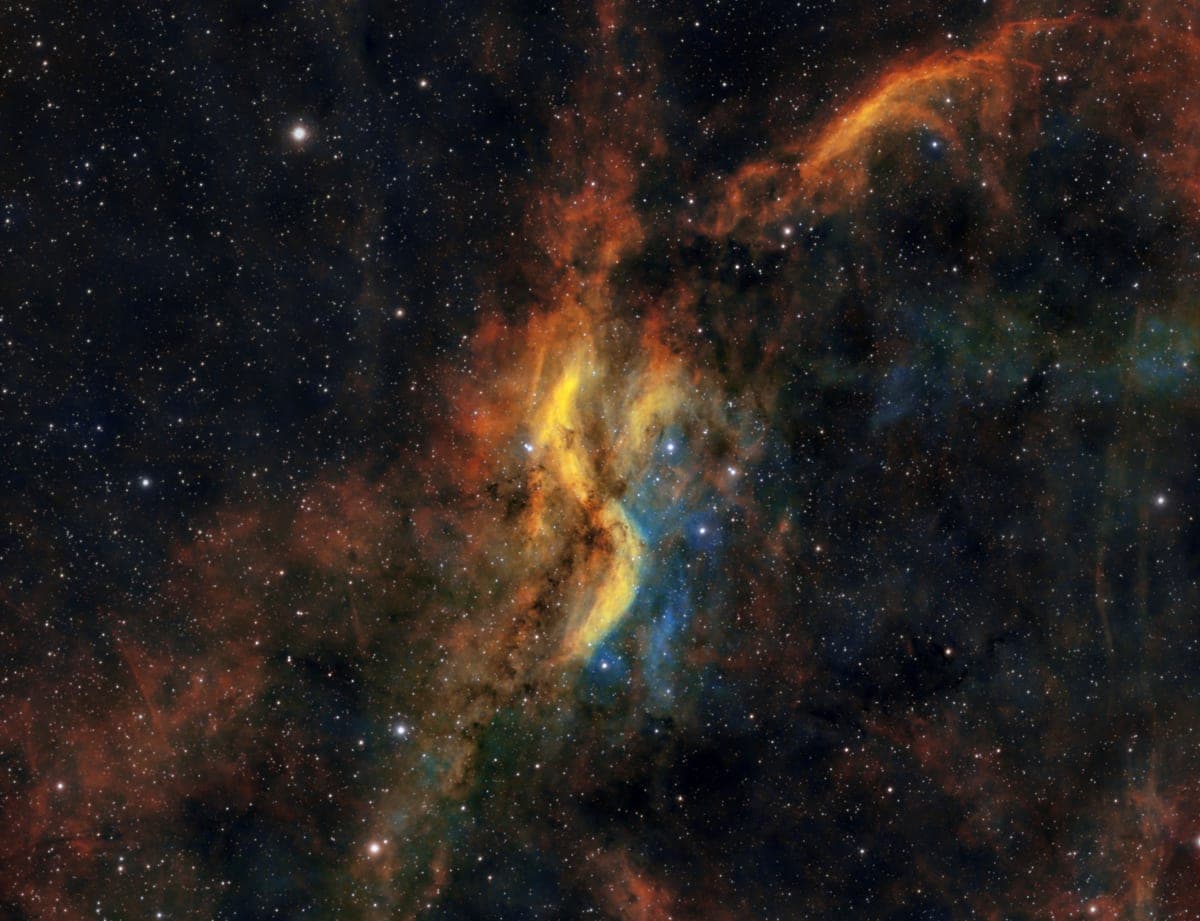
Faint fuzzies are an aperture problem and a darkness problem. Magnification is neither.
By Scooter M. · published September 13, 2026
I'm not an astronomer and I don't have a lab. I'm someone who's genuinely into this — I read the manuals, compile the published specs, and do the arithmetic the box doesn't do for you. No lab coat. How we pick.
How this is funded. Lens & Lightyear earns a commission when you buy through a link on this page, at no extra cost to you. It does not change which products we pick or what we say about them — every card below carries a real reason to skip it. Prices are pulled live and were last verified October 18, 2026. Full disclosure.
The short answer
Buy the largest aperture you can actually set up, and drive somewhere dark. Deep-sky objects are faint and extended, so they are won with light-collecting area and sky darkness — never with magnification. A 130mm under a dark sky beats a 200mm from a lit street.
This is the page where the site's usual advice inverts. Everywhere else we argue that aperture is oversold relative to weight and usability. For faint fuzzies, aperture genuinely is the thing — and so is the one variable no telescope can fix.
What limiting magnitude actually tells you
Manufacturers publish a limiting stellar magnitude: the faintest star the telescope should show under good conditions. The scale runs backwards — bigger numbers mean fainter objects — and it is logarithmic, so the differences are larger than they look.
| Aperture | Published limiting magnitude | Light vs a 7mm eye pupil |
|---|---|---|
| 70mm refractor | 11.7 | about 100x |
| 80mm refractor | 12.0 | about 131x |
| 102mm refractor | 12.5 | about 212x |
| 114mm reflector | 12.8 | about 265x |
| 130mm reflector | Not published by Sky-Watcher | about 345x |
Limiting magnitudes are each manufacturer's published figure. The light column is our arithmetic — aperture divided by a 7mm dark-adapted pupil, squared. We leave the Heritage's magnitude blank because Sky-Watcher does not publish one.
Two cautions about that column. It describes point sources — stars. Galaxies and nebulae are extended objects whose light is spread across an area, so they are harder than their cataloged magnitude suggests. And every figure assumes a dark sky, which brings us to the part no telescope solves.
The light pollution problem, honestly
Sky brightness is the dominant variable in deep-sky observing, and it is the one people try hardest to buy their way out of. You cannot. Aperture collects more object light and more sky glow at the same time, so under a bright sky the contrast between them barely improves.
- The Moon and planets are immune. They are bright enough to punch through almost any sky, which is why our city advice everywhere else is cheerful.
- Faint galaxies are not. Under a heavily lit sky, most are simply not there at any aperture you can carry.
- Driving beats spending. Twenty minutes toward darker sky does more for a faint object than doubling your aperture does. It is also free.
- A filter is not a fix. Narrowband filters help on some emission nebulae by cutting specific wavelengths, and do nothing at all for galaxies, which emit across the spectrum.
Quick picks
Telescopes that reach deepest
| # | Product | Best for | Price |
|---|---|---|---|
| 1 | 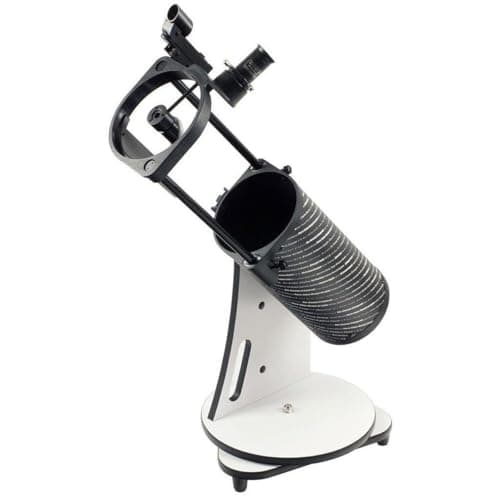 Sky-Watcher Heritage 130 Tabletop Dobsonian 130mm of parabolic mirror — roughly 345 times the light of a dark-adapted human eye. | The most light-gathering we recommend | |
| 2 | 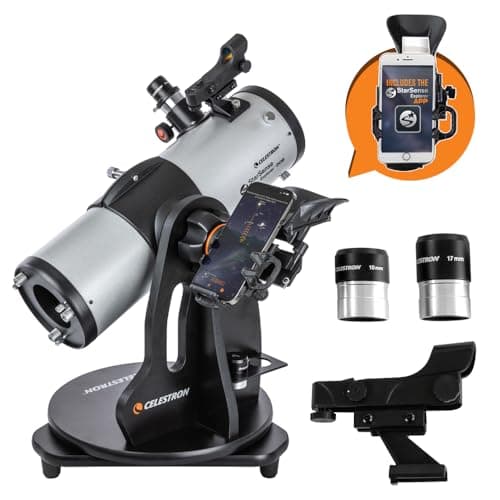 Celestron StarSense Explorer 114mm Tabletop Dobsonian A published limiting stellar magnitude of 12.8, and an app that puts faint targets in the field. | The deepest published figure here, plus help finding it | |
| 3 | 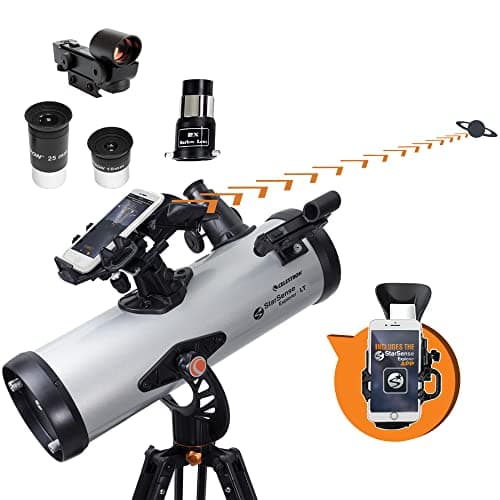 Celestron StarSense Explorer LT 114AZ 114mm and a 12.8 limiting magnitude, with its own 52-inch tripod. | The same reach, on a tripod instead of a table |
Rows link to the full write-up further down this page. Prices come from the live price layer only; where there is no live figure the button reads “Check price” rather than showing a number we remembered.
What you will realistically see
Set expectations here rather than after the box is open, because deep-sky is where the gap between photographs and eyepieces is widest.
| Target | 114mm-130mm, dark sky | The same telescope, lit sky |
|---|---|---|
| Orion Nebula | Bright, structured, four Trapezium stars | Visible but flat and gray |
| Andromeda Galaxy | A large obvious oval core | A faint smudge, if at all |
| Pleiades and open clusters | Excellent — resolves into many stars | Still very good |
| Globular clusters (M13) | Grainy ball, edges starting to resolve | Dim round glow |
| Ring Nebula | A small distinct smoke ring | Usually not visible |
| Spiral arms in any galaxy | No — that needs a camera | No |
| Color in nebulae | No — the eye cannot see color at low light | No |
The last two rows are the ones that cause disappointment, and they are true at every aperture and every price. Photographs are long exposures; the human eye cannot accumulate light. The full target-by-target picture is on what you can actually see.
A realistic first deep-sky list, in order of difficulty
Deep-sky observing rewards working up a ladder rather than starting with the famous targets. This order builds confidence and teaches the skill of seeing faint things, which is genuinely a learned skill rather than an equipment property.
| Target | Difficulty | What to expect at 114-130mm |
|---|---|---|
| The Pleiades | Easy | Brilliant blue-white stars; use your lowest power, it is large |
| Orion Nebula | Easy | Obvious gray-green cloud with four Trapezium stars inside it |
| Andromeda Galaxy | Moderate | A large oval core; the disc extends further than you first think |
| Hercules Cluster (M13) | Moderate | A grainy ball that starts resolving into individual stars at higher power |
| Ring Nebula (M57) | Harder | A small, distinct smoke ring — surprisingly obvious once found |
| Whirlpool Galaxy (M51) | Hard | Two faint smudges under a dark sky; spiral structure needs a camera |
| Horsehead Nebula | Do not start here | Effectively a photographic target, not a visual one |
Difficulty assumes a reasonably dark sky. Under heavy light pollution the bottom half of this table largely disappears, whatever the aperture.
Two techniques matter more than another 16mm of aperture. Averted vision — looking slightly to one side of a faint object — uses the more light-sensitive part of the retina and genuinely reveals detail that vanishes when you look straight at it. And time at the eyepiece: faint structure emerges over a minute or two of steady looking, which children and impatient adults both tend to skip.
What to buy alongside
- A red torch. Dark adaptation takes twenty to thirty minutes and one white screen resets it. On faint objects this matters more than an aperture upgrade, and costs a fraction. See the stargazing night kit.
- One low-power, wide-field eyepiece. Deep-sky wants the widest true field you can get, not the highest power. This is the opposite of the planetary upgrade path.
- Nothing else, yet. Filters, camera adapters and eyepiece sets are where beginner budgets go to die — see the space gifts not to buy.
We have not handled any of these telescopes. Every published figure above is linked to the manufacturer page it came from, and every derived number is arithmetic you can repeat. Our method is on the methodology page.
Questions people actually ask
- What telescope is best for deep space objects?
- The largest aperture you can realistically set up, used under the darkest sky you can reach. A 114mm to 130mm reflector is the practical sweet spot before weight starts preventing use.
- Can you see galaxies with a beginner telescope?
- Andromeda and a handful of brighter galaxies, as oval smudges, under a genuinely dark sky. Spiral arms need a camera and a long exposure — no visual telescope shows them at any price.
- Does magnification help with deep space objects?
- Almost never. Faint extended objects want a wide field and maximum light, so low power usually shows them better. Magnification spreads the same light over a larger, dimmer image.
- Do light pollution filters work?
- On some emission nebulae, yes — they cut specific wavelengths of skyglow. On galaxies they do essentially nothing, because galaxies emit across the whole spectrum that the filter is blocking.
- What is averted vision?
- Looking slightly to one side of a faint object rather than straight at it. The off-center part of the retina is more light-sensitive, so faint galaxies and nebulae often appear noticeably brighter when you are not looking directly at them.
- How dark does the sky need to be for deep space objects?
- Darker than most gardens. The Moon and planets are immune to light pollution, but faint galaxies largely disappear under a bright sky at any aperture — which is why driving twenty minutes out beats buying a bigger telescope.
- What does limiting stellar magnitude mean?
- The faintest star a telescope should reveal under good conditions. The scale runs backwards, so 12.8 is fainter than 11.7, and it assumes a dark sky — extended objects like galaxies are harder than their cataloged magnitude suggests.
Sources
Read next
Where to go from here
- The best kids' telescope to see planets
Planets are the one thing every child asks about. Which telescopes show them properly, and what Jupiter and Saturn genuinely look like at this aperture.
- The best telescopes under $500
Between $200 and $500 you can have aperture, a parabolic mirror, or guided finding — but not all three. What each choice costs, and who should make which.
- What you can actually see with a kids' telescope
The honest target-by-target list for 70mm, 76mm and 114mm telescopes, so nobody is disappointed on night one.
- Sky-Watcher Heritage 130 review
130mm of parabolic mirror that collapses for storage. The biggest single jump in what a child can see, and the planning problem that comes with it.
- Celestron StarSense Explorer LT 114AZ review
114mm of aperture that brings its own tripod. Same published ceiling as the tabletop Dobsonian, a spherical mirror instead of parabolic, and why f/9 makes that fine.
- The stargazing night kit
A red torch does more for what a child sees than doubling the aperture. The full kit, in order of how much it changes.
- The best telescope for viewing planets and galaxies
Planets want magnification and contrast; galaxies want aperture and a wide field. The trade explained with published numbers, and the telescopes that split the difference honestly.
- Sky-Watcher Heritage 150 review
150mm f/5 parabolic optics on a collapsible tabletop base. The aperture arithmetic against the Heritage 130 — including where our figure and Sky-Watcher's disagree — and what the maker leaves unpublished.
- Sky-Watcher Virtuoso GTi 150P review
150mm f/5 parabolic optics on a Wi-Fi GoTo tabletop mount that also moves by hand. The arithmetic on why tracking matters, and the two cheaper ways to solve the same problem.