Telescopes
Celestron StarSense Explorer LT 114AZ review
The same 114mm as our tabletop pick, on a tripod — and a different mirror entirely.
By Scooter M. · published September 13, 2026
I'm not an astronomer and I don't have a lab. I'm someone who's genuinely into this — I read the manuals, compile the published specs, and do the arithmetic the box doesn't do for you. No lab coat. How we pick.
How this is funded. Lens & Lightyear earns a commission when you buy through a link on this page, at no extra cost to you. It does not change which products we pick or what we say about them — every card below carries a real reason to skip it. Prices are pulled live and were last verified October 18, 2026. Full disclosure.
The short answer
Buy it when you want 114mm of aperture and do not have a solid outdoor surface. It matches the tabletop 114mm on aperture, published ceiling and limiting magnitude, brings its own 52-inch tripod, and weighs 2.2 lbs less. Its mirror is spherical rather than parabolic, which at f/9 is a fair trade.
Two telescopes in this range carry 114mm and the StarSense app, and people assume they are the same telescope on different legs. They are not, and the difference is the mirror.
Spherical versus parabolic, honestly
A spherical mirror is easier and cheaper to grind than a parabolic one, and it does not bring all incoming light to a single focus — the error is called spherical aberration. That sounds damning until you look at when it actually matters.
The severity depends on focal ratio. At fast ratios the error is large and visible; as the optic slows it falls away quickly. At f/9, which is what this telescope is, a spherical mirror of this aperture is a legitimate engineering choice rather than a corner cut. At the tabletop model's f/4, it would not be — which is precisely why that model uses a parabolic mirror and costs what it costs.
The two 114mm telescopes, side by side
| LT 114AZ (this one) | 114mm Tabletop Dobsonian | |
|---|---|---|
| Aperture | 114mm | 114mm |
| Focal length / ratio | 1000mm, f/9 | 450mm, f/4 |
| Primary mirror | Spherical | Parabolic |
| Mount | Full tripod, 52 in | Tabletop base — needs a surface |
| Eyepieces supplied | 25mm + 10mm, plus 2x Barlow | 17mm + 10mm |
| What those give | 40x / 100x, or 80x / 200x | 26x / 45x |
| Share of ceiling in the box | about 74% | about 17% |
| Published ceiling | 269x | 269x |
| Limiting magnitude | 12.8 | 12.8 |
| Total kit weight | 10.4 lbs | 12.6 lbs |
Both columns from Celestron's own published specification pages. Bold marks the advantage in each row; the aperture rows are identical because the aperture is identical.
Read that table and the choice resolves to one question: do you have a solid outdoor surface at the child's chest height? If yes, the tabletop's parabolic mirror and wide low-power field make it the better telescope. If no, this one is the only one of the two that works at all.
Quick picks
The LT 114AZ against the other 114mm
| # | Product | Best for | Price |
|---|---|---|---|
| 1 | 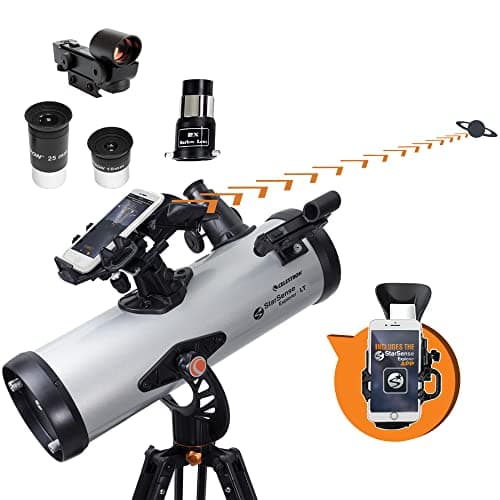 Celestron StarSense Explorer LT 114AZ A 12.8 limiting magnitude on its own 52-inch tripod, with the phone finding targets. | 114mm of aperture without needing a table | |
| 2 | 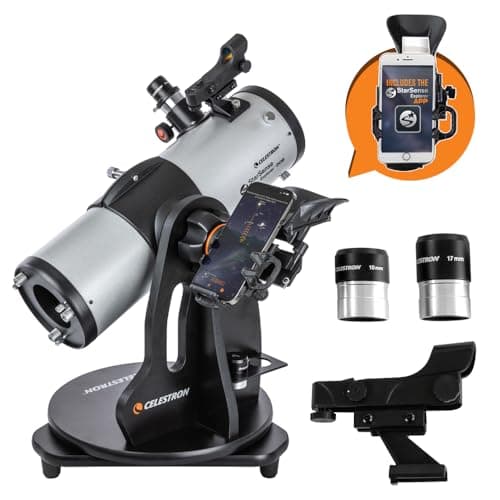 Celestron StarSense Explorer 114mm Tabletop Dobsonian Parabolic mirror rather than spherical, and the most aperture per pound on this site. | Better optics, if you have the surface | |
| 3 | 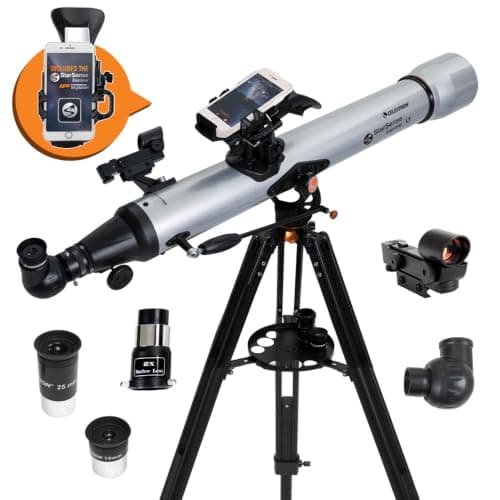 Celestron StarSense Explorer LT 80AZ 80mm at f/11 with 95 percent of its ceiling supplied, and a sealed tube. | Half the light, but a finished box and no collimation |
Rows link to the full write-up further down this page. Prices come from the live price layer only; where there is no live figure the button reads “Check price” rather than showing a number we remembered.
What the long focal length changes
1000mm is more than twice the tabletop's 450mm, and that shows up everywhere in how the telescope behaves.
- Higher magnification from the same eyepieces. A 10mm gives 100x here and 45x on the tabletop. For planets that is a genuine advantage straight out of the box.
- A narrower field. The flip side: sweeping for a target is slower, and wide objects like the Pleiades no longer fit. The app removes most of the pain of finding things, but not the framing limit.
- A longer tube, and more leverage on the mount. Aim, let go completely, and wait a few seconds before looking. This habit matters more here than on any other telescope we recommend.
- Spherical aberration stops mattering. As above — f/9 is slow enough that the cheaper mirror is not costing you a visible amount.
Collimation, and who should own it
Every Newtonian needs its mirrors kept aligned, and knocks gradually put them out. It is a ten-minute job the first time and five minutes after that; neglected, stars go slightly soft rather than anything breaking.
A careful eleven or twelve-year-old can genuinely own this task, and it is one of the more satisfying things to hand over. If that sounds like something your household will never do, the LT 80AZ is a sealed refractor and the honest alternative. The full design comparison is on refractor vs reflector for kids.
What we did and did not do
We have not handled this telescope. Every specification is from Celestron's own published page, linked below and checked on the date at the top of this page, and every comparison is arithmetic on those published figures. No price appears in this prose. Our method is on the methodology page.
The picks in full
Pick 1
Celestron StarSense Explorer LT 114AZ
114mm of aperture without needing a table
The arithmetic
The same 114mm aperture as the tabletop Dobsonian, the same published 269x ceiling and the same 12.8 limiting magnitude — but a completely different instrument: 1000mm at f/9 on its own full-height tripod, against 450mm at f/4 on a base that needs a table. The mirror here is SPHERICAL rather than parabolic, and at f/9 that is a legitimate engineering choice rather than a corner cut: spherical aberration only becomes visible at fast focal ratios. 1000mm over the supplied eyepieces gives 40x and 100x, or 80x and 200x with the Barlow — about 74 percent of the ceiling in the box.
This is the telescope that answers the single most common objection to our tabletop pick. Same 114mm aperture, same published 269x ceiling, same 12.8 limiting stellar magnitude — and it stands on its own full-height tripod, so the garden-table problem disappears.
It gets there differently. 1000mm at f/9 against the tabletop's 450mm at f/4. The long focal length is why the supplied 25mm and 10mm give 40x and 100x here rather than 26x and 45x, and with the 2x Barlow you reach 200x against the 269x ceiling — about 74 percent of the telescope in the box.
It is also 10.4 lbs against the tabletop's 12.6, and that 2.2 lb saving comes with a tripod rather than instead of one.
The honest cost of the tripod is stability: a 1000mm tube on a light alt-azimuth mount has more leverage to wobble than a Dobsonian base sitting flat on a table. Let go of it after aiming and give it a few seconds.
Skip it if
You want a sealed, maintenance-free tube. This is a Newtonian: the mirrors drift out of alignment eventually, and on an alt-azimuth mount the eyepiece ends up at awkward angles when you point near the zenith.
| Optical design | Newtonian reflector, spherical primary mirror |
|---|---|
| Aperture | 114mm (4.5") |
| Focal length | 1000mm (39.3") |
| Focal ratio | f/9 |
| Eyepieces supplied | 25mm (40x) and 10mm (100x) |
| Barlow | 2x (1.25") |
| Finderscope | StarPointer red dot |
| Mount | Manual alt-azimuth |
| Tripod | 1320.8mm (52") max height |
| Highest useful magnification | 269x |
| Limiting stellar magnitude | 12.8 |
| Total kit weight | 10.4 lbs (4.71 kg) |
| Phone requirement | Android 12 and later; iOS 18 and newer, iPhone XR and newer |
| What the box does not do | No case. The long tube on an alt-azimuth mount means the eyepiece ends up in awkward positions near the zenith, which is the standard Newtonian-on-a-tripod compromise. Being a reflector it will eventually need collimation, which the refractors in this range never do. |
Specifications from Celestron — StarSense Explorer LT 114AZ specifications. We have not handled this one — everything above is the published spec sheet plus our own arithmetic on it.
Pick 2
Celestron StarSense Explorer 114mm Tabletop Dobsonian
Better optics, if you have the surface
The arithmetic
A parabolic mirror rather than the spherical one in cheaper reflectors, which is what keeps a fast f/4 sharp at the edges. 114mm gathers roughly 2.7 times the light of a 70mm refractor, and the published limiting magnitude of 12.8 is the deepest on this site. The supplied eyepieces only reach 45x against a 269x ceiling, so the box gives you wide, bright, easy views and leaves the high-power ones to buy later.
The optical case for the tabletop is the mirror: parabolic rather than spherical. At its f/4 that is not optional — a spherical mirror that fast visibly smears stars toward the edge of the field.
It also delivers about 9.0mm of aperture per pound carried against this model's 11.0mm per pound, though that comparison flatters the LT because its weight includes a tripod the Dobsonian does not have.
If you have a table, the tabletop is the better instrument. If you do not, it is not an instrument at all. Full review.
Skip it if
There is no solid outdoor surface at the child's chest height. No tripod is included and none is offered for it.
| Optical design | Newtonian reflector, parabolic primary mirror |
|---|---|
| Aperture | 114mm (4.48") |
| Focal length | 450mm (17.71") |
| Focal ratio | f/4 |
| Eyepieces supplied | 17mm (26x) and 10mm (45x) |
| Finderscope | StarPointer red dot |
| Mount | Alt-azimuth tabletop Dobsonian base |
| Highest useful magnification | 269x |
| Limiting stellar magnitude | 12.8 |
| Total kit weight | 12.6 lbs (5.71 kg) |
| What the box does not do | No tripod — it is a tabletop instrument and needs a solid surface at the right height, which is a real planning problem in a garden. A reflector's mirror can drift out of alignment; expect to learn collimation eventually. |
Specifications from Celestron — StarSense Explorer 114mm Dobsonian specifications. We have not handled this one — everything above is the published spec sheet plus our own arithmetic on it.
Pick 3
Celestron StarSense Explorer LT 80AZ
Half the light, but a finished box and no collimation
The arithmetic
900mm over the supplied 25mm and 10mm gives 36x and 90x, and the included 2x Barlow doubles those to 72x and 180x against a published 189x ceiling. That is about 95 percent of the telescope in the box — the highest share of any StarSense on this site, and unusual at any price. At f/11 this is among the slowest, most color-corrected refractors we list (only the f/13 AstroMaster 70AZ is slower): false color on a bright Moon is minimal and focus is forgiving. 80mm collects about 1.3 times the light of a 70mm. The cost is length and weight — 9.2 lbs and a long tube that a breeze will find.
The refractor alternative at a similar price, and the trade is clean: you give up about half the light and you gain a sealed tube that never needs aligning.
You also gain the most complete eyepiece set in the range — 95 percent of its published ceiling in the box, against 74 percent here.
For a younger child, or a household that will never learn collimation, that is a reasonable swap. Full review.
Skip it if
Faint objects are the point. 80mm reaches a published limiting magnitude of 12 against this model's 12.8, and no eyepiece closes that gap.
| Optical design | Refractor |
|---|---|
| Aperture | 80mm (3.1") |
| Focal length | 900mm (35.43") |
| Focal ratio | f/11 |
| Eyepieces supplied | 25mm (36x) and 10mm (90x) |
| Barlow | 2x (1.25") |
| Finderscope | StarPointer red dot |
| Mount | Manual alt-azimuth with altitude slow-motion adjustment |
| Tripod | 1320.8mm (52") max height |
| Highest useful magnification | 189x |
| Limiting stellar magnitude | 12 |
| Total kit weight | 9.2 lbs (4.17 kg) |
| Phone requirement | Android 12 and later; iOS 18 and newer, iPhone XR and newer |
| What the box does not do | No case, and the tube's length makes it awkward for a small child to carry assembled. The phone requirement is a hard gate: Android 12+ or iOS 18+ on an iPhone XR or newer, and without the app this is an ordinary 80mm refractor bought at a guided price. |
Specifications from Celestron — StarSense Explorer LT 80AZ specifications. We have not handled this one — everything above is the published spec sheet plus our own arithmetic on it.
Questions people actually ask
- Is the StarSense Explorer LT 114AZ good for a beginner?
- Yes. It pairs 114mm of aperture with phone-guided finding and its own tripod, so it needs no table and no star-hopping skill. It is a reflector, so expect to learn collimation eventually.
- Is a spherical mirror bad?
- Not at this focal ratio. Spherical aberration grows as an optic gets faster; at f/9 it is negligible for a 114mm mirror. It would be a real problem at f/4, which is why the tabletop 114mm uses a parabolic mirror instead.
- What is the difference between the LT 114AZ and the 114mm tabletop Dobsonian?
- Same aperture, ceiling and limiting magnitude. The LT is 1000mm at f/9 with a spherical mirror on a tripod; the tabletop is 450mm at f/4 with a parabolic mirror and needs a solid surface to stand on.
- What can you see with the LT 114AZ?
- The Moon in high detail, Jupiter's cloud belts and moons, Saturn's rings clearly separated, the Orion Nebula with structure, and many clusters. Its published limiting magnitude of 12.8 is the deepest figure we list.
- Does the LT 114AZ come with a tripod?
- Yes — a full-height alt-azimuth tripod with a 52 inch maximum height, which is the main practical advantage over the tabletop 114mm.
Sources
Read next
Where to go from here
- Celestron StarSense Explorer DX 102AZ review
102mm of sealed refractor on the steadiest mount in the StarSense range. What dual-axis slow-motion controls are worth, and why a cheaper sibling out-apertures it.
- Celestron StarSense Explorer DX 130AZ review
130mm f/5 parabolic optics with phone guidance and dual-axis slow-motion controls, at 18 lbs. The arithmetic on what the box reaches, and the two cheaper routes to the same mirror.
- Celestron StarSense Explorer 114mm review
114mm of parabolic mirror plus phone-guided finding — the telescope we recommend more than any other here. What that combination buys, and the one thing it demands.
- Celestron StarSense Explorer LT 80AZ review
80mm of slow, color-corrected glass with phone-guided finding — and the supplied eyepieces reach 95 percent of its published ceiling, which nothing else here does.
- Which Celestron StarSense Explorer is best for a kid?
LT 70AZ, DX 102AZ or the 114mm tabletop Dobsonian? Compared on published specs, weight, and what the box actually gives you against what it could.
- Refractor or reflector for a child?
Mirrors are cheaper per millimeter of aperture; lenses never need aligning. Which trade suits which child, with the arithmetic on both.
- The best telescope for deep space
Galaxies and nebulae are won with aperture and dark skies, never magnification. What limiting magnitude means in practice, and the telescopes that reach deepest here.
- The best telescopes under $500
Between $200 and $500 you can have aperture, a parabolic mirror, or guided finding — but not all three. What each choice costs, and who should make which.
- Celestron PowerSeeker 127EQ review
The most aperture of any tripod telescope on this site, on an equatorial mount that needs balancing and polar alignment, with a Barlow that reaches two and a half times its own ceiling.