Telescopes
The best telescopes under $500
The band where you stop compromising on optics and start choosing between them.
By Scooter M. · published September 13, 2026
I'm not an astronomer and I don't have a lab. I'm someone who's genuinely into this — I read the manuals, compile the published specs, and do the arithmetic the box doesn't do for you. No lab coat. How we pick.
How this is funded. Lens & Lightyear earns a commission when you buy through a link on this page, at no extra cost to you. It does not change which products we pick or what we say about them — every card below carries a real reason to skip it. Prices are pulled live and were last verified October 18, 2026. Full disclosure.
The short answer
Between $200 and $500 you can buy serious aperture, a parabolic mirror, or phone-guided finding — realistically two of the three. Choose aperture if someone already knows the sky, guided finding if nobody does, and check whether a tabletop model's missing tripod is a dealbreaker before anything else.
This is the first band where nothing is compromised to hit a price. Below it you are working around limitations; here you are choosing between genuine strengths, which is a much better problem and a slightly harder one.
What the money buys here that it did not below
| Band | What changes | Where it leaves you |
|---|---|---|
| Under $100 | 70-76mm of honest optics, basic mount, no finding help | Viable. See under $100. |
| $100 - $200 | A real tripod, a red dot finder, sometimes guided finding | The sweet spot for a first telescope. See under $200. |
| $200 - $500 | 102-130mm aperture, parabolic mirrors, guided finding | Faint objects become genuinely visible rather than rumored. |
| Over $500 | More aperture, tracking mounts, serious weight | Not for a child. The weight alone stops unsupervised use. |
The practical difference is what a dark night shows. At 70mm, Andromeda is a faint smudge you have to believe in. At 114mm to 130mm it is an obvious oval, the Orion Nebula has structure, and a dozen clusters resolve into individual stars. That is the step this band buys.
Quick picks
Telescopes under $500
| # | Product | Best for | Price |
|---|---|---|---|
| 1 | 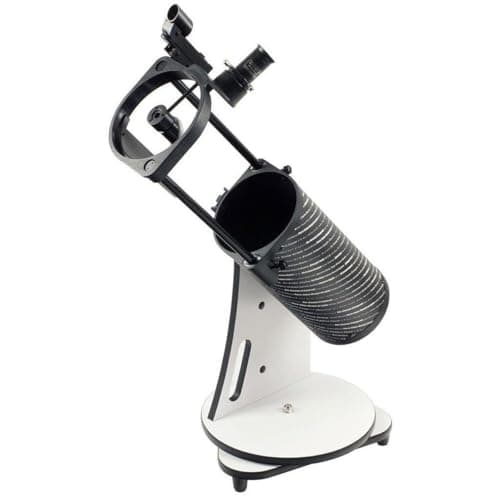 Sky-Watcher Heritage 130 Tabletop Dobsonian 130mm of parabolic mirror — about 3.4 times the light of a 70mm, and it collapses for storage. | The most light in the band | |
| 2 | No image Celestron StarSense Explorer DX 102AZ 102mm on a full 49-inch tripod with app-guided finding and a 240x published ceiling. | The most capable refractor here | |
| 3 | 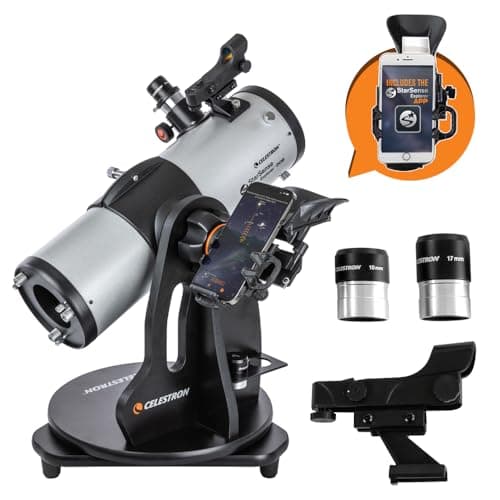 Celestron StarSense Explorer 114mm Tabletop Dobsonian 114mm of parabolic mirror plus the app, at the bottom of this band rather than the top. | Aperture and guided finding together, cheapest |
Rows link to the full write-up further down this page. Prices come from the live price layer only; where there is no live figure the button reads “Check price” rather than showing a number we remembered.
The three-way trade, stated plainly
| Heritage 130 | StarSense DX 102AZ | StarSense 114mm Dob | |
|---|---|---|---|
| Aperture | 130mm | 102mm | 114mm |
| Light vs a 70mm | about 3.4x | about 2.1x | about 2.7x |
| Mount | Tabletop — needs a surface | Full tripod, 49 in | Tabletop — needs a surface |
| Finding help | Finderscope only | App-guided | App-guided |
| Maintenance | Collimation eventually | None — sealed refractor | Collimation eventually |
| Weight | Not published by Sky-Watcher | 14.2 lbs | 12.6 lbs |
| Price within the band | Middle | Top | Bottom |
Bold marks the advantage in each row. No column wins outright, which is the actual finding — these are three different answers to three different households.
Which one, by household
- An adult already knows the sky, and you have a garden table → the Heritage 130. Most light per dollar in the band and nothing wasted on finding help you do not need.
- Nobody can find anything, and there is no table → the DX 102AZ. The only pick here that solves both problems at once.
- Nobody can find anything, but you do have a table → the 114mm tabletop. The same app for less money, with more aperture than the DX.
- The child must set up alone → none of these comfortably. Drop to under $200, where 7.4 lb kits live.
Manual or motorized at this price
Around $500 the first motorized and GoTo mounts start appearing, and they are tempting for the same reason phone-guided finding is: they promise to remove the hard part. For a child, we would still take the manual telescope, and the reason is where the money goes.
- A motor has to be paid for out of the same budget. At a fixed price, every dollar spent on electronics is a dollar not spent on aperture — and aperture is the only thing that changes what is visible.
- Batteries and alignment become part of every session. A GoTo mount that needs a star alignment before it works is one more thing to fail on a cold evening with a child waiting.
- Phone-guided finding gets most of the benefit for far less. You still push the telescope by hand, but you always know where to push it.
- Manual teaches the sky. A child who star-hops learns where things are. A motor means the telescope knows and the child does not.
Motorized tracking genuinely matters for astrophotography, which is a different hobby with a different budget. For visual observing at this price, aperture plus guided finding beats a motor.
Where the last $50 should go
If you land under budget, the temptation is to stretch to the next telescope up. Usually the better return is elsewhere — and if you are shopping the band below this one, our picks are on telescopes under $300.
- A red torch, if you do not own one. Dark adaptation takes twenty to thirty minutes and one white light resets it — on faint objects this is worth more than the next aperture step.
- One good mid-range eyepiece, once you know which magnification you actually use.
- A tripod or a sturdy surface, if you bought a tabletop model and have been improvising. The base is only as good as what it stands on.
- Fuel to somewhere darker. For deep-sky objects this genuinely outperforms every hardware upgrade on this page, and it is on best telescope for deep space.
What none of them do
- None of them track. All three are manual: you nudge by hand as the sky moves, every 30 seconds or so at high power. Motorized tracking starts well above this band.
- None of them show color in faint objects. Nebulae are gray to the human eye at every aperture and price — the photographs are long exposures. See what you can actually see.
- None of them are astrophotography telescopes. That is a different hobby with a different budget, and a manual alt-azimuth mount is the wrong starting point for it.
We have not handled any of these telescopes. Every figure is from the manufacturer's own published page, linked on each product card; the comparisons are our arithmetic on those figures. Our method is on the methodology page.
Questions people actually ask
- What is the best telescope under $500?
- It depends on your household rather than the specs. The Heritage 130 gives the most light if someone already knows the sky; the StarSense DX 102AZ solves finding and needs no table; the 114mm tabletop gives aperture plus the app for less.
- Is a $500 telescope worth it over a $200 one?
- For faint objects, yes — 114mm to 130mm collects two to three times the light of a 70mm, which is the difference between a galaxy being rumored and being obvious. For the Moon and planets the gain is much smaller.
- What aperture can you get for under $500?
- Comfortably 102mm to 130mm. Above 130mm the weight starts to rule out unsupervised use by a child, which is why we do not push further in this band.
- Do telescopes under $500 track the sky automatically?
- No. Everything in this band is manual — you re-center by hand as the sky moves. Motorized tracking starts above it.
- Should I buy a GoTo or motorized telescope for under $500?
- For visual observing with a child, no. At a fixed budget every dollar spent on motors is a dollar not spent on aperture, and a GoTo mount adds batteries and an alignment routine to every session. Phone-guided finding gets most of the benefit for far less.
- Is a 130mm telescope too big for a child?
- Not optically — it is the most light we recommend for a child. The constraint is practical: a 130mm tabletop needs an adult to lift it onto a solid surface, so the child cannot start a session entirely alone.
- Do I need to buy extra eyepieces?
- On two of these three, eventually yes. The DX ships at about 28 percent of its published magnification ceiling and the tabletop at about 17 percent, so one good mid-range eyepiece is a sensible addition.
Sources
Read next
Where to go from here
- Celestron StarSense Explorer DX 102AZ review
102mm of sealed refractor on the steadiest mount in the StarSense range. What dual-axis slow-motion controls are worth, and why a cheaper sibling out-apertures it.
- The best beginner telescopes under $200
Between $100 and $200 you can buy a steady mount, real aperture, or phone-guided finding. What each of those is worth, with the arithmetic.
- Best telescopes under $300
Under $300 buys 130mm — nearly three times the light of the best telescope on our under-$100 page. Which of the four to buy depends on mirror figure, mount, and how much of the ceiling is actually in the box.
- Sky-Watcher Heritage 130 review
130mm of parabolic mirror that collapses for storage. The biggest single jump in what a child can see, and the planning problem that comes with it.
- The best telescope for deep space
Galaxies and nebulae are won with aperture and dark skies, never magnification. What limiting magnitude means in practice, and the telescopes that reach deepest here.
- The best telescope for an 11 or 12 year old
At eleven and twelve the child is the limiting factor no longer. Picks chosen on aperture and on what they will not outgrow in a year.
- The best beginner telescope
The four things that actually decide whether a first telescope gets used twice, and the picks that satisfy them. Including the case for buying binoculars instead.
- How much should you spend on a telescope for a child?
Band by band, what the money buys and where it stops helping. The jump from $60 to $150 matters more than the one above it.
- Celestron Inspire 100AZ review
100mm at 660mm f/6.5 with an integrated phone adapter, an erect image diagonal and a red flashlight in the box. The same optics as the DX 102AZ without the guidance app — and 1.8 lbs lighter.