Telescopes
Best telescopes under $300
The bracket where aperture finally arrives, and where two telescopes waste it.
By Scooter M. · published October 10, 2026
I'm not an astronomer and I don't have a lab. I'm someone who's genuinely into this — I read the manuals, compile the published specs, and do the arithmetic the box doesn't do for you. No lab coat. How we pick.
How this is funded. Lens & Lightyear earns a commission when you buy through a link on this page, at no extra cost to you. It does not change which products we pick or what we say about them — every card below carries a real reason to skip it. Prices are pulled live and were last verified October 18, 2026. Full disclosure.
The short answer
The Sky-Watcher Heritage 130. It is the only 130mm here with a parabolic mirror, which at f/5 is what keeps stars sharp across the field, and its tabletop base needs no assembly ritual. Choose the StarSense Explorer LT 114AZ instead if nobody in the house can find anything.
This is the bracket where aperture arrives. Below $200 you are choosing between 70mm and 80mm with the occasional 114mm; here, 130mm is routine. That is the biggest single jump in what a telescope can show you anywhere on the price ladder — and two of the four telescopes in it ship accessories that waste most of it.
What this bracket changes
Light gathering scales with the square of aperture, so the step up is larger than the numbers look. 130mm against the 76mm that leads our under-$100 page is 130 squared over 76 squared — about 2.9 times the light. Against a 70mm refractor it is roughly 3.4 times.
That is the difference between the Orion Nebula as a faint gray smudge and the Orion Nebula as a structured cloud with the Trapezium stars resolved inside it. It is not magnification — nothing here makes things bigger than a cheaper telescope can. It makes faint things visible at all, which is the thing beginners most often expect magnification to do. We work that distinction through on what you can actually see.
How we ranked these
Four criteria, applied in this order, before any product was placed. Aperture is the headline but it is not the tiebreaker, because in this bracket two telescopes share the same aperture and are not the same telescope.
- Mirror figure against focal ratio. A spherical mirror is fine at f/9 and visibly compromised at f/5. This is the one row that separates the two 130mm telescopes here, and it decided first place.
- How much of the telescope is in the box. Take the highest magnification the supplied eyepieces reach and divide it by the maker's own published ceiling. The spread across these four runs from 21 percent to 250 percent, and both ends are a problem.
- What has to happen before anyone looks at anything. A Dobsonian base is a surface and a push. A German equatorial is a counterweight, balancing in two axes and a latitude setting. For a gift, that gap matters more than a spec sheet row.
- Aperture per pound, where it is published. A telescope that does not get carried outside does not get used, and three of these four publish an assembled weight.
Two 130mm telescopes, same focal ratio, different mirror
This is the comparison that decided the ranking, and it is the thing we would most want a buyer in this bracket to know. Both telescopes are 130mm. Both are f/5. One has a parabolic primary and one does not.
| Heritage 130 | AstroMaster 130EQ | |
|---|---|---|
| Aperture | 130mm | 130mm — identical |
| Focal length / ratio | 650mm, f/5 | 650mm, f/5 — identical |
| Primary mirror figure | Parabolic, borosilicate | Spherical |
| Mirror coating | Radiant Aluminum Quartz | Not specified on the product page |
| Mount | Tabletop Dobsonian — no setup | CG-3 German equatorial |
| Needs a table | Yes | No — full tripod, 32-51 in |
| Published ceiling | Not published by Sky-Watcher | 307x |
| Supplied eyepieces | Not published by Sky-Watcher | 20mm + 10mm, no Barlow |
| Assembled weight | Not published by Sky-Watcher | 17 lbs |
Figures from Sky-Watcher USA's and Celestron's own published specification pages, linked at the foot of this page. Bold marks the better figure for a beginner. Where Sky-Watcher publishes nothing we say so rather than estimating.
At f/5 a spherical mirror cannot focus the edge of the field to the same point as the center — the departure from the ideal parabola is largest at fast focal ratios, which is why the same mirror figure is a non-issue on the f/9 telescope further down this page and a real one here. Buying the parabolic 130mm is the single highest-value decision available in this bracket.
What the AstroMaster gives you back is the mount. It stands on its own tripod at 32 to 51 inches, so there is no hunting for a garden table in the dark. If you have no solid outdoor surface at all, that reverses the order of these two — and it is a planning question, not a specification. The format trade is covered on tabletop vs tripod.
How much of each telescope is actually in the box
Take the highest magnification the supplied eyepieces can reach, divide by that model's own published ceiling, and the bracket sorts itself into an order nobody would guess from the prices.
| Model | Top magnification supplied | Published ceiling | Share of the telescope you get |
|---|---|---|---|
| StarSense Explorer LT 114AZ | 200x (10mm + the 2x Barlow) | 269x | about 74% |
| AstroMaster 130EQ | 65x (10mm, no Barlow) | 307x | about 21% |
| PowerSeeker 127EQ | 750x (4mm + the 3x Barlow) | 300x | 250% — it overshoots |
| Heritage 130 | Eyepieces not published | Not published | Cannot be calculated |
Arithmetic on the makers' published figures: focal length divided by eyepiece focal length, times any supplied Barlow, against that model's own stated ceiling.
Both failure modes on that table are real, and they are opposites. The AstroMaster leaves four fifths of its own aperture unreachable until you buy an eyepiece. The PowerSeeker ships a combination that goes two and a half times past the limit its own maker publishes, which produces a huge, dim, mushy image that makes a beginner conclude the telescope is broken.
The smallest-aperture telescope here is the only one whose box is honestly matched to its optics. That is worth sitting with, because the box is what decides the first night, and the first night is what decides whether the telescope gets used again. The same pattern across the StarSense range is on which StarSense Explorer, and the magnification claims that break the rule entirely are on toy brands vs real optics.
Quick picks
The four telescopes in this bracket, ranked
| # | Product | Best for | Price |
|---|---|---|---|
| 1 | 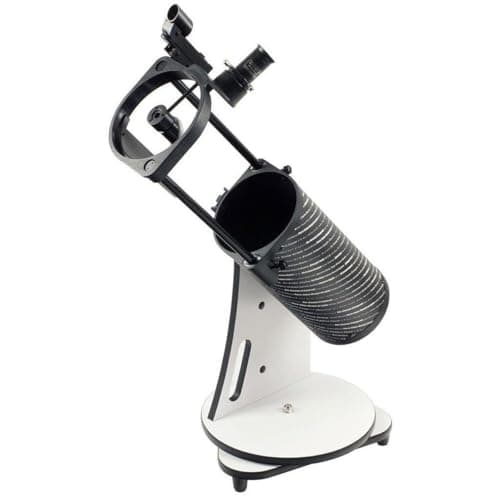 Sky-Watcher Heritage 130 Tabletop Dobsonian The only 130mm here with a parabolic mirror, on the only mount that needs no setup ritual. | Almost everyone in this bracket | |
| 2 | 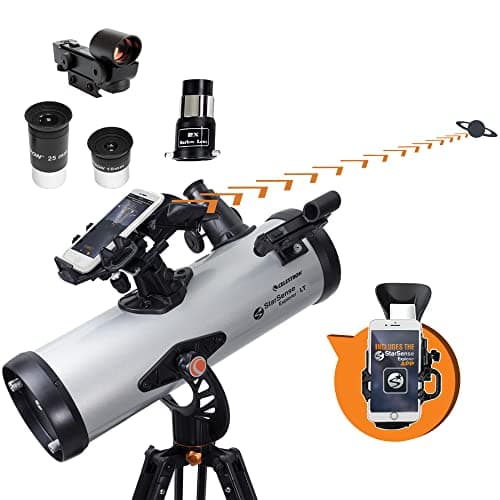 Celestron StarSense Explorer LT 114AZ The least aperture here and by far the most complete box — about 74 percent of its own ceiling, plus phone guidance and its own tripod. | A household where nobody can find anything in the sky | |
| 3 | 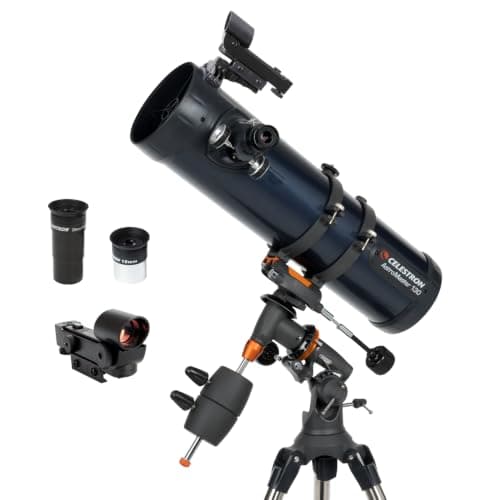 Celestron AstroMaster 130EQ 130mm and a published 13.1 limiting magnitude on a German equatorial — with a spherical mirror at f/5 and 21 percent of its ceiling in the box. | Someone who wants 130mm on a full-height tripod and will learn the mount | |
| 4 | 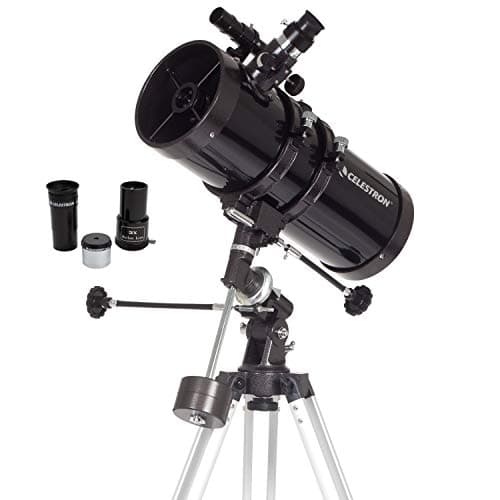 Celestron PowerSeeker 127EQ Real 127mm optics and a published limiting magnitude of 13, shipped with a Barlow that reaches two and a half times its own ceiling. | A patient teen or adult who wants to learn an equatorial mount cheaply |
Rows link to the full write-up further down this page. Prices come from the live price layer only; where there is no live figure the button reads “Check price” rather than showing a number we remembered.
Three mounts, three different jobs
Mount type separates these four more sharply than aperture does, because it decides what happens in the twenty minutes before anyone sees anything.
| Mount | On which model | What it asks of you |
|---|---|---|
| Tabletop Dobsonian | Heritage 130 | A solid surface at chest height. Then you push the tube. Nothing to assemble, nothing to align. |
| Alt-azimuth on a tripod | StarSense Explorer LT 114AZ | Stands on its own at up to 52 in. Up, down, left, right. Awkward eyepiece angles near the zenith. |
| German equatorial | AstroMaster 130EQ, PowerSeeker 127EQ | Counterweight fitted, balancing in two axes, a latitude setting, and polar alignment before it will track. A real skill, genuinely worth having — and not on a first night with a child. |
Mount descriptions from each maker's published specification page.
None of these four tracks a target by itself. On every one of them the object drifts out of the field as the Earth turns, and at higher magnification you re-center every thirty seconds or so. An equatorial mount makes that one smooth motion instead of two once it is polar aligned, which is the whole point of the format — and the reason it is the wrong format for a gift.
Weight, and who carries it outside
Three of the four publish an assembled weight. Dividing aperture by weight gives a blunt but useful figure for how much telescope you get per pound carried.
| Model | Published weight | Aperture per pound |
|---|---|---|
| StarSense Explorer LT 114AZ | 10.4 lbs | about 11mm per lb |
| PowerSeeker 127EQ | 13 lbs | about 9.8mm per lb |
| AstroMaster 130EQ | 17 lbs | about 7.6mm per lb |
| Heritage 130 | Not published by Sky-Watcher | Cannot be calculated |
Aperture in millimeters divided by published assembled kit weight in pounds. A rough figure, but it is the one that predicts whether a telescope gets carried outside on a cold night.
17 lbs is a two-hands, one-trip telescope, and under about twelve years old it means an adult sets it up every single time. That is most of why the AstroMaster 130EQ sits third on a page written for gift buyers rather than first on a page written for spec sheets.
Where this bracket stops
Just above this band the same Sky-Watcher tabletop Dobsonian is available in a 150mm version, which collects about 1.3 times the light of the 130mm for a real step up in bulk. If your ceiling is genuinely firm at $300 it is out of reach; if it is soft, it is the next thing worth looking at, and we review it on the Heritage 150 page.
Going the other way, if this bracket is more than you wanted to spend, the honest answer for a younger child is often not a telescope at all — a pair of 7x50 binoculars shows more on a first night and needs no setup. Our band-by-band view of what each level of spending actually buys is on how much to spend, and the neighboring brackets are under $200 and under $500.
What we did and did not do here
We have not handled any of these four telescopes and we do not say otherwise. Every figure above was read from the manufacturer's own published specification page for that model, re-checked on the date at the top of this page, and linked in the sources below. The light-gathering ratios, the share-of-ceiling percentages, the aperture-per-pound figures and the 60-times-inches check on the published ceilings are our arithmetic on those published figures, shown in full so you can redo every one of them.
Where a maker publishes nothing we say so instead of estimating. That is why the Heritage 130 — our first pick — has three empty rows in the tables above: Sky-Watcher does not publish its supplied eyepieces, its finderscope or its assembled weight, and inventing them would be the easiest lie on this page to get away with. Our full method is on the methodology page.
Prices on the buy buttons above come from the live price feed on the date shown beside them, never from us. If a figure is missing, the button says so and takes you to the retailer rather than showing a number we remembered.
The picks in full
Pick 1
Sky-Watcher Heritage 130 Tabletop Dobsonian
Almost everyone in this bracket
The arithmetic
130mm of aperture collects roughly 3.4 times the light of a 70mm refractor — the single biggest jump available at anything like gift money. At 650mm focal length, a common 25mm eyepiece gives 26x and a 10mm gives 65x. The rule of thumb astronomers use for a maximum useful magnification is about 2x the aperture in millimeters, which puts a sensible ceiling near 260x on a genuinely steady night.
Two things put this first, and neither is aperture — both 130mm telescopes here have the same 130mm.
The first is the mirror. Sky-Watcher publishes this primary as a borosilicate parabolic mirror with their Radiant Aluminum Quartz coating. The AstroMaster 130EQ below has the same 130mm aperture at the same f/5, and Celestron publishes its primary as spherical. At f/5 that distinction is not academic: a spherical mirror at a fast focal ratio cannot bring the edge of the field to the same focus as the center, which shows up as stars that soften as they move off-axis. Same aperture, same focal ratio, different optical figure.
The second is that there is nothing to get wrong. A Dobsonian base is two bearings and a locking knob — you put it on a surface and push the tube. No counterweight, no balancing in two axes, no latitude setting, no polar alignment. On a first night with a child losing interest by the minute, that is worth more than any specification.
650mm at f/5 means a 25mm eyepiece gives 26x and a 10mm gives 65x, and the tube collapses for storage with collimation retained. 130mm collects roughly 3.4 times the light of a 70mm refractor and about 2.9 times the 76mm that leads our under-$100 page.
The honest gap is the published data. Sky-Watcher's own page is silent on eyepieces, finder and weight, so this is the one telescope here whose box-to-ceiling ratio we cannot calculate. Our full Heritage 130 review says the same thing.
Skip it if
You have nowhere solid to stand it, or you need to know exactly what is in the box before you buy. This is a tabletop instrument with no tripod and no tripod option, so it needs a table or low wall at the observer's chest height. Sky-Watcher also does not publish the supplied eyepieces, the finderscope or the assembled weight, and we are not going to invent them.
| Optical design | Newtonian reflector, borosilicate parabolic primary mirror |
|---|---|
| Aperture | 130mm |
| Focal length | 650mm |
| Focal ratio | f/5 |
| Mirror coatings | Sky-Watcher Radiant Aluminum Quartz (RAQ) |
| Focuser | 1.25" helical |
| Mount | Tabletop Dobsonian base, Teflon bearings, altitude locking knob |
| Tube | Collapsible for storage, retains collimation |
| What the box does not do | Sky-Watcher's product page does not publish the supplied eyepieces, finderscope or assembled weight, so we do not state them. No tripod — this is a tabletop instrument. The collapsible tube is open to the air, so it collects dust and will need occasional mirror cleaning and collimation. |
Specifications from Sky-Watcher USA — Heritage 130 Tabletop Dobsonian. We have not handled this one — everything above is the published spec sheet plus our own arithmetic on it.
Pick 2
Celestron StarSense Explorer LT 114AZ
A household where nobody can find anything in the sky
The arithmetic
The same 114mm aperture as the tabletop Dobsonian, the same published 269x ceiling and the same 12.8 limiting magnitude — but a completely different instrument: 1000mm at f/9 on its own full-height tripod, against 450mm at f/4 on a base that needs a table. The mirror here is SPHERICAL rather than parabolic, and at f/9 that is a legitimate engineering choice rather than a corner cut: spherical aberration only becomes visible at fast focal ratios. 1000mm over the supplied eyepieces gives 40x and 100x, or 80x and 200x with the Barlow — about 74 percent of the ceiling in the box.
This is the telescope to buy if the failure mode you are worried about is not optical but navigational — a family that owns a telescope and has never found anything with it.
The phone sits in a cradle over a mirror, photographs the star field, matches it against a database and then shows arrows telling you which way to push. It is the single biggest cause of a failed first night solved, and it is the reason this ranks above a telescope with more glass.
It is also the only kit here that is honestly matched to its own optics. 1000mm over the supplied 25mm and 10mm gives 40x and 100x, and the included 2x Barlow doubles those to 80x and 200x against Celestron's published 269x ceiling — about 74 percent of the telescope, in the box, on night one. Nothing else in this bracket comes close.
At 10.4 lbs it is the lightest full kit here and works out to roughly 11mm of aperture per pound, the best ratio of the three telescopes that publish a weight. Its mirror is spherical, but at f/9 that is a legitimate engineering choice rather than a corner cut — spherical aberration only becomes visible at fast focal ratios, which is exactly why it matters on the f/5 pair and not here.
The trade is light. 114mm gathers about 77 percent of what 130mm does, and a 1000mm tube on an alt-azimuth mount puts the eyepiece in awkward places near the zenith. The full LT 114AZ review covers both, and the whole StarSense range is compared on which StarSense Explorer.
Skip it if
The phone that will actually be used in the garden is old. Celestron publishes the requirement as Android 12 or later, or iOS 18 and newer on an iPhone XR or newer, and without a compatible phone you have paid guided-telescope money for an ordinary manual telescope. Check the real phone before you buy.
| Optical design | Newtonian reflector, spherical primary mirror |
|---|---|
| Aperture | 114mm (4.5") |
| Focal length | 1000mm (39.3") |
| Focal ratio | f/9 |
| Eyepieces supplied | 25mm (40x) and 10mm (100x) |
| Barlow | 2x (1.25") |
| Finderscope | StarPointer red dot |
| Mount | Manual alt-azimuth |
| Tripod | 1320.8mm (52") max height |
| Highest useful magnification | 269x |
| Limiting stellar magnitude | 12.8 |
| Total kit weight | 10.4 lbs (4.71 kg) |
| Phone requirement | Android 12 and later; iOS 18 and newer, iPhone XR and newer |
| What the box does not do | No case. The long tube on an alt-azimuth mount means the eyepiece ends up in awkward positions near the zenith, which is the standard Newtonian-on-a-tripod compromise. Being a reflector it will eventually need collimation, which the refractors in this range never do. |
Specifications from Celestron — StarSense Explorer LT 114AZ specifications. We have not handled this one — everything above is the published spec sheet plus our own arithmetic on it.
Pick 3
Celestron AstroMaster 130EQ
Someone who wants 130mm on a full-height tripod and will learn the mount
The arithmetic
Its published spec sheet is the StarSense Explorer DX 130AZ's, line for line — 130mm, 650mm, f/5, a 307x ceiling, 13.1 limiting magnitude, 345x the light of the eye, 34 percent obstruction — with one exception that matters at this focal ratio: Celestron publishes this primary mirror as SPHERICAL, where the DX 130AZ and the Sky-Watcher Heritage 130 are parabolic. The supplied eyepieces give 33x and 65x, and with no Barlow in the box the kit reaches about 21 percent of its own 307x ceiling. At 17 lbs it works out to about 7.6mm of aperture per pound.
On paper this is the most capable telescope in the bracket: 130mm, a published 307x highest useful magnification and a limiting stellar magnitude of 13.1, the deepest figure here. It is also the only 130mm in this bracket that arrives on its own full-height tripod rather than needing a table.
Two published figures hold it back, and both are the maker's own.
The first is the mirror, discussed above: Celestron publishes this primary as spherical at f/5, where the Heritage 130 at the same aperture and the same focal ratio is parabolic. Of all the rows on these four spec sheets, that is the one we would weight most heavily.
The second is the box. The supplied 20mm and 10mm give 33x and 65x, there is no Barlow, and 65x against a 307x ceiling is about 21 percent of the telescope you paid for. A second eyepiece is a when, not an if, and it belongs in the budget rather than in a surprise three months later.
Its spec sheet is otherwise the StarSense Explorer DX 130AZ's line for line — same aperture, focal length, ceiling, limiting magnitude and 34 percent central obstruction — which is a useful thing to know if you were weighing the two. At 17 lbs it is about 7.6mm of aperture per pound, the heaviest-working ratio here. The full AstroMaster 130EQ review has the rest.
Skip it if
A child is the user, or this is a gift that needs to work on the first clear night. 17 lbs assembled, a counterweight to fit, balancing in two axes and a latitude setting all happen before anyone looks at anything. Buy the Heritage 130 instead and put the difference toward an eyepiece.
| Optical design | Newtonian reflector, spherical primary mirror |
|---|---|
| Aperture | 130mm (5.11") |
| Focal length | 650mm (25.6") |
| Focal ratio | f/5 |
| Optical tube length | 552mm (21.7") |
| Eyepieces supplied | 20mm (33x, built-in erect image corrector) and 10mm (65x) |
| Barlow | Not included |
| Finderscope | Built-on StarPointer red dot |
| Mount | CG-3 German equatorial, setting circles, R.A. and Dec. slow-motion controls |
| Tripod | 812.8mm-1295.4mm (32"-51") height range, 1.25" steel legs |
| Secondary mirror obstruction | 34% by diameter, 11% by area |
| Highest useful magnification | 307x |
| Limiting stellar magnitude | 13.1 |
| Total kit weight | 17 lbs (7.71 kg) |
| What the box does not do | No Barlow and no motor, so the top supplied magnification is 65x and you track objects by turning the slow-motion knobs by hand. The equatorial mount needs its counterweight fitted, balancing in both axes and a latitude setting before the first look. As a Newtonian it will need occasional collimation, and at f/5 the alignment matters more than it would on a slower tube. |
Specifications from Celestron — AstroMaster 130EQ specifications; Celestron — AstroMaster EQ instruction manual (PDF, covers the 130EQ). We have not handled this one — everything above is the published spec sheet plus our own arithmetic on it.
Pick 4
Celestron PowerSeeker 127EQ
A patient teen or adult who wants to learn an equatorial mount cheaply
The arithmetic
1000mm over the supplied eyepieces gives 50x and 250x. The included 3x Barlow turns those into 150x and 750x — and 750x is two and a half times the 300x highest useful magnification Celestron publishes for this telescope. Celestron's own manual puts most observing at 20 to 35 power per inch of aperture, which for 5 inches is 100x to 175x: of the four combinations in the box, only the 20mm with the Barlow (150x) lands in that range. The other number worth doing is the tube: 1000mm of focal length in a 436mm tube means something in the light path is extending the focal length, because a plain Newtonian's tube runs close to its focal length.
The optics here are genuinely real, and this telescope gets tarred with its family's reputation more than its aperture deserves: 127mm, a published 300x ceiling, a limiting magnitude of 13 and a 32 percent central obstruction. It is the most aperture per dollar in the bracket.
The accessories are the problem, and the arithmetic is Celestron's own. 1000mm over the supplied 20mm and 4mm gives 50x and 250x. The included 3x Barlow turns those into 150x and 750x — and 750x is two and a half times the 300x highest useful magnification Celestron publishes for this same telescope. Meanwhile Celestron's own manual puts most observing at 20 to 35 power per inch of aperture, which for five inches is 100x to 175x. Of the four combinations in the box, exactly one — the 20mm with the Barlow, at 150x — lands inside the maker's own recommended range.
There is a second published oddity worth knowing. Celestron lists 1000mm of focal length in a 436mm optical tube. A plain Newtonian's tube runs close to its focal length, so something in the light path is extending it. Our PowerSeeker 114EQ review shows the contrast: 900mm in an 875mm tube, which is what an honest Newtonian looks like.
None of that makes 127mm of mirror disappear. If the user is a patient teenager who actively wants to learn a German equatorial mount and will put the 4mm eyepiece in a drawer, this is a lot of aperture for the money. For the gift buyer this site is written for, it is the wrong telescope in the bracket. The full 127EQ review goes through it in detail.
Skip it if
This is a gift, or a first telescope, or a child will be the one using it. The eyepiece set actively works against the telescope, the mount needs polar aligning before it tracks anything, and the finder is a 5x24. Everything a beginner needs, the Heritage 130 does better and more simply.
| Optical design | Newtonian reflector, spherical primary mirror |
|---|---|
| Aperture | 127mm (5") |
| Focal length | 1000mm (39") |
| Focal ratio | f/7.87 |
| Optical tube length | 436mm (17.2") |
| Eyepieces supplied | 20mm (50x, erect image) and 4mm (250x) |
| Barlow | 3x |
| Finderscope | 5x24 |
| Mount | Manual German equatorial, setting circles, R.A. and Dec. slow-motion controls |
| Tripod | 812.8mm-1295.4mm (32"-51") height range, steel legs |
| Secondary mirror obstruction | 32% by diameter, 10% by area |
| Highest useful magnification | 300x |
| Limiting stellar magnitude | 13 |
| Total kit weight | 13 lbs (5.9 kg) |
| What the box does not do | No motor — tracking needs Celestron's optional single-axis motor drive, and only works once the mount is polar aligned. No phone guidance or red dot finder; finding things is the 5x24 finderscope and a star chart. Before the first look, the mount needs its counterweight fitted, two slow-motion cables attached, balancing in both axes and a latitude setting — steps an alt-azimuth telescope does not have. As a reflector it will need collimation eventually. |
Specifications from Celestron — PowerSeeker 127EQ specifications; Celestron — PowerSeeker 60, 70, 80, 114 and 127EQ instruction manual (PDF). We have not handled this one — everything above is the published spec sheet plus our own arithmetic on it.
Questions people actually ask
- What is the best telescope under $300?
- The Sky-Watcher Heritage 130. Both 130mm telescopes in this bracket run at f/5, but only the Heritage publishes a parabolic primary mirror, and at that focal ratio a spherical mirror softens stars toward the edge of the field. It also needs no assembly, which on a first night matters more than a spec sheet.
- Is 130mm enough aperture for a beginner?
- Comfortably. 130mm collects roughly 3.4 times the light of a 70mm refractor and about 2.9 times a 76mm, which is the difference between a faint smudge and visible structure on the brighter nebulae. It is the biggest single jump in capability on the whole price ladder.
- Parabolic or spherical mirror — does it matter?
- It depends entirely on focal ratio. At f/9 a spherical mirror is a legitimate choice and you will not see the difference. At f/5 it cannot focus the field edge to the same point as the center, so stars soften off-axis. Both 130mm telescopes here are f/5, which is why the mirror figure decides between them.
- Should I buy an equatorial mount telescope as a gift?
- Usually not. A German equatorial needs its counterweight fitted, balancing in two axes, a latitude setting and polar alignment before it tracks anything. It is a real and worthwhile skill, but it stands between the recipient and their first view. A Dobsonian base is a surface and a push.
- Why is the PowerSeeker 127EQ ranked last if it has the most aperture per dollar?
- Because of what ships with it. Its 4mm eyepiece with the supplied 3x Barlow reaches 750x against the 300x ceiling Celestron publishes for the same telescope, and Celestron's own manual recommends 100x to 175x for five inches of aperture. The optics are real; the accessory set works against them.
- Do any of these telescopes track objects automatically?
- No. All four are manual. Objects drift out of the field as the Earth turns, and at higher magnification you re-center roughly every thirty seconds. A polar-aligned equatorial mount makes that a single smooth motion, but there is no motor in any of these boxes.
- What do I need besides the telescope?
- For the Heritage 130, a solid outdoor surface at chest height. For the AstroMaster 130EQ, a second eyepiece, because the box reaches only about 21 percent of its published ceiling. For all of them, a red light and realistic expectations — a telescope shows detail and faint objects, not magnified photographs.
Sources
- Sky-Watcher USA — Heritage 130 Tabletop Dobsonian specifications
- Celestron — StarSense Explorer LT 114AZ specifications
- Celestron — AstroMaster 130EQ specifications
- Celestron — PowerSeeker 127EQ specifications
- Celestron — PowerSeeker instruction manual (PDF, 20-35x per inch guidance)
- Sky-Watcher USA — Heritage 150 Tabletop Dobsonian specifications
Read next
Where to go from here
- The best beginner telescopes under $200
Between $100 and $200 you can buy a steady mount, real aperture, or phone-guided finding. What each of those is worth, with the arithmetic.
- The best telescopes under $500
Between $200 and $500 you can have aperture, a parabolic mirror, or guided finding — but not all three. What each choice costs, and who should make which.
- Sky-Watcher Heritage 130 review
130mm of parabolic mirror that collapses for storage. The biggest single jump in what a child can see, and the planning problem that comes with it.
- Celestron StarSense Explorer LT 114AZ review
114mm of aperture that brings its own tripod. Same published ceiling as the tabletop Dobsonian, a spherical mirror instead of parabolic, and why f/9 makes that fine.
- Celestron AstroMaster 130EQ review
130mm at f/5 on a German equatorial mount, with a spherical primary where its siblings are parabolic. The one spec that differs, what it implies, and the honest case for buying it anyway.
- Celestron PowerSeeker 127EQ review
The most aperture of any tripod telescope on this site, on an equatorial mount that needs balancing and polar alignment, with a Barlow that reaches two and a half times its own ceiling.
- Tabletop or tripod? The choice your garden makes for you
A tabletop reflector buys more aperture for the money and needs a solid surface. A tripod telescope stands anywhere and costs you glass. Which one your garden allows.
- Which Celestron StarSense Explorer is best for a kid?
LT 70AZ, DX 102AZ or the 114mm tabletop Dobsonian? Compared on published specs, weight, and what the box actually gives you against what it could.
- The best beginner telescope
The four things that actually decide whether a first telescope gets used twice, and the picks that satisfy them. Including the case for buying binoculars instead.
- How much should you spend on a telescope for a child?
Band by band, what the money buys and where it stops helping. The jump from $60 to $150 matters more than the one above it.
- What you can actually see with a kids' telescope
The honest target-by-target list for 70mm, 76mm and 114mm telescopes, so nobody is disappointed on night one.
- The best telescope for teens
Above about 13 the weight limits and patience limits that shape our age pages stop applying. What to buy when the telescope has to keep up with the person for years.