Telescopes
The best beginner telescope
Criteria first, picks second. Most beginner guides do that backwards.
By Scooter M. · published September 13, 2026
I'm not an astronomer and I don't have a lab. I'm someone who's genuinely into this — I read the manuals, compile the published specs, and do the arithmetic the box doesn't do for you. No lab coat. How we pick.
How this is funded. Lens & Lightyear earns a commission when you buy through a link on this page, at no extra cost to you. It does not change which products we pick or what we say about them — every card below carries a real reason to skip it. Prices are pulled live and were last verified October 18, 2026. Full disclosure.
The short answer
For most beginners, a 70mm to 80mm refractor with a way of finding things, or a 114mm reflector if there is somewhere solid to stand it. Below about $60, buy 7x50 binoculars instead. Advertised magnification should play no part in the decision at any price.
Almost every beginner telescope guide opens with a ranked list. That order is backwards: without the criteria, a list is just an assertion. So the criteria come first here, and you can disagree with our picks while still using them.
The four criteria, in the order that matters
- Can you find anything with it? The biggest cause of abandoned telescopes is not poor optics, it is never locating the target. A red dot finder works once you have practiced; a phone-guided system removes the skill requirement entirely. Weigh this first, because it decides whether the rest is ever used.
- Is the mount steady? Mount stiffness is the most under-reported specification in the category — nobody publishes a number for it. A wobbly tripod means every touch of the focuser throws the target out of view, which a beginner reads as the telescope being broken.
- Does it arrive finished? Compare the magnification the supplied eyepieces reach against the manufacturer's own published ceiling. A box at 95 percent is a complete instrument; a box at 17 percent is a platform that expects another purchase.
- Is the aperture honest? Light gathering scales with the square of aperture and nothing else. Everything printed about magnification is downstream of it, and usually oversold.
Notice what is absent: the number of eyepieces, the advertised magnification, a smartphone camera adapter, and the word *professional* on the carton. Those are what the cheapest telescopes compete on precisely because they are cheap to add.
How the picks score against those criteria
| Finding | Mount | Finished | Aperture | |
|---|---|---|---|---|
| LT 80AZ | App-guided | Full tripod | about 95% | 80mm |
| Cometron 7x50 | Trivial — 6.6° field | Handheld or tripod | Complete | 50mm per side |
| 114mm Tabletop Dob | App-guided | Needs a table | about 17% | 114mm |
| PowerSeeker 50AZ (avoid) | Red dot | Light tripod | Oversold past its ceiling | 50mm |
"Finished" is the share of the manufacturer's own published magnification ceiling that the supplied eyepieces reach — our arithmetic on their published figures.
Quick picks
Beginner telescopes worth the money
| # | Product | Best for | Price |
|---|---|---|---|
| 1 | 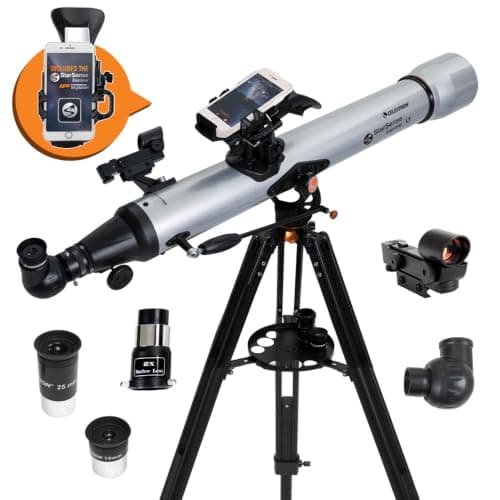 Celestron StarSense Explorer LT 80AZ About 95 percent of its published ceiling supplied in the box, and f/11 optics that focus easily. | The most complete first telescope | |
| 2 | 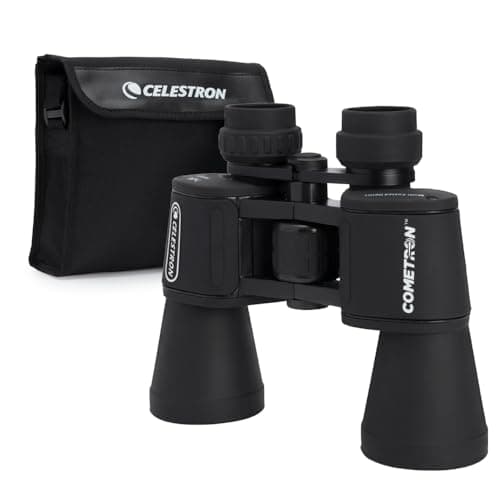 Celestron Cometron 7x50 A 7.1mm exit pupil, a five-second setup, and nothing that can be assembled wrongly. | The honest answer for a lot of beginners | |
| 3 | 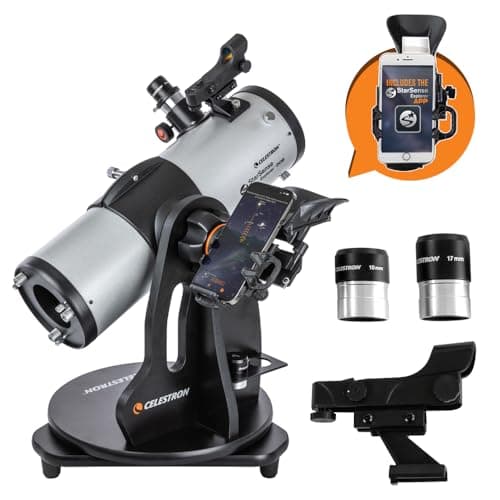 Celestron StarSense Explorer 114mm Tabletop Dobsonian 114mm of parabolic mirror, a 12.8 limiting magnitude, and the app to aim it. | The most aperture a beginner should buy | |
| ! | 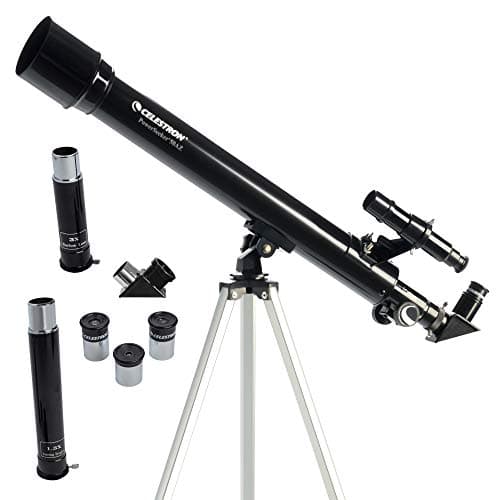 Celestron PowerSeeker 50AZ Published ceiling 118x. Supplied eyepieces and Barlow reach roughly 450x. Skip this one — see why below | The shape of the beginner trap | Not recommended |
Rows link to the full write-up further down this page. Prices come from the live price layer only; where there is no live figure the button reads “Check price” rather than showing a number we remembered.
The magnification rule, once, properly
A telescope's realistic ceiling is set by its aperture, not its eyepieces. Two conventions describe it and they agree closely: roughly twice the aperture in millimeters, or 60x per inch — the formula Celestron actually uses. 3.1496 inches times 60 is 188.98, published as 189x for the 80mm. The same formula gives 269x for a 114mm and 118x for a 50mm.
So when a box advertises 525x on 50mm of glass, it is describing the eyepieces in the box, not the optics — and those two things are unrelated. That single check filters most of the beginner shelf in ten seconds, and we work it through in full on toy brands vs real optics.
The first three months, in order
A beginner telescope fails or succeeds in its first few outings, and the sequence matters more than the hardware. This is the order we would follow.
- Assemble it indoors, in daylight, before the first clear night. Every fiddly step happens once, warm, with the instructions readable. This single habit removes most first-night frustration.
- Align the finder on a distant daytime object — a chimney or a pylon at least 300 yards away, never the Sun. A finder that is out by two degrees makes the telescope feel broken.
- Night one: the Moon, at the lowest power in the box. Aim for a half Moon rather than a full one; the shadows along the terminator are what make craters look three-dimensional.
- Night two or three: Jupiter. Even a small telescope shows a disc with up to four moons in a line, and they visibly move between nights — the single most reliable hook there is.
- Then Saturn, which resolves as a distinct ringed oval from about 50x and is the view most people remember years later.
- Only then consider an eyepiece. By this point you know which magnifications you actually reach for, which is the only sound basis for buying one.
The full night-one sequence is on your first night with a telescope; if the view is empty, why can't I see anything has the ranked causes.
The one upgrade worth making, and when
Most beginner telescopes ship below their own published ceiling, so a single eyepiece is the natural first purchase. Buy one good one rather than a set of six — the sets exist because cheap eyepieces are cheap, not because you need that many.
Work out what you are missing before you buy: divide your telescope's focal length by the magnification you want. On a 900mm telescope, a 6mm eyepiece gives 150x; on a 450mm tabletop, the same 6mm gives 75x. The same eyepiece is a different tool on a different telescope, which is why generic recommendations are useless here.
When a beginner should buy nothing at all
Three situations where we would steer you away from a telescope, and we would rather say so than sell you one.
- Nobody will go outside in the cold. A telescope needs a willing adult in January. If that person does not exist, a star projector is the honest answer rather than a consolation prize.
- The budget is under about $60. At that price the telescopes are sold on numbers their optics cannot deliver. Buy binoculars and a red torch instead.
- You are buying for a child under six. Attention span and hand strength are the binding constraints, not optics. See what age for a telescope.
Where to go from here
- Buying for a specific age? The age ladder starts at ages 5-6 and runs to ages 11-12.
- Working to a budget? Under $100, under $200 and under $500 each cover what that money genuinely buys.
- Lens or mirror? Refractor vs reflector settles the design question.
- Want to know what you will actually see? What you can actually see manages that expectation before the box is opened, which is worth more than any specification here.
We have not handled any of these telescopes. Every figure above is from a manufacturer's published specification page, linked on each product card, and everything else is arithmetic on those figures. Our full method is on the methodology page.
Questions people actually ask
- What is the best beginner telescope?
- For most people a 70mm to 80mm refractor with phone-guided finding, or a 114mm reflector if you have a solid surface for a tabletop model. The deciding factor is whether you can find anything with it, not the optics.
- What magnification do I need for a beginner telescope?
- Far less than the box suggests. A telescope's realistic ceiling is about twice its aperture in millimeters, and most good views happen between 30x and 100x regardless of what the packaging claims.
- Are binoculars better than a telescope for a beginner?
- Under about $100, usually yes — no setup, no alignment, a wider field and a brighter image. Above that a telescope shows planetary detail binoculars cannot reach.
- How much should a beginner spend on a telescope?
- Between $100 and $200 buys a telescope that gets used more than twice. Below $60 the magnification claims stop matching the optics. Above about $250 you are mostly buying weight.
- What should a beginner look at first?
- A half Moon at low magnification — bright, easy to find, and genuinely impressive. Jupiter with its moons is the natural second target.
Sources
Read next
Where to go from here
- Celestron StarSense Explorer LT 80AZ review
80mm of slow, color-corrected glass with phone-guided finding — and the supplied eyepieces reach 95 percent of its published ceiling, which nothing else here does.
- The best beginner telescopes under $200
Between $100 and $200 you can buy a steady mount, real aperture, or phone-guided finding. What each of those is worth, with the arithmetic.
- Refractor or reflector for a child?
Mirrors are cheaper per millimeter of aperture; lenses never need aligning. Which trade suits which child, with the arithmetic on both.
- How much should you spend on a telescope for a child?
Band by band, what the money buys and where it stops helping. The jump from $60 to $150 matters more than the one above it.
- The best telescopes under $500
Between $200 and $500 you can have aperture, a parabolic mirror, or guided finding — but not all three. What each choice costs, and who should make which.
- What you can actually see with a kids' telescope
The honest target-by-target list for 70mm, 76mm and 114mm telescopes, so nobody is disappointed on night one.
- The best telescope for viewing planets and galaxies
Planets want magnification and contrast; galaxies want aperture and a wide field. The trade explained with published numbers, and the telescopes that split the difference honestly.