Telescopes
Toy telescopes versus real optics: how to tell in thirty seconds
One calculation separates a real telescope from a magnification claim.

By Scooter M. · published September 1, 2026
I'm not an astronomer and I don't have a lab. I'm someone who's genuinely into this — I read the manuals, compile the published specs, and do the arithmetic the box doesn't do for you. No lab coat. How we pick.
How this is funded. Lens & Lightyear earns a commission when you buy through a link on this page, at no extra cost to you. It does not change which products we pick or what we say about them — every card below carries a real reason to skip it. Prices are pulled live and were last verified October 18, 2026. Full disclosure.
The short answer
Divide the telescope's focal length by its shortest supplied eyepiece, then multiply by any Barlow. If that number is more than about twice the aperture in millimeters, the box is selling you magnification the optics cannot deliver. It takes ten seconds and it filters most of the shelf.
Why magnification is the number they inflate
Because it is free. Aperture costs money — glass, grinding, coating, a bigger tube, a stronger mount. Magnification costs nothing: put a shorter eyepiece in the box and the number on the front goes up.
And it is the number a non-expert buyer instinctively trusts. A telescope is a thing that makes things look bigger, so more must be better. That intuition is wrong in a specific and important way, and understanding why is the whole of this page.
Why more magnification is not more detail
A telescope's ability to resolve detail is set by its aperture, through the physics of diffraction. That limit is fixed the moment the lens or mirror is made. Magnification does not add information — it enlarges whatever information the aperture already collected.
Past a certain point, called empty magnification, you are simply making the same blurry image bigger and dimmer. It is the optical equivalent of zooming into a low-resolution photograph: the pixels get larger, and no detail appears.
The thirty-second test
- Find the aperture in millimeters. If the listing does not state it, that is your answer already — walk away.
- Double it. That is your honest ceiling.
- Find the focal length and the shortest supplied eyepiece. Divide the first by the second. Multiply by any Barlow that comes in the box.
- Compare. If step 3 is bigger than step 2, the box is oversold. If it is well below, the manufacturer is selling optics rather than numbers.
- Check the diagonal size. 1.25 inches means standard eyepieces fit and the telescope is upgradeable. 0.96 inches means it is not.
Quick picks
Real optics, and the trap they are up against
| # | Product | Best for | Price |
|---|---|---|---|
| 1 | 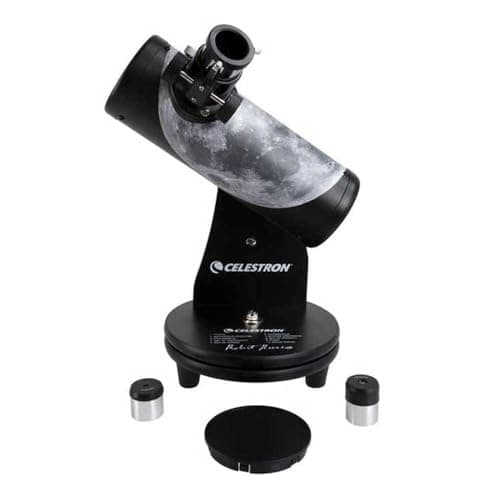 Celestron FirstScope 76mm Tabletop 76mm aperture, 180x published ceiling, and eyepieces that reach only 75x. | The cheapest telescope here that passes the test | |
| 2 | 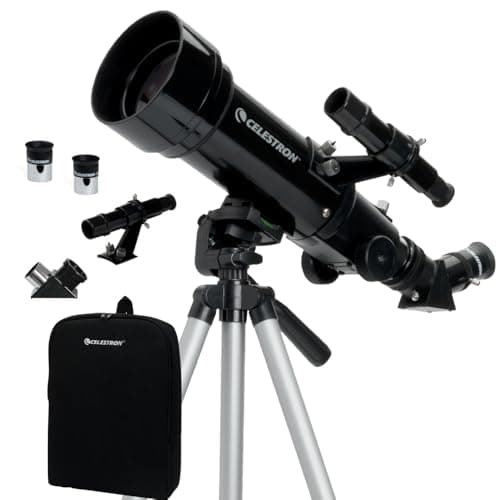 Celestron Travel Scope 70 70mm, 168x published ceiling, and the supplied eyepieces stop at 40x. | The same honesty with a tripod | |
| 3 | 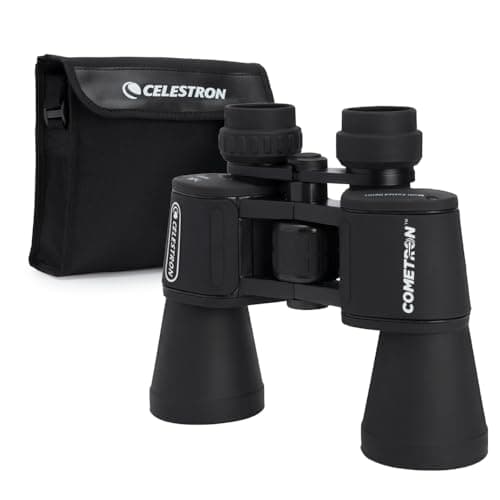 Celestron Cometron 7x50 Real 50mm optics per side, no magnification claim to inflate, works instantly. | The escape hatch when the budget is toy-telescope money | |
| ! | 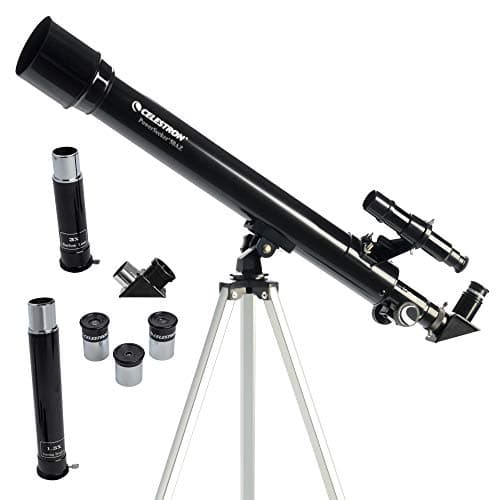 Celestron PowerSeeker 50AZ Published ceiling 118x. Supplied eyepieces and Barlow reach roughly 450x. Skip this one — see why below | The worked example | Not recommended |
Rows link to the full write-up further down this page. Prices come from the live price layer only; where there is no live figure the button reads “Check price” rather than showing a number we remembered.
The other tells
Magnification is the main one, but these are worth a glance too.
| Warning sign | Why it matters |
|---|---|
| Aperture not stated anywhere | The one specification that determines everything is missing. This is never an accident. |
| Magnification in the headline, aperture in the small print | Tells you which number the manufacturer thinks will sell it. |
| A large number of supplied eyepieces | Six eyepieces is not generosity at this price. It is filler, and most of them will be unusable. |
| 0.96 inch diagonal or eyepieces | A dead end. Standard is 1.25 inches, and it means the telescope can never be improved. |
| Plastic focuser and plastic tripod | Focus will be coarse and the image will shake. Both make a telescope feel broken to a child. |
| Character or cartoon branding | Almost always a licensed name over plastic optics. A real 76mm reflector often costs the same. |
| The word "professional" on a $40 box | Nothing professional costs $40. It is a word chosen for buyers with no reference points. |
What a genuinely good box looks like
Inverted: aperture stated first and prominently, a published highest useful magnification, two or three eyepieces rather than six, a 1.25 inch diagonal, and supplied magnifications comfortably below the ceiling. That last one is counter-intuitive — you want the box to give you *less* magnification than the telescope can handle, because it means someone chose eyepieces that would actually produce a good view.
If you would like to see the whole process applied across brands rather than models, telescope brands for kids covers who publishes what. And if the budget is the constraint, under $100 is the page that maps price bands to what is genuinely available.
The picks in full
Pick 1
Celestron FirstScope 76mm Tabletop
The cheapest telescope here that passes the test
The arithmetic
The 20mm eyepiece gives 300 / 20 = 15x, and the 4mm gives 300 / 4 = 75x. Celestron's own published ceiling is 180x, so the 4mm sits well inside what the optics support — unusual honesty at this price. There is no tripod: it needs a table, a wall, a car roof or a stack of books at roughly chest height for the child using it.
Run the test on this telescope and it passes cleanly, which is why it leads the page.
Aperture 76mm. Aperture times two is roughly 152x — the honest practical ceiling. Celestron's own published figure is 180x, slightly above our rule of thumb, which is normal since the rule is conservative.
Now the supplied eyepieces: 20mm and 4mm on a 300mm focal length, giving 15x and 75x. The highest magnification in the box is less than half the published ceiling.
That is what an honest box looks like. The manufacturer is selling you aperture and a usable low-power view, not a number.
Skip it if
You need a tripod. The FirstScope passes the honesty test easily but it is a tabletop instrument, and no amount of specification integrity helps if you have nowhere to stand it.
| Optical design | Newtonian reflector, spherical primary mirror |
|---|---|
| Aperture | 76mm (2.99") |
| Focal length | 300mm (12") |
| Focal ratio | f/3.95 |
| Eyepieces supplied | 20mm (15x) and 4mm (75x) |
| Highest useful magnification | 180x |
| Lowest useful magnification | 11x |
| Limiting stellar magnitude | 11.9 |
| Light gathering vs the eye | 118x |
| Mount | Dobsonian-style tabletop base |
| What the box does not do | No tripod, no finderscope, and no way to track an object as the sky moves — you nudge the tube by hand. The 4mm eyepiece is usable but tight; most children get on better with the 20mm all evening. |
Specifications from Celestron — FirstScope specifications. We have not handled this one — everything above is the published spec sheet plus our own arithmetic on it.
Pick 2
Celestron Travel Scope 70
The same honesty with a tripod
The arithmetic
400mm focal length over the two supplied eyepieces gives 20x and 40x. Celestron's published ceiling for a 70mm objective is 168x, so both eyepieces are comfortably inside it — the box is not overselling. The 3.3 lb total is the number that matters for a gift: a child can carry the whole kit themselves, which is most of why it gets used more than once.
Another clean pass, and a useful one because it shows honesty is not confined to one design.
70mm aperture, so aperture times two is 140x. Celestron publishes 168x. The supplied 20mm and 10mm eyepieces give 20x and 40x on a 400mm focal length.
40x out of a possible 168x. A cynic would say Celestron is under-equipping the box; the more accurate reading is that they know a beginner will use the low-power eyepiece almost exclusively, and that a cheap 4mm would produce a bad view and a bad review.
This is the pattern to look for. Boxes that under-claim tend to come from companies selling optics; boxes that over-claim tend to come from companies selling boxes.
Skip it if
You want maximum magnification in the box. The supplied eyepieces reach only 40x of a 168x ceiling, which is deliberately conservative — you will want a shorter eyepiece eventually for planets.
| Optical design | Refractor |
|---|---|
| Aperture | 70mm (2.8") |
| Focal length | 400mm (15.74") |
| Focal ratio | f/5.7 |
| Eyepieces supplied | 20mm (20x) and 10mm (40x) |
| Finderscope | 5x24 |
| Diagonal | 45 degree erect image, 1.25" |
| Mount | Manual alt-azimuth on aluminum tripod |
| Highest useful magnification | 168x |
| Limiting stellar magnitude | 11.7 |
| Total kit weight | 3.3 lbs (1.5 kg), tripod 1.8 lbs (0.81 kg) |
| Included | Custom backpack, Starry Night Basic software, SkyPortal app access |
| What the box does not do | The tripod is the weak part. At 1.8 lbs it is light enough to carry and light enough to wobble, and a child nudging the eyepiece will lose the target. The 45 degree erect-image diagonal is built for daytime use and costs you a little light at night. |
Specifications from Celestron — Travel Scope 70 specifications. We have not handled this one — everything above is the published spec sheet plus our own arithmetic on it.
Pick 3
Celestron Cometron 7x50
The escape hatch when the budget is toy-telescope money
The arithmetic
Exit pupil is objective divided by magnification: 50 / 7 = 7.1mm, which matches Celestron's published figure. That is the single most useful number here. A fully dark-adapted young pupil opens to around 7mm, so a child uses nearly all of that 7.1mm cone and the view is as bright as the optics can make it. An adult over about forty typically dilates to 5mm or less and simply cannot use the extra — this is one of the rare cases where a child gets more out of the hardware than the grown-up does.
The practical answer to the whole problem. If your budget lands in the range where telescopes are sold on magnification claims, step sideways rather than down.
Binoculars cannot play the magnification game, because the magnification is fixed and printed on the front. A 7x50 is 7x. There is no eyepiece to swap in and no Barlow to multiply by, so there is nothing to inflate.
50mm per side is real aperture, the 7.1mm exit pupil matches a child's dark-adapted eye, and the 6.6 degree field makes finding things trivial.
This is why astronomy clubs recommend binoculars to beginners so much more often than the internet does. There is no way to sell a bad pair as a good one using a number.
Skip it if
A telescope is specifically what was wanted. This is the better optical purchase at toy-telescope money, and it is still not the present a child imagining a telescope was hoping for.
| Magnification | 7x |
|---|---|
| Objective lens | 50mm (1.97") |
| Prism glass | BK7 porro |
| Lens coatings | Multi-coated |
| Angular field of view | 6.6 degrees |
| Linear field at 1000 yds | 344 ft (105 m) |
| Exit pupil | 7.1mm (.28") |
| Eye relief | 13mm (.51") |
| Close focus | 26.2 ft (8 m) |
| Weight | 27.3 oz (774 g) |
| Tripod adaptable | Yes |
| Environmental | Water resistant |
| What the box does not do | 27.3 oz is heavy for small arms held up at the sky — plan on leaning against a wall or lying on a blanket, or add the tripod adapter. BK7 prisms are the cheaper glass and show slight softening at the edge of the field. Water resistant is not waterproof. |
Specifications from Celestron — Cometron 7x50mm specifications. We have not handled this one — everything above is the published spec sheet plus our own arithmetic on it.
Skip this
Celestron PowerSeeker 50AZ
The worked example
The arithmetic
This is the arithmetic that explains the whole category. Celestron publishes a highest useful magnification of 118x for this 50mm objective. The box also supplies a 4mm eyepiece — 600 / 4 = 150x, already past the ceiling — and a 3x Barlow, which takes that combination to 450x. Roughly four times more magnification than the manufacturer's own spec sheet says the optics can deliver. At 450x you are magnifying a blur.
Here is the full worked example, using only numbers Celestron publishes about their own product.
Step 1 — find the aperture. 50mm. Aperture times two gives a rule-of-thumb ceiling of 100x. Celestron's own published highest useful magnification is 118x, so the manufacturer and the rule broadly agree.
Step 2 — find the focal length and the eyepieces. Focal length 600mm. Supplied eyepieces: 20mm, 12mm and 4mm, plus a 3x Barlow lens.
Step 3 — do the division. 600 / 20 = 30x. 600 / 12 = 50x. 600 / 4 = 150x. The 4mm alone is already past the published 118x ceiling. Now apply the 3x Barlow: 450x. That is roughly four times what Celestron's own specification says these optics can usefully deliver.
Step 4 — check the diagonal. 0.96 inches, a legacy size. Standard eyepieces are 1.25 inches, so you cannot buy your way out of the problem later.
Skip it if
Always, for a child. We use it here as the teaching example precisely because it comes from a manufacturer we otherwise recommend — which proves the test has to be run on the model, not the badge.
| Optical design | Refractor |
|---|---|
| Aperture | 50mm (1.97") |
| Focal length | 600mm (24") |
| Focal ratio | f/12 |
| Eyepieces supplied | 20mm (30x), 12mm (50x), 4mm (150x) |
| Also supplied | 3x Barlow lens, 1.5x erecting eyepiece |
| Finderscope | 5x24 |
| Diagonal | 0.96" |
| Highest useful magnification | 118x |
| Limiting stellar magnitude | 11 |
| Total kit weight | 2.31 lbs (1.05 kg) |
| What the box does not do | The 0.96" diagonal is a legacy size, so almost no aftermarket eyepiece will fit it. The high-power combinations in the box are effectively unusable, which means the "three eyepieces and a Barlow" on the packaging is really one usable eyepiece and some cardboard filler. |
Specifications from Celestron — PowerSeeker 50AZ specifications. We have not handled this one — everything above is the published spec sheet plus our own arithmetic on it.
Questions people actually ask
- How can I tell if a kid's telescope is a toy?
- Divide the focal length by the shortest supplied eyepiece and multiply by any Barlow. If the result is more than about twice the aperture in millimeters, it is being sold on magnification the optics cannot deliver.
- Why do cheap telescopes advertise 525x magnification?
- Because magnification is free to add and aperture is not. A shorter eyepiece raises the number on the box at no manufacturing cost, and the number is the one non-expert buyers trust.
- Are Discovery Kids or LeapFrog style telescopes worth buying?
- Character-branded telescopes generally use plastic optics, do not publish an aperture, and advertise magnifications their optics cannot support. A real 76mm tabletop reflector usually costs about the same and shows vastly more.
- What magnification does a kid's telescope actually need?
- Far less than the box suggests. 15x to 40x covers almost everything a child will look at, and 75x to 150x covers planets. Anything advertised past twice the aperture in millimeters is not real.
- Is a 600x telescope better than a 150x one?
- No, and it is usually worse. A 600x claim on a small aperture means the manufacturer packed the box with eyepieces the optics cannot support. The 150x telescope is more likely to have been designed around its glass.
Sources
Read next
Where to go from here
- The space gifts not to buy — and what to buy instead
The four ways the kids astronomy aisle disappoints, each with the arithmetic that exposes it and the honest alternative at the same money.
- Telescope brands for kids, and which ones mean anything
The difference between a telescope brand and a licensed name, and which of the ones you will see in search results actually design what they sell.
- The best kids' telescopes under $100
The sub-$100 shelf is where the 525x claims live. What that money genuinely buys, and the one telescope here we tell you not to buy.
- Celestron PowerSeeker 127EQ review
The most aperture of any tripod telescope on this site, on an equatorial mount that needs balancing and polar alignment, with a Barlow that reaches two and a half times its own ceiling.
- Our methodology
What we compile, what arithmetic we run, and what we do not do.
- Are kids' telescopes worth it?
A direct verdict with the honest nuance: where the money starts working, where it does not, and what to buy instead below the line.
- What you can actually see with a kids' telescope
The honest target-by-target list for 70mm, 76mm and 114mm telescopes, so nobody is disappointed on night one.
- Binoculars
Cheaper, easier, and they work on night one. The case for starting here.
- Celestron PowerSeeker 114EQ review
900mm in an 875mm tube and a 22 percent obstruction — genuinely clean optics for the money. The box then supplies 675x against Celestron's own 269x limit.