Guides
Are kids' telescopes worth it?
Yes above about $60, no below it, and there is a better answer than either.

By Scooter M. · published September 1, 2026
I'm not an astronomer and I don't have a lab. I'm someone who's genuinely into this — I read the manuals, compile the published specs, and do the arithmetic the box doesn't do for you. No lab coat. How we pick.
How this is funded. Lens & Lightyear earns a commission when you buy through a link on this page, at no extra cost to you. It does not change which products we pick or what we say about them — every card below carries a real reason to skip it. Prices are pulled live and were last verified October 18, 2026. Full disclosure.
The short answer
Above roughly $60, yes — a kids' telescope shows the Moon, Jupiter's moons and Saturn's rings, and those are real, memorable sights. Below that, no. The telescopes on the cheapest shelf are sold on magnification numbers their optics cannot deliver, and they teach a child that telescopes do not work.
That is the whole answer, and everything below is why. The question is worth taking seriously, because the failure mode here is not wasted money. It is a child who concludes that real space is disappointing, which is a considerably more expensive outcome than $40.
What a kids' telescope genuinely delivers
A 70mm to 76mm telescope — the size most gift telescopes are — reliably shows four things, and all four are worth seeing.
- The Moon, in detail. Craters, mountain ranges, long shadows along the terminator line. At 30x to 50x this is genuinely spectacular, and it works from a city center on a school night.
- Jupiter and up to four of its moons. A small bright disc with pinpricks in a line beside it. The moons visibly change position from one night to the next, which is the single most reliable hook we know of for a child.
- Saturn's rings. From about 50x in a 70mm telescope they resolve as a distinct oval. Small, unmistakable, and the thing people remember years later.
- Star clusters, and one nebula. The Pleiades, the Orion Nebula as a gray patch with the Trapezium stars inside it, a handful of doubles that split into two colored points.
Set against a $60 to $200 spend on any other kind of gift, that is a good return. What it is not is a photograph. We take the expectation problem seriously enough to give it its own page — what you can actually see.
Where the money stops working
There is a real floor in this category and it sits at roughly $60. Below it, manufacturers compete on the numbers that are cheap to print rather than the ones that are expensive to build.
| Price | What is actually in the box | Worth it? |
|---|---|---|
| Under $40 | Plastic optics, cartoon branding, magnification claimed in the hundreds | No. This is the outcome we are warning about. |
| $40 - $60 | A small glass objective, a poor mount, an oversold eyepiece set | No — buy [binoculars](/binoculars) instead. Better view, less frustration, same money. |
| $60 - $100 | 70mm to 76mm of real optics, a workable mount, honest published specs | Yes. This is where a first telescope starts working. See under $100. |
| $100 - $200 | Steadier mounts, more aperture, phone-guided finding | Yes, and it is the sweet spot if you can stretch. See under $200. |
The magnification trap, in one worked example
Every telescope has a ceiling set by its aperture — roughly two times the aperture in millimeters. Past it you are not resolving more detail, only magnifying the blur.
Take a common 50mm beginner refractor. Its manufacturer publishes a highest useful magnification of 118x on its own website. The eyepieces and Barlow supplied in the box reach roughly 450x. That is not a manufacturing defect; it is a decision about what to print on a carton, and it is the decision that whole shelf has made. We show the full arithmetic on toy brands vs real optics.
When a telescope is the wrong gift entirely
Three situations where we would steer you away, and we would rather say so than sell you something.
- The child is under six. Attention span and hand strength are the binding constraints, not optics. A star projector or a light pair of binoculars does more.
- Your sky is a lit apartment balcony with no view. The Moon and planets still work — they are bright enough to punch through anything — but nothing fainter will. Be honest about that before spending $200.
- Nobody in the house wants to go outside in the cold. This is the real one. A telescope needs an adult willing to stand in a garden in January. If that adult does not exist, buy the projector and enjoy it indoors — we ask the same question of that category on are star projectors worth it.
Quick picks
What we would actually buy
| # | Product | Best for | Price |
|---|---|---|---|
| 1 | 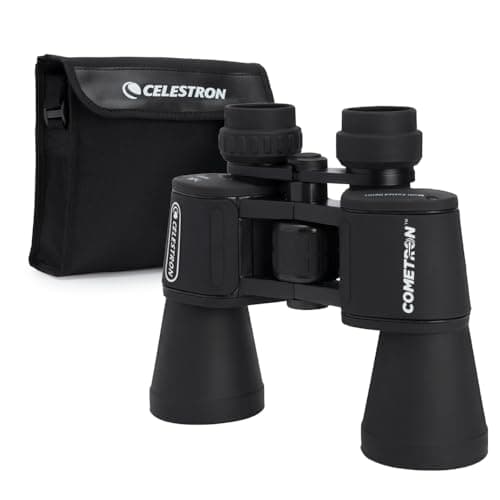 Celestron Cometron 7x50 More astronomy per dollar than any telescope under $100, with nothing to assemble. | The cheapest genuinely good first night | |
| 2 | 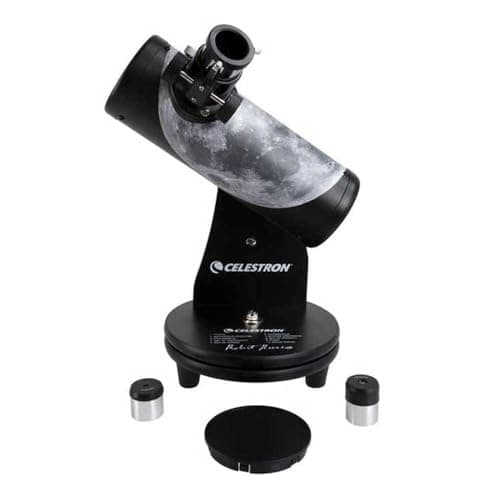 Celestron FirstScope 76mm Tabletop 76mm of real aperture, zero assembly, and no invented magnification on the box. | The cheapest telescope we would defend | |
| 3 | No image Celestron StarSense Explorer LT 70AZ The phone finds the target for you, which removes the single biggest cause of a failed first night. | Households where no adult knows the sky |
Rows link to the full write-up further down this page. Prices come from the live price layer only; where there is no live figure the button reads “Check price” rather than showing a number we remembered.
The sequence we would actually recommend
If you want the highest chance of producing a child who is still interested in a year, this order beats spending more money on night one.
- Binoculars, a free planetarium app and a red torch. Together they cost less than the cheapest telescope on the shelf and produce a better first three months.
- A winter of actually going outside. The app teaches where things are, which is the skill that makes a telescope worth owning later.
- Then a real telescope with real aperture, chosen for the age the child now is. Our age bands start there.
That sequence produces more young astronomers than a cheap telescope at Christmas does. It is also, awkwardly for us, the cheaper path — but it is the one we would follow ourselves, so it is the one on the page.
What we can and cannot tell you
We have not handled any of these telescopes. Everything above comes from published manufacturer specifications, the arithmetic we run on them, and the failure modes documented across the category. Where a number appears, its source is linked. Our full method, including what we deliberately do not do, is on the methodology page.
Questions people actually ask
- Are cheap telescopes worth buying for kids?
- Under about $60, no. Those telescopes are sold on magnification claims their optics cannot support. Spend the same money on 7x50 binoculars and the first night is better.
- Is a telescope a good gift for a 7 year old?
- Yes, if it is light enough to carry and simple enough to point. At that age the constraints are weight and patience rather than optics — see telescopes for ages 7-8.
- Will a kids' telescope show planets?
- Jupiter as a disc with up to four moons, and Saturn's rings as an oval from about 50x. Mars and Venus show as bright discs with little surface detail in a beginner telescope.
- Are binoculars better than a telescope for a child?
- Under $100, usually yes — no setup, no alignment, a much wider field and a brighter image. The exception is when the child specifically asked for a telescope.
- How long will a child stay interested in a telescope?
- We cannot honestly quantify that, and any site that gives you a number is guessing. What we can say is what shortens it: a wobbly mount, a finder that was never aligned, and a first night spent hunting for something faint.
Sources
Read next
Where to go from here
- The space gifts not to buy — and what to buy instead
The four ways the kids astronomy aisle disappoints, each with the arithmetic that exposes it and the honest alternative at the same money.
- The best kids' telescopes under $100
The sub-$100 shelf is where the 525x claims live. What that money genuinely buys, and the one telescope here we tell you not to buy.
- Binoculars
Cheaper, easier, and they work on night one. The case for starting here.
- Star Projectors
The split nobody explains: real star fields versus colored light shows.
- What you can actually see with a kids' telescope
The honest target-by-target list for 70mm, 76mm and 114mm telescopes, so nobody is disappointed on night one.
- How much should you spend on a telescope for a child?
Band by band, what the money buys and where it stops helping. The jump from $60 to $150 matters more than the one above it.
- Toy telescopes versus real optics: how to tell in thirty seconds
The arithmetic that exposes a 525x claim on a 70mm box, worked through on a real product using its own manufacturer's published numbers.
- Are star projectors worth it?
Worth it as room atmosphere and a bedtime ritual; not worth it as astronomy teaching. The honest answer on boredom, plus four picks matched to what you actually want from it.