Guides
What age is a telescope right for?
A readiness checklist rather than a number, because readiness is not a birthday.
By Scooter M. · published September 1, 2026
I'm not an astronomer and I don't have a lab. I'm someone who's genuinely into this — I read the manuals, compile the published specs, and do the arithmetic the box doesn't do for you. No lab coat. How we pick.
How this is funded. Lens & Lightyear earns a commission when you buy through a link on this page, at no extra cost to you. It does not change which products we pick or what we say about them — every card below carries a real reason to skip it. Prices are pulled live and were last verified October 18, 2026. Full disclosure.
The short answer
Around five with an adult driving, around seven to use one with help, around nine to set one up alone. But readiness is about hand strength, patience and whether the child can follow a two-step instruction in the dark — not about a birthday. The checklist below beats the number.
Age does not change the physics. A 70mm lens gathers exactly the same light for a five-year-old as for a fifteen-year-old. What age changes is everything around the lens: what the child can lift, what they can set up without an adult standing over them, and how long they stay interested when the first thing they point it at is a slightly blurry dot.
The readiness checklist
Score these honestly for the actual child rather than the ideal one. Four or more yes answers means a telescope will probably work; two or fewer means it probably will not, yet.
- Can they close one eye on purpose? Sounds trivial. It is the single most common physical blocker for under-fives at an eyepiece.
- Can they follow a two-step instruction without being shown? *Look through the little scope first, then the big one.* If not, an adult will be driving every session, which is fine — but buy for that.
- Can they stay with one activity for fifteen minutes? Outdoors, in the cold, at night, when the first attempt has not worked.
- Can they carry it? A 7 lb telescope is not portable for an eight-year-old, and a telescope somebody else has to carry gets used only when that person feels like it.
- Can they accept that the picture will be small? This is the expectation gap that ends more first nights than any hardware fault. What you can actually see is written for exactly this conversation.
What each age can genuinely do
| Age | What they can do unaided | What to buy |
|---|---|---|
| 3-5 | Look at a ceiling. Not much at an eyepiece, and that is completely normal. | A star projector. Indoors, warm, no bedtime negotiation. |
| 5-6 | Look through an eyepiece an adult has aimed. Very little else. | Ages 5-6: tabletop, no assembly, low power, or light binoculars. |
| 7-8 | Carry it, point it roughly, turn a focuser, lose patience after 20 minutes. | Ages 7-8: light enough to carry themselves, red dot finder. |
| 9-10 | Set it up alone, find the Moon and one planet, read a chart with help. | Ages 9-10: a real tripod, more aperture, room to grow. |
| 11-12 | All of the above, plus genuine research and real frustration tolerance. | Ages 11-12: aperture is now the limit. Buy glass, not features. |
The bands overlap deliberately. A patient seven-year-old is often better served by the 9-10 page, and a reluctant ten-year-old by the 7-8 one.
Quick picks
What we would buy at each stage
| # | Product | Best for | Price |
|---|---|---|---|
| 1 | 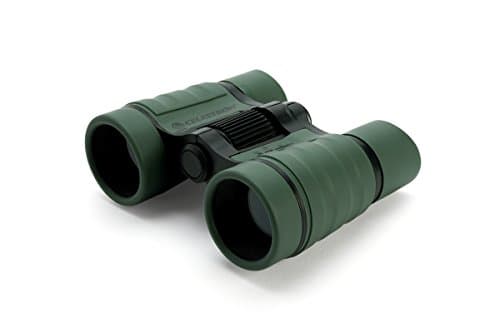 Celestron Celestron Kids 4x30 4.7 oz — about a sixth the weight of a 7x50, which is the whole reason they get used. | Ages 4-6, where weight beats magnification | $9.95 on Amazon #ad How we’re funded · price as of October 18, 2026 |
| 2 | 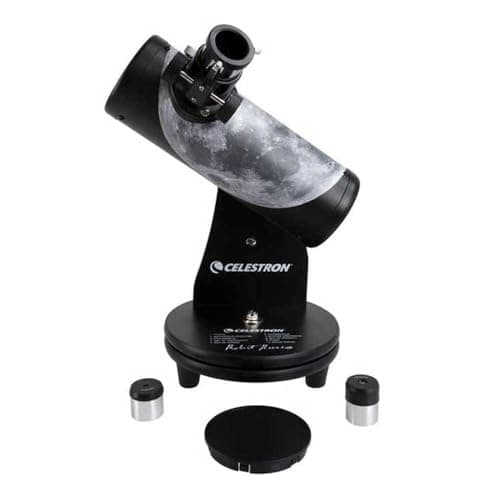 Celestron FirstScope 76mm Tabletop Nothing to assemble, nothing to align, and 76mm of genuine aperture. | Ages 6-8, the first real telescope | |
| 3 | 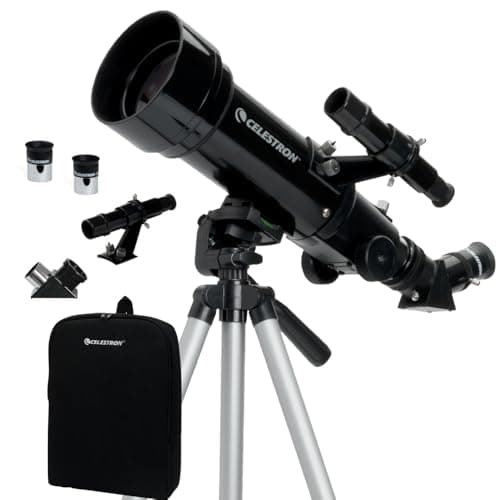 Celestron Travel Scope 70 3.3 lbs for the whole kit, in a backpack a child can actually wear. | Ages 8-10, when they want to carry it themselves |
Rows link to the full write-up further down this page. Prices come from the live price layer only; where there is no live figure the button reads “Check price” rather than showing a number we remembered.
At what age can a child use binoculars?
Earlier than a telescope, and by a wide margin. Binoculars need no assembly, no alignment and no understanding of magnification — a three-year-old can hold a light pair and see something bigger. That is genuinely the whole requirement.
The constraints are weight and interpupillary distance: a small child's eyes are closer together than an adult's, so a large adult pair physically will not adjust narrow enough. That is why 4x30 exists as a category rather than as a compromise. Full breakdown on binoculars by age.
What to buy while you wait
If the checklist says not yet, the answer is not nothing. The interest is real and it deserves feeding — it just should not be fed with an instrument that will frustrate them.
- A star projector. Indoors, warm, no weather, no bedtime argument. The accurate ones genuinely teach constellations. See accurate vs decorative.
- Light binoculars. Real optics, real sights, and reusable for wildlife by day. See binoculars by age.
- A [free planetarium app](/guides/stargazing-apps-for-kids) on the adult's phone. Learning where things are is the skill that makes a telescope worth owning later.
- Naked-eye nights. Genuinely. Finding one constellation together does more for long-term interest than any hardware.
Age guidance printed on boxes
Treat it with care. Manufacturer age ratings in this category are usually safety and small-parts ratings, not usability ones — and they can point either way. The National Geographic Astro Planetarium, which sits on a shelf that reads as a nursery product, carries a manufacturer age guidance of 14 and up because of its discs and mechanism.
So read the rating for what it is, and use the checklist above for whether the child will get anything out of it. When we quote a manufacturer's age guidance on this site, we link the page it came from.
Questions people actually ask
- How old should a child be to use a telescope?
- Around five with an adult aiming it, seven to use one with help, and nine to set one up alone. Hand strength and patience matter more than the birthday.
- At what age can a child use binoculars?
- Around three with a light pair. The limits are weight and whether the barrels adjust narrow enough for a small child's eyes, which is why 4x30 models exist.
- Is a telescope a good gift for a 5 year old?
- Only a tabletop one with no assembly, and only with an adult driving. At that age a star projector or light binoculars usually get far more use.
- What is the best age to get a first telescope?
- Between seven and ten for most children. That is when they can carry it, point it and stay with it long enough to see something, without needing an adult for every step.
Sources
Read next
Where to go from here
- The best telescope for a 5 or 6 year old
What a five or six year old can actually do with a telescope, and the two picks built around that rather than around a spec sheet.
- The best telescope for a 7 or 8 year old
Seven and eight is where independence starts. The picks here are chosen on carry weight and how easy it is to find something, not on aperture.
- The best telescope for a 9 or 10 year old
Nine and ten is the first band where a bigger, heavier telescope is a better telescope. Four picks and the arithmetic behind the jump.
- Binoculars for kids, by age
What a child can physically hold at each age, and which published weight and eye-relief figures to check before buying.
- The best star projector for a toddler's room
For a very young child the useful specifications are noise level, dimming and cable placement. Star count barely matters. What to actually look for.
- The best telescope for an 11 or 12 year old
At eleven and twelve the child is the limiting factor no longer. Picks chosen on aperture and on what they will not outgrow in a year.
- The best telescope for teens
Above about 13 the weight limits and patience limits that shape our age pages stop applying. What to buy when the telescope has to keep up with the person for years.