Telescopes
The best telescope for a 5 or 6 year old
At this age the adult drives. Buy for that, and it works.

By Scooter M. · published September 1, 2026
I'm not an astronomer and I don't have a lab. I'm someone who's genuinely into this — I read the manuals, compile the published specs, and do the arithmetic the box doesn't do for you. No lab coat. How we pick.
How this is funded. Lens & Lightyear earns a commission when you buy through a link on this page, at no extra cost to you. It does not change which products we pick or what we say about them — every card below carries a real reason to skip it. Prices are pulled live and were last verified October 18, 2026. Full disclosure.
The short answer
At five and six, buy for the adult as much as for the child. A tabletop reflector with no assembly and a wide low-power view will get used; a tripod telescope with a finderscope will not. Expect to point it yourself every time, and choose something that makes that easy.
This is the age band where the honest recommendation diverges most sharply from what the shelves are selling. Search for a telescope for a five-year-old and you will be shown things with cartoon branding, plastic tripods and magnification claims in the hundreds. None of that is built around what a five-year-old can actually do.
What a 5 or 6 year old can actually do unaided
This matters more than any specification on this page, so it is worth being specific rather than vague about it.
- They can look through an eyepiece someone else has aimed. This is the big one, and it is genuinely enough for a good evening.
- They can turn a focuser, once shown, though they will usually turn it past sharp and back again several times.
- They cannot align a finderscope, and they cannot use one to find anything. A red dot finder is workable with help; an optical finderscope is not.
- They cannot judge when a view is bad because of the eyepiece choice. If it is blurry they will assume it is meant to be blurry.
- They will lose interest after about fifteen minutes, and that is completely normal. Fifteen good minutes on the Moon beats an hour of frustration.
Read that list back and the hardware requirements write themselves: no assembly, low magnification, a wide field of view, and something an adult can aim in two seconds. That is a tabletop reflector, and it is why the Celestron FirstScope leads this page rather than something with more impressive numbers.
Should you buy a telescope at all at this age?
Honestly, sometimes not — and we would rather say so than sell you the wrong thing. There are three good gifts for a five or six-year-old who is interested in space, and a telescope is only one of them.
| Gift | Works on night one? | Grows with them? | Best when |
|---|---|---|---|
| Tabletop telescope | Yes, with an adult aiming | Two or three years | There is an adult who will go outside with them |
| Very light binoculars | Yes, instantly | Daylight use continues indefinitely | You want something they own and control themselves |
| Planetarium projector | Yes, indoors, every night | Yes, and it teaches constellations | Bedtime and cloudy weather are the reality |
If you are torn, telescope versus binoculars versus projector walks the decision through properly.
Quick picks
Telescopes for a 5 or 6 year old
| # | Product | Best for | Price |
|---|---|---|---|
| 1 | 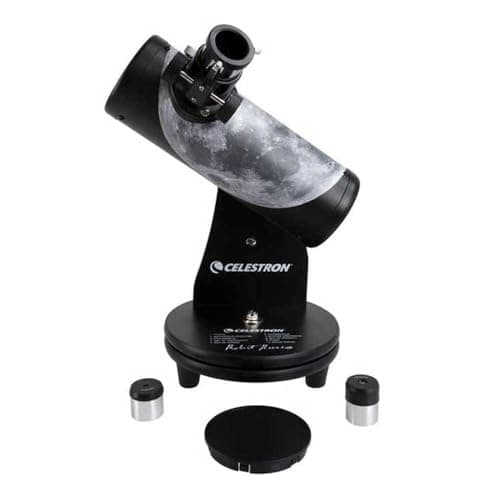 Celestron FirstScope 76mm Tabletop No assembly, nothing to lose, and the 20mm eyepiece does 90 percent of the work. | The realistic first telescope at this age | |
| 2 | 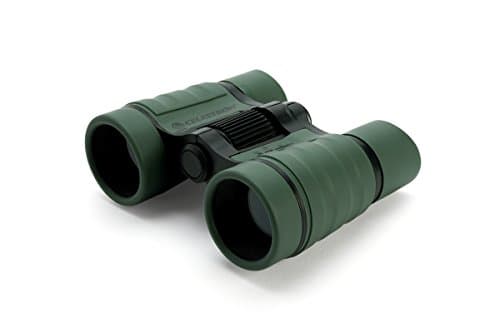 Celestron Celestron Kids 4x30 Under five ounces, which is the only spec that matters at this age. | Something they can hold themselves | $9.95 on Amazon #ad How we’re funded · price as of October 18, 2026 |
| 3 | No image National Geographic Astro Planetarium 8,000 real stars and 61 named constellations, adjustable to tonight's actual sky. | Astronomy on a cloudy night, or in a bedroom | |
| ! | 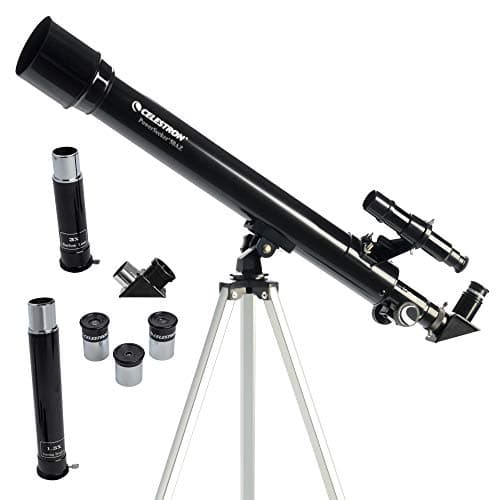 Celestron PowerSeeker 50AZ The manufacturer publishes a 118x ceiling and puts 450x worth of eyepieces in the box. Skip this one — see why below | Nothing, at this age or any other | Not recommended |
Rows link to the full write-up further down this page. Prices come from the live price layer only; where there is no live figure the button reads “Check price” rather than showing a number we remembered.
What they will actually see
Set this expectation before the present is opened, not after. It is the single biggest determinant of whether a first telescope succeeds.
The Moon is the whole show at this age, and it is genuinely spectacular. Through even the smallest telescope on this page, the Moon shows craters, mountain shadows along the terminator line, and dark gray plains. A five-year-old seeing that for the first time is exactly the moment you were hoping to buy.
Jupiter shows as a small bright disc with up to four tiny moons in a line beside it. That line of moons is real, it changes night to night, and it is the thing that turns interest into obsession for some children. Saturn's rings are visible at around 50x and up, which the FirstScope's 4mm eyepiece reaches. Everything else — nebulae, galaxies, the pictures on the box — is beyond this equipment and beyond this age. Say so cheerfully rather than avoiding it.
Our full honest list is on what you can actually see, and it is worth ten minutes before you decide.
The mistakes that ruin the first night
- Fitting the highest-power eyepiece first. It is the most exciting-sounding one and it gives the worst view. Start with the longest number on the eyepiece — 20mm or 25mm — every single time.
- Opening it for the first time in the dark, outdoors, with a child watching. Assemble and test everything indoors in daylight first. Our setup checklist is written for exactly this, and it takes twenty minutes.
- Pointing at something low in the sky. Near the horizon you are looking through the most atmosphere and usually over rooftops. Anything high overhead is sharper.
- Using a phone torch. One glance at a white screen destroys twenty minutes of dark adaptation for everyone present.
- Aiming for a long session. Fifteen minutes on the Moon, ending while they still want more, is a better outcome than an hour ending in tears.
If it has already gone wrong, why can't I see anything through my telescope is the page to open, and nine times out of ten nothing is broken.
When to move up
The signal is not a birthday, it is behavior: when the child starts asking to go out rather than being taken out, and when they start wanting to find things themselves. That is usually somewhere around seven or eight, and it is where a telescope they can carry and aim on their own starts to make sense — see telescopes for ages 7-8.
Do not rush it. A five-year-old who had fifteen brilliant minutes on the Moon three times is in a far better place than one who was given a telescope too complicated to use and quietly decided astronomy was not for them.
The picks in full
Pick 1
Celestron FirstScope 76mm Tabletop
The realistic first telescope at this age
The arithmetic
The 20mm eyepiece gives 300 / 20 = 15x, and the 4mm gives 300 / 4 = 75x. Celestron's own published ceiling is 180x, so the 4mm sits well inside what the optics support — unusual honesty at this price. There is no tripod: it needs a table, a wall, a car roof or a stack of books at roughly chest height for the child using it.
Everything about this telescope suits a five-year-old for one reason: there is nothing to get wrong. It comes out of the box assembled. You put it on a table, you point the tube, you look. There is no tripod to level, no counterweight, no finderscope to align, and no combination of parts that produces a black circle instead of a view.
The 300mm focal length and the supplied 20mm eyepiece give 15x. That sounds low, and it is exactly right here. At 15x the field of view is wide enough that pointing the tube roughly at the Moon actually puts the Moon in the eyepiece, which is the single skill a child this age can manage. The whole Moon fits in the view at once, craters and all, and it is bright enough that light pollution barely matters.
The 4mm eyepiece gives 75x, well inside Celestron's published 180x ceiling for this aperture. In practice you will use it on the Moon on a still night and then go back to the 20mm, because at 75x the Moon drifts out of view in under a minute and a five-year-old cannot chase it.
One genuine caution: this is an open-tube reflector with a mirror at the bottom. Small fingers will reach in. It is worth one calm sentence about not touching the mirror before it goes outside, and worth choosing a spot where it will not be knocked over.
Skip it if
You have nowhere to put it. A tabletop telescope needs a genuinely solid surface at roughly the child's chest height, outdoors, in the dark. A garden table works. A wobbly camping chair does not, and a five-year-old leaning on it will tip the whole thing over.
| Optical design | Newtonian reflector, spherical primary mirror |
|---|---|
| Aperture | 76mm (2.99") |
| Focal length | 300mm (12") |
| Focal ratio | f/3.95 |
| Eyepieces supplied | 20mm (15x) and 4mm (75x) |
| Highest useful magnification | 180x |
| Lowest useful magnification | 11x |
| Limiting stellar magnitude | 11.9 |
| Light gathering vs the eye | 118x |
| Mount | Dobsonian-style tabletop base |
| What the box does not do | No tripod, no finderscope, and no way to track an object as the sky moves — you nudge the tube by hand. The 4mm eyepiece is usable but tight; most children get on better with the 20mm all evening. |
Specifications from Celestron — FirstScope specifications. We have not handled this one — everything above is the published spec sheet plus our own arithmetic on it.
Pick 2
Celestron Celestron Kids 4x30
Something they can hold themselves
The arithmetic
4.7 oz is the whole point: about a sixth of the weight of a 7x50, which is the difference between a four-year-old using them and a four-year-old putting them down. 30 / 4 = 7.5mm exit pupil, so the view is bright. But 4x is genuinely low magnification — this is a first pair of real optics for very small hands, not a stargazing instrument.
This is here because of one number: 4.7 ounces. A full-size astronomy binocular weighs around 27 ounces, which a five-year-old cannot hold up for more than a few seconds. These they can hold all afternoon.
The exit pupil works out at 30 divided by 4, which is 7.5mm — wider than a dark-adapted child's pupil, so the view is as bright as it can be. What you give up is magnification. At 4x this is a device for looking at the Moon, at birds in a garden, and at things across a park, and it genuinely works for all three.
The honest framing for a gift: this is a first pair of real optics, not a stargazing instrument. Bought as the second, it is a small and useful present. Bought as the first and only astronomy gift for a child who has been asking about planets, it will not carry the weight.
The 5mm eye relief is short, which makes them awkward for a child in glasses. Worth knowing before you buy.
Skip it if
You want them to see the Moon in detail. 4x is genuinely low magnification — the Moon will look like a slightly bigger Moon, not a cratered world. If detail is the point, a proper 7x50 on a tripod is the answer, and it costs less than most people expect.
| Magnification | 4x |
|---|---|
| Objective lens | 30mm (1.18") |
| Lens coatings | Coated |
| Angular field of view | 4.3 degrees |
| Linear field at 1000 yds | 225 ft (68.58 m) |
| Exit pupil | 7.5mm (.29") |
| Eye relief | 5mm (.2") |
| Weight | 4.7 oz (133 g) |
| Environmental | Not weather sealed |
| Included | Woven nylon case, attached neck strap, lens cloth |
| What the box does not do | 5mm of eye relief is very short and makes them awkward over glasses. No weather sealing and no tripod thread. At 4x you will see the Moon as a slightly larger Moon; you will not resolve craters the way a 7x50 does. |
Specifications from Celestron — Celestron Kids 4x30mm Roof Binocular. We have not handled this one — everything above is the published spec sheet plus our own arithmetic on it.
#ad How we’re funded · price as of October 18, 2026
Pick 3
National Geographic Astro Planetarium
Astronomy on a cloudy night, or in a bedroom
The arithmetic
8,000 real stars and 61 named constellations, adjustable to a specific date and time — so you can set it to the sky outside tonight and then go and find the same thing. That is the useful trick. Note the manufacturer's own age guidance of 14 and up: this is a mechanism with small parts and fiddly discs, not a nursery night light, whatever the shelf it sits on suggests.
At five, the gap between wanting to look at space and being able to look at space is enormous. It is dark late in summer, cold in winter, and cloudy a lot of the time in between. A planetarium projector closes that gap: the sky comes indoors, at bedtime, every night, regardless of weather.
What separates this from the color-changing galaxy lights is that its stars are real. Over 8,000 of them, 61 named constellations, and a date-and-time adjustment — so you can set it to tonight, find Orion on the ceiling, and then find the same Orion out of the window on the next clear evening. That is a genuinely good way to teach a small child the sky.
Practical constraints worth knowing: the maximum throw is 3 meters, so it needs a reasonably low ceiling or a close wall. It runs on three AA batteries or a 5V cable that is not supplied, and on batteries alone it is an occasional-use device rather than a nightly one.
Bresser's own age guidance is 14 and up. We would read that as a statement about small parts and unsupervised handling rather than about comprehension — a five-year-old will love it, but an adult should be the one changing the discs.
Skip it if
The child is under about six and will be handling it alone. The manufacturer's own age guidance is 14 and up, and while that is conservative for supervised use, the discs are small and fiddly and the mechanism is not built for a nursery.
| Stars projected | Over 8,000 |
|---|---|
| Constellations | 61 named |
| Discs | 2 projection discs included |
| Projection area | 1.6 x 2.1 m at 2 m distance |
| Maximum projection distance | 3 m |
| Motion | Dual motors, 6 speeds |
| Timer | Auto shut-off at 30, 60 or 120 minutes |
| Power | 3 x AA (supplied) or 5 V DC cable (not supplied) |
| Manufacturer age guidance | 14 and up |
| Included | 2 projection discs, 3 AA batteries, instruction manual |
| What the box does not do | The 3 m maximum throw means it needs a reasonably close ceiling. The DC cable is not supplied, so on batteries alone it is an occasional-use device. No app, no speaker, no color. |
Specifications from Bresser — National Geographic Astro Planetarium; Space.com — National Geographic Astro Planetarium review. We have not handled this one — everything above is the published spec sheet plus our own arithmetic on it.
Skip this
Celestron PowerSeeker 50AZ
Nothing, at this age or any other
The arithmetic
This is the arithmetic that explains the whole category. Celestron publishes a highest useful magnification of 118x for this 50mm objective. The box also supplies a 4mm eyepiece — 600 / 4 = 150x, already past the ceiling — and a 3x Barlow, which takes that combination to 450x. Roughly four times more magnification than the manufacturer's own spec sheet says the optics can deliver. At 450x you are magnifying a blur.
We are including this because it is the shape of the trap, not because it is uniquely bad. Half the telescopes on the sub-$60 shelf work exactly this way.
Celestron publishes a highest useful magnification of 118x for the 50mm objective on this telescope. In the box are a 20mm, a 12mm, a 4mm and a 3x Barlow. The 4mm on a 600mm focal length gives 150x, already past the ceiling. Put the Barlow in front of it and you get 450x — roughly four times what the manufacturer's own specification says the optics can deliver.
What that looks like on a real evening: the child fits the most impressive-sounding eyepiece, points it at Jupiter, and sees a dim wobbling smudge. They conclude the telescope is broken, or that space is boring. Neither is true, and neither is recoverable once they have decided it.
There is a second practical problem. The diagonal is 0.96 inches, a legacy size, so almost no aftermarket eyepiece fits. You cannot improve your way out of the accessory problem later.
Skip it if
Always, for a child. The optics are not the problem; the accessories and the expectations they set are. If the budget is around this level, the FirstScope above or a pair of 7x50 binoculars will both produce a much better first night.
| Optical design | Refractor |
|---|---|
| Aperture | 50mm (1.97") |
| Focal length | 600mm (24") |
| Focal ratio | f/12 |
| Eyepieces supplied | 20mm (30x), 12mm (50x), 4mm (150x) |
| Also supplied | 3x Barlow lens, 1.5x erecting eyepiece |
| Finderscope | 5x24 |
| Diagonal | 0.96" |
| Highest useful magnification | 118x |
| Limiting stellar magnitude | 11 |
| Total kit weight | 2.31 lbs (1.05 kg) |
| What the box does not do | The 0.96" diagonal is a legacy size, so almost no aftermarket eyepiece will fit it. The high-power combinations in the box are effectively unusable, which means the "three eyepieces and a Barlow" on the packaging is really one usable eyepiece and some cardboard filler. |
Specifications from Celestron — PowerSeeker 50AZ specifications. We have not handled this one — everything above is the published spec sheet plus our own arithmetic on it.
Questions people actually ask
- What is the best telescope for a 5 year old?
- A tabletop reflector with no assembly, used with an adult aiming it. The Celestron FirstScope above is the standard answer because the 20mm eyepiece gives a wide, bright, forgiving 15x view that a child can actually find things in.
- Is 5 too young for a telescope?
- No, provided an adult is going to operate it. Five-year-olds cannot find objects themselves, so a telescope bought on the assumption they will use it alone will fail. Bought as a shared activity, it works well.
- What is the best telescope for a 6 year old?
- The same tabletop reflector, and a six-year-old will typically manage the focuser and simple aiming themselves. If they are showing real independence, look at ages 7-8 instead.
- Should I buy a toy telescope for a preschooler?
- No. Toy telescopes with cartoon branding usually have plastic optics that show nothing, which teaches a child that telescopes do not work. A real tabletop reflector often costs the same. See toy brands versus real optics.
- How long will a 5 year old stay interested?
- Fifteen to twenty minutes on a good night. Plan for that, end while they still want more, and the telescope will come out again next week.
Sources
Read next
Where to go from here
- The best telescope for a 7 or 8 year old
Seven and eight is where independence starts. The picks here are chosen on carry weight and how easy it is to find something, not on aperture.
- Binoculars for kids, by age
What a child can physically hold at each age, and which published weight and eye-relief figures to check before buying.
- The best star projector for a toddler's room
For a very young child the useful specifications are noise level, dimming and cable placement. Star count barely matters. What to actually look for.
- What age is a telescope right for?
What a child can genuinely do at five, seven, nine and eleven, and what to buy at each stage instead of guessing.
- Why can't I see anything through my telescope?
The ranked causes of a telescope that shows nothing, most common first, each with a fix you can do tonight without tools.
- What you can actually see with a kids' telescope
The honest target-by-target list for 70mm, 76mm and 114mm telescopes, so nobody is disappointed on night one.
- Is the Celestron PowerSeeker 50AZ any good?
Celestron publishes a 118x ceiling for this 50mm refractor, then supplies eyepieces and a Barlow reaching 450x. Why that matters, and the two better telescopes at a similar price.