Telescopes
Is the Celestron FirstScope any good?
76mm, no assembly, no tripod. A short answer and a long one.
By Scooter M. · published September 1, 2026
I'm not an astronomer and I don't have a lab. I'm someone who's genuinely into this — I read the manuals, compile the published specs, and do the arithmetic the box doesn't do for you. No lab coat. How we pick.
How this is funded. Lens & Lightyear earns a commission when you buy through a link on this page, at no extra cost to you. It does not change which products we pick or what we say about them — every card below carries a real reason to skip it. Prices are pulled live and were last verified October 18, 2026. Full disclosure.
The short answer
Yes, if you have somewhere solid to stand it. The FirstScope is 76mm of honest aperture with nothing to assemble, nothing to align and no magnification claim its optics cannot meet. The one thing that stops it working is not optical — it is having nowhere to put it.
The published specification, and what each line means
| Specification | Published figure | What it means in practice |
|---|---|---|
| Aperture | 76mm | More light than the 70mm refractors it competes with. Sets everything else. |
| Focal length | 300mm | Short, so magnification per eyepiece is low and the field of view is wide. |
| Focal ratio | f/3.95 | Fast. Bright wide views; less forgiving of cheap eyepieces at the edge. |
| Eyepieces | 20mm (15x) and 4mm (75x) | The 20mm does almost all the work. The 4mm is for the Moon on a still night. |
| Highest useful magnification | 180x | Both supplied eyepieces are inside this. The box is not overselling. |
| Limiting stellar magnitude | 11.9 | Far fainter than anything a beginner will hunt for. Not a constraint. |
| Light gathering vs the eye | 118x | Celestron's own figure for how much more light it collects than an unaided eye. |
| Mount | Tabletop Dobsonian base | No tripod. This is the decision point, not the optics. |
Every figure above is Celestron's published specification. The interpretations in the third column are ours.
The arithmetic
Magnification is focal length divided by eyepiece focal length. So 300 / 20 = 15x, and 300 / 4 = 75x. Both are comfortably inside the published 180x ceiling, and the useful ceiling implied by the aperture rule — 76mm times two, so roughly 152x — is above them too.
That matters because it is the opposite of what most telescopes at this price do. A 50mm refractor with a published 118x ceiling ships eyepieces that reach 450x. Celestron ships this one with eyepieces that reach less than half its ceiling. You are not being sold a number.
Quick picks
The FirstScope and its alternatives
| # | Product | Best for | Price |
|---|---|---|---|
| 1 | 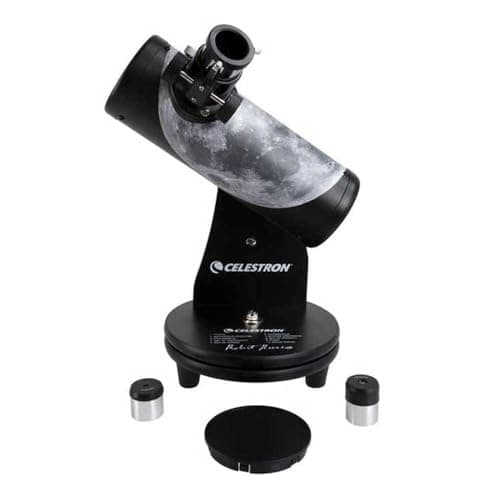 Celestron FirstScope 76mm Tabletop 76mm of honest aperture with nothing to assemble and nothing oversold. | A first telescope with a solid table to stand it on | |
| 2 | 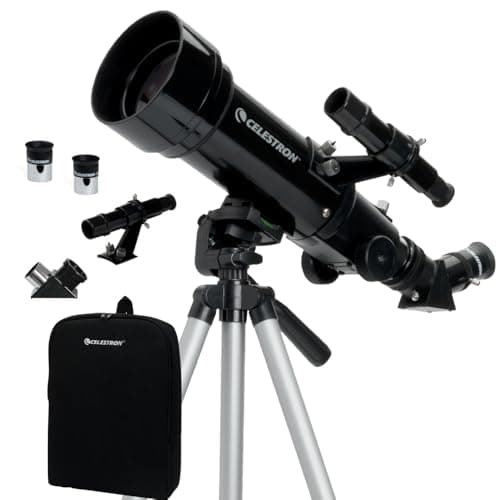 Celestron Travel Scope 70 Slightly less aperture, but it brings its own tripod and its own backpack. | The alternative if you have no table | |
| 3 | 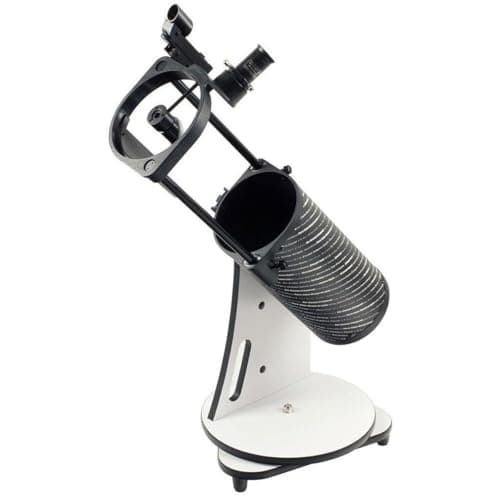 Sky-Watcher Heritage 130 Tabletop Dobsonian The same tabletop idea with 130mm of parabolic mirror instead of 76mm. | The upgrade from here |
Rows link to the full write-up further down this page. Prices come from the live price layer only; where there is no live figure the button reads “Check price” rather than showing a number we remembered.
The table problem, in detail
We keep returning to this because it is the thing that actually decides whether people are happy with this telescope, and it is barely mentioned anywhere else.
A tabletop Dobsonian has no legs — including the motorized Virtuoso GTi 150P. It needs a flat, solid, level surface at roughly the eye height of whoever is using it, standing outdoors, in the dark — what to stand one on covers the dedicated tripod and the free alternatives. Get that wrong and every problem you have will be blamed on the telescope.
- A garden table works. This is the intended case and it works well.
- A low wall works, if the height suits the child.
- A car roof works and is a common trick, though the car needs to be off and cooled — a warm bonnet throws up heat currents that ruin the view.
- A plastic garden chair does not work. It flexes, and a child leaning in will tip the telescope.
- A camping table is marginal. Test it with weight on it before the first night.
- A dedicated tripod with a flat platform is the proper fix if none of the above exist, and it costs less than upgrading the telescope.
What it will actually show
At 15x, the entire Moon fits in the field with craters and mare visible, and it is bright enough that light pollution barely matters. At 75x, individual craters and mountain shadows along the terminator line, though the Moon drifts out of view in under a minute and someone has to nudge the tube.
Jupiter shows as a small bright disc with up to four moons in a line. Saturn's rings are visible at 75x as a small distinct oval. The Pleiades and other bright open clusters look genuinely good at 15x — the wide field is an advantage there. The Orion Nebula is a gray patch with stars in it.
What it will not show: cloud detail on Jupiter, color in nebulae, galaxy structure, or anything resembling the photographs on space posters. Our full honest list is what you can actually see.
The two practical cautions
- It is an open tube with a mirror at the bottom, and children will reach in. Fingerprints on a primary mirror are a genuine nuisance to remove and mildly degrade the view. One calm sentence before it goes outside solves this permanently.
- A reflector's mirror can drift out of alignment. At f/3.95 it is more sensitive to this than a slower telescope. If the views go soft over a year, collimation is the likely cause — it is a learnable twenty-minute job, not a repair.
The picks in full
Pick 1
Celestron FirstScope 76mm Tabletop
A first telescope with a solid table to stand it on
The arithmetic
The 20mm eyepiece gives 300 / 20 = 15x, and the 4mm gives 300 / 4 = 75x. Celestron's own published ceiling is 180x, so the 4mm sits well inside what the optics support — unusual honesty at this price. There is no tripod: it needs a table, a wall, a car roof or a stack of books at roughly chest height for the child using it.
The short version: yes, it is good, for a specific job. It is a 76mm Newtonian reflector on a Dobsonian-style tabletop base, and it does the one thing a first telescope most needs to do — work immediately, with nothing to get wrong.
Celestron publishes an aperture of 76mm, a focal length of 300mm and a focal ratio of f/3.95. The supplied 20mm eyepiece gives 15x and the 4mm gives 75x, against a published highest useful magnification of 180x. Both eyepieces are inside the ceiling, which on the sub-$100 shelf is genuinely notable.
76mm is more aperture than the 70mm refractors it competes with, because mirrors are cheaper to make than lenses. Celestron's published light-gathering figure is 118 times the human eye, and the limiting stellar magnitude is 11.9.
The absence of a finderscope sounds like a flaw. At 15x with a wide field it mostly is not — you sight along the tube and the target appears. At 75x it is a real limitation, and the reason most families end up using the 20mm all evening.
Skip it if
You have no solid outdoor surface at roughly the child's chest height. This is not a minor caveat — it is the single thing that decides whether this telescope works in your house, and no amount of optical quality compensates for a telescope standing on a wobbly chair.
| Optical design | Newtonian reflector, spherical primary mirror |
|---|---|
| Aperture | 76mm (2.99") |
| Focal length | 300mm (12") |
| Focal ratio | f/3.95 |
| Eyepieces supplied | 20mm (15x) and 4mm (75x) |
| Highest useful magnification | 180x |
| Lowest useful magnification | 11x |
| Limiting stellar magnitude | 11.9 |
| Light gathering vs the eye | 118x |
| Mount | Dobsonian-style tabletop base |
| What the box does not do | No tripod, no finderscope, and no way to track an object as the sky moves — you nudge the tube by hand. The 4mm eyepiece is usable but tight; most children get on better with the 20mm all evening. |
Specifications from Celestron — FirstScope specifications. We have not handled this one — everything above is the published spec sheet plus our own arithmetic on it.
Pick 2
Celestron Travel Scope 70
The alternative if you have no table
The arithmetic
400mm focal length over the two supplied eyepieces gives 20x and 40x. Celestron's published ceiling for a 70mm objective is 168x, so both eyepieces are comfortably inside it — the box is not overselling. The 3.3 lb total is the number that matters for a gift: a child can carry the whole kit themselves, which is most of why it gets used more than once.
This is the straight substitution when the table problem is unsolvable, and it is a fair trade rather than a downgrade.
70mm against 76mm is a light-gathering difference of about 15 percent, which is real but not dramatic. In exchange you get a tripod, so the telescope stands anywhere, and a backpack, so a child can carry the whole thing themselves.
The optics are a 400mm f/5.7 refractor with 20mm and 10mm eyepieces giving 20x and 40x, inside Celestron's published 168x ceiling. There is a 5x24 finderscope, which the FirstScope lacks.
The tripod is the compromise. At 1.8 lbs it is light enough to carry and light enough to wobble, and touching the focuser will move the view for a second or two before it settles.
Skip it if
You do have a solid surface. The FirstScope gives you more aperture for less money; the only reason to pay for this is the tripod and the portability, and if you do not need those you are paying for nothing.
| Optical design | Refractor |
|---|---|
| Aperture | 70mm (2.8") |
| Focal length | 400mm (15.74") |
| Focal ratio | f/5.7 |
| Eyepieces supplied | 20mm (20x) and 10mm (40x) |
| Finderscope | 5x24 |
| Diagonal | 45 degree erect image, 1.25" |
| Mount | Manual alt-azimuth on aluminum tripod |
| Highest useful magnification | 168x |
| Limiting stellar magnitude | 11.7 |
| Total kit weight | 3.3 lbs (1.5 kg), tripod 1.8 lbs (0.81 kg) |
| Included | Custom backpack, Starry Night Basic software, SkyPortal app access |
| What the box does not do | The tripod is the weak part. At 1.8 lbs it is light enough to carry and light enough to wobble, and a child nudging the eyepiece will lose the target. The 45 degree erect-image diagonal is built for daytime use and costs you a little light at night. |
Specifications from Celestron — Travel Scope 70 specifications. We have not handled this one — everything above is the published spec sheet plus our own arithmetic on it.
Pick 3
Sky-Watcher Heritage 130 Tabletop Dobsonian
The upgrade from here
The arithmetic
130mm of aperture collects roughly 3.4 times the light of a 70mm refractor — the single biggest jump available at anything like gift money. At 650mm focal length, a common 25mm eyepiece gives 26x and a 10mm gives 65x. The rule of thumb astronomers use for a maximum useful magnification is about 2x the aperture in millimeters, which puts a sensible ceiling near 260x on a genuinely steady night.
If the FirstScope is right in principle but you want more, this is where the same design goes.
130mm against 76mm is a light-gathering ratio of about 2.9 — nearly three times as much. The mirror is parabolic rather than spherical, which at f/5 keeps stars sharp across the whole field where a cheaper mirror would not.
Same tabletop premise, same no-tripod constraint, same solid-surface requirement. The tube collapses for storage and Sky-Watcher states it retains collimation when it does.
Sky-Watcher does not publish the supplied eyepieces, finderscope or assembled weight for this model, so we cannot tell you those. That is a genuine information gap and it is fair to weigh it.
Skip it if
The child is under about eight, or the budget is fixed near the FirstScope's. This is a substantially bigger and more demanding instrument, and it needs an even more solid surface for a longer, heavier tube.
| Optical design | Newtonian reflector, borosilicate parabolic primary mirror |
|---|---|
| Aperture | 130mm |
| Focal length | 650mm |
| Focal ratio | f/5 |
| Mirror coatings | Sky-Watcher Radiant Aluminum Quartz (RAQ) |
| Focuser | 1.25" helical |
| Mount | Tabletop Dobsonian base, Teflon bearings, altitude locking knob |
| Tube | Collapsible for storage, retains collimation |
| What the box does not do | Sky-Watcher's product page does not publish the supplied eyepieces, finderscope or assembled weight, so we do not state them. No tripod — this is a tabletop instrument. The collapsible tube is open to the air, so it collects dust and will need occasional mirror cleaning and collimation. |
Specifications from Sky-Watcher USA — Heritage 130 Tabletop Dobsonian. We have not handled this one — everything above is the published spec sheet plus our own arithmetic on it.
Questions people actually ask
- Is the Celestron FirstScope good?
- Yes, for a first telescope, provided you have a solid outdoor surface to stand it on. 76mm of aperture, no assembly, and both supplied eyepieces sit inside the published 180x magnification ceiling.
- Does the Celestron FirstScope come with a tripod?
- No. It is a tabletop Dobsonian and needs a table, a low wall or a similar solid surface at roughly the user's chest height. This is the main thing to check before buying.
- What magnification does the FirstScope have?
- 15x with the supplied 20mm eyepiece and 75x with the 4mm, from a 300mm focal length. Celestron's published highest useful magnification for the 76mm aperture is 180x.
- Can you see Saturn with a Celestron FirstScope?
- Yes. At 75x with the supplied 4mm eyepiece, Saturn shows as a small sharp oval with its rings clearly separated from the planet.
- What age is the FirstScope suitable for?
- Five and up with an adult aiming it, and roughly seven and up for independent use. See telescopes for ages 5-6 and ages 7-8.
Sources
Read next
Where to go from here
- The best telescope for a 5 or 6 year old
What a five or six year old can actually do with a telescope, and the two picks built around that rather than around a spec sheet.
- The best kids' telescopes under $100
The sub-$100 shelf is where the 525x claims live. What that money genuinely buys, and the one telescope here we tell you not to buy.
- Tabletop or tripod? The choice your garden makes for you
A tabletop reflector buys more aperture for the money and needs a solid surface. A tripod telescope stands anywhere and costs you glass. Which one your garden allows.
- Is the Celestron Travel Scope 70 any good?
The most portable telescope we recommend, and the tripod that is the direct price of that portability. What it shows and who it suits.
- The telescope setup checklist
The indoor, daylight pre-flight that removes the common first-night failures before anyone goes outside.
- Why can't I see anything through my telescope?
The ranked causes of a telescope that shows nothing, most common first, each with a fix you can do tonight without tools.