Telescopes
Sky-Watcher Virtuoso GTi 150P review
Identical mirror to the manual version. Everything you are paying for is underneath it.

By Scooter M. · published October 3, 2026
I'm not an astronomer and I don't have a lab. I'm someone who's genuinely into this — I read the manuals, compile the published specs, and do the arithmetic the box doesn't do for you. No lab coat. How we pick.
How this is funded. Lens & Lightyear earns a commission when you buy through a link on this page, at no extra cost to you. It does not change which products we pick or what we say about them — every card below carries a real reason to skip it. Prices are pulled live and were last verified October 18, 2026. Full disclosure.
The short answer
Buy it if you want the telescope to find objects and keep them centered without anyone learning the sky first. The mirror is identical to the manual Heritage 150, so the premium is entirely the motorized mount — and it needs 8 AA batteries Sky-Watcher does not include.
This is the first telescope on this site with motors in it, so the review is really about one question: what does a GoTo mount actually do for a family, and is it worth the difference over a mirror you point yourself?
What GoTo actually means, and what it does not
The term covers two separate jobs, and most buyers only think about the first.
- Finding (slewing). You choose an object in the SynScan Pro app and the motors drive the telescope there. Sky-Watcher publishes a database of over 10,000 objects, which is far more than anyone will exhaust.
- Following (tracking). Once it arrives, the mount keeps turning at the sky's own rate so the object stays in the eyepiece. This is the half people underestimate, and the arithmetic below is why.
- Not: showing you more. A motor adds no light. A 150mm mirror shows exactly what a 150mm mirror shows, driven or not.
- Not: skipping the setup. The mount needs an alignment at the start of each session — Sky-Watcher lists one-star, brightest-star, north-level and three-star routines.
The arithmetic that justifies a motor
The sky appears to rotate once every 23 hours 56 minutes, which works out at roughly 15 arcseconds per second of time. That number sounds trivial and is not, because magnification shrinks the window you are looking through.
| Eyepiece on this telescope | Magnification | Approximate true field | Time from center to edge |
|---|---|---|---|
| 25mm supplied | 30x | about 100 arcminutes | roughly 3 minutes |
| 10mm supplied | 75x | about 40 arcminutes | roughly 80 seconds |
| A 6mm you might add | 125x | about 24 arcminutes | roughly 48 seconds |
| A 5mm at the practical ceiling | 150x | about 20 arcminutes | roughly 40 seconds |
Our arithmetic on the 750mm focal length and the sidereal drift rate, assuming an ordinary 50-degree apparent-field eyepiece. True field is the apparent field divided by the magnification; center-to-edge is half of that at 15 arcseconds per second.
So on the Moon at 30x you have a few minutes of peace. On Jupiter at 150x a centered planet reaches the edge in about forty seconds, which is the real reason untracked high-power observing with children goes badly: every time the child finally gets their eye in position, the planet has left.
Quick picks
The GoTo, the manual twin, and the push-to middle
| # | Product | Best for | Price |
|---|---|---|---|
| 1 | 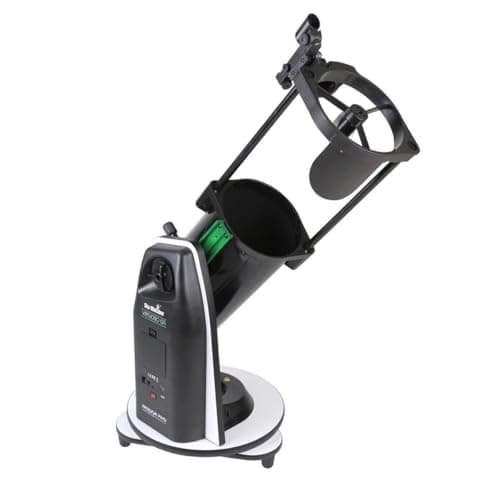 Sky-Watcher Virtuoso GTi 150P 150mm f/5 parabolic optics on a motorized Wi-Fi mount with a 10,000-object database. | A family that wants the telescope to find and follow things by itself | |
| 2 | 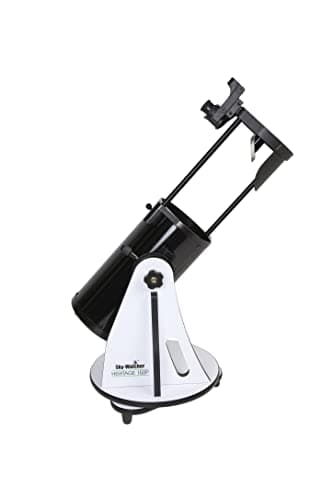 Sky-Watcher Heritage 150 Tabletop Dobsonian 150mm f/5 parabolic on a plain tabletop base — the most aperture per dollar on this site. | The same mirror, manual, for meaningfully less | |
| 3 | 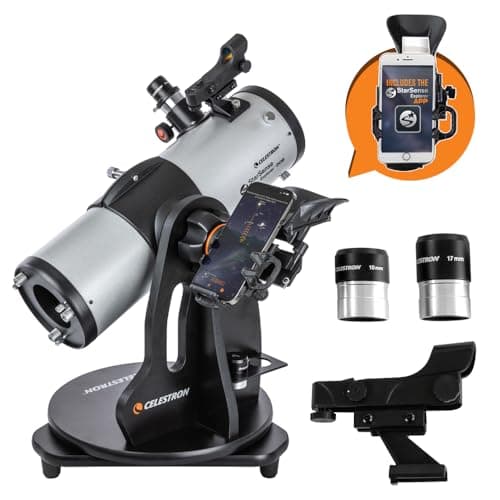 Celestron StarSense Explorer 114mm Tabletop Dobsonian 114mm parabolic tabletop Dobsonian with StarSense push-to guidance, no motors at all. | The middle path — the phone finds it, you move it |
Rows link to the full write-up further down this page. Prices come from the live price layer only; where there is no live figure the button reads “Check price” rather than showing a number we remembered.
The same mirror, three ways to point it
| Virtuoso GTi 150P | Heritage 150 | StarSense 114mm Dob | |
|---|---|---|---|
| Aperture | 150mm | 150mm | 114mm |
| Focal length / ratio | 750mm, f/5 | 750mm, f/5 | 450mm, f/4 |
| Mirror | Parabolic, RAQ coated | Parabolic, RAQ coated | Parabolic |
| Finds objects for you | Yes — motorized GoTo | No | Yes — app push-to |
| Keeps them centered | Yes — tracking | No | No |
| Needs power | 8 AA or 12 V, not included | None | Phone only |
| Session setup | Alignment routine | None | None |
| Eyepieces supplied | 25mm + 10mm | Not published | 17mm + 10mm |
| Price bracket | Highest here | Middle | Middle |
Published figures from Sky-Watcher and Celestron for each model, linked below. Sky-Watcher does not publish the Heritage 150's supplied eyepieces or weight, so those cells stay empty rather than estimated.
Read across the tracking row and the decision becomes concrete. If your household will mostly look at the Moon and bright planets for a few minutes at a time, the manual Heritage 150 gives identical views for less. If a child wants to stare at Saturn at high power while a parent takes a turn, the motor earns its money.
The battery question, stated plainly
Sky-Watcher lists power as 8 AA batteries or an external 12 V supply, and includes neither. It publishes no runtime figure, so we will not invent one — but eight alkaline cells per telescope is a recurring cost and an easy way to lose an evening.
- Buy rechargeable AAs with the telescope, not after the first dead session.
- Or buy a 12 V power bank if you already own one for camping — the mount accepts an external supply.
- Keep a spare set in the case. A GoTo mount with flat batteries is worse than a manual telescope, because you cannot aim it by the setting circles it does not have.
- It still works unpowered as a push-to, thanks to the dual encoders — but without tracking, which is the thing you paid for.
Who this is for
| Situation | Verdict |
|---|---|
| Nobody in the house knows the sky, and you want tracking | Buy it. This is what it is for. |
| Budget is the constraint | The Heritage 150 — identical optics, no electronics. |
| You want finding help but not motors | The StarSense 114mm Dob or a DX 130AZ. |
| No solid surface to stand it on | It is a tabletop telescope — see what to stand one on. |
| A child under about ten, using it alone | Probably not. The alignment is an adult job; see ages 9-10. |
| You want to photograph what you see | Tracking helps, but this is not an astrophotography mount. See the smartphone adapter guide. |
What we did and did not do
We have not handled this telescope. Every specification above was read from Sky-Watcher USA's published page for the Virtuoso GTi 150P, linked below and checked on the date at the top of this page. The drift table is arithmetic on the sidereal rate and the published focal length, using an ordinary 50-degree eyepiece as the assumption — it is shown so you can repeat it, and it is an approximation rather than a measurement.
Where Sky-Watcher publishes nothing — assembled weight, battery runtime, a magnification ceiling — we say so rather than estimating. No price appears in this prose; live figures come only from our price feed with the date they were checked. Our full method is on the methodology page.
The picks in full
Pick 1
Sky-Watcher Virtuoso GTi 150P
A family that wants the telescope to find and follow things by itself
The arithmetic
The optics are the Heritage 150's: 150mm, 750mm, f/5, the same parabolic mirror with the same RAQ coating. Everything you pay extra for is the mount. The 25mm and 10mm eyepieces give 30x and 75x, and with no published magnification ceiling from Sky-Watcher the usual rule of twice the aperture in millimeters puts a sensible limit near 300x — so the box reaches about a quarter of what the mirror can do. The number that justifies a motor is the sky's own drift rate: about 15 arcseconds per second of time. At 75x a typical eyepiece frames roughly 40 arcminutes, so a centered object reaches the edge in a little over a minute; at 150x it is gone in about 40 seconds.
This is the first motorized telescope on this site, and it earns the place for one reason: the optics are the [Heritage 150's](/telescopes/skywatcher-heritage-150) — 150mm, 750mm, f/5, the same parabolic mirror with the same RAQ coating Sky-Watcher rates at 94% reflectivity.
What the money buys is underneath the tube. Built-in Wi-Fi, full GoTo through the SynScan Pro app, a database of over 10,000 objects, and tracking at sidereal, lunar and solar rates. You tell a phone what to look at and the telescope goes there and stays there.
The feature that matters most for a child is the least advertised: Freedom Find dual encoders. You can grab the tube and push it by hand without the mount losing its alignment — which is exactly what a seven-year-old will do within the first ten minutes, and on most GoTo mounts that means starting the alignment again.
Honest costs: no batteries in the box and no published runtime, no eyepiece beyond the supplied 25mm and 10mm, an alignment to perform at the start of every session, and the same tabletop problem every Dobsonian here has — it needs a solid surface at the right height.
Skip it if
The budget is the constraint. The mirror is identical to the manual Heritage 150, so every extra dollar buys the mount — and you still need 8 AA batteries or a 12 V supply, because Sky-Watcher includes neither.
| Model | S21205 |
|---|---|
| Optical design | Newtonian reflector, parabolic primary mirror |
| Aperture | 150mm |
| Focal length | 750mm |
| Focal ratio | f/5 |
| Mirror coating | Radiant Aluminum Quartz (RAQ), 94% reflectivity |
| Eyepieces supplied | 25mm (30x) and 10mm (75x) Super |
| Finderscope | Red dot |
| Mount | Virtuoso GTi motorized tabletop, V-style dovetail |
| Control | Built-in Wi-Fi, full GoTo via the SynScan Pro app |
| Object database | Over 10,000 objects |
| Alignment modes | One-star, brightest star, north-level, three-star |
| Tracking rates | Sidereal, lunar, solar, plus alignment-free solar tracking |
| Manual override | Freedom Find dual encoders — move it by hand without losing alignment |
| Power | 8 x AA batteries or external 12 V supply, neither included |
| Tube | Collapsible for storage and transport |
| What the box does not do | Power. Sky-Watcher lists 8 AA batteries or a 12 V supply and includes neither, and publishes no runtime figure, so we do not state one — budget rechargeables on day one. No eyepiece beyond the supplied 25mm and 10mm, no assembled weight published, and like every tabletop Dobsonian it needs a solid surface at the right height. The GoTo needs an alignment on each session before it can find anything. |
Specifications from Sky-Watcher USA — Virtuoso GTi 150P. We have not handled this one — everything above is the published spec sheet plus our own arithmetic on it.
Pick 2
Sky-Watcher Heritage 150 Tabletop Dobsonian
The same mirror, manual, for meaningfully less
The arithmetic
150mm is the most aperture on this site, and the arithmetic on it is worth doing carefully. Against the Heritage 130 the simple ratio of apertures squared — 150 over 130, squared — gives about 33 percent more light. Sky-Watcher publishes 44 percent. Neither model's central obstruction is published, and accounting for obstruction is the usual reason a real-world figure beats the simple one, so we quote the maker's number and use our own. Against a 70mm refractor the gain is about 4.6 times. At 750mm and f/5 a common 25mm eyepiece gives 30x, and the rule of thumb of twice the aperture in millimeters puts a sensible ceiling near 300x.
The honest comparison, and for many families the better buy: identical aperture, identical focal length, identical mirror, no electronics.
What you give up is finding and following. You point it yourself, and at high magnification you nudge it every minute or so as the sky drifts — which is a skill worth having and an irritation worth knowing about in advance.
What you gain is simplicity and price. There is nothing to align, nothing to charge, nothing to pair with a phone, and no session that ends because the batteries died.
Skip it if
Nobody in the house can find anything, or the child wants to look at one object for longer than a minute at high power without nudging the tube.
| Model | S11710 |
|---|---|
| Optical design | Newtonian reflector, borosilicate parabolic primary mirror |
| Aperture | 150mm |
| Focal length | 750mm |
| Focal ratio | f/5 |
| Mirror coating | Sky-Watcher Radiant Aluminum Quartz (RAQ) |
| Focuser | 1.25" helical |
| Mount | Tabletop azimuth base, Teflon bearings, altitude locking knob |
| Tube | Collapsible for storage, retains collimation |
| Base | Skid-resistant, vibration-suppressing rubber feet |
| What the box does not do | Sky-Watcher does not publish the supplied eyepieces, a finderscope, an assembled weight or a magnification ceiling for this telescope, so we do not state them — the same gap as on the 130. It is a tabletop instrument with no tripod, and 150mm of open tube collects dust and will need collimation eventually. |
Specifications from Sky-Watcher USA — Heritage 150 Tabletop Dobsonian. We have not handled this one — everything above is the published spec sheet plus our own arithmetic on it.
Pick 3
Celestron StarSense Explorer 114mm Tabletop Dobsonian
The middle path — the phone finds it, you move it
The arithmetic
A parabolic mirror rather than the spherical one in cheaper reflectors, which is what keeps a fast f/4 sharp at the edges. 114mm gathers roughly 2.7 times the light of a 70mm refractor, and the published limiting magnitude of 12.8 is the deepest on this site. The supplied eyepieces only reach 45x against a 269x ceiling, so the box gives you wide, bright, easy views and leaves the high-power ones to buy later.
The cheapest answer to the finding problem, and the one this site has recommended longest: the app photographs the sky, works out where the tube is pointing, and walks you to the object with on-screen arrows.
It solves half of what the Virtuoso solves. You still move the telescope, and you still re-center a planet every minute at high power — but nothing needs batteries beyond the phone in your pocket, and nothing needs aligning first.
The trade is aperture: 114mm against 150mm is about 58 percent of the light, though its published 12.8 limiting magnitude is still deeper than most telescopes at the price.
Skip it if
You want tracking. This points you at the target with arrows and then stops helping — the sky keeps drifting and you keep nudging.
| Optical design | Newtonian reflector, parabolic primary mirror |
|---|---|
| Aperture | 114mm (4.48") |
| Focal length | 450mm (17.71") |
| Focal ratio | f/4 |
| Eyepieces supplied | 17mm (26x) and 10mm (45x) |
| Finderscope | StarPointer red dot |
| Mount | Alt-azimuth tabletop Dobsonian base |
| Highest useful magnification | 269x |
| Limiting stellar magnitude | 12.8 |
| Total kit weight | 12.6 lbs (5.71 kg) |
| What the box does not do | No tripod — it is a tabletop instrument and needs a solid surface at the right height, which is a real planning problem in a garden. A reflector's mirror can drift out of alignment; expect to learn collimation eventually. |
Specifications from Celestron — StarSense Explorer 114mm Dobsonian specifications. We have not handled this one — everything above is the published spec sheet plus our own arithmetic on it.
Questions people actually ask
- Is the Sky-Watcher Virtuoso GTi 150P worth it over the Heritage 150?
- Only if you want the mount to find and follow objects. The optics are identical — 150mm, 750mm, f/5, the same parabolic mirror and RAQ coating — so the entire premium buys motors, Wi-Fi and a 10,000-object database, plus a battery requirement the manual version does not have.
- Does the Virtuoso GTi 150P track objects automatically?
- Yes. Once aligned it tracks at sidereal, lunar or solar rates, and Sky-Watcher also lists an alignment-free solar tracking mode. That matters most at high power: at about 150x, an untracked object drifts from the center of the field to the edge in roughly 40 seconds.
- What batteries does the Virtuoso GTi 150P need?
- Eight AA batteries, or an external 12 V supply. Sky-Watcher includes neither and publishes no runtime figure, so budget rechargeables or a 12 V power bank at the same time as the telescope.
- Can you move the Virtuoso GTi by hand?
- Yes, and this is one of its best features for families. Sky-Watcher's Freedom Find dual encoders let you push the tube manually without losing the alignment, so a child grabbing the telescope does not force you to start the setup again.
- Is a GoTo telescope good for a child?
- It solves the biggest cause of disappointing first nights — not being able to find anything — and tracking keeps the target in view while a child gets their eye in position. The costs are an alignment routine at the start of each session and a dependence on batteries.
- What magnification do the supplied eyepieces give?
- 30x with the 25mm and 75x with the 10mm, from the 750mm focal length. Sky-Watcher publishes no magnification ceiling; the usual rule of twice the aperture in millimeters puts a sensible limit near 300x, so the box reaches about a quarter of what the mirror can do.
Sources
Read next
Where to go from here
- Sky-Watcher Heritage 150 review
150mm f/5 parabolic optics on a collapsible tabletop base. The aperture arithmetic against the Heritage 130 — including where our figure and Sky-Watcher's disagree — and what the maker leaves unpublished.
- Celestron StarSense Explorer 114mm review
114mm of parabolic mirror plus phone-guided finding — the telescope we recommend more than any other here. What that combination buys, and the one thing it demands.
- What to stand a tabletop Dobsonian on
Tabletop Dobsonians give the most aperture per dollar and arrive without anything to stand on. The dedicated Celestron tripod, what it fits, and the cheaper answers that work.
- Celestron StarSense Explorer DX 130AZ review
130mm f/5 parabolic optics with phone guidance and dual-axis slow-motion controls, at 18 lbs. The arithmetic on what the box reaches, and the two cheaper routes to the same mirror.
- The best telescope for deep space
Galaxies and nebulae are won with aperture and dark skies, never magnification. What limiting magnitude means in practice, and the telescopes that reach deepest here.
- Which Celestron StarSense Explorer is best for a kid?
LT 70AZ, DX 102AZ or the 114mm tabletop Dobsonian? Compared on published specs, weight, and what the box actually gives you against what it could.