Telescopes
Sky-Watcher Heritage 150 review
The most aperture on this site, and the shortest specification sheet behind it.
By Scooter M. · published September 27, 2026
I'm not an astronomer and I don't have a lab. I'm someone who's genuinely into this — I read the manuals, compile the published specs, and do the arithmetic the box doesn't do for you. No lab coat. How we pick.
How this is funded. Lens & Lightyear earns a commission when you buy through a link on this page, at no extra cost to you. It does not change which products we pick or what we say about them — every card below carries a real reason to skip it. Prices are pulled live and were last verified October 18, 2026. Full disclosure.
The short answer
Buy it for the most aperture per dollar on this site, if you have a solid waist-height surface outdoors. 150mm at f/5 with a parabolic mirror is a genuinely capable deep-sky telescope. Buy the Heritage 130 instead if portability or price matters — the design is identical and the aperture gap is about a third.
This telescope sits at the top of the tabletop Dobsonian class, which is the best value in beginner astronomy and the class with the most awkward requirement: it needs something to stand on.
The aperture arithmetic, including where we disagree with the maker
Sky-Watcher publishes two comparisons on this product: that it collects 363 percent more light than the human eye, and 44 percent more light than the 130mm model. The second one is worth checking, because checking published arithmetic is what this site is for.
| Comparison | Our arithmetic | Sky-Watcher publishes |
|---|---|---|
| Heritage 150 against Heritage 130 | about 33% more light (150 ÷ 130, squared) | 44% more |
| Heritage 150 against a 70mm refractor | about 4.6 times the light | Not published |
| Heritage 150 against a 102mm refractor | about 2.2 times the light | Not published |
Light gathering scales with the square of the aperture, so the simple ratio is the aperture ratio squared. We cannot reconcile 33 with 44 from published figures — neither telescope's central obstruction is published, and obstruction is the usual reason a real-world figure beats the simple one. We quote the maker's number and use our own.
That is not an accusation. A manufacturer comparing *effective* light grasp after the secondary mirror blocks its share can legitimately arrive at a bigger number than the raw aperture ratio. But neither obstruction is published, so neither you nor we can verify it, and the honest thing is to say so rather than repeat a figure we cannot check.
What 150mm actually shows
- Galaxies and nebulae — this is where the aperture goes. A third more light than the 130 is a real, visible step on faint extended objects under a dark sky.
- The Moon and planets — excellent, but not a third better. Planetary detail is limited by atmospheric steadiness long before it is limited by a 20mm aperture difference.
- Star clusters — at f/5 the field stays wide, so big open clusters frame properly instead of spilling past the edge.
- From a bright suburb — much less than the above. Aperture cannot outrun light pollution on faint objects; our deep space page sets out what changes and what does not.
The specifications Sky-Watcher does not publish
We normally run our standing arithmetic here — supplied eyepieces against the maker's published magnification ceiling. On this telescope we cannot, and that is worth stating plainly rather than filling the gap with estimates.
| Specification | Celestron publishes it? | Sky-Watcher publishes it? |
|---|---|---|
| Aperture, focal length, focal ratio | Yes | Yes |
| Mirror figure (parabolic or spherical) | Yes | Yes |
| Supplied eyepieces and magnifications | Yes | No |
| Highest useful magnification | Yes | No |
| Limiting stellar magnitude | Yes | No |
| Assembled or kit weight | Yes | No |
Which is why every comparison on this page is an aperture comparison. Where a figure is not published we leave the cell empty rather than estimating it.
For planning purposes the rule of thumb we use everywhere applies: a realistic magnification ceiling is about twice the aperture in millimeters, so roughly 300x on a genuinely steady night, and a 25mm eyepiece on a 750mm telescope gives 30x.
Quick picks
The Heritage 150 and the two telescopes either side of it
| # | Product | Best for | Price |
|---|---|---|---|
| 1 | 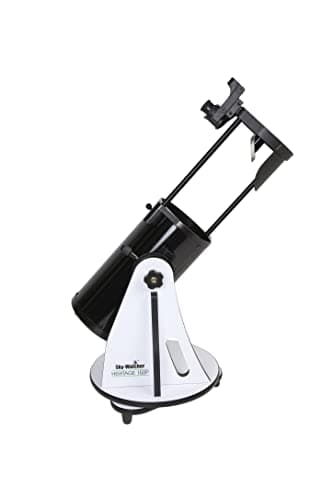 Sky-Watcher Heritage 150 Tabletop Dobsonian 150mm of borosilicate parabolic mirror at f/5, on a collapsible tabletop base — the same optics as the motorized Virtuoso GTi 150P. | The most light per dollar, if you have somewhere to stand it | |
| 2 | 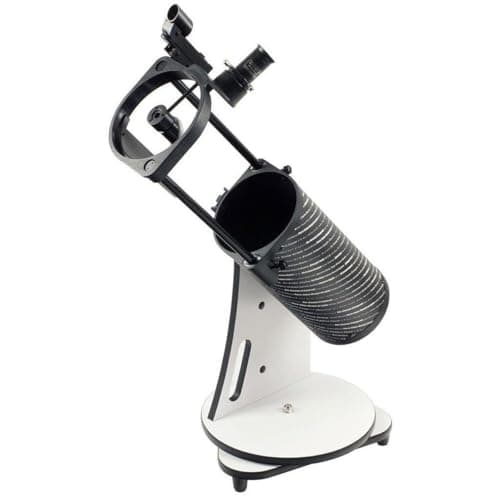 Sky-Watcher Heritage 130 Tabletop Dobsonian 130mm f/5 parabolic on the same collapsible tabletop pattern. | The same design, cheaper and lighter | |
| 3 | 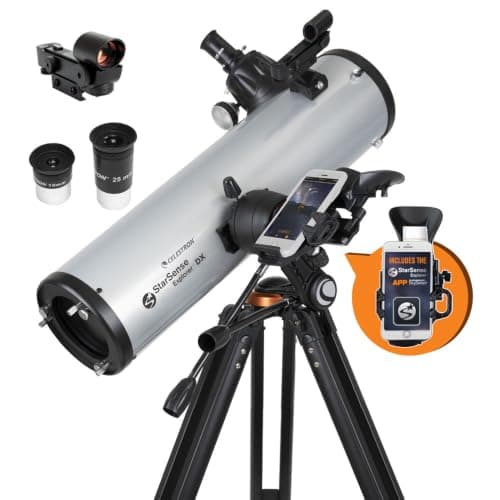 Celestron StarSense Explorer DX 130AZ 130mm f/5 parabolic with dual-axis slow-motion controls and phone guidance. | Similar aperture, on a tripod, with an app that finds things | $499.95 on Amazon #ad How we’re funded · price as of October 18, 2026 |
Rows link to the full write-up further down this page. Prices come from the live price layer only; where there is no live figure the button reads “Check price” rather than showing a number we remembered.
The surface problem, one more time
A tabletop Dobsonian with a 150mm mirror is bigger than most people picture. It needs a stable surface at roughly chest height for whoever is looking through it, outdoors, in the dark — and garden furniture is usually the wrong height, the wrong stability or not there at all.
The free answers work: a sturdy stool, an upturned crate, a picnic table with a chair. The paid answer for Celestron's own tabletop Dobsonians is a dedicated tripod, and Sky-Watcher publishes no tripod fitting for the Heritage base, so we will not tell you one fits. The whole decision is on what to stand a tabletop Dobsonian on.
Who this is for
| Situation | Verdict |
|---|---|
| Deep-sky objects under a dark sky | Buy it. The most light on this site. |
| First telescope for a younger child | The Heritage 130 or a 70mm on a tripod — smaller is more used. |
| No solid outdoor surface | Not this one. A tripod telescope instead. |
| Nobody in the house can find anything | The DX 130AZ — app guidance is worth more than 20mm of aperture. |
| You want published numbers to compare | Celestron publishes far more; see which StarSense Explorer. |
| Bright suburban sky | Aperture will not fix it. Read for deep space before spending. |
What we did and did not do
We have not handled this telescope. Every specification above was read from Sky-Watcher USA's published page for the Heritage 150, linked below and checked on the date at the top of this page. The light-gathering ratios are our arithmetic on published apertures, shown so you can repeat them — including the one that does not match the maker's own figure, which we have flagged rather than smoothed over.
No price appears in this prose. Live figures come only from our price feed with the date they were checked. Our full method is on the methodology page.
The picks in full
Pick 1
Sky-Watcher Heritage 150 Tabletop Dobsonian
The most light per dollar, if you have somewhere to stand it
The arithmetic
150mm is the most aperture on this site, and the arithmetic on it is worth doing carefully. Against the Heritage 130 the simple ratio of apertures squared — 150 over 130, squared — gives about 33 percent more light. Sky-Watcher publishes 44 percent. Neither model's central obstruction is published, and accounting for obstruction is the usual reason a real-world figure beats the simple one, so we quote the maker's number and use our own. Against a 70mm refractor the gain is about 4.6 times. At 750mm and f/5 a common 25mm eyepiece gives 30x, and the rule of thumb of twice the aperture in millimeters puts a sensible ceiling near 300x.
This is the largest aperture on this site, and at f/5 it keeps the wide, forgiving field that makes the Heritage 130 such an easy telescope to recommend.
The mirror is the same specification family as its smaller sibling: borosilicate, parabolic, with Sky-Watcher's RAQ coating. Parabolic is not optional at f/5 — a spherical mirror that fast visibly smears stars toward the edge of the field — so this is the right corner to spend money on.
The collapsible tube is the reason a 150mm telescope can live in a cupboard. Sky-Watcher states it retains collimation through the collapse, which is the claim that makes the design practical rather than clever.
Two honest problems. It is a tabletop instrument, so the surface question decides everything — see what to stand a tabletop Dobsonian on. And Sky-Watcher publishes strikingly little: no eyepieces, no finder, no weight, no magnification ceiling.
Skip it if
There is no solid waist-height surface outdoors. It has no tripod, and Sky-Watcher publishes no assembled weight, so you cannot even plan around how heavy the thing you are lifting is.
| Model | S11710 |
|---|---|
| Optical design | Newtonian reflector, borosilicate parabolic primary mirror |
| Aperture | 150mm |
| Focal length | 750mm |
| Focal ratio | f/5 |
| Mirror coating | Sky-Watcher Radiant Aluminum Quartz (RAQ) |
| Focuser | 1.25" helical |
| Mount | Tabletop azimuth base, Teflon bearings, altitude locking knob |
| Tube | Collapsible for storage, retains collimation |
| Base | Skid-resistant, vibration-suppressing rubber feet |
| What the box does not do | Sky-Watcher does not publish the supplied eyepieces, a finderscope, an assembled weight or a magnification ceiling for this telescope, so we do not state them — the same gap as on the 130. It is a tabletop instrument with no tripod, and 150mm of open tube collects dust and will need collimation eventually. |
Specifications from Sky-Watcher USA — Heritage 150 Tabletop Dobsonian. We have not handled this one — everything above is the published spec sheet plus our own arithmetic on it.
Pick 2
Sky-Watcher Heritage 130 Tabletop Dobsonian
The same design, cheaper and lighter
The arithmetic
130mm of aperture collects roughly 3.4 times the light of a 70mm refractor — the single biggest jump available at anything like gift money. At 650mm focal length, a common 25mm eyepiece gives 26x and a 10mm gives 65x. The rule of thumb astronomers use for a maximum useful magnification is about 2x the aperture in millimeters, which puts a sensible ceiling near 260x on a genuinely steady night.
For most families this remains the better buy, and the reason is not optical — it is that a smaller tabletop telescope is easier to place, easier to carry and cheaper to replace if interest fades.
The optical formula is the same: parabolic borosilicate mirror, f/5, collapsible tube, Teflon-bearing base. What you give up against the 150 is aperture, and the arithmetic on that is in the table below.
It has the same unpublished-specification problem, so the comparison between the two is entirely a comparison of apertures.
Skip it if
You want the deepest views this category offers. 150mm gathers about a third more light, and on faint objects that is the difference you actually notice.
| Optical design | Newtonian reflector, borosilicate parabolic primary mirror |
|---|---|
| Aperture | 130mm |
| Focal length | 650mm |
| Focal ratio | f/5 |
| Mirror coatings | Sky-Watcher Radiant Aluminum Quartz (RAQ) |
| Focuser | 1.25" helical |
| Mount | Tabletop Dobsonian base, Teflon bearings, altitude locking knob |
| Tube | Collapsible for storage, retains collimation |
| What the box does not do | Sky-Watcher's product page does not publish the supplied eyepieces, finderscope or assembled weight, so we do not state them. No tripod — this is a tabletop instrument. The collapsible tube is open to the air, so it collects dust and will need occasional mirror cleaning and collimation. |
Specifications from Sky-Watcher USA — Heritage 130 Tabletop Dobsonian. We have not handled this one — everything above is the published spec sheet plus our own arithmetic on it.
Pick 3
Celestron StarSense Explorer DX 130AZ
Similar aperture, on a tripod, with an app that finds things
The arithmetic
The most aperture of anything on this site: 130mm collects about 1.6 times the light of the DX 102AZ, 1.3 times the LT 114AZ and roughly 3.4 times a 70mm refractor, and Celestron's published limiting magnitude of 13.1 is the deepest we list. The published 307x ceiling is 60x per inch of aperture (5.11 inches times 60 is 306.6). The supplied eyepieces give 26x and 65x, so the box reaches about 21 percent of that ceiling — and, like the DX 102AZ, the DX omits the 2x Barlow the cheaper LT models include. The 635mm tube for a 650mm focal length is what a plain Newtonian looks like: nothing in the light path is stretching the focal length.
The alternative for a household where nobody can find anything: the same mirror formula on a full tripod, plus the StarSense app that reads the sky through a phone camera and walks you to the target.
It publishes what Sky-Watcher does not — 307x ceiling, 13.1 limiting magnitude, 18 lb kit weight — which is worth something in itself when you are trying to compare telescopes honestly.
The Heritage 150 beats it on raw aperture and on price; the DX beats it on finding things and on not needing a table. Full review.
Skip it if
Budget or weight decide it. It is the most expensive telescope we recommend and the heaviest at 18 lbs, and it needs a compatible phone.
| Optical design | Newtonian reflector, parabolic primary mirror |
|---|---|
| Aperture | 130mm (5.11") |
| Focal length | 650mm (25.59") |
| Focal ratio | f/5 |
| Optical tube length | 635mm (25") |
| Eyepieces supplied | 25mm (26x) and 10mm (65x) |
| Barlow | Not included |
| Finderscope | StarPointer red dot |
| Mount | Manual alt-azimuth, dual-axis slow-motion controls |
| Tripod | 1244.6mm (49") max height |
| Secondary mirror obstruction | 34% by diameter, 11% by area |
| Highest useful magnification | 307x |
| Limiting stellar magnitude | 13.1 |
| Total kit weight | 18 lbs (8.16 kg) |
| Phone requirement | Android 12 and later; iOS 18 and newer, iPhone XR and newer |
| What the box does not do | No Barlow, so the top supplied magnification is 65x against a 307x ceiling — a shorter eyepiece belongs in the budget. At 18 lbs total this is the heaviest telescope on this site, and the mount and tripod alone weigh 9.2 lbs; an adult carries it, every session. A reflector's mirrors will eventually need collimation, and at f/5 the alignment matters more than it does on a slower tube. |
Specifications from Celestron — StarSense Explorer DX 130AZ specifications. We have not handled this one — everything above is the published spec sheet plus our own arithmetic on it.
#ad How we’re funded · price as of October 18, 2026
Questions people actually ask
- Is the Sky-Watcher Heritage 150 worth it over the Heritage 130?
- If you have the surface for it and faint objects are the goal, yes — the aperture ratio squared gives about 33 percent more light. If portability or price matters, the 130 is the same optical design in an easier package.
- How much more light does the Heritage 150 gather than the 130?
- Our arithmetic on published apertures gives about 33 percent (150 divided by 130, squared). Sky-Watcher publishes 44 percent. Neither model's central obstruction is published, so we cannot reconcile the two figures and we quote both.
- What eyepieces come with the Heritage 150?
- Sky-Watcher does not publish the supplied eyepieces for this telescope, so we do not state them. It also publishes no finderscope, no assembled weight and no magnification ceiling, which is why every comparison on our page is an aperture comparison.
- Does the Heritage 150 need a tripod?
- It needs a surface, not necessarily a tripod. It is a tabletop Dobsonian with no legs, so it wants a stable support at roughly chest height. A sturdy stool or picnic table works; Sky-Watcher publishes no tripod fitting for this base.
- Is 150mm too big for a child?
- For a child using it alone, usually yes — it is the largest telescope on this site and Sky-Watcher does not publish its weight. As a family telescope with an adult placing it on a surface, it is a superb instrument for the money.
Sources
Read next
Where to go from here
- Sky-Watcher Heritage 130 review
130mm of parabolic mirror that collapses for storage. The biggest single jump in what a child can see, and the planning problem that comes with it.
- What to stand a tabletop Dobsonian on
Tabletop Dobsonians give the most aperture per dollar and arrive without anything to stand on. The dedicated Celestron tripod, what it fits, and the cheaper answers that work.
- The best telescope for deep space
Galaxies and nebulae are won with aperture and dark skies, never magnification. What limiting magnitude means in practice, and the telescopes that reach deepest here.
- Celestron StarSense Explorer DX 130AZ review
130mm f/5 parabolic optics with phone guidance and dual-axis slow-motion controls, at 18 lbs. The arithmetic on what the box reaches, and the two cheaper routes to the same mirror.
- Tabletop or tripod? The choice your garden makes for you
A tabletop reflector buys more aperture for the money and needs a solid surface. A tripod telescope stands anywhere and costs you glass. Which one your garden allows.
- The best telescope for viewing planets and galaxies
Planets want magnification and contrast; galaxies want aperture and a wide field. The trade explained with published numbers, and the telescopes that split the difference honestly.
- Sky-Watcher Virtuoso GTi 150P review
150mm f/5 parabolic optics on a Wi-Fi GoTo tabletop mount that also moves by hand. The arithmetic on why tracking matters, and the two cheaper ways to solve the same problem.