Telescopes
Tabletop or tripod? The choice your garden makes for you
More aperture, or somewhere to put it. You do not get both.
By Scooter M. · published September 1, 2026
I'm not an astronomer and I don't have a lab. I'm someone who's genuinely into this — I read the manuals, compile the published specs, and do the arithmetic the box doesn't do for you. No lab coat. How we pick.
How this is funded. Lens & Lightyear earns a commission when you buy through a link on this page, at no extra cost to you. It does not change which products we pick or what we say about them — every card below carries a real reason to skip it. Prices are pulled live and were last verified October 18, 2026. Full disclosure.
The short answer
A tabletop reflector gives you noticeably more aperture for the money because you are not paying for legs. A tripod telescope stands anywhere. If you have a solid outdoor table at roughly the child's chest height, buy tabletop. If you do not, buy tripod and stop reading.
Why tabletop telescopes are cheaper for the same aperture
A telescope mount has to hold the tube rigidly enough that touching the focuser does not throw the target out of the eyepiece. That gets rapidly harder and more expensive as the tube gets bigger and heavier, and at some point the mount costs more than the optics.
A tabletop Dobsonian sidesteps the problem by putting the tube on a simple rotating base and letting your table do the structural work. The largest one we recommend is the Sky-Watcher Heritage 130, and the underlying lens-or-mirror question is on refractor vs reflector. No legs, no head, no counterweight, no tripod engineering. The money that would have gone into a mount goes into the mirror instead.
That is not a trick — it is a genuinely good design, and it is why serious amateur astronomers own Dobsonians. It just moves one requirement from the product to your garden.
The trade in one table
| Tabletop | Tripod | |
|---|---|---|
| Aperture per dollar | Much better. No mount to pay for | Worse. Legs and a head cost real money |
| Where it can stand | Solid surface at chest height only | Anywhere. Grass, patio, slope |
| Height adjustment | None. The table sets it | Yes, and it matters as a child grows |
| Steadiness | Excellent, if the surface is solid | Depends entirely on the tripod's weight |
| Setup time | Seconds. Put it down and look | A minute or two to level and assemble |
| Portability | Compact tube, but needs furniture | Self-contained. Light ones travel well |
| Maintenance | Reflector: occasional collimation | Refractor: none, ever |
| Best for | Getting the most that can be seen | Not owning a suitable outdoor table |
Quick picks
Two tabletops, two tripods
| # | Product | Best for | Price |
|---|---|---|---|
| 1 | 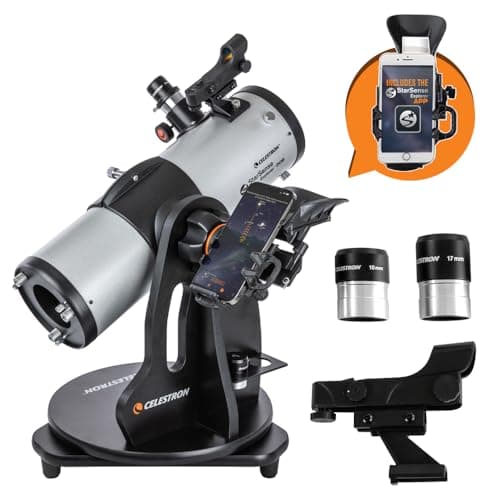 Celestron StarSense Explorer 114mm Tabletop Dobsonian 114mm parabolic mirror and a 12.8 limiting magnitude, on a base that needs a table. Full review. | Tabletop: the most capable pick | |
| 2 | 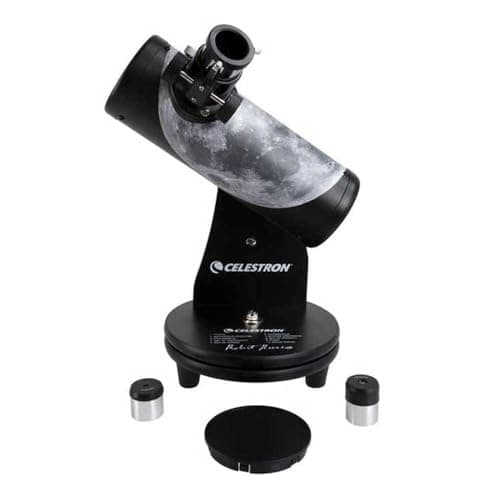 Celestron FirstScope 76mm Tabletop 76mm with nothing to assemble at all, and the widest, most forgiving view here. | Tabletop: the simplest version of the idea | |
| 3 | No image Celestron AstroMaster LT 70AZ 70mm f/10 on steel legs — it stands anywhere and settles fast after a nudge. | Tripod: the steadiest at the price | |
| 4 | 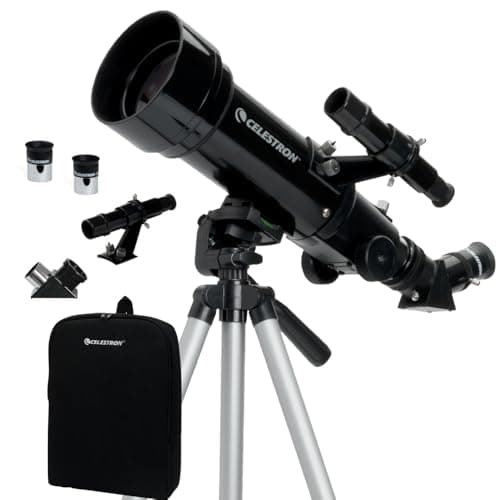 Celestron Travel Scope 70 3.3 lbs for the whole kit including tripod, and it packs into a backpack. | Tripod: when it needs to travel |
Rows link to the full write-up further down this page. Prices come from the live price layer only; where there is no live figure the button reads “Check price” rather than showing a number we remembered.
The surface question, answered properly
Everything above hinges on one thing, so it is worth being concrete about what actually works.
- A wooden or metal garden table. The intended case. Works perfectly.
- A low wall or a wide fence post. Excellent, and often better than a table because it cannot be knocked.
- A car roof. Works, and is a well-known trick. The car must be switched off and cool — a warm bonnet or roof throws heat currents straight up through your view.
- A plastic garden chair. No. It flexes, and a child leaning on it will tip the telescope over.
- A folding camping table. Marginal. Test it with real weight before the first night.
- A dedicated flat-platform tripod. The proper solution if none of the above exists. It costs a fraction of upgrading the telescope, and it turns a tabletop instrument into a go-anywhere one.
Reflector versus refractor comes bundled with this choice
In practice, tabletop telescopes at this price are almost always Newtonian reflectors and tripod telescopes are almost always refractors, so choosing a mount tends to choose an optical design too.
That brings a second set of trade-offs. Reflectors give more aperture per dollar but the mirror needs occasional alignment and the open tube collects dust. Refractors need no maintenance at all and give slightly crisper planetary contrast, but cost much more per millimeter of aperture.
For a child who wants to see as much as possible, reflector. For a child who wants sharp planets and zero fuss, refractor. We work this through by age on telescopes for ages 11-12, where the choice starts to matter most.
The picks in full
Pick 1
Celestron StarSense Explorer 114mm Tabletop Dobsonian
Tabletop: the most capable pick
The arithmetic
A parabolic mirror rather than the spherical one in cheaper reflectors, which is what keeps a fast f/4 sharp at the edges. 114mm gathers roughly 2.7 times the light of a 70mm refractor, and the published limiting magnitude of 12.8 is the deepest on this site. The supplied eyepieces only reach 45x against a 269x ceiling, so the box gives you wide, bright, easy views and leaves the high-power ones to buy later.
The best case for the tabletop design. 114mm of parabolic mirror, phone-guided finding, and a published limiting stellar magnitude of 12.8 — the deepest of anything we recommend.
You would pay considerably more for that aperture on a tripod, because a mount stiff enough to hold a 114mm tube steady costs more than the mirror does. Removing the mount is how tabletop telescopes deliver their value.
The supplied 17mm and 10mm eyepieces give 26x and 45x against a 269x ceiling, which is a deliberately wide, bright, forgiving setup.
12.6 lbs on a base that needs a solid surface at roughly chest height. Decide where that surface is before you buy, not after.
Skip it if
Your observing spot is the middle of a lawn. There is no version of this telescope that works without a solid surface at the right height, and 12.6 lbs of tube makes the surface requirement stricter, not looser.
| Optical design | Newtonian reflector, parabolic primary mirror |
|---|---|
| Aperture | 114mm (4.48") |
| Focal length | 450mm (17.71") |
| Focal ratio | f/4 |
| Eyepieces supplied | 17mm (26x) and 10mm (45x) |
| Finderscope | StarPointer red dot |
| Mount | Alt-azimuth tabletop Dobsonian base |
| Highest useful magnification | 269x |
| Limiting stellar magnitude | 12.8 |
| Total kit weight | 12.6 lbs (5.71 kg) |
| What the box does not do | No tripod — it is a tabletop instrument and needs a solid surface at the right height, which is a real planning problem in a garden. A reflector's mirror can drift out of alignment; expect to learn collimation eventually. |
Specifications from Celestron — StarSense Explorer 114mm Dobsonian specifications. We have not handled this one — everything above is the published spec sheet plus our own arithmetic on it.
Pick 2
Celestron FirstScope 76mm Tabletop
Tabletop: the simplest version of the idea
The arithmetic
The 20mm eyepiece gives 300 / 20 = 15x, and the 4mm gives 300 / 4 = 75x. Celestron's own published ceiling is 180x, so the 4mm sits well inside what the optics support — unusual honesty at this price. There is no tripod: it needs a table, a wall, a car roof or a stack of books at roughly chest height for the child using it.
The entry point to the tabletop design, and the clearest demonstration of why it exists.
76mm of aperture at this price, where a tripod telescope in the same money manages 70mm and has to spend the difference on legs. The 20mm eyepiece gives 15x — the widest, easiest-to-aim view of anything on this site.
Nothing to assemble, no finderscope to align, no diagonal to fit. The number of ways a first night can go wrong is close to zero.
Same constraint, less severe: a shorter, lighter tube is more forgiving about what it stands on than the 114mm above.
Skip it if
The child wants something that looks like a telescope. A short tube on a small base does not match the mental image, and at seven or eight that genuinely matters to some children.
| Optical design | Newtonian reflector, spherical primary mirror |
|---|---|
| Aperture | 76mm (2.99") |
| Focal length | 300mm (12") |
| Focal ratio | f/3.95 |
| Eyepieces supplied | 20mm (15x) and 4mm (75x) |
| Highest useful magnification | 180x |
| Lowest useful magnification | 11x |
| Limiting stellar magnitude | 11.9 |
| Light gathering vs the eye | 118x |
| Mount | Dobsonian-style tabletop base |
| What the box does not do | No tripod, no finderscope, and no way to track an object as the sky moves — you nudge the tube by hand. The 4mm eyepiece is usable but tight; most children get on better with the 20mm all evening. |
Specifications from Celestron — FirstScope specifications. We have not handled this one — everything above is the published spec sheet plus our own arithmetic on it.
Pick 3
Celestron AstroMaster LT 70AZ
Tripod: the steadiest at the price
The arithmetic
Optically this is the same 70mm f/10 as the StarSense LT 70AZ — same aperture, same 700mm focal length, same 165x ceiling, same 11.7 limiting magnitude — without the phone dock and app. If the child has no compatible phone, you are paying for the identical optics and skipping a feature they cannot use. Steel legs rather than aluminum is the other quiet difference, and it is the one that stops a nudge from ending the view.
The tripod case, made properly. This telescope stands on grass, on a patio, on a slope, at whatever height the child needs, and it does not care what furniture you own.
70mm f/10 at 700mm focal length, with 20mm and 10mm eyepieces giving 35x and 70x against a published 165x ceiling. Limiting magnitude 11.7.
The steel tripod legs are the specification worth noticing. The most common complaint about beginner telescopes is that touching the focuser sends the target out of view; a stiffer tripod settles in a fraction of the time an aluminum one takes.
What you give up is aperture. You will see meaningfully less through this than through the 114mm tabletop at similar money. That is the deal.
Skip it if
You want maximum aperture for the money. 70mm on a tripod costs what 114mm on a tabletop does. You are paying for the legs, and that is a real cost, not a rounding error.
| Optical design | Refractor |
|---|---|
| Aperture | 70mm (2.76") |
| Focal length | 700mm (28") |
| Focal ratio | f/10 |
| Eyepieces supplied | 20mm (35x) and 10mm (70x) |
| Finderscope | Built-on StarPointer red dot |
| Mount | Manual alt-azimuth |
| Tripod | 31.75mm (1.25") steel tube legs, pre-assembled |
| Highest useful magnification | 165x |
| Limiting stellar magnitude | 11.7 |
| Total kit weight | 7.2 lbs (3.27 kg) |
| What the box does not do | No Barlow and no app: finding things is entirely on you and a red dot finder. That is a genuine learning curve on the first two evenings, and it is why we send people to the first-night guide before they open the box. |
Specifications from Celestron — AstroMaster LT 70AZ specifications. We have not handled this one — everything above is the published spec sheet plus our own arithmetic on it.
Pick 4
Celestron Travel Scope 70
Tripod: when it needs to travel
The arithmetic
400mm focal length over the two supplied eyepieces gives 20x and 40x. Celestron's published ceiling for a 70mm objective is 168x, so both eyepieces are comfortably inside it — the box is not overselling. The 3.3 lb total is the number that matters for a gift: a child can carry the whole kit themselves, which is most of why it gets used more than once.
The other kind of tripod telescope: one bought for where it can go rather than how steady it is.
3.3 lbs total, in a supplied backpack. A child can carry the entire telescope to the end of the garden, to a campsite or to a grandparent's house without help.
70mm f/5.7 at 400mm, with 20mm and 10mm eyepieces giving 20x and 40x against a published 168x ceiling. The 45 degree erect-image diagonal makes it genuinely useful in daylight too.
The tripod is the cost. At 1.8 lbs it wobbles, and every focus adjustment needs a second or two to settle. That is the direct, unavoidable price of the weight that makes it worth buying.
Skip it if
Steadiness matters more than portability. The 1.8 lb tripod is the lightest here and the wobbliest, and if the telescope will live in one garden that is a pure loss.
| Optical design | Refractor |
|---|---|
| Aperture | 70mm (2.8") |
| Focal length | 400mm (15.74") |
| Focal ratio | f/5.7 |
| Eyepieces supplied | 20mm (20x) and 10mm (40x) |
| Finderscope | 5x24 |
| Diagonal | 45 degree erect image, 1.25" |
| Mount | Manual alt-azimuth on aluminum tripod |
| Highest useful magnification | 168x |
| Limiting stellar magnitude | 11.7 |
| Total kit weight | 3.3 lbs (1.5 kg), tripod 1.8 lbs (0.81 kg) |
| Included | Custom backpack, Starry Night Basic software, SkyPortal app access |
| What the box does not do | The tripod is the weak part. At 1.8 lbs it is light enough to carry and light enough to wobble, and a child nudging the eyepiece will lose the target. The 45 degree erect-image diagonal is built for daytime use and costs you a little light at night. |
Specifications from Celestron — Travel Scope 70 specifications. We have not handled this one — everything above is the published spec sheet plus our own arithmetic on it.
Questions people actually ask
- Is a tabletop telescope good for a kid?
- Yes, provided you have a solid outdoor surface at roughly the child's chest height. Tabletop reflectors give more aperture per dollar than any tripod telescope, and they are quicker to set up.
- What can I put a tabletop telescope on?
- A garden table, a low wall, a wide fence post, or a cooled car roof. Not a plastic chair, and only cautiously on a folding camping table. A dedicated flat-platform tripod is the proper fix if you have none of these.
- Do tabletop Dobsonians come with a tripod?
- No. That is the entire point of the design — removing the mount is how they deliver more aperture for the money. You supply the surface.
- Is a tripod telescope more stable than a tabletop one?
- Usually not. A tabletop telescope on a solid table is steadier than most beginner tripods, because a table is heavier and stiffer than three light aluminum legs.
- Which is better for a beginner, tabletop or tripod?
- Tabletop, if you have somewhere to put it — more aperture, faster setup, fewer parts to get wrong. Tripod, if you do not, because a tabletop telescope with nowhere to stand is unusable at any price.
Sources
Read next
Where to go from here
- Celestron StarSense Explorer 114mm review
114mm of parabolic mirror plus phone-guided finding — the telescope we recommend more than any other here. What that combination buys, and the one thing it demands.
- Refractor or reflector for a child?
Mirrors are cheaper per millimeter of aperture; lenses never need aligning. Which trade suits which child, with the arithmetic on both.
- Sky-Watcher Heritage 130 review
130mm of parabolic mirror that collapses for storage. The biggest single jump in what a child can see, and the planning problem that comes with it.
- The best telescope for a 9 or 10 year old
Nine and ten is the first band where a bigger, heavier telescope is a better telescope. Four picks and the arithmetic behind the jump.
- The best beginner telescopes under $200
Between $100 and $200 you can buy a steady mount, real aperture, or phone-guided finding. What each of those is worth, with the arithmetic.
- Is the Celestron FirstScope any good?
The most-bought first telescope in the category. What its published specs actually mean, and the one household constraint that decides whether it works.
- The best telescope for an 11 or 12 year old
At eleven and twelve the child is the limiting factor no longer. Picks chosen on aperture and on what they will not outgrow in a year.
- The telescope setup checklist
The indoor, daylight pre-flight that removes the common first-night failures before anyone goes outside.
- How much should you spend on a telescope for a child?
Band by band, what the money buys and where it stops helping. The jump from $60 to $150 matters more than the one above it.
- What to stand a tabletop Dobsonian on
Tabletop Dobsonians give the most aperture per dollar and arrive without anything to stand on. The dedicated Celestron tripod, what it fits, and the cheaper answers that work.