Telescopes
What to stand a tabletop Dobsonian on
The surface problem is the one thing nobody mentions before you buy a tabletop telescope.
By Scooter M. · published September 21, 2026
I'm not an astronomer and I don't have a lab. I'm someone who's genuinely into this — I read the manuals, compile the published specs, and do the arithmetic the box doesn't do for you. No lab coat. How we pick.
How this is funded. Lens & Lightyear earns a commission when you buy through a link on this page, at no extra cost to you. It does not change which products we pick or what we say about them — every card below carries a real reason to skip it. Prices are pulled live and were last verified October 18, 2026. Full disclosure.
The short answer
For a Celestron StarSense Explorer tabletop Dobsonian, the dedicated 93480 tripod solves it properly — it bolts the base down with three captured screws and adjusts from 24 to 41 inches. For any other tabletop telescope, a sturdy stool, crate or picnic table at roughly waist height works and costs nothing.
Tabletop Dobsonians are the best value in beginner astronomy and they arrive with a problem the box never mentions: they are not telescopes you put on the ground. Get the surface wrong and a good telescope feels like a bad one.
Why the surface decides whether it gets used
- Height sets your posture. The eyepiece of a Newtonian sits near the top of the tube. Stand the base too low and you kneel; too high and a child cannot reach it at all.
- Stability sets the magnification. Anything above about 60x on a wobbly surface is unusable, because every touch of the focuser sends the image swimming for seconds.
- Level matters more than it sounds. A Dobsonian base rotates in azimuth. On a sloped surface it drifts back toward the low side while you observe.
- Footprint matters for safety. A 12.6 lb telescope on a narrow plant stand is a telescope waiting to fall over in the dark.
Quick picks
The dedicated tripod, and the telescope it is built for
| # | Product | Best for | Price |
|---|---|---|---|
| 1 | 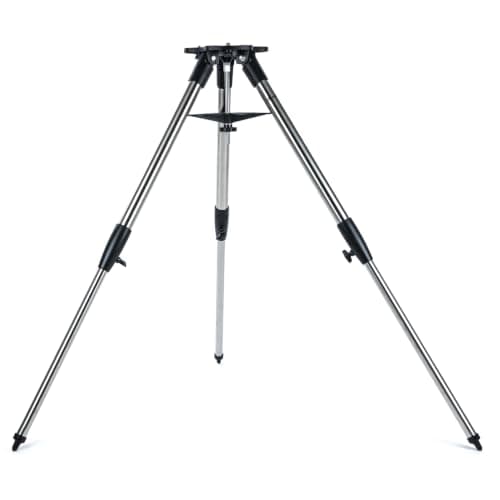 Celestron Tripod for StarSense Explorer Tabletop Dobsonians 24 to 41 inches of stainless steel, a 25 lb capacity and three captured screws that lock the base down. | StarSense Explorer tabletop Dobsonian owners who want it solved properly | |
| 2 | 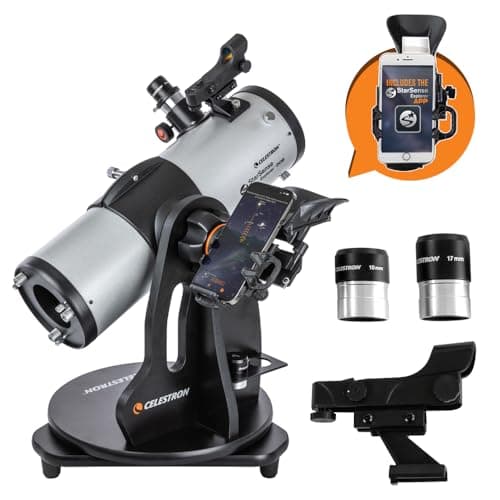 Celestron StarSense Explorer 114mm Tabletop Dobsonian 114mm parabolic at f/4 with phone guidance, 12.6 lbs, and no legs in the box. | The telescope this tripod is built around | |
| 3 | 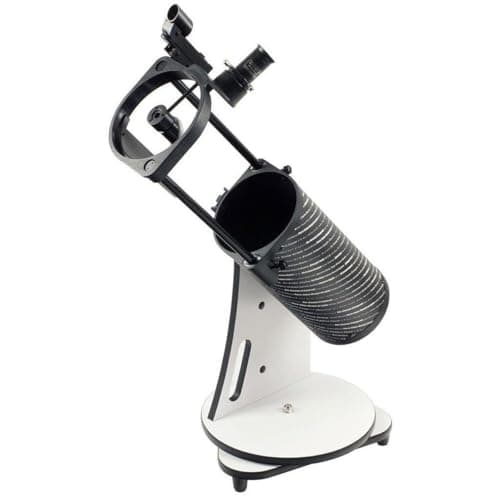 Sky-Watcher Heritage 130 Tabletop Dobsonian 130mm of parabolic mirror on a collapsible tube — the most light in the tabletop class. | More aperture, but check the base before you plan a tripod |
Rows link to the full write-up further down this page. Prices come from the live price layer only; where there is no live figure the button reads “Check price” rather than showing a number we remembered.
The free and cheap alternatives, honestly
A dedicated tripod is not the only answer, and for many households it is not the best one. These all work, and we would rather you spent the money on an eyepiece.
| Option | Works because | Watch out for |
|---|---|---|
| A sturdy wooden stool | Right height, wide footprint, already in the house | Wobbly legs on grass — test it with a push before dark |
| A plastic storage crate | Light, stackable for height, weatherproof | Flexes under weight; better upside-down on firm ground |
| A picnic table | Extremely stable, room for eyepieces | Usually too low for standing use — bring a chair |
| A garden chair plus a low table | Seated observing is steadier and more comfortable | Needs the table close enough to reach the focuser |
| A camera tripod with a flat head | Adjustable height | Capacity and tipping — most photo tripods are rated well below 12 lbs, and the base is not secured |
The last row is the one to be careful with: unless the manufacturer publishes a fitting for your specific base, a tabletop Dobsonian on a photo tripod is resting there rather than attached.
Before you buy any tripod, check the fit
- Find out what your manufacturer publishes. Celestron sells the 93480 tripod for its StarSense Explorer tabletop Dobsonians. Sky-Watcher publishes no tripod fitting for the Heritage base.
- Look underneath your base. A dedicated tripod uses captured screws through the base's own feet or mounting holes; if nothing lines up, it does not fit.
- Check capacity against telescope weight, with margin. Celestron publishes 12.6 lbs for the StarSense 114mm and 25 lbs of capacity for the tripod — roughly double, which is the right ratio.
- Add the weight you will carry. A 9 lb tripod under a 12.6 lb telescope nearly doubles the trip to the garden. That is a real cost for a telescope chosen partly for portability.
Is a tabletop telescope still the right choice?
If the surface problem sounds like a deal-breaker, it is worth revisiting the decision rather than solving it with accessories. Our tabletop versus tripod page compares the two shapes directly.
The short version: a tabletop Dobsonian gives more aperture per dollar and needs a surface; a tripod telescope brings its own legs and gives up aperture at the same price. Adding a dedicated tripod to a tabletop telescope closes that gap in convenience and closes it in price too — at which point a tripod-mounted telescope deserves a second look.
What we did and did not do
We have not handled this tripod. Its specifications were read from Celestron's published page, linked below and checked on the date at the top of this page. Where a manufacturer publishes no fitting — as Sky-Watcher does not for the Heritage base — we say so rather than guessing, because a telescope falling off a stand is the kind of guess that ends the hobby.
No price appears in this prose. Live figures come only from our price feed with the date they were checked. Our full method is on the methodology page.
The picks in full
Pick 1
Celestron Tripod for StarSense Explorer Tabletop Dobsonians
StarSense Explorer tabletop Dobsonian owners who want it solved properly
The arithmetic
This solves the one problem every tabletop Dobsonian owner hits: the telescope needs a surface, and garden furniture is the wrong height, wrong stability or not there at all. The published range of 24 to 41 inches covers the seated-adult to standing-child span, and the 25 lb capacity is roughly double the 12.6 lb StarSense Explorer 114mm it is built for, which is the margin you want holding something a child will nudge.
The honest appeal of this over any camera tripod is the attachment. Three captured screws pull the Dobsonian base down onto a cast aluminum head, so the telescope cannot creep, tip or rotate off the top — which is exactly the failure mode that makes people nervous about improvised stands.
The published numbers support the job: a 25 lb capacity against the 12.6 lb StarSense Explorer 114mm it is designed for, which is roughly double, and 1.5-inch stainless steel legs. That margin is what stops the whole assembly shivering when a child nudges the tube.
Height range is 24 to 41 inches, which covers a seated adult through a standing child. Combined with the telescope's own altitude range, that is the span that matters.
Two honest costs: it is 9 lbs on its own, which for a 12.6 lb telescope is most of the weight again, and it is model-specific rather than universal.
Skip it if
You own a different tabletop telescope. Celestron sells this for its StarSense Explorer tabletop Dobsonians specifically, and the three captured screws expect that base.
| Item number | 93480 |
|---|---|
| Designed for | StarSense Explorer tabletop Dobsonian telescopes |
| Height range | 609.6mm-1041.4mm (24"-41") |
| Maximum supported weight | 25 lbs (11.34 kg) |
| Legs | 38.1mm (1.5") stainless steel, two sections, screw locks |
| Head | Cast aluminum, three captured screws lock the Dobsonian base |
| Accessory tray | Holds up to five 1.25" eyepieces |
| Collapsed size | 228.6 x 228.6 x 711.2mm (9" x 9" x 28") |
| Weight | 9 lbs (4.08 kg) |
| Warranty | 2 year |
| What the box does not do | It is model-specific — Celestron sells it for the StarSense Explorer tabletop Dobsonians, not as a universal stand, and the three captured screws expect that base. It adds 9 lbs to what you carry outside, which for a 12.6 lb telescope is most of the weight again. |
Specifications from Celestron — Tripod for StarSense Explorer Tabletop Dobsonian Telescopes. We have not handled this one — everything above is the published spec sheet plus our own arithmetic on it.
Pick 2
Celestron StarSense Explorer 114mm Tabletop Dobsonian
The telescope this tripod is built around
The arithmetic
A parabolic mirror rather than the spherical one in cheaper reflectors, which is what keeps a fast f/4 sharp at the edges. 114mm gathers roughly 2.7 times the light of a 70mm refractor, and the published limiting magnitude of 12.8 is the deepest on this site. The supplied eyepieces only reach 45x against a 269x ceiling, so the box gives you wide, bright, easy views and leaves the high-power ones to buy later.
If you are reading this page before buying rather than after, this is the telescope the tripod exists for, and the pairing is the most sensible way into a tabletop Dobsonian.
Its parabolic mirror at f/4 gives wide, bright, forgiving views and a published 12.8 limiting magnitude — deeper than telescopes costing considerably more. The app removes the finding problem that otherwise sinks first nights.
What it does not include, and what its own product page does not dwell on, is anything to stand it on. That is the entire reason this page exists. Full review.
Skip it if
Planets are the priority. The supplied eyepieces reach only 45x against a published 269x ceiling, so high-power work means buying an eyepiece straight away.
| Optical design | Newtonian reflector, parabolic primary mirror |
|---|---|
| Aperture | 114mm (4.48") |
| Focal length | 450mm (17.71") |
| Focal ratio | f/4 |
| Eyepieces supplied | 17mm (26x) and 10mm (45x) |
| Finderscope | StarPointer red dot |
| Mount | Alt-azimuth tabletop Dobsonian base |
| Highest useful magnification | 269x |
| Limiting stellar magnitude | 12.8 |
| Total kit weight | 12.6 lbs (5.71 kg) |
| What the box does not do | No tripod — it is a tabletop instrument and needs a solid surface at the right height, which is a real planning problem in a garden. A reflector's mirror can drift out of alignment; expect to learn collimation eventually. |
Specifications from Celestron — StarSense Explorer 114mm Dobsonian specifications. We have not handled this one — everything above is the published spec sheet plus our own arithmetic on it.
Pick 3
Sky-Watcher Heritage 130 Tabletop Dobsonian
More aperture, but check the base before you plan a tripod
The arithmetic
130mm of aperture collects roughly 3.4 times the light of a 70mm refractor — the single biggest jump available at anything like gift money. At 650mm focal length, a common 25mm eyepiece gives 26x and a 10mm gives 65x. The rule of thumb astronomers use for a maximum useful magnification is about 2x the aperture in millimeters, which puts a sensible ceiling near 260x on a genuinely steady night.
The Heritage 130 is the aperture answer in this class and the awkward one for this page, because the dedicated tripod above is not sold for it.
Sky-Watcher publishes no mounting thread, no assembled weight and no tripod accessory for this base, so anything we told you about bolting it to a photo tripod would be a guess. What is verifiable is that it needs a steady surface at roughly waist height like every other tabletop instrument.
In practice that means the free and cheap options below — a picnic table, a sturdy stool, a plastic storage crate — all of which work, none of which need a spec sheet. Full review.
Skip it if
You were counting on the Celestron tripod. It is sold for Celestron's StarSense Explorer tabletop Dobsonians, and Sky-Watcher does not publish a tripod fitting or thread for the Heritage base, so we will not tell you it fits.
| Optical design | Newtonian reflector, borosilicate parabolic primary mirror |
|---|---|
| Aperture | 130mm |
| Focal length | 650mm |
| Focal ratio | f/5 |
| Mirror coatings | Sky-Watcher Radiant Aluminum Quartz (RAQ) |
| Focuser | 1.25" helical |
| Mount | Tabletop Dobsonian base, Teflon bearings, altitude locking knob |
| Tube | Collapsible for storage, retains collimation |
| What the box does not do | Sky-Watcher's product page does not publish the supplied eyepieces, finderscope or assembled weight, so we do not state them. No tripod — this is a tabletop instrument. The collapsible tube is open to the air, so it collects dust and will need occasional mirror cleaning and collimation. |
Specifications from Sky-Watcher USA — Heritage 130 Tabletop Dobsonian. We have not handled this one — everything above is the published spec sheet plus our own arithmetic on it.
Questions people actually ask
- What do you put a tabletop Dobsonian on?
- Any stable surface that puts the eyepiece between chest and chin height — a sturdy stool, an upturned crate or a picnic table all work. Celestron also sells a dedicated tripod (item 93480) for its StarSense Explorer tabletop Dobsonians.
- Can you put a tabletop Dobsonian on a camera tripod?
- Only if the manufacturer publishes a fitting for your base. Most tabletop Dobsonians simply rest on a surface rather than bolting to it, and most photo tripods are rated well below the 12 to 13 lbs these telescopes weigh.
- How tall should the stand be?
- Aim for the eyepiece to land between the observer's chest and chin. For a seated adult that is usually a surface around 24 to 30 inches; a standing child needs more. Celestron's dedicated tripod adjusts from 24 to 41 inches for exactly this reason.
- Does the Celestron tabletop Dobsonian tripod fit the Sky-Watcher Heritage 130?
- Celestron sells it for its own StarSense Explorer tabletop Dobsonians, and Sky-Watcher publishes no tripod fitting or thread for the Heritage base. We will not tell you it fits, because nobody publishes that it does.
- Is a tabletop telescope worth it if you need to buy a stand?
- Often yes, because the stand can be a stool you already own. If you are buying a dedicated tripod, add its price and weight to the telescope's and compare the total against a telescope that brings its own tripod.
Sources
Read next
Where to go from here
- Tabletop or tripod? The choice your garden makes for you
A tabletop reflector buys more aperture for the money and needs a solid surface. A tripod telescope stands anywhere and costs you glass. Which one your garden allows.
- Celestron StarSense Explorer 114mm review
114mm of parabolic mirror plus phone-guided finding — the telescope we recommend more than any other here. What that combination buys, and the one thing it demands.
- Sky-Watcher Heritage 130 review
130mm of parabolic mirror that collapses for storage. The biggest single jump in what a child can see, and the planning problem that comes with it.
- The best telescope for an 11 or 12 year old
At eleven and twelve the child is the limiting factor no longer. Picks chosen on aperture and on what they will not outgrow in a year.
- The telescope setup checklist
The indoor, daylight pre-flight that removes the common first-night failures before anyone goes outside.
- The best telescope for teens
Above about 13 the weight limits and patience limits that shape our age pages stop applying. What to buy when the telescope has to keep up with the person for years.
- Sky-Watcher Heritage 150 review
150mm f/5 parabolic optics on a collapsible tabletop base. The aperture arithmetic against the Heritage 130 — including where our figure and Sky-Watcher's disagree — and what the maker leaves unpublished.
- Sky-Watcher Virtuoso GTi 150P review
150mm f/5 parabolic optics on a Wi-Fi GoTo tabletop mount that also moves by hand. The arithmetic on why tracking matters, and the two cheaper ways to solve the same problem.