Telescopes
Sky-Watcher Heritage 130 review
The most aperture we recommend for a child, and the most surface it demands from you.
By Scooter M. · published September 6, 2026
I'm not an astronomer and I don't have a lab. I'm someone who's genuinely into this — I read the manuals, compile the published specs, and do the arithmetic the box doesn't do for you. No lab coat. How we pick.
How this is funded. Lens & Lightyear earns a commission when you buy through a link on this page, at no extra cost to you. It does not change which products we pick or what we say about them — every card below carries a real reason to skip it. Prices are pulled live and were last verified October 21, 2026. Full disclosure.
The short answer
Yes, if you have somewhere solid to stand it. 130mm of parabolic mirror is the biggest jump in what a child can actually see at anything like gift money, and the collapsible tube means it stores. It has no tripod, no published eyepiece list, and it is the most expensive telescope we recommend.
The Heritage 130 is the telescope experienced amateurs recommend to beginners and it deserves that reputation. Our job on this page is the part those recommendations skip: what it demands from a household with a child in it.
What 130mm actually changes
Light gathering scales with the square of aperture, so the differences are larger than the numbers look. Here is the same telescope compared three ways, using published apertures only.
| Against | Aperture | Heritage 130 collects |
|---|---|---|
| A dark-adapted human eye | about 7mm pupil | roughly 345 times the light |
| A 70mm beginner refractor | 70mm | about 3.4 times the light |
| A 76mm tabletop reflector | 76mm | about 2.9 times the light |
| A 114mm tabletop reflector | 114mm | about 1.3 times the light |
Our arithmetic, from each manufacturer's published aperture: the ratio of the two apertures, squared. You can check any row in one line.
In practice that is the difference between the Orion Nebula as a gray smudge and the Orion Nebula with structure, and between one or two galaxies being findable and a dozen. It does not make the Moon bigger — magnification does that, and every telescope on this site can already deliver more magnification than the atmosphere usually allows. See what you can actually see.
The two things Sky-Watcher does not publish
We only print specifications a manufacturer publishes, and for this telescope two useful ones are absent from Sky-Watcher's own product page: the supplied eyepieces and finderscope, and the assembled weight.
So we do not state them. Retail listings carry numbers for both and they disagree with each other, which is exactly why we do not use retail listings as a source. What we can tell you is the shape of the problem: at 650mm focal length, whatever eyepieces arrive will give roughly 26x at 25mm and 65x at 10mm, and a 130mm tube is heavy enough that an adult should be the one lifting it onto the table.
Quick picks
The Heritage 130 and what it is really up against
| # | Product | Best for | Price |
|---|---|---|---|
| 1 | 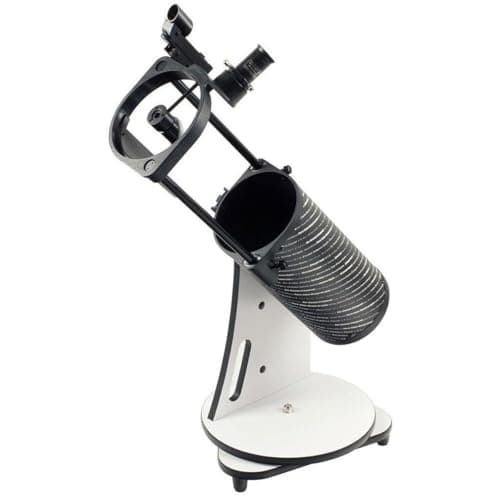 Sky-Watcher Heritage 130 Tabletop Dobsonian 130mm of parabolic mirror, collapsible for storage, and roughly 3.4 times the light of a 70mm. | The most light a child can realistically be given | |
| 2 | 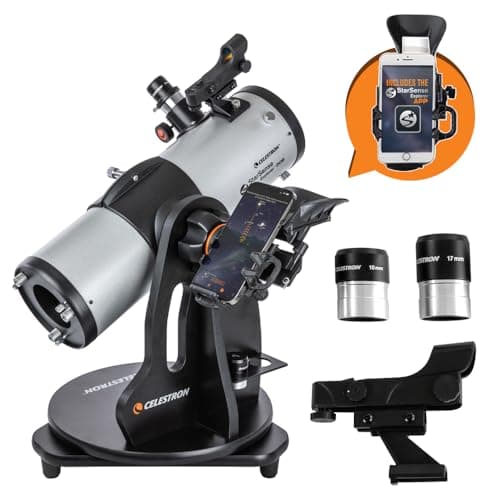 Celestron StarSense Explorer 114mm Tabletop Dobsonian 114mm against 130mm is a 30 percent light difference — and this one tells you where to point. | Slightly less mirror, but the phone finds things for you | |
| 3 | 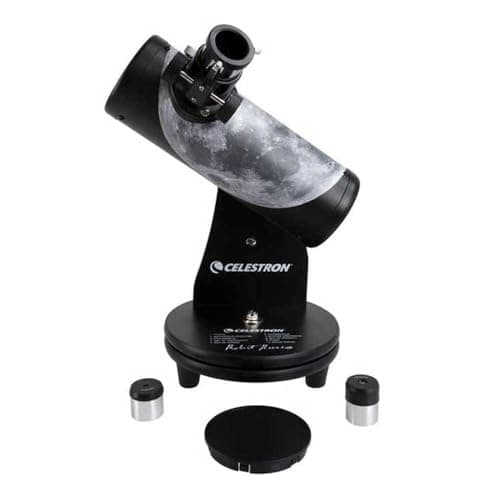 Celestron FirstScope 76mm Tabletop 76mm rather than 130mm, but the identical no-assembly tabletop idea at the bottom of the price range. | The same format for a fraction of the money |
Rows link to the full write-up further down this page. Prices come from the live price layer only; where there is no live figure the button reads “Check price” rather than showing a number we remembered.
The surface problem, stated plainly
Every tabletop Dobsonian has it and this one has it hardest, because it is the largest. There is no tripod in the box and Sky-Watcher does not sell one for it — the base *is* the mount.
- What works: a garden table, a low wall, a sturdy bench, a flat car roof, a plastic storage crate with something heavy inside it.
- What does not: a camping chair, a plastic patio table that flexes, a windowsill, or the ground. On the ground a child has to lie down to reach the eyepiece, and the view is through the worst air in the sky.
- The height that matters is the child's chest, not yours. Too high and they cannot reach the eyepiece; too low and they are stooping in the cold, which ends sessions early.
Decide where it will stand before you buy it. That single sentence is the most useful thing on this page, and it is the same advice we give on tabletop vs tripod.
Maintenance a refractor does not need
The collapsible tube is open to the air when extended. That is the price of the design and it has two consequences worth knowing before rather than after.
- Dust reaches the mirror. Not quickly, and not fatally — a slightly dusty mirror loses a trivial amount of light. But it means an eventual clean, done carefully and rarely, rather than never.
- Collimation. The mirrors need to stay aligned with each other. Sky-Watcher states the tube retains collimation through collapsing, which is the main thing, but a knock will eventually put it out and you will need to learn to correct it. It is a ten-minute skill, not a workshop job — and it is genuinely one a twelve-year-old can own.
A refractor has neither problem, which is a real argument for one at a younger age. We compare the two designs properly on refractor vs reflector for kids.
Who this is genuinely for
| Situation | Verdict |
|---|---|
| Child is 11-12, already interested, and you have a garden table | Buy it. This is the best answer on the site for that household. See ages 11-12. |
| Child is 8-10 and an adult will help set up | Works well, with the adult lifting it. The extra aperture is not wasted at this age. |
| Child is under 8 | Too much telescope. Weight and patience are the limits at that age, not aperture. Start at ages 5-6 or ages 7-8. |
| No solid outdoor surface | Do not buy it. Choose a tripod model instead — the aperture advantage evaporates on an unstable base. |
| Nobody in the house can find anything in the sky | Consider the phone-guided 114mm instead, and accept 30 percent less light for a much better hit rate. |
What we did and did not do
We have not handled this telescope and we do not say otherwise. Every figure above is either read from Sky-Watcher's own published specification page, linked below and re-checked on the date at the top of this page, or it is arithmetic on that page's numbers, shown in full so you can redo it. Where Sky-Watcher publishes nothing, neither do we. Our full method is on the methodology page.
The picks in full
Pick 1
Sky-Watcher Heritage 130 Tabletop Dobsonian
The most light a child can realistically be given
The arithmetic
130mm of aperture collects roughly 3.4 times the light of a 70mm refractor — the single biggest jump available at anything like gift money. At 650mm focal length, a common 25mm eyepiece gives 26x and a 10mm gives 65x. The rule of thumb astronomers use for a maximum useful magnification is about 2x the aperture in millimeters, which puts a sensible ceiling near 260x on a genuinely steady night.
Aperture is the only specification that changes what is genuinely visible rather than how big it looks, and 130mm is the most we would put in a child's hands. Our arithmetic on Sky-Watcher's published figures: against a 70mm refractor it collects (130 / 70) squared, or about 3.4 times the light. Against the 114mm tabletop reflector it is about 1.3 times.
The primary is a borosilicate parabolic mirror with Sky-Watcher's Radiant Aluminum Quartz coating. Parabolic matters at f/5 — a spherical mirror that fast smears stars toward the edge of the field, and the cheaper reflectors in this category use spherical mirrors precisely because they are cheaper to grind.
At 650mm focal length, a common 25mm eyepiece gives 26x and a 10mm gives 65x. Sky-Watcher does not publish a highest useful magnification for this telescope, so we will not quote one as though they had: the two conventions in the industry put the sensible ceiling somewhere between 260x (twice the aperture in millimeters) and 307x (60x per inch, the figure Celestron uses). Either way it is far above anything the supplied eyepieces reach.
The collapsible tube is the quiet convenience. It shortens for storage and Sky-Watcher states it retains collimation when it does, which is what makes a 130mm telescope live in a cupboard instead of a corner.
Skip it if
You do not have a solid outdoor surface at the child's chest height. This is a tabletop instrument with no tripod and no tripod option, and 130mm of mirror standing on something wobbly is worse than 70mm standing on something firm.
| Optical design | Newtonian reflector, borosilicate parabolic primary mirror |
|---|---|
| Aperture | 130mm |
| Focal length | 650mm |
| Focal ratio | f/5 |
| Mirror coatings | Sky-Watcher Radiant Aluminum Quartz (RAQ) |
| Focuser | 1.25" helical |
| Mount | Tabletop Dobsonian base, Teflon bearings, altitude locking knob |
| Tube | Collapsible for storage, retains collimation |
| What the box does not do | Sky-Watcher's product page does not publish the supplied eyepieces, finderscope or assembled weight, so we do not state them. No tripod — this is a tabletop instrument. The collapsible tube is open to the air, so it collects dust and will need occasional mirror cleaning and collimation. |
Specifications from Sky-Watcher USA — Heritage 130 Tabletop Dobsonian. We have not handled this one — everything above is the published spec sheet plus our own arithmetic on it.
Pick 2
Celestron StarSense Explorer 114mm Tabletop Dobsonian
Slightly less mirror, but the phone finds things for you
The arithmetic
A parabolic mirror rather than the spherical one in cheaper reflectors, which is what keeps a fast f/4 sharp at the edges. 114mm gathers roughly 2.7 times the light of a 70mm refractor, and the published limiting magnitude of 12.8 is the deepest on this site. The supplied eyepieces only reach 45x against a 269x ceiling, so the box gives you wide, bright, easy views and leaves the high-power ones to buy later.
This is the honest competitor and the choice is not obvious. You give up about 30 percent of the light gathering and you gain the StarSense app, which photographs the sky and steers you to the target with on-screen arrows.
For a child who cannot yet find anything, that trade is usually worth it — a bigger mirror pointed at nothing shows less than a smaller one pointed at Saturn. For a household with an adult who can already find Jupiter, the Heritage's extra aperture wins.
Both are tabletop Dobsonians, so the surface problem is identical. Neither solves it. We set the three StarSense models against each other on which StarSense Explorer is best for a kid.
Skip it if
Somebody in the house already knows the sky. Then you are paying for a finding aid you do not need, and that money buys mirror instead.
| Optical design | Newtonian reflector, parabolic primary mirror |
|---|---|
| Aperture | 114mm (4.48") |
| Focal length | 450mm (17.71") |
| Focal ratio | f/4 |
| Eyepieces supplied | 17mm (26x) and 10mm (45x) |
| Finderscope | StarPointer red dot |
| Mount | Alt-azimuth tabletop Dobsonian base |
| Highest useful magnification | 269x |
| Limiting stellar magnitude | 12.8 |
| Total kit weight | 12.6 lbs (5.71 kg) |
| What the box does not do | No tripod — it is a tabletop instrument and needs a solid surface at the right height, which is a real planning problem in a garden. A reflector's mirror can drift out of alignment; expect to learn collimation eventually. |
Specifications from Celestron — StarSense Explorer 114mm Dobsonian specifications. We have not handled this one — everything above is the published spec sheet plus our own arithmetic on it.
Pick 3
Celestron FirstScope 76mm Tabletop
The same format for a fraction of the money
The arithmetic
The 20mm eyepiece gives 300 / 20 = 15x, and the 4mm gives 300 / 4 = 75x. Celestron's own published ceiling is 180x, so the 4mm sits well inside what the optics support — unusual honesty at this price. There is no tripod: it needs a table, a wall, a car roof or a stack of books at roughly chest height for the child using it.
If the Heritage's price is the obstacle rather than the surface, this is the same concept executed cheaply and honestly: put it on a table, point the tube, look.
76mm against 130mm is a real gap — (130 / 76) squared is about 2.9 times the light in the Heritage's favor. What the FirstScope buys instead is the ability to be wrong about the whole thing cheaply, which for a five or six-year-old is a completely legitimate purchase.
Our full write-up is on the FirstScope review.
Skip it if
The child is nine or older and already interested. The FirstScope's 76mm will feel small within a year to someone who has started looking things up.
| Optical design | Newtonian reflector, spherical primary mirror |
|---|---|
| Aperture | 76mm (2.99") |
| Focal length | 300mm (12") |
| Focal ratio | f/3.95 |
| Eyepieces supplied | 20mm (15x) and 4mm (75x) |
| Highest useful magnification | 180x |
| Lowest useful magnification | 11x |
| Limiting stellar magnitude | 11.9 |
| Light gathering vs the eye | 118x |
| Mount | Dobsonian-style tabletop base |
| What the box does not do | No tripod, no finderscope, and no way to track an object as the sky moves — you nudge the tube by hand. The 4mm eyepiece is usable but tight; most children get on better with the 20mm all evening. |
Specifications from Celestron — FirstScope specifications. We have not handled this one — everything above is the published spec sheet plus our own arithmetic on it.
Questions people actually ask
- Is the Sky-Watcher Heritage 130 good for a child?
- Yes, from about eight upward and provided you have a solid outdoor surface at the child's chest height. It offers the most light gathering of any telescope we recommend for a child, but it is a tabletop instrument with no tripod option.
- Does the Heritage 130 come with a tripod?
- No. It is a tabletop Dobsonian and the base is the mount. There is no tripod in the box and none is offered, so a table, wall or bench is a requirement rather than an accessory.
- How much more can you see with a 130mm telescope?
- Against a 70mm it collects about 3.4 times the light, and against a 114mm about 1.3 times. That is the difference between a faint object being a smudge and being recognizable — it does not make anything look bigger.
- Does the Heritage 130 need collimation?
- Eventually, yes. Sky-Watcher states the collapsible tube retains collimation through storage, but any reflector drifts out of alignment after knocks. It is a ten-minute skill rather than a workshop job.
- What eyepieces come with the Heritage 130?
- Sky-Watcher does not publish the supplied eyepieces on its product page, so we do not state them. At 650mm focal length, a 25mm eyepiece would give 26x and a 10mm would give 65x.
Sources
Read next
Where to go from here
- The best telescope for deep space
Galaxies and nebulae are won with aperture and dark skies, never magnification. What limiting magnitude means in practice, and the telescopes that reach deepest here.
- Celestron StarSense Explorer 114mm review
114mm of parabolic mirror plus phone-guided finding — the telescope we recommend more than any other here. What that combination buys, and the one thing it demands.
- The best telescope for an 11 or 12 year old
At eleven and twelve the child is the limiting factor no longer. Picks chosen on aperture and on what they will not outgrow in a year.
- Tabletop or tripod? The choice your garden makes for you
A tabletop reflector buys more aperture for the money and needs a solid surface. A tripod telescope stands anywhere and costs you glass. Which one your garden allows.
- Refractor or reflector for a child?
Mirrors are cheaper per millimeter of aperture; lenses never need aligning. Which trade suits which child, with the arithmetic on both.
- Which Celestron StarSense Explorer is best for a kid?
LT 70AZ, DX 102AZ or the 114mm tabletop Dobsonian? Compared on published specs, weight, and what the box actually gives you against what it could.
- What you can actually see with a kids' telescope
The honest target-by-target list for 70mm, 76mm and 114mm telescopes, so nobody is disappointed on night one.
- The best beginner telescopes under $200
Between $100 and $200 you can buy a steady mount, real aperture, or phone-guided finding. What each of those is worth, with the arithmetic.
- Celestron PowerSeeker 127EQ review
The most aperture of any tripod telescope on this site, on an equatorial mount that needs balancing and polar alignment, with a Barlow that reaches two and a half times its own ceiling.
- Celestron StarSense Explorer DX 130AZ review
130mm f/5 parabolic optics with phone guidance and dual-axis slow-motion controls, at 18 lbs. The arithmetic on what the box reaches, and the two cheaper routes to the same mirror.
- Celestron AstroMaster 130EQ review
130mm at f/5 on a German equatorial mount, with a spherical primary where its siblings are parabolic. The one spec that differs, what it implies, and the honest case for buying it anyway.
- Sky-Watcher Heritage 150 review
150mm f/5 parabolic optics on a collapsible tabletop base. The aperture arithmetic against the Heritage 130 — including where our figure and Sky-Watcher's disagree — and what the maker leaves unpublished.