Telescopes
Celestron AstroMaster 130EQ review
One word on the spec sheet separates this from the telescope above it, and it is the word that matters at f/5.

By Scooter M. · published September 19, 2026
I'm not an astronomer and I don't have a lab. I'm someone who's genuinely into this — I read the manuals, compile the published specs, and do the arithmetic the box doesn't do for you. No lab coat. How we pick.
How this is funded. Lens & Lightyear earns a commission when you buy through a link on this page, at no extra cost to you. It does not change which products we pick or what we say about them — every card below carries a real reason to skip it. Prices are pulled live and were last verified October 18, 2026. Full disclosure.
The short answer
Buy it if you want 130mm on a tracking equatorial mount, an adult will set it up, and you understand that the mirror is spherical at f/5. If the mirror figure matters more than the mount, the Sky-Watcher Heritage 130 publishes a parabolic primary at the same 130mm f/5 for less money.
This is one of the most searched-for beginner reflectors Celestron makes, and it sits in an awkward spot on this site: its specification sheet is nearly identical to a telescope we recommend, and the one line that differs is the line we have spent other pages explaining.
The spec sheets, side by side
| AstroMaster 130EQ | StarSense Explorer DX 130AZ | Heritage 130 | |
|---|---|---|---|
| Aperture | 130mm | 130mm | 130mm |
| Focal length / ratio | 650mm, f/5 | 650mm, f/5 | 650mm, f/5 |
| Primary mirror | Spherical | Parabolic | Parabolic |
| Published ceiling | 307x | 307x | Not published |
| Limiting stellar magnitude | 13.1 | 13.1 | Not published |
| Central obstruction | 34% by diameter | 34% by diameter | Not published |
| Eyepieces in the box | 20mm + 10mm (33x / 65x) | 25mm + 10mm (26x / 65x) | Not published |
| Barlow | No | No | Not published |
| Finding things | StarPointer red dot | Red dot plus the phone app | Not published |
| Mount | CG-3 German equatorial, slow-motion both axes | Alt-azimuth, dual-axis slow-motion | Tabletop Dobsonian |
| Kit weight | 17 lbs | 18 lbs | Not published |
| Price bracket | Middle | Top of the site | Middle |
Every figure is from the manufacturer's own published specification page for that model, linked in the sources below. Where Sky-Watcher publishes nothing, we say so rather than estimating.
Two of these three telescopes have the same optical formula and a parabolic mirror. The third has the same formula and a spherical one, which is the whole of this review.
What spherical at f/5 actually means
A spherical mirror is a section of a sphere; a parabolic mirror is ground to a slightly different curve. The sphere is cheaper to make, and it does not bring light from the whole mirror to exactly the same point — an error called spherical aberration.
How much that costs depends entirely on focal ratio. As a mirror gets slower, the error falls away fast, which is why we defend the spherical mirror in the StarSense Explorer LT 114AZ rather than criticize it. At f/5 the mirror is fast, and the same error is no longer negligible: expect stars away from the center of the field to look less tight than they do in the middle. That is what the design implies, stated as design rather than as a measurement — we have not looked through this telescope.
How much of the telescope is in the box
Our standing arithmetic: focal length divided by eyepiece focal length, against the manufacturer's own published ceiling. Celestron's 307x is 60x per inch of aperture, as it is on every model in their range.
| Combination in the box | Magnification | Share of the 307x ceiling |
|---|---|---|
| 20mm (erect image) | 33x | about 11% |
| 10mm | 65x | about 21% |
| No Barlow supplied | — | — |
Our arithmetic on Celestron's published 650mm focal length and supplied eyepieces.
Worth saying plainly, because this site names boxes that oversell themselves: the AstroMaster 130EQ is not one of them. Nothing in this package is magnified past the maker's own limit. Compare the PowerSeeker 127EQ, whose 4mm eyepiece with a 3x Barlow reaches 750x against a published 300x — or its cheaper sibling the 114EQ, which has the better optics and the same oversold eyepiece case — two and a half times the ceiling. The AstroMaster's fault is the opposite one: it ships with too little magnification available, not too much.
| Model | Highest supplied | Published ceiling | Supplied against ceiling |
|---|---|---|---|
| PowerSeeker 127EQ | 750x | 300x | 250% — past the limit |
| StarSense LT 114AZ | 200x | 269x | about 74% |
| AstroMaster 130EQ | 65x | 307x | about 21% |
| StarSense DX 130AZ | 65x | 307x | about 21% |
Our arithmetic on Celestron's published focal lengths, supplied eyepieces and highest useful magnifications.
Quick picks
Three 130mm telescopes, and which one to actually buy
| # | Product | Best for | Price |
|---|---|---|---|
| 1 | 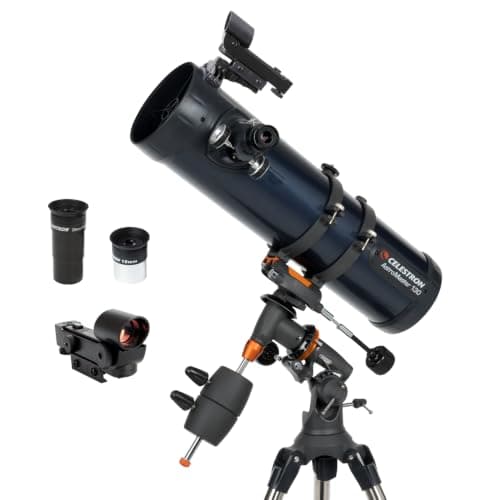 Celestron AstroMaster 130EQ 130mm, 650mm, f/5 and a 307x ceiling — with a spherical primary mirror and 65x in the box. | An adult who wants 130mm on a tracking mount and knows what f/5 spherical means | |
| 2 | 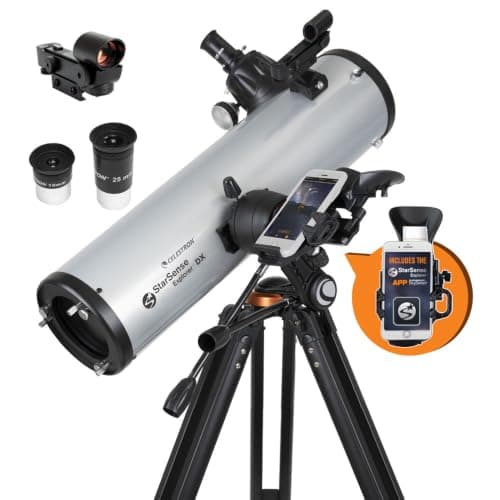 Celestron StarSense Explorer DX 130AZ 130mm f/5 parabolic, dual-axis slow-motion controls and the StarSense app, at the top of this site's price range. | The same numbers with a parabolic mirror and a phone that finds things | $499.95 on Amazon #ad How we’re funded · price as of October 18, 2026 |
| 3 | 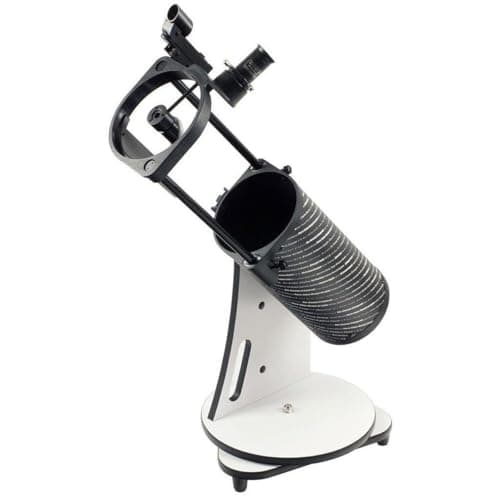 Sky-Watcher Heritage 130 Tabletop Dobsonian 130mm, 650mm, f/5, parabolic, on a tabletop Dobsonian base with nothing to align. | The parabolic mirror, for less than either Celestron | |
| 4 | 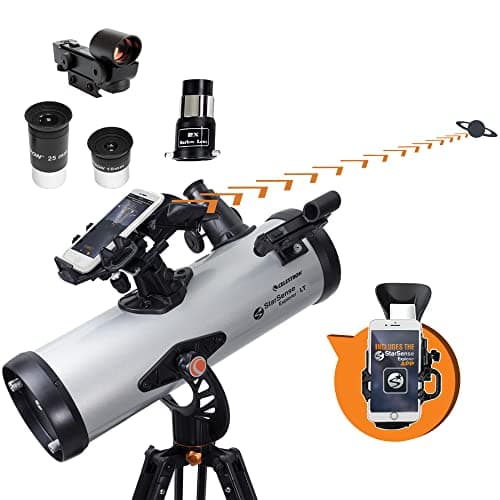 Celestron StarSense Explorer LT 114AZ 114mm on a plain alt-azimuth tripod, phone-guided, with a Barlow in the box — at 10.4 lbs. | The version of this a child can actually use |
Rows link to the full write-up further down this page. Prices come from the live price layer only; where there is no live figure the button reads “Check price” rather than showing a number we remembered.
The equatorial mount, and one line in the manual that helps
An equatorial mount rotates around an axis tilted to your latitude and aimed near the North Star, so a single knob follows a star as the Earth turns. Our PowerSeeker 127EQ review sets out why that is the wrong first mount for a child: the counterweight, the balancing in two axes, the latitude setting.
All of that applies here, with one mitigation worth knowing about. Celestron's AstroMaster EQ manual says the latitude setting generally only needs doing once if you set up in the same place each time — moving between the front yard and the back yard does not change it. So the recurring nightly effort is smaller than the first-night effort makes it look.
- Once, when it arrives: fit the counterweight bar and counterweights, balance in right ascension by sliding the counterweight, balance in declination by sliding the tube in its dovetail, then set the latitude scale and point the polar axis north.
- Every session after that: carry it out, point the polar axis north, and observe. The latitude stays where you left it.
- Still an adult's job: the balancing steps need one hand on the tube throughout, and 17 lbs of telescope is not a child's carry.
The mount also has a real advantage over the plain alt-azimuth heads on the cheaper StarSense models: slow-motion controls on both axes, which at 65x and above is the difference between tracking a planet and chasing it.
Aperture per pound
The ratio we use for anything a child might carry, and where this telescope lands mid-table.
| Model | Aperture | Kit weight | Aperture per pound |
|---|---|---|---|
| LT 114AZ | 114mm | 10.4 lbs | about 11.0 mm/lb |
| PowerSeeker 127EQ | 127mm | 13 lbs | about 9.8 mm/lb |
| AstroMaster 130EQ | 130mm | 17 lbs | about 7.6 mm/lb |
| DX 130AZ | 130mm | 18 lbs | about 7.2 mm/lb |
| DX 102AZ | 102mm | 14.2 lbs | about 7.2 mm/lb |
Our arithmetic on published apertures and published total kit weights.
Celestron publishes the split as 7.7 lbs of optical tube and 9.3 lbs of mount and tripod. As with every equatorial telescope, most of the weight is the thing holding it up.
A tube the normal length for its focal length
A small detail that matters on this site, because two telescopes we have reviewed fail it. Celestron lists this optical tube at 552mm for a 650mm focal length — about 85 percent, which is the ordinary proportion for a plain Newtonian, since the light comes to focus just outside the tube wall.
Compare the PowerSeeker 127EQ at 1000mm of focal length in a 436mm tube, and the LT 114AZ at 1000mm in 609.6mm. Both need an optical element in the light path to reach the focal length they advertise. The AstroMaster 130EQ does not: its f/5 is the mirror's own.
Availability, stated plainly
At the time of writing Celestron's own store lists this telescope as out of stock, while it remains stocked at the major retailers. That is not unusual for this model and it is why our buy button goes where the stock is. If you find it unavailable everywhere, the Heritage 130 is the closest optical substitute and a better mirror.
Who this is for
| Situation | Verdict |
|---|---|
| An adult wants 130mm and a mount that can track | A fair buy. Fit the counterweight, set the latitude once, and add one short eyepiece. |
| The mirror figure matters more than the mount | The Heritage 130 — parabolic, same aperture, less money. |
| Nobody in the house can find anything in the sky | The DX 130AZ — same optics done right, plus the phone. |
| The telescope is a gift for a child | Not this one. See the LT 114AZ or our ages 11-12 picks. |
| Wide star fields are what you enjoy most | Spherical at f/5 is the wrong tool. Parabolic, or binoculars. |
| You are choosing by the magnification on the box | Read the space gifts not to buy — though this box is honest about its numbers. |
What we did and did not do
We have not handled this telescope. Every specification above was read from Celestron's own published page and its AstroMaster EQ instruction manual, both linked below and checked on the date at the top of this page, and the comparison figures come from each manufacturer's published page for that model. Everything else is arithmetic on those figures, shown so you can repeat it. The note on spherical aberration is what the published mirror figure and focal ratio imply, not an observation we made.
No price appears in this prose. Live figures come only from our price feed with the date they were checked, and where there is no live figure the button reads *check price*. Our full method is on the methodology page.
The picks in full
Pick 1
Celestron AstroMaster 130EQ
An adult who wants 130mm on a tracking mount and knows what f/5 spherical means
The arithmetic
Its published spec sheet is the StarSense Explorer DX 130AZ's, line for line — 130mm, 650mm, f/5, a 307x ceiling, 13.1 limiting magnitude, 345x the light of the eye, 34 percent obstruction — with one exception that matters at this focal ratio: Celestron publishes this primary mirror as SPHERICAL, where the DX 130AZ and the Sky-Watcher Heritage 130 are parabolic. The supplied eyepieces give 33x and 65x, and with no Barlow in the box the kit reaches about 21 percent of its own 307x ceiling. At 17 lbs it works out to about 7.6mm of aperture per pound.
Put this telescope's published specification next to the StarSense Explorer DX 130AZ and the two sheets are the same document: 130mm of aperture, 650mm of focal length, f/5, a published 307x ceiling, a 13.1 limiting stellar magnitude, 345 times the light of the naked eye, a 34 percent central obstruction by diameter.
One line differs. Celestron publishes the DX 130AZ's primary mirror as parabolic and this one as spherical — and f/5 is exactly the focal ratio at which that distinction stops being academic. It is the same judgment we apply to every reflector on this site, and it does not get a pass here because the rest of the sheet is impressive.
What you get in exchange is a genuinely capable mount for the money: a CG-3 German equatorial with setting circles and slow-motion controls on both axes, on a full-height steel tripod that extends to 51 inches. And unlike the PowerSeeker 127EQ, nothing in this box is magnified past the maker's own ceiling — the supplied 20mm and 10mm give 33x and 65x, and there is no Barlow trying to turn those into numbers the optics cannot support.
The honest gap is the same one both DX models have: no Barlow, so 65x is the top magnification in the box against a 307x ceiling — about 21 percent of the telescope. Budget one eyepiece around 6mm, which would give 108x here.
Skip it if
A child is the user. The equatorial mount needs a counterweight, balancing in both axes and a latitude setting before the first look, and at 17 lbs an adult is carrying it.
| Optical design | Newtonian reflector, spherical primary mirror |
|---|---|
| Aperture | 130mm (5.11") |
| Focal length | 650mm (25.6") |
| Focal ratio | f/5 |
| Optical tube length | 552mm (21.7") |
| Eyepieces supplied | 20mm (33x, built-in erect image corrector) and 10mm (65x) |
| Barlow | Not included |
| Finderscope | Built-on StarPointer red dot |
| Mount | CG-3 German equatorial, setting circles, R.A. and Dec. slow-motion controls |
| Tripod | 812.8mm-1295.4mm (32"-51") height range, 1.25" steel legs |
| Secondary mirror obstruction | 34% by diameter, 11% by area |
| Highest useful magnification | 307x |
| Limiting stellar magnitude | 13.1 |
| Total kit weight | 17 lbs (7.71 kg) |
| What the box does not do | No Barlow and no motor, so the top supplied magnification is 65x and you track objects by turning the slow-motion knobs by hand. The equatorial mount needs its counterweight fitted, balancing in both axes and a latitude setting before the first look. As a Newtonian it will need occasional collimation, and at f/5 the alignment matters more than it would on a slower tube. |
Specifications from Celestron — AstroMaster 130EQ specifications; Celestron — AstroMaster EQ instruction manual (PDF, covers the 130EQ). We have not handled this one — everything above is the published spec sheet plus our own arithmetic on it.
Pick 2
Celestron StarSense Explorer DX 130AZ
The same numbers with a parabolic mirror and a phone that finds things
The arithmetic
The most aperture of anything on this site: 130mm collects about 1.6 times the light of the DX 102AZ, 1.3 times the LT 114AZ and roughly 3.4 times a 70mm refractor, and Celestron's published limiting magnitude of 13.1 is the deepest we list. The published 307x ceiling is 60x per inch of aperture (5.11 inches times 60 is 306.6). The supplied eyepieces give 26x and 65x, so the box reaches about 21 percent of that ceiling — and, like the DX 102AZ, the DX omits the 2x Barlow the cheaper LT models include. The 635mm tube for a 650mm focal length is what a plain Newtonian looks like: nothing in the light path is stretching the focal length.
This is the same aperture and focal ratio with the mirror figure corrected and a phone dock added, and it is the telescope we would point most people to if the budget reaches.
The mount is alt-azimuth rather than equatorial: no counterweight, no balancing, no latitude setting, and it still has dual-axis slow-motion controls for creeping along at higher power. For a household where nobody knows the sky, the app is the feature that decides it — it photographs the sky, works out where the tube is pointing and shows arrows to the target.
It ships with the same omission: no Barlow, 26x and 65x in the box, about 21 percent of its own ceiling. So the eyepiece purchase applies to both.
Skip it if
Weight or budget decide it. At 18 lbs it is the heaviest telescope on this site, it is the most expensive telescope we recommend, and it needs a phone running Android 12 or iOS 18 on an iPhone XR or newer.
| Optical design | Newtonian reflector, parabolic primary mirror |
|---|---|
| Aperture | 130mm (5.11") |
| Focal length | 650mm (25.59") |
| Focal ratio | f/5 |
| Optical tube length | 635mm (25") |
| Eyepieces supplied | 25mm (26x) and 10mm (65x) |
| Barlow | Not included |
| Finderscope | StarPointer red dot |
| Mount | Manual alt-azimuth, dual-axis slow-motion controls |
| Tripod | 1244.6mm (49") max height |
| Secondary mirror obstruction | 34% by diameter, 11% by area |
| Highest useful magnification | 307x |
| Limiting stellar magnitude | 13.1 |
| Total kit weight | 18 lbs (8.16 kg) |
| Phone requirement | Android 12 and later; iOS 18 and newer, iPhone XR and newer |
| What the box does not do | No Barlow, so the top supplied magnification is 65x against a 307x ceiling — a shorter eyepiece belongs in the budget. At 18 lbs total this is the heaviest telescope on this site, and the mount and tripod alone weigh 9.2 lbs; an adult carries it, every session. A reflector's mirrors will eventually need collimation, and at f/5 the alignment matters more than it does on a slower tube. |
Specifications from Celestron — StarSense Explorer DX 130AZ specifications. We have not handled this one — everything above is the published spec sheet plus our own arithmetic on it.
#ad How we’re funded · price as of October 18, 2026
Pick 3
Sky-Watcher Heritage 130 Tabletop Dobsonian
The parabolic mirror, for less than either Celestron
The arithmetic
130mm of aperture collects roughly 3.4 times the light of a 70mm refractor — the single biggest jump available at anything like gift money. At 650mm focal length, a common 25mm eyepiece gives 26x and a 10mm gives 65x. The rule of thumb astronomers use for a maximum useful magnification is about 2x the aperture in millimeters, which puts a sensible ceiling near 260x on a genuinely steady night.
The cheapest published route to a parabolic 130mm f/5 mirror, and the reason the AstroMaster's spherical primary is hard to argue for on optics alone.
There is no equatorial mount to learn and no counterweight to balance: the tube sits in a base with two motions, and a child can push it at the sky without an adult setting anything up first. The tube collapses for storage and Sky-Watcher states it retains collimation when it does.
What Sky-Watcher does not give you is a full specification. No published eyepieces, no published weight, no published magnification ceiling — which is why we cannot run our usual share-of-the-ceiling arithmetic on its box, and we say so rather than filling the gap.
Skip it if
There is no solid waist-height surface outdoors, or you want a mount that tracks. It has no tripod and no slow-motion controls, and Sky-Watcher does not publish its supplied eyepieces or assembled weight.
| Optical design | Newtonian reflector, borosilicate parabolic primary mirror |
|---|---|
| Aperture | 130mm |
| Focal length | 650mm |
| Focal ratio | f/5 |
| Mirror coatings | Sky-Watcher Radiant Aluminum Quartz (RAQ) |
| Focuser | 1.25" helical |
| Mount | Tabletop Dobsonian base, Teflon bearings, altitude locking knob |
| Tube | Collapsible for storage, retains collimation |
| What the box does not do | Sky-Watcher's product page does not publish the supplied eyepieces, finderscope or assembled weight, so we do not state them. No tripod — this is a tabletop instrument. The collapsible tube is open to the air, so it collects dust and will need occasional mirror cleaning and collimation. |
Specifications from Sky-Watcher USA — Heritage 130 Tabletop Dobsonian. We have not handled this one — everything above is the published spec sheet plus our own arithmetic on it.
Pick 4
Celestron StarSense Explorer LT 114AZ
The version of this a child can actually use
The arithmetic
The same 114mm aperture as the tabletop Dobsonian, the same published 269x ceiling and the same 12.8 limiting magnitude — but a completely different instrument: 1000mm at f/9 on its own full-height tripod, against 450mm at f/4 on a base that needs a table. The mirror here is SPHERICAL rather than parabolic, and at f/9 that is a legitimate engineering choice rather than a corner cut: spherical aberration only becomes visible at fast focal ratios. 1000mm over the supplied eyepieces gives 40x and 100x, or 80x and 200x with the Barlow — about 74 percent of the ceiling in the box.
If the telescope is a gift for a child rather than an adult, this is the shape the answer usually takes: less aperture, far less weight, and nothing that has to be balanced before the first look.
It is also the one model in this comparison whose box is nearly finished. The included 2x Barlow takes the supplied eyepieces to 80x and 200x against a 269x ceiling — about 74 percent of the telescope, against 21 percent for both 130mm Celestrons.
The trade is real: a smaller mirror, a larger published obstruction (38 percent by diameter against 34), and a mount with no slow-motion controls at all.
Skip it if
You want the 130mm light grasp. It gathers about 77 percent of what a 130mm does, and its published limiting magnitude is 12.8 against 13.1.
| Optical design | Newtonian reflector, spherical primary mirror |
|---|---|
| Aperture | 114mm (4.5") |
| Focal length | 1000mm (39.3") |
| Focal ratio | f/9 |
| Eyepieces supplied | 25mm (40x) and 10mm (100x) |
| Barlow | 2x (1.25") |
| Finderscope | StarPointer red dot |
| Mount | Manual alt-azimuth |
| Tripod | 1320.8mm (52") max height |
| Highest useful magnification | 269x |
| Limiting stellar magnitude | 12.8 |
| Total kit weight | 10.4 lbs (4.71 kg) |
| Phone requirement | Android 12 and later; iOS 18 and newer, iPhone XR and newer |
| What the box does not do | No case. The long tube on an alt-azimuth mount means the eyepiece ends up in awkward positions near the zenith, which is the standard Newtonian-on-a-tripod compromise. Being a reflector it will eventually need collimation, which the refractors in this range never do. |
Specifications from Celestron — StarSense Explorer LT 114AZ specifications. We have not handled this one — everything above is the published spec sheet plus our own arithmetic on it.
Questions people actually ask
- Is the Celestron AstroMaster 130EQ a good telescope?
- For an adult who wants 130mm on a tracking equatorial mount, yes — and nothing in its box is magnified past Celestron's own ceiling. Its weakness is the mirror: Celestron publishes it as spherical at f/5, where the DX 130AZ and Sky-Watcher Heritage 130 publish parabolic primaries at the same aperture and focal ratio.
- Is the AstroMaster 130EQ good for kids?
- Not as a child's own telescope. The German equatorial mount needs a counterweight fitted, balancing in two axes and a latitude setting before the first look, and the kit weighs 17 lbs. For a child we would buy the StarSense Explorer LT 114AZ instead.
- What magnification does the AstroMaster 130EQ give?
- 33x with the supplied 20mm eyepiece and 65x with the 10mm, from its 650mm focal length. There is no Barlow in the box, so the kit reaches about 21 percent of Celestron's published 307x ceiling. One eyepiece around 6mm would add 108x.
- What is the difference between the AstroMaster 130EQ and the StarSense Explorer DX 130AZ?
- Almost nothing on paper except two things that matter: the DX 130AZ has a parabolic primary mirror where this one is spherical, and it adds a phone dock and app that find targets for you. The AstroMaster answers with an equatorial mount that can track, and a lower price.
- Does a spherical mirror at f/5 matter?
- Yes, more than it would at f/9. Spherical aberration grows as a mirror gets faster, so at f/5 expect stars away from the center of the field to look less tight than in the middle. On the Moon and planets, where you observe in the center of the field, it matters far less.
- Does the AstroMaster 130EQ track objects automatically?
- No. It has slow-motion control knobs on both axes that you turn by hand, and it tracks accurately only once the mount is polar aligned. Celestron sells a motorized variant of this telescope separately.
- How often do you have to set the latitude on the AstroMaster 130EQ?
- Celestron's AstroMaster EQ manual says the latitude setting generally only needs doing once if you set up in the same location each time — you would only change it if you traveled far enough to change your latitude by a degree, roughly 70 miles.
- Does the AstroMaster 130EQ need collimation?
- Eventually, like every Newtonian, and at f/5 the alignment matters more than on a slower tube. Celestron's manual covers the procedure and calls it a painless process; it is checked on a slightly out-of-focus star.
Sources
- Celestron — AstroMaster 130EQ specifications
- Celestron — AstroMaster EQ instruction manual (PDF, covers the 130EQ)
- Celestron — StarSense Explorer DX 130AZ specifications
- Celestron — StarSense Explorer LT 114AZ specifications
- Celestron — PowerSeeker 127EQ specifications
- Sky-Watcher USA — Heritage 130 Tabletop Dobsonian
Read next
Where to go from here
- Celestron StarSense Explorer DX 130AZ review
130mm f/5 parabolic optics with phone guidance and dual-axis slow-motion controls, at 18 lbs. The arithmetic on what the box reaches, and the two cheaper routes to the same mirror.
- Sky-Watcher Heritage 130 review
130mm of parabolic mirror that collapses for storage. The biggest single jump in what a child can see, and the planning problem that comes with it.
- Celestron PowerSeeker 127EQ review
The most aperture of any tripod telescope on this site, on an equatorial mount that needs balancing and polar alignment, with a Barlow that reaches two and a half times its own ceiling.
- Celestron StarSense Explorer LT 114AZ review
114mm of aperture that brings its own tripod. Same published ceiling as the tabletop Dobsonian, a spherical mirror instead of parabolic, and why f/9 makes that fine.
- Refractor or reflector for a child?
Mirrors are cheaper per millimeter of aperture; lenses never need aligning. Which trade suits which child, with the arithmetic on both.
- The best telescope for deep space
Galaxies and nebulae are won with aperture and dark skies, never magnification. What limiting magnitude means in practice, and the telescopes that reach deepest here.