Telescopes
Which Celestron StarSense Explorer is best for a kid?
Three telescopes, one app, and a weight difference that decides it for most families.
By Scooter M. · published September 3, 2026
I'm not an astronomer and I don't have a lab. I'm someone who's genuinely into this — I read the manuals, compile the published specs, and do the arithmetic the box doesn't do for you. No lab coat. How we pick.
How this is funded. Lens & Lightyear earns a commission when you buy through a link on this page, at no extra cost to you. It does not change which products we pick or what we say about them — every card below carries a real reason to skip it. Prices are pulled live and were last verified October 18, 2026. Full disclosure.
The short answer
For most children, the LT 70AZ. It is 7.4 lbs with its own tripod and the only one whose supplied eyepieces reach most of its own magnification ceiling. Choose the 114mm tabletop Dobsonian instead if you have a solid surface and want real aperture, and the DX 102AZ only if an adult will be setting it up.
All three run the same app and solve the same problem — a beginner cannot find anything in the sky. What separates them is not the software. It is aperture, weight, and how much of each telescope the box actually lets you use.
What StarSense Explorer does, and what it does not
The phone sits in a cradle over a mirror, photographs the sky, matches the star field against a database, and then shows on-screen arrows telling you which way to push the telescope. When the target is centered, the bullseye turns green.
That is genuinely the single biggest cause of a failed first night solved, and it is why these telescopes are worth a premium in a household where no adult knows the sky. What it is not is a motorized telescope. Nothing tracks. You push the tube by hand, and at higher magnification you re-center every 30 seconds or so as the Earth turns.
The three, side by side
| LT 70AZ | 114mm Tabletop Dob | DX 102AZ | |
|---|---|---|---|
| Optical design | 70mm refractor | 114mm reflector, parabolic mirror | 102mm refractor |
| Focal length / ratio | 700mm, f/10 | 450mm, f/4 | 660mm, f/6.5 |
| Eyepieces in the box | 25mm + 10mm, plus a 2x Barlow | 17mm + 10mm | 25mm + 10mm |
| What those actually give | 28x / 70x, or 56x / 140x with the Barlow | 26x / 45x | 26x / 66x |
| Published useful ceiling | 165x | 269x | 240x |
| Limiting stellar magnitude | 11.7 | 12.8 | 12.5 |
| Mount | Full tripod, 52 in max | Tabletop base — needs a surface | Full tripod, 49 in max |
| Total kit weight | 7.4 lbs | 12.6 lbs | 14.2 lbs |
| Price bracket | Least expensive | Middle | Most expensive |
Every figure is from Celestron's own published specification page for that model, linked in the sources at the foot of this page. Bold marks the winner in each row.
There is a fourth tripod model above these three: the 130mm DX 130AZ, with a parabolic mirror and the deepest published limiting magnitude on this site. At 18 lbs it is out of the running for a child, which is why it is reviewed separately rather than added to this table.
The number Celestron publishes that nobody explains
Look at the three published ceilings — 165x, 240x, 269x — and they look like measurements. They are not. They are a formula, and once you see it you can never unsee it on any telescope box.
- LT 70AZ: 2.76 inches of aperture x 60 = 165.6, published as 165x
- DX 102AZ: 4.01 inches x 60 = 240.6, published as 240x
- 114mm Dobsonian: 4.48 inches x 60 = 268.8, published as 269x
Sixty times the aperture in inches, every time, to the nearest whole number. That is the industry convention for highest useful magnification, and it is why the figure is a ceiling rather than a promise: it describes what the aperture could theoretically support on a perfect night, not what the box in front of you delivers or what the atmosphere will allow.
The practical version, which we use across this site, is the same rule in metric: roughly twice the aperture in millimeters. It is the check that exposes the boxes claiming 525x on 50mm of glass, which we work through on toy brands vs real optics.
Quick picks
The three StarSense Explorers, ranked for a child
| # | Product | Best for | Price |
|---|---|---|---|
| 1 | No image Celestron StarSense Explorer LT 70AZ 7.4 lbs with its own tripod, and the only one whose box reaches most of its own ceiling. | Most families, and almost every child under ten | |
| 2 | 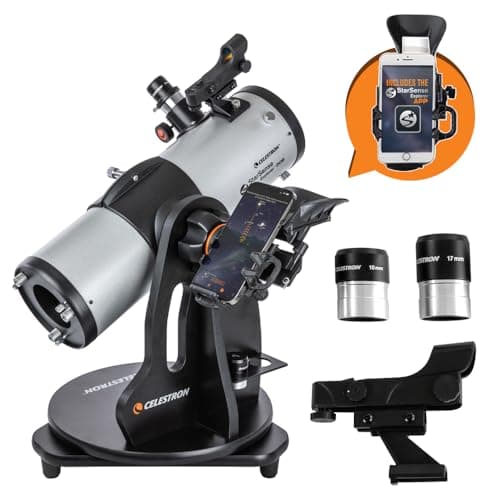 Celestron StarSense Explorer 114mm Tabletop Dobsonian 2.7 times the light of the LT for 5.2 lbs more, and the deepest published limiting magnitude here. | The most light for the least weight — if you have a table | |
| 3 | No image Celestron StarSense Explorer DX 102AZ The most capable of the three on paper, and at 14.2 lbs the least likely to be carried by a child. | A family telescope an adult will set up |
Rows link to the full write-up further down this page. Prices come from the live price layer only; where there is no live figure the button reads “Check price” rather than showing a number we remembered.
How much of each telescope is actually in the box
Here is the comparison that changed our ranking, and we have not seen it made anywhere else. Take the highest magnification the supplied eyepieces can reach, and divide it by that model's published ceiling.
| Model | Top magnification supplied | Published ceiling | Share of the telescope you get |
|---|---|---|---|
| LT 70AZ | 140x (10mm + the 2x Barlow) | 165x | about 85% |
| DX 102AZ | 66x (10mm, no Barlow) | 240x | about 28% |
| 114mm Tabletop Dob | 45x (10mm) | 269x | about 17% |
Arithmetic on Celestron's published figures: focal length divided by eyepiece focal length, against the maker's own stated ceiling for that model.
The pattern is the opposite of what you would expect from the prices. The more you spend, the further below its own ceiling the telescope ships. That is not a criticism of the bigger models — it is what buying aperture means. Wide, bright, low-power views are the right default for a beginner, and high magnification is the thing you add later once you know whether the interest has stuck.
But it does mean that on the DX and the Dobsonian, a second eyepiece is a when rather than an if, and that belongs in your budget rather than in a surprise three months later. Our band-by-band view of what that money buys is on how much to spend.
Three questions that decide it
- Who carries it outside? If the honest answer is the child, the 7.4 lb LT wins and it is not close. If an adult will do it every time, the DX opens up.
- Is there a solid surface at the child's chest height, outdoors, where you would actually observe? A garden table, a low wall, a flat car roof. If yes, the 114mm Dobsonian is the most telescope per pound here. If no, cross it off entirely — it has no tripod and no way to acquire one.
- Do you want more sky, or more magnification? More sky means aperture, and that means the 114mm. More magnification on the Moon and planets tonight, out of the box, means the LT — it is the only one that arrives with a Barlow.
Notice what is not on that list: the app. It is the same app, with the same database and the same phone requirement, on all three. It is not a reason to choose between them.
The low-power view is nearly identical on all three
One more piece of arithmetic worth having before you spend the extra. Every one of these telescopes starts at roughly the same magnification with the eyepiece you will use most.
- LT 70AZ: 700mm / 25mm = 28x
- DX 102AZ: 660mm / 25mm = 26x
- 114mm Dobsonian: 450mm / 17mm = 26x
So the Moon will look about the same size in all three. What changes is how much light is arriving to build that image: the 114mm collects roughly 2.7 times what the 70mm does, and the 102mm about 2.1 times. That extra light is what makes a fainter object visible at all — it is not what makes things bigger. It is the most commonly misunderstood point in the whole category, and it is why what you can actually see is worth reading before the box is opened.
Where each one fits by age
| Age | Our pick of the three | Why |
|---|---|---|
| Under 8 | None of them, usually | The premium buys finding help the child is not yet doing themselves. See ages 5-6 and ages 7-8. |
| 8-10 | LT 70AZ | Light enough to carry alone, complete in the box, and forgiving to focus. It leads our ages 9-10 page for the same reason. |
| 11-12 | 114mm Tabletop Dobsonian | Aperture becomes the limiting factor at this age, and it leads our ages 11-12 page. |
| A shared family telescope | DX 102AZ | The most capable, if the person setting it up is an adult who wants it too. |
What we did and did not do here
We have not handled any of these three telescopes and we do not say otherwise. Every figure above was read from Celestron's own published specification page for that model, re-checked on the date at the top of this page, and linked in the sources below. Everything else is arithmetic on those figures, shown in full so you can redo it.
One availability note, because it affects what you will find when you click: at the time of writing the LT 70AZ is out of stock on Celestron's own store while remaining widely stocked at the major retailers. That is why our buy buttons go to a retailer search rather than a fixed product page — a search finds the model wherever it is currently in stock, and cannot rot into a dead listing. Our full method is on the methodology page.
The picks in full
Pick 1
Celestron StarSense Explorer LT 70AZ
Most families, and almost every child under ten
The arithmetic
700mm over 25mm and 10mm gives 28x and 70x; the 2x Barlow doubles those to 56x and 140x. Celestron's published ceiling is 165x, so even the Barlowed 10mm stays legal — a rare box where every supplied combination is inside the optics' honest limit. At f/10 the images are contrasty and easy to focus, which is exactly what an inexperienced pair of hands needs.
This wins for the reason almost nothing on a spec sheet captures: it is 7.4 lbs for the entire kit, tripod included, and a nine-year-old can carry it to the end of the garden without help. A telescope that gets carried out on a whim gets used; a telescope that needs an adult and two hands gets used when that adult is in the mood.
It is also the only one of the three whose supplied eyepieces come close to using the telescope. 700mm over the 25mm and 10mm gives 28x and 70x, and the included 2x Barlow doubles those to 56x and 140x — against Celestron's published ceiling of 165x. That is 85 percent of the telescope's stated limit, in the box, on night one.
At f/10 the images are contrasty and the focus is forgiving, which matters more than it sounds when the hands on the focuser are small and cold. Saturn's rings resolve comfortably at 70x and Jupiter's cloud belts show on a steady night.
The trade you are making is depth. 70mm is the least light of the three, and the app is perfectly willing to route you to targets the optics cannot deliver. Our full write-up is on the StarSense Explorer LT review.
Skip it if
You want the app to show you faint things. 70mm and a published limiting magnitude of 11.7 is the shallowest of the three by a clear margin — the app will happily steer you to a galaxy this telescope cannot show you. If that is the plan, buy aperture instead.
| Optical design | Refractor |
|---|---|
| Aperture | 70mm (2.76") |
| Focal length | 700mm (27.56") |
| Focal ratio | f/10 |
| Eyepieces supplied | 25mm (28x) and 10mm (70x) |
| Barlow | 2x (1.25") |
| Finderscope | StarPointer red dot |
| Mount | Manual alt-azimuth |
| Tripod | Aluminum, 1320.8mm (52") max height |
| Highest useful magnification | 165x |
| Limiting stellar magnitude | 11.7 |
| Total kit weight | 7.4 lbs (3.35 kg) |
| Phone requirement | Android 12 and later; iOS 18 and newer, iPhone XR and newer |
| What the box does not do | The phone requirement is a real constraint, not fine print: Android 12+ or iOS 18+ on an iPhone XR or newer. An older hand-me-down phone will not run it, and without the app this is an ordinary 70mm refractor at the price of a guided one. |
Specifications from Celestron — StarSense Explorer LT 70AZ specifications. We have not handled this one — everything above is the published spec sheet plus our own arithmetic on it.
Pick 2
Celestron StarSense Explorer 114mm Tabletop Dobsonian
The most light for the least weight — if you have a table
The arithmetic
A parabolic mirror rather than the spherical one in cheaper reflectors, which is what keeps a fast f/4 sharp at the edges. 114mm gathers roughly 2.7 times the light of a 70mm refractor, and the published limiting magnitude of 12.8 is the deepest on this site. The supplied eyepieces only reach 45x against a 269x ceiling, so the box gives you wide, bright, easy views and leaves the high-power ones to buy later.
If the question is how much sky you get per pound carried, this is the answer, and it has a full review of its own. 114mm gathers roughly 2.7 times the light of the LT's 70mm and about 1.25 times the DX's 102mm, and it does it at 12.6 lbs against the DX's 14.2 lbs.
Its published limiting stellar magnitude of 12.8 is the deepest figure on this site. In practice that is the difference between the Orion Nebula as a gray patch and the Orion Nebula with visible structure and four stars in its heart.
The primary mirror is parabolic rather than the spherical mirror in cheaper reflectors, which is what keeps a fast f/4 sharp toward the edge of the field. That is a real manufacturing cost rather than a word on a carton.
The catch beyond the missing tripod: the supplied 17mm and 10mm eyepieces only reach 45x against a 269x ceiling, so the box gives you wide, bright, easy views and leaves everything above 45x to buy later. For a child that is arguably the right way round — but it means a second eyepiece is a when, not an if. We cover the format trade on tabletop vs tripod.
Skip it if
You have nowhere solid to stand it. There is no tripod, and a 12.6 lb tabletop telescope needs a garden table or a low wall at roughly the child's chest height. In a garden with only grass, this is the wrong telescope however good its optics are — and that is a planning problem, not a detail.
| Optical design | Newtonian reflector, parabolic primary mirror |
|---|---|
| Aperture | 114mm (4.48") |
| Focal length | 450mm (17.71") |
| Focal ratio | f/4 |
| Eyepieces supplied | 17mm (26x) and 10mm (45x) |
| Finderscope | StarPointer red dot |
| Mount | Alt-azimuth tabletop Dobsonian base |
| Highest useful magnification | 269x |
| Limiting stellar magnitude | 12.8 |
| Total kit weight | 12.6 lbs (5.71 kg) |
| What the box does not do | No tripod — it is a tabletop instrument and needs a solid surface at the right height, which is a real planning problem in a garden. A reflector's mirror can drift out of alignment; expect to learn collimation eventually. |
Specifications from Celestron — StarSense Explorer 114mm Dobsonian specifications. We have not handled this one — everything above is the published spec sheet plus our own arithmetic on it.
Pick 3
Celestron StarSense Explorer DX 102AZ
A family telescope an adult will set up
The arithmetic
The jump from 70mm to 102mm is the biggest single upgrade on this site: light-gathering scales with the square of aperture, so a 102mm objective collects about 2.1 times what a 70mm does. The published limiting magnitude moves from 11.7 to 12.5 and the useful ceiling from 165x to 240x. The cost is 14.2 lbs — this is a two-hands, one-trip-to-the-garden telescope, not a carry-it-yourself one.
On specs alone this is the best telescope here: 102mm of aperture, a 240x published ceiling, and a limiting magnitude of 12.5. Light gathering scales with the square of aperture, so the step from the LT's 70mm to 102mm roughly doubles what you collect.
It also has the steadiest setup of the three, with a full-height alt-azimuth mount on a 49-inch tripod rather than a tabletop base. Nobody has to find a garden table in the dark.
Two honest problems for our buyer. The first is the 14.2 lbs, which is most of why this is third on a page about children rather than first. The second is that there is no Barlow in the box, so the supplied eyepieces top out at 66x against that 240x ceiling — 28 percent of what the telescope can do. You are buying aperture and an upgrade path, not a finished kit.
If an adult in the household is genuinely going to be the one operating it, this is the one to buy and the one that will still be interesting in five years. If the plan is a child and a garden, the two above are better matched to the plan.
Skip it if
The child is meant to use it alone. 14.2 lbs assembled is a two-hands, one-trip-to-the-garden telescope, and under about ten years old that means an adult sets it up every single time. It is also the most expensive of the three, and the extra buys aperture you may not be able to get outside.
| Optical design | Refractor |
|---|---|
| Aperture | 102mm (4.01") |
| Focal length | 660mm (25.98") |
| Focal ratio | f/6.5 |
| Eyepieces supplied | 25mm (26x) and 10mm (66x) |
| Finderscope | StarPointer red dot |
| Mount | Manual alt-azimuth |
| Tripod | 1244.6mm (49") max height |
| Highest useful magnification | 240x |
| Limiting stellar magnitude | 12.5 |
| Total kit weight | 14.2 lbs (6.44 kg) |
| What the box does not do | No Barlow in the box, so the supplied top magnification is 66x against a 240x ceiling — you will want a shorter eyepiece eventually. At 14.2 lbs assembled, a child under about ten will not be setting this up alone. |
Specifications from Celestron — StarSense Explorer DX 102AZ specifications. We have not handled this one — everything above is the published spec sheet plus our own arithmetic on it.
Questions people actually ask
- Which Celestron StarSense Explorer is the best?
- For a child, the LT 70AZ — it is the lightest, it is complete in the box, and its supplied eyepieces reach about 85 percent of its own magnification ceiling. The 114mm tabletop Dobsonian is the better telescope if you have a solid surface to stand it on.
- What is the difference between the StarSense Explorer LT and DX?
- Aperture and weight. The DX 102AZ collects roughly twice the light of the LT 70AZ and has a higher published ceiling, but it weighs 14.2 lbs against the LT's 7.4 lbs and ships without a Barlow.
- Does StarSense Explorer track objects automatically?
- No. The app tells you which way to push the telescope and confirms when the target is centered, but there is no motor. You re-center by hand as the sky moves, which at high magnification means every 30 seconds or so.
- What phone do you need for StarSense Explorer?
- Celestron publishes the same requirement for all three models: Android 12 or later, or iOS 18 and newer on an iPhone XR or newer. Without a compatible phone the app will not run and the telescope is an ordinary manual one.
- Is the StarSense Explorer worth the extra money?
- In a household where no adult can find things in the sky, usually yes — finding the target is where most first nights fail. If someone already knows the sky, that money buys more aperture on a plain telescope instead.
- Does the StarSense Explorer 114mm need a table?
- Yes. It is a tabletop Dobsonian with no tripod and no tripod option, so it needs a solid outdoor surface at roughly the child's chest height. If you do not have one, choose one of the tripod models instead.
Sources
Read next
Where to go from here
- Celestron StarSense Explorer DX 102AZ review
102mm of sealed refractor on the steadiest mount in the StarSense range. What dual-axis slow-motion controls are worth, and why a cheaper sibling out-apertures it.
- Celestron StarSense Explorer DX 130AZ review
130mm f/5 parabolic optics with phone guidance and dual-axis slow-motion controls, at 18 lbs. The arithmetic on what the box reaches, and the two cheaper routes to the same mirror.
- Celestron StarSense Explorer LT 114AZ review
114mm of aperture that brings its own tripod. Same published ceiling as the tabletop Dobsonian, a spherical mirror instead of parabolic, and why f/9 makes that fine.
- Celestron StarSense Explorer LT 80AZ review
80mm of slow, color-corrected glass with phone-guided finding — and the supplied eyepieces reach 95 percent of its published ceiling, which nothing else here does.
- Celestron StarSense Explorer 114mm review
114mm of parabolic mirror plus phone-guided finding — the telescope we recommend more than any other here. What that combination buys, and the one thing it demands.
- Celestron StarSense Explorer LT: how it works and whether it is worth it
Phone-guided finding removes the main reason first telescopes fail. How the system works, what it costs, and the phone requirement that is easy to miss.
- The best telescope for a 9 or 10 year old
Nine and ten is the first band where a bigger, heavier telescope is a better telescope. Four picks and the arithmetic behind the jump.
- The best telescope for an 11 or 12 year old
At eleven and twelve the child is the limiting factor no longer. Picks chosen on aperture and on what they will not outgrow in a year.
- Tabletop or tripod? The choice your garden makes for you
A tabletop reflector buys more aperture for the money and needs a solid surface. A tripod telescope stands anywhere and costs you glass. Which one your garden allows.
- The best beginner telescopes under $200
Between $100 and $200 you can buy a steady mount, real aperture, or phone-guided finding. What each of those is worth, with the arithmetic.
- How much should you spend on a telescope for a child?
Band by band, what the money buys and where it stops helping. The jump from $60 to $150 matters more than the one above it.
- Sky-Watcher Virtuoso GTi 150P review
150mm f/5 parabolic optics on a Wi-Fi GoTo tabletop mount that also moves by hand. The arithmetic on why tracking matters, and the two cheaper ways to solve the same problem.