Guides
How much should you spend on a telescope for a child?
Where the floor is, where the sweet spot is, and where spending more stops helping.
By Scooter M. · published September 1, 2026
I'm not an astronomer and I don't have a lab. I'm someone who's genuinely into this — I read the manuals, compile the published specs, and do the arithmetic the box doesn't do for you. No lab coat. How we pick.
How this is funded. Lens & Lightyear earns a commission when you buy through a link on this page, at no extra cost to you. It does not change which products we pick or what we say about them — every card below carries a real reason to skip it. Prices are pulled live and were last verified October 18, 2026. Full disclosure.
The short answer
Between $100 and $200 is the sweet spot for a first telescope. Below $60 buy binoculars instead. Between $60 and $100 you can get genuinely usable optics if you ignore the magnification claims. Above $250 you are mostly buying aperture and weight, and weight is what stops a child using it alone.
This is one of the few questions in the category with a defensible numerical answer, because the price bands map to real hardware differences rather than to brand positioning.
What each band actually buys
| Band | What the money goes on | Verdict |
|---|---|---|
| Under $40 | Plastic optics, licensed branding, magnification claimed in the hundreds | Avoid. This is the band that produces children who think telescopes do not work. |
| $40 - $60 | A small glass objective, a poor mount, an oversold eyepiece set | Buy [binoculars](/binoculars) instead. Better night, same money. |
| $60 - $100 | 70mm-76mm of real optics, a workable mount, honest published specs | Viable. The floor of usefulness. See under $100. |
| $100 - $200 | A real tripod, a red dot finder, sometimes phone-guided finding | The sweet spot. See under $200. |
| $200 - $400 | More aperture, better mounts, parabolic mirrors | Worth it for an older child who has already shown the interest sticks. See under $300. |
| Over $400 | Serious aperture, tracking mounts, weight | Not for a first telescope. The weight alone will stop a child using it unsupervised. |
The three things the money actually goes on
Between roughly $50 and $300 — where almost every gift telescope sits — the price is decided by three components, in this order of impact.
- Aperture. The width of the front lens or mirror. Light gathering scales with the square of aperture, so 70mm to 102mm roughly doubles it and 70mm to 130mm roughly triples it. This is the most honest line item in the category.
- The mount. The most under-rated thing in the box and the most common reason a telescope ends up in a cupboard. A wobbly tripod means every touch of the focuser throws the target out of view, which a child reads as the telescope being broken.
- Finding things. A plain red dot finder is nearly free and works once you have practiced. A phone-guided system costs real money and removes the biggest single cause of first-night failure. Whether that is worth paying for depends entirely on whether an adult in the house already knows the sky.
Notice what is not on that list: the number of eyepieces, the advertised magnification, a smartphone adapter, and the word *professional* anywhere on the carton. Those are what the cheapest telescopes compete on, precisely because they are cheap to add.
Quick picks
One pick per band
| # | Product | Best for | Price |
|---|---|---|---|
| 1 | 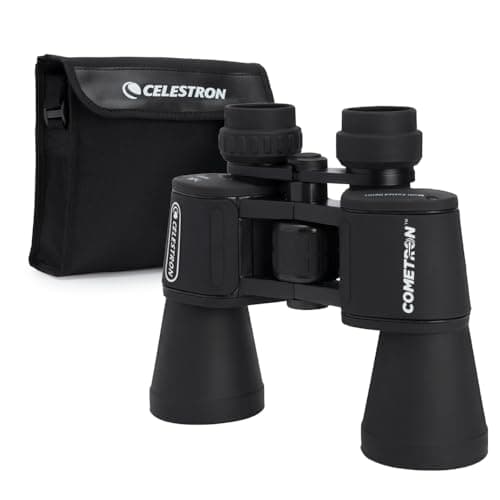 Celestron Cometron 7x50 The only thing we would buy below the telescope floor, and it beats the telescopes above it. | Under $60, without compromise | |
| 2 | 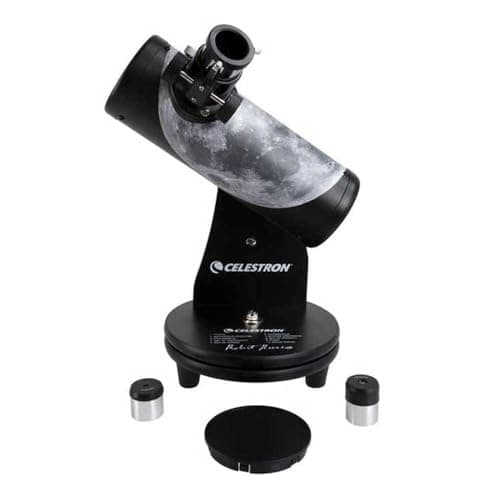 Celestron FirstScope 76mm Tabletop 76mm of aperture and a box that does not lie about magnification. | The $60 to $100 band | |
| 3 | No image Celestron StarSense Explorer LT 70AZ This is where the money stops buying specifications and starts buying successful nights. | The $100 to $200 sweet spot |
Rows link to the full write-up further down this page. Prices come from the live price layer only; where there is no live figure the button reads “Check price” rather than showing a number we remembered.
Where the curve flattens
Spending scales usefulness, but not evenly. The steepest part of the curve is between about $60 and $150 — that is where you go from optics that technically work to a telescope that a family will actually use on a Tuesday.
From $150 to $400 you gain aperture and see more, genuinely. From $400 upward, for a child, you mostly gain weight and complexity — and a telescope that needs an adult to carry it is a telescope that gets used when the adult is in the mood.
Budget by age, roughly
- Ages 5-6 — $30 to $80, and consider spending it on binoculars or a star projector rather than a telescope. See telescopes for ages 5-6.
- Ages 7-8 — $60 to $150. Light enough to carry themselves is the binding constraint. See ages 7-8.
- Ages 9-10 — $100 to $250. A real tripod and something they will not outgrow in a year. See ages 9-10.
- Ages 11-12 — $150 to $400. Aperture is now the limiting factor; buy glass, not features. See ages 11-12.
And if the honest budget is under $50, that is not a problem to apologize for. Gifts under $50 is a real page with real picks, not a consolation shelf.
About the prices on this site
Every band above is a band, not a quote. We do not print a price we cannot verify: figures come only from our live price layer and carry the date they were checked. Where no live figure exists, the button reads *check price* and takes you to the retailer, rather than showing you a number we remembered. The full policy is on the affiliate disclosure.
Questions people actually ask
- How much should I spend on a telescope for a child?
- Between $100 and $200 for a first telescope that will be used more than twice. Below $60, buy binoculars instead — the telescopes in that band are sold on magnification their optics cannot deliver.
- Is a $50 telescope worth buying?
- Rarely. At that price the money goes into an eyepiece set and packaging rather than optics and the mount. A pair of 7x50 binoculars costs the same and shows more on night one.
- Do more expensive telescopes show more?
- Up to a point, yes — aperture is real. But for a child the curve flattens above roughly $250, because the next thing you buy is weight, and weight is what stops a child using it alone.
- What is the best telescope under $200 for a kid?
- In that band we would take phone-guided finding over extra aperture, because finding things is where most first nights fail. Our picks are on telescopes under $200.
Sources
Read next
Where to go from here
- The best telescopes under $500
Between $200 and $500 you can have aperture, a parabolic mirror, or guided finding — but not all three. What each choice costs, and who should make which.
- The best beginner telescope
The four things that actually decide whether a first telescope gets used twice, and the picks that satisfy them. Including the case for buying binoculars instead.
- The best kids' telescopes under $100
The sub-$100 shelf is where the 525x claims live. What that money genuinely buys, and the one telescope here we tell you not to buy.
- The best beginner telescopes under $200
Between $100 and $200 you can buy a steady mount, real aperture, or phone-guided finding. What each of those is worth, with the arithmetic.
- Best telescopes under $300
Under $300 buys 130mm — nearly three times the light of the best telescope on our under-$100 page. Which of the four to buy depends on mirror figure, mount, and how much of the ceiling is actually in the box.
- Space gifts for kids under $50
Under $50 you can buy genuinely good optics — just not a telescope. What the money actually buys, and the allocation we would make ourselves.
- Are kids' telescopes worth it?
A direct verdict with the honest nuance: where the money starts working, where it does not, and what to buy instead below the line.
- Telescopes
Four age bands, two budget gates, and the honest arithmetic behind every pick.
- The stargazing night kit
A red torch does more for what a child sees than doubling the aperture. The full kit, in order of how much it changes.