Binoculars
Binoculars for kids, by age
Weight decides this, not magnification. Published figures, band by band.
By Scooter M. · published September 1, 2026
I'm not an astronomer and I don't have a lab. I'm someone who's genuinely into this — I read the manuals, compile the published specs, and do the arithmetic the box doesn't do for you. No lab coat. How we pick.
How this is funded. Lens & Lightyear earns a commission when you buy through a link on this page, at no extra cost to you. It does not change which products we pick or what we say about them — every card below carries a real reason to skip it. Prices are pulled live and were last verified October 18, 2026. Full disclosure.
The short answer
Weight decides this, not magnification. Under about seven, a child needs something around 5 ounces, which means very low power. From seven to ten, roughly 18 ounces works. From eight upward, a 27-ounce 7x50 is manageable if they can lean on something. Check weight first, everything else second.
The age table
| Age | What they can hold | Sensible spec | What to check |
|---|---|---|---|
| 4-6 | Around 5 oz, briefly | 4x30 or similar compact | Weight above all. Also whether they can set the eyepiece spacing. |
| 7-8 | Up to about 18 oz comfortably; 27 oz braced | 8x32 for everyday, 7x50 for stargazing with support | Eye relief if they wear glasses. Whether there is a wall to lean on. |
| 9-10 | 27 oz with support, comfortably | 7x50 for astronomy, 8x32 or 8x42 for everything | Whether they will actually carry it, or leave it indoors. |
| 11-12 | 27 oz unsupported, for a while | 7x50 or 10x50 | Whether they can hold 10x steady. Many can; some cannot. |
Weights are the manufacturers' published figures for the specific products on this page. The age thresholds are our judgment about what children can physically manage, not measured data.
The specification nobody checks: interpupillary distance
Binoculars hinge in the middle so the two eyepieces can be spaced to match the distance between your eyes. That distance is smaller in children than in adults, and full-size binoculars have a minimum spacing.
If a pair will not close far enough, a young child sees two separate circles instead of one merged image, and there is no fixing it. They will usually say it looks *weird* rather than describing the problem, and it gets mistaken for the binoculars being broken or the child not trying.
Compact binoculars generally close further than full-size ones, which is a second reason light pairs suit small children beyond the weight. If you can, have the child hold a pair before you buy — and if you cannot, that is a real argument for starting compact.
Quick picks
Binoculars by age band
| # | Product | Best for | Price |
|---|---|---|---|
| 1 | 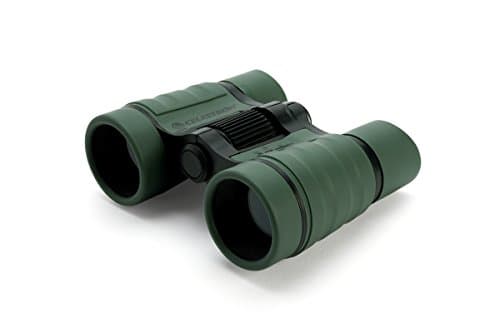 Celestron Celestron Kids 4x30 4.7 oz — about a sixth of a full-size astronomy pair. | Ages 4-6: a first real pair | $9.95 on Amazon #ad How we’re funded · price as of October 18, 2026 |
| 2 | 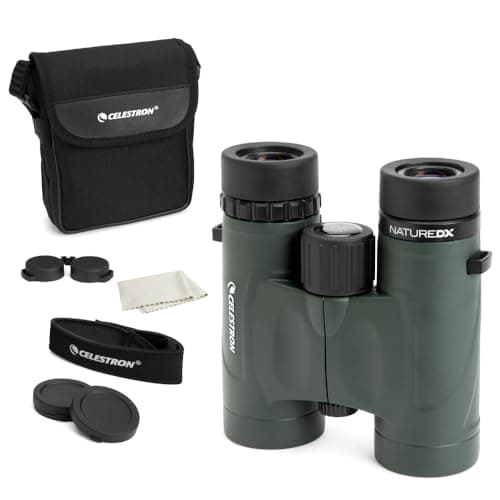 Celestron Nature DX 8x32 18 oz, 17.5mm eye relief, waterproof — built for hands and eyes this size. | Ages 7-10: the pair that fits a child properly | $90.97 on Amazon #ad How we’re funded · price as of October 18, 2026 |
| 3 | 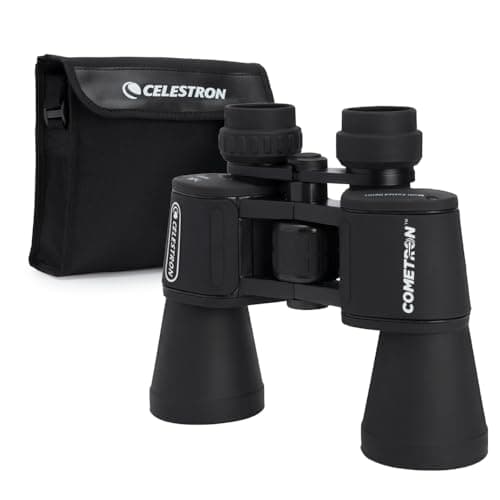 Celestron Cometron 7x50 7.1mm exit pupil, and the brightest night view available for a child's eye. | Ages 8+: the dedicated astronomy pair | |
| 4 | 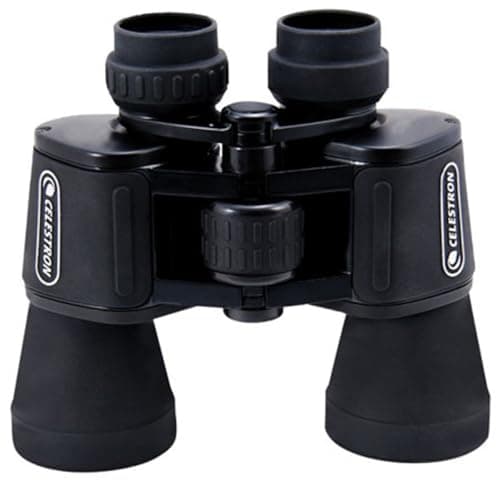 Celestron UpClose G2 10x50 10x on 50mm objectives, for an older child who can hold them still. | Ages 11+: more magnification, once hands are steady | $64.53 on Amazon #ad How we’re funded · price as of October 18, 2026 |
Rows link to the full write-up further down this page. Prices come from the live price layer only; where there is no live figure the button reads “Check price” rather than showing a number we remembered.
Eye relief matters more than you think
Eye relief is how far your eye can sit from the eyepiece and still see the whole field. It is measured in millimeters and it is published for every serious pair.
For a child without glasses, anything from about 10mm works. For a child *with* glasses, you need roughly 15mm or more, because the lenses hold their eye further back. Below that they will see a restricted circle, and taking the glasses off changes the focus.
| Pair | Published eye relief | Works over glasses? |
|---|---|---|
| Nature DX 8x32 | 17.5mm | Yes, comfortably |
| Cometron 7x50 | 13mm | Marginal |
| UpClose G2 10x50 | 12mm | No |
| Celestron Kids 4x30 | 5mm | No |
All figures are Celestron's published specifications. The third column is our reading of them against the usual 15mm guideline.
When a child is ready to move up
The signal is not a birthday. It is when they start bracing themselves without being told — leaning on a fence, sitting down, resting elbows on knees. That is a child who has worked out that steadiness is the problem, and they are ready for more magnification or more weight.
The other signal is asking to look at something specific rather than looking at whatever is in front of them. That is the point where a 7x50 and a star chart start paying off, and where a first telescope becomes a sensible next step rather than an over-purchase.
The picks in full
Pick 1
Celestron Celestron Kids 4x30
Ages 4-6: a first real pair
The arithmetic
4.7 oz is the whole point: about a sixth of the weight of a 7x50, which is the difference between a four-year-old using them and a four-year-old putting them down. 30 / 4 = 7.5mm exit pupil, so the view is bright. But 4x is genuinely low magnification — this is a first pair of real optics for very small hands, not a stargazing instrument.
Everything about this pick comes down to 4.7 ounces. A 7x50 weighs 27 ounces, and a five-year-old holding that above their head sees a shaking blur for about eight seconds before putting it down.
The exit pupil is 30 divided by 4, which is 7.5mm — Celestron's published figure. Bright, and matched to a young eye. What you are trading away is magnification: at 4x the Moon looks like a slightly larger Moon rather than a cratered world.
The 4.3 degree field is narrower than the 6.6 degrees of a 7x50, which is unexpected but consistent with the small objectives. Finding things is still easy at this magnification.
5mm of eye relief is very short and makes these awkward over glasses. No weather sealing and no tripod thread. They come with a woven nylon case, an attached neck strap and a lens cloth.
Full review of the Celestron Kids 4x30, including what a child can and cannot see at 4x.
Skip it if
The child is old enough to hold something heavier. 4x is genuinely low magnification, and a seven-year-old who can manage a 7x50 will get far more from one. This is a solution to a weight problem, not an optical choice.
| Magnification | 4x |
|---|---|
| Objective lens | 30mm (1.18") |
| Lens coatings | Coated |
| Angular field of view | 4.3 degrees |
| Linear field at 1000 yds | 225 ft (68.58 m) |
| Exit pupil | 7.5mm (.29") |
| Eye relief | 5mm (.2") |
| Weight | 4.7 oz (133 g) |
| Environmental | Not weather sealed |
| Included | Woven nylon case, attached neck strap, lens cloth |
| What the box does not do | 5mm of eye relief is very short and makes them awkward over glasses. No weather sealing and no tripod thread. At 4x you will see the Moon as a slightly larger Moon; you will not resolve craters the way a 7x50 does. |
Specifications from Celestron — Celestron Kids 4x30mm Roof Binocular. We have not handled this one — everything above is the published spec sheet plus our own arithmetic on it.
#ad How we’re funded · price as of October 18, 2026
Pick 2
Celestron Nature DX 8x32
Ages 7-10: the pair that fits a child properly
The arithmetic
32 / 8 = 4mm exit pupil — dimmer at night than either 50mm pair above, and that is the honest trade. What you get for it: 18 oz instead of 27, which a seven-year-old can actually hold steady; 17.5mm of eye relief, so a child in glasses sees the full field; 6.5 ft close focus, so it works on a ladybird in the garden as well as the Moon; and genuinely waterproof rather than water resistant. This is the pair that gets used on Tuesday afternoon, not just on a clear Saturday night.
The sweet spot for most children between about seven and ten, and the pick if you want one pair that does everything.
18 oz is nine ounces lighter than a 7x50 — a third less weight, which is the difference between a comfortable ten minutes and an uncomfortable two.
17.5mm of eye relief is the specification that quietly matters. It means a child wearing glasses sees the entire field with them on, which neither porro pair on this site manages. If the child wears glasses, this is close to the only sensible pick here.
6.5 ft close focus makes them work on a beetle in the garden. Genuinely waterproof rather than water resistant. Phase-coated BaK-4 roof prisms and fully multi-coated optics — better glass than the cheaper pairs, and it shows in daylight contrast.
Skip it if
Stargazing is the main purpose. The 4mm exit pupil is meaningfully dimmer than a 50mm pair at night. For a dedicated astronomy pair at this age, the Cometron below is brighter, at the cost of nine extra ounces.
| Magnification | 8x |
|---|---|
| Objective lens | 32mm (1.26") |
| Prism glass | BaK-4 roof, phase coated |
| Lens coatings | Fully multi-coated |
| Angular field of view | 7.4 degrees |
| Linear field at 1000 yds | 388 ft (129 m) |
| Exit pupil | 4mm (.157") |
| Eye relief | 17.5mm (.69") |
| Close focus | 6.5 ft (2 m) |
| Weight | 18 oz (510 g) |
| Tripod adaptable | Yes |
| Environmental | Waterproof |
| What the box does not do | A 4mm exit pupil means noticeably dimmer star fields than a 7x50 — the Milky Way will not leap out of it. It costs meaningfully more than the porro pairs above, and none of that money is buying you light. |
Specifications from Celestron — Nature DX 8x32mm specifications. We have not handled this one — everything above is the published spec sheet plus our own arithmetic on it.
#ad How we’re funded · price as of October 18, 2026
Pick 3
Celestron Cometron 7x50
Ages 8+: the dedicated astronomy pair
The arithmetic
Exit pupil is objective divided by magnification: 50 / 7 = 7.1mm, which matches Celestron's published figure. That is the single most useful number here. A fully dark-adapted young pupil opens to around 7mm, so a child uses nearly all of that 7.1mm cone and the view is as bright as the optics can make it. An adult over about forty typically dilates to 5mm or less and simply cannot use the extra — this is one of the rare cases where a child gets more out of the hardware than the grown-up does.
From about eight, if the purpose is specifically stargazing, this is where the money should go.
50mm objectives with 7x magnification give a 7.1mm exit pupil, matching a dark-adapted young pupil almost exactly. That is the brightest view any binocular can deliver to a child's eye, and it is why 7x50 has been the standard astronomy specification for decades.
The 6.6 degree field — around thirteen Moon widths — makes finding targets trivial. On a dark night the Milky Way through these resolves into individual stars, which is one of the genuinely unforgettable experiences available in this hobby.
27.3 oz is the honest constraint. It is tripod adaptable, and using that thread is the single best thing you can do with these. Water resistant, not waterproof. BK7 prisms soften slightly at the field edge.
Skip it if
The child cannot brace them. 27.3 oz is a real load for a small person, and without a wall, a blanket or a tripod the shake will cost more than the brightness gains.
| Magnification | 7x |
|---|---|
| Objective lens | 50mm (1.97") |
| Prism glass | BK7 porro |
| Lens coatings | Multi-coated |
| Angular field of view | 6.6 degrees |
| Linear field at 1000 yds | 344 ft (105 m) |
| Exit pupil | 7.1mm (.28") |
| Eye relief | 13mm (.51") |
| Close focus | 26.2 ft (8 m) |
| Weight | 27.3 oz (774 g) |
| Tripod adaptable | Yes |
| Environmental | Water resistant |
| What the box does not do | 27.3 oz is heavy for small arms held up at the sky — plan on leaning against a wall or lying on a blanket, or add the tripod adapter. BK7 prisms are the cheaper glass and show slight softening at the edge of the field. Water resistant is not waterproof. |
Specifications from Celestron — Cometron 7x50mm specifications. We have not handled this one — everything above is the published spec sheet plus our own arithmetic on it.
Pick 4
Celestron UpClose G2 10x50
Ages 11+: more magnification, once hands are steady
The arithmetic
50 / 10 = 5mm exit pupil, against 7.1mm for the 7x50. Same front lens, 30 percent less light reaching the eye, because the extra magnification spreads it over a wider image. The trade you are buying is more detail on the Moon and a shakier view of everything: at 10x, a hand tremor is magnified 10 times too, and children shake more than adults do.
The step up for an older child, and the reason it is a step up is entirely about steadiness rather than optics.
Same 50mm objectives as the Cometron, so the same amount of light is collected. 10x spreads it over a larger image, giving a 5mm exit pupil against 7.1mm — around 30 percent less light reaching a dark-adapted young eye.
What you buy with that is resolution: more lunar detail, tighter double stars split, and more structure visible in bright clusters. It is a real gain, but only if the image is steady enough to see it.
6.8 degrees of field, 23 ft close focus, 27 oz, tripod adaptable, water resistant. 12mm eye relief is short — check whether the child wears glasses before buying.
Skip it if
The child is under about eleven or wears glasses. 12mm of eye relief cuts off the field for a spectacle wearer, and 10x magnifies tremor as effectively as it magnifies the Moon.
| Magnification | 10x |
|---|---|
| Objective lens | 50mm (1.96") |
| Prism glass | BK7 porro |
| Lens coatings | Multi-coated |
| Angular field of view | 6.8 degrees |
| Linear field at 1000 yds | 354 ft (118 m) |
| Exit pupil | 5mm (.19") |
| Eye relief | 12mm (.47") |
| Close focus | 23 ft (7 m) |
| Weight | 27 oz (765 g) |
| Tripod adaptable | Yes |
| Environmental | Water resistant |
| What the box does not do | 12mm of eye relief is short. A child who wears glasses will not see the whole field with them on, and taking them off changes the focus. Water resistant, not waterproof. |
Specifications from Celestron — UpClose G2 10x50mm specifications. We have not handled this one — everything above is the published spec sheet plus our own arithmetic on it.
#ad How we’re funded · price as of October 18, 2026
Questions people actually ask
- At what age can a child use binoculars?
- From around four with a very light compact pair of about 5 ounces, and properly from about seven with something around 18 ounces. The limits are weight and whether the eyepieces close far enough for a small face, not eyesight.
- What binoculars are best for a 7 year old?
- An 8x32 at around 18 oz is the practical everyday choice, with generous eye relief if they wear glasses. For stargazing specifically, a 7x50 works at seven if there is a wall to lean on or a blanket to lie on.
- What binoculars are best for a 10 year old?
- A 7x50 for astronomy, or an 8x32 or 8x42 as an all-rounder. At ten most children can handle 27 ounces with support, which opens up the brighter astronomy pairs.
- Are binoculars safe for children?
- Yes, with one absolute rule: never point them at the Sun or anywhere near it. Binoculars concentrate sunlight enough to cause instant permanent eye damage. Say it out loud before the first use.
- Should you take glasses off when using binoculars?
- Only if the eye relief is too short to see the full field with them on — under about 15mm. With generous eye relief, keeping glasses on is better, because they correct astigmatism that the binocular focus cannot.
Sources
Read next
Where to go from here
- The best stargazing binoculars under $50
Under $50 binoculars outperform every telescope at the price. What the money buys in coatings and exit pupil, and the honest limits of the budget.
- Celestron Nature DX 8x32 review
A third lighter than a 7x50, waterproof, and it focuses down to 6.5 feet. What that buys by day, and exactly what it costs you at night.
- The best binoculars for stargazing with kids
The exit pupil calculation that decides which binoculars suit a child, and what a 7x50 actually shows on a first clear night.
- One pair for birds and stars: what to give up
Birding and astronomy want opposite specifications. What a single pair can honestly do, and which compromise suits a child best.
- 7x50 versus 10x42: which for a child, and why
The exit pupil arithmetic that settles the classic binocular argument, and why the answer is different for a child than for an adult.
- The best telescope for a 7 or 8 year old
Seven and eight is where independence starts. The picks here are chosen on carry weight and how easy it is to find something, not on aperture.
- What age is a telescope right for?
What a child can genuinely do at five, seven, nine and eleven, and what to buy at each stage instead of guessing.
- Astronomy gifts for kids, by age
The whole site re-sorted for someone who knows the child's age and nothing else about telescopes. One pick per band.
- The best stargazing binoculars under $100
Three pairs under $100, judged on exit pupil, prism glass and steadiness rather than on magnification claims — plus the two corners this budget always cuts.