Binoculars
The best stargazing binoculars under $50
The one budget in astronomy where the cheap option is also the right one.
By Scooter M. · published September 13, 2026
I'm not an astronomer and I don't have a lab. I'm someone who's genuinely into this — I read the manuals, compile the published specs, and do the arithmetic the box doesn't do for you. No lab coat. How we pick.
How this is funded. Lens & Lightyear earns a commission when you buy through a link on this page, at no extra cost to you. It does not change which products we pick or what we say about them — every card below carries a real reason to skip it. Prices are pulled live and were last verified October 18, 2026. Full disclosure.
The short answer
A 7x50 porro binocular, and there is little to debate. Under $50 no telescope competes: you get 50mm of real glass per side, a 7.1mm exit pupil that matches a dark-adapted young eye, and a five-second setup with nothing that can be assembled wrongly.
Every other budget page on this site involves a compromise. This one does not, and that is genuinely unusual — under $50 the binocular is not the consolation prize for people who cannot afford a telescope, it is the better instrument.
Why binoculars win at this price and telescopes lose
A telescope at $50 has to pay for optics, a mount, a tripod, a diagonal, a finder and two eyepieces out of the same $50. Something gives, and what gives is usually the mount and the honesty of the magnification claims.
A binocular at the same price pays for two small refractors and a hinge. No mount, no tripod, no finder, no diagonal — so nearly all of the money goes into glass and coatings. That is the entire reason the comparison is so lopsided, and it stops being true above about $100 where telescopes can finally afford a decent mount.
| What $50 buys | In a telescope | In binoculars |
|---|---|---|
| Aperture | 50-60mm, often plastic-mounted | 50mm per side, real glass |
| Mount | Light, wobbly tripod | Your hands — nothing to wobble |
| Setup | 10-30 minutes the first time | Five seconds |
| Ways it can go wrong | Finder, focus, mount, eyepiece choice | Almost none |
| Magnification honesty | Frequently 450x claimed on 118x optics | 7x is 7x — nothing to oversell |
| Saturn's rings | In principle, if everything goes right | No — needs about 50x |
The last row is the one genuine thing a telescope offers at this price, and it is why we never tell someone who specifically asked for a telescope to buy binoculars instead without saying so plainly.
Quick picks
Stargazing binoculars under $50
| # | Product | Best for | Price |
|---|---|---|---|
| 1 | 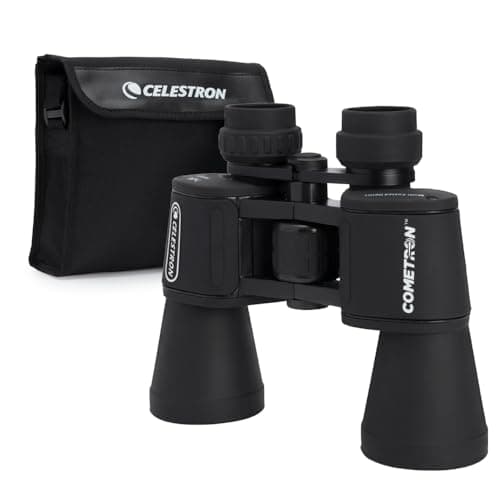 Celestron Cometron 7x50 A 7.1mm exit pupil matched almost exactly to a child's dark-adapted eye. | The best astronomy buy at any budget under $100 | |
| 2 | 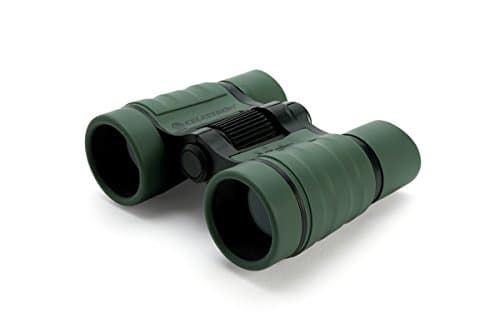 Celestron Celestron Kids 4x30 4.7 oz — about a sixth of a 7x50, which is the only spec that matters at that age. | Four to six year olds, where weight beats everything | $9.95 on Amazon #ad How we’re funded · price as of October 18, 2026 |
Rows link to the full write-up further down this page. Prices come from the live price layer only; where there is no live figure the button reads “Check price” rather than showing a number we remembered.
What to look for on a sub-$50 spec sheet
Four things, and only four. Everything else at this price is marketing.
- Exit pupil, which you compute yourself. Objective divided by magnification. A 7x50 gives 7.1mm — matched to a dark-adapted young eye. A 10x50 gives 5mm and delivers about half the light. A 10x25 pocket pair gives 2.5mm and is close to useless at night.
- Porro prisms, not roof. Roof prisms need an expensive phase coating to perform. At this price that coating is absent, so a cheap roof pair is dimmer and softer than a porro pair costing the same. Above about $130 the calculation flips.
- "Multi-coated" at minimum. Coatings cut reflection losses at every glass surface. "Coated" means one surface; "multi-coated" means several; "fully multi-coated" means all of them. Each step is real light.
- BaK-4 over BK7 if the price is equal. BaK-4 prism glass gives rounder, brighter field edges. At this budget BK7 is normal and acceptable — it is not a reason to reject a pair.
What this budget cannot do
- No Saturn's rings. Those need roughly 50x; 7x is nowhere close. This is the single honest reason to want a telescope instead.
- No waterproofing. Water-resistant is what $50 buys. Dew is survivable; a dropped pair in wet grass may not be.
- No lightweight 50mm. Physics sets the weight, and 27.3 oz is what 50mm objectives weigh at this price. Lighter means smaller objectives and a dimmer night view.
- No tripod adapter included, though both picks accept one. A cheap photo tripod plus an adapter is the best upgrade available and costs less than a better binocular.
How to check a cheap pair when it arrives
Quality control is looser at this price than higher up, and the failures are easy to spot if you know what to look for. Five minutes on the day they arrive, indoors, is worth doing.
- Check collimation first. Look at a distant object and slowly pull the binoculars away from your eyes. The two circles should drift apart evenly and stay level. If one image sits noticeably higher, the barrels are misaligned — your eyes will fight it and you will get a headache within minutes. Return them; this is not adjustable at home.
- Set the interpupillary distance. Bend the hinge until the two circles merge into one. Children need this narrower than adults, and a pair that will not close far enough is a pair that will not work for a small face.
- Set the diopter. Close your right eye, focus the center wheel until the left is sharp, then close the left and adjust only the right-eye diopter ring. Done once, it stays.
- Look for loose internals. A gentle shake should be silent. A rattle means something has come adrift and it will get worse.
- Check the field edges on a bright day. Some softening at the very edge is normal at this price. A smeared outer third is not.
Where to go from here
- Want the full binocular argument? Binoculars for stargazing covers sizes, formats and what each shows.
- Buying for a specific age? Binoculars by age starts at four years old.
- Considering 10x instead of 7x? 7x50 vs 10x42 works through the trade.
- Ready to spend more? Space gifts under $100 opens up the waterproof, lighter roof-prism pairs.
We have not handled these binoculars. Every specification is from Celestron's own published page, linked on each card, and every computed figure is arithmetic on those numbers. No price appears in this prose — live figures come from our price feed only. Our method is on the methodology page.
Questions people actually ask
- What are the best binoculars for stargazing under $50?
- A 7x50 porro pair. The 7.1mm exit pupil matches a dark-adapted young eye almost exactly, the wide field makes aiming trivial, and nothing at this price needs assembling or aligning.
- Are cheap binoculars good enough for astronomy?
- Under $50, yes — better than any telescope at the same money. Binoculars spend nearly all of the budget on glass because there is no mount, tripod, finder or diagonal to pay for.
- What size binoculars are best for stargazing?
- 7x50 for a child, because the exit pupil matches a young dark-adapted pupil. 10x50 suits adults better; anything with an exit pupil under about 4mm is a daylight instrument.
- Can you see planets with $50 binoculars?
- Jupiter as a disc with up to four moons beside it, yes. Saturn's rings need about 50x and no handheld binocular provides that.
- How do you check if binoculars are collimated?
- Look at a distant object and slowly draw the binoculars away from your eyes. The two circles should separate evenly and stay level. If one image sits higher than the other, the barrels are misaligned — return them, because it causes eye strain and is not fixable at home.
- Do cheap binoculars need a tripod?
- Not at 7x — that is low enough to hold steady, and lying down or leaning on a wall removes most of the remaining shake. Tripods become genuinely necessary at 10x and essential at 15x.
- Porro or roof prisms at this price?
- Porro. Roof prisms need phase coating to perform well and that is absent below about $130, so a cheap roof pair is dimmer and softer than a porro pair at the same price.
Sources
Read next
Where to go from here
- The best binoculars for stargazing with kids
The exit pupil calculation that decides which binoculars suit a child, and what a 7x50 actually shows on a first clear night.
- Binoculars for kids, by age
What a child can physically hold at each age, and which published weight and eye-relief figures to check before buying.
- 7x50 versus 10x42: which for a child, and why
The exit pupil arithmetic that settles the classic binocular argument, and why the answer is different for a child than for an adult.
- Space gifts for kids under $50
Under $50 you can buy genuinely good optics — just not a telescope. What the money actually buys, and the allocation we would make ourselves.
- Celestron Cometron 7x50: the beginner astronomy binocular
Why 7x50 is the standard beginner astronomy specification, what this particular pair publishes, and the one thing to plan around.
- The best kids' telescopes under $100
The sub-$100 shelf is where the 525x claims live. What that money genuinely buys, and the one telescope here we tell you not to buy.
- The best stargazing binoculars under $100
Three pairs under $100, judged on exit pupil, prism glass and steadiness rather than on magnification claims — plus the two corners this budget always cuts.