Binoculars
The best stargazing binoculars under $100
This is the bracket where binoculars beat telescopes outright — if you know which corner is being cut.
By Scooter M. · published September 21, 2026
I'm not an astronomer and I don't have a lab. I'm someone who's genuinely into this — I read the manuals, compile the published specs, and do the arithmetic the box doesn't do for you. No lab coat. How we pick.
How this is funded. Lens & Lightyear earns a commission when you buy through a link on this page, at no extra cost to you. It does not change which products we pick or what we say about them — every card below carries a real reason to skip it. Prices are pulled live and were last verified October 18, 2026. Full disclosure.
The short answer
Buy a 7x50 for night skies, a 10x50 if the same pair must work in daylight, or a 15x70 only if a tripod is part of the purchase. Under $100 you are choosing which compromise to accept — exit pupil, coatings or steadiness — not whether to accept one.
This is also the budget where binoculars beat telescopes outright. A telescope under $100 is compromised at every point — optics, mount and eyepieces — while a binocular at the same money can be genuinely good, because the design is simpler and the mount is your hands.
How we judged, before any ranking
- Exit pupil first. Objective divided by magnification. Anything of 5mm or more works well under a dark sky; below about 4mm you are throwing away the aperture you bought.
- Steadiness second. Magnification multiplies hand shake exactly. Above 12x this stops being a preference and becomes a tripod requirement.
- Prism glass and coatings third. BaK-4 prisms and fully multi-coated optics are real, checkable specifications rather than adjectives. At this price something has to give here.
- Weight last, but it decides gifts. A pair a child will not lift is a pair that stays in the cupboard, whatever the spec sheet says.
Notice what is not on that list: magnification. It is the number printed largest on the box and the least useful one for choosing. The full argument is on binoculars for stargazing.
The exit pupil table for this bracket
| Specification | Exit pupil | Steady in the hand? | Night verdict |
|---|---|---|---|
| 7x50 | 7.1mm | Yes, for anyone | Best all-round night choice |
| 10x50 | 5.0mm | Borderline — brace it | Good, and usable by day |
| 8x42 | 5.25mm | Yes | Good, lighter, pricier than this bracket |
| 10x42 | 4.2mm | Borderline | Dimmer; better in daylight |
| 15x70 | 4.7mm | No — mount it | Deepest, with a tripod attached |
| 10x25 compact | 2.5mm | Yes | Avoid for astronomy — too little light |
Our arithmetic: objective diameter divided by magnification. The last row is the specification most often given as a gift and the least suited to a night sky.
Quick picks
Three pairs under $100, and what each one gives up
| # | Product | Best for | Price |
|---|---|---|---|
| 1 | 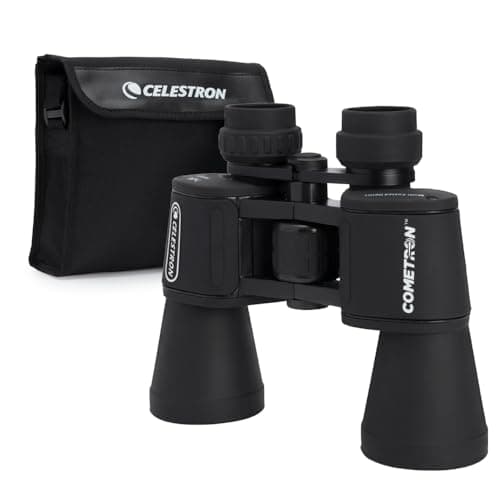 Celestron Cometron 7x50 50mm objectives, a 7.1mm exit pupil and 7x that a child can hold steady. | The best night-sky view per dollar on this site | |
| 2 | 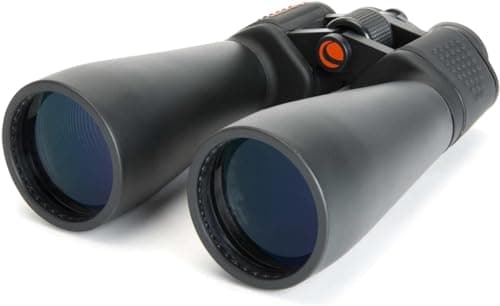 Celestron SkyMaster 15x70 70mm objectives at 15x — more aperture than any telescope under $100. | The deepest views in the bracket, if you will mount it | |
| 3 | 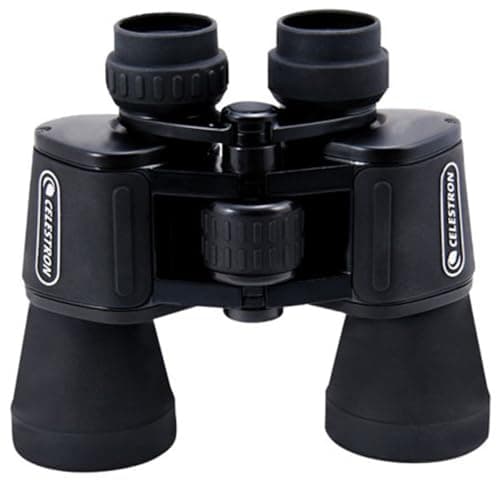 Celestron UpClose G2 10x50 10x50 with a 5mm exit pupil, usable in both directions without excelling in either. | The compromise pick — one pair for stars and daylight | $64.53 on Amazon #ad How we’re funded · price as of October 18, 2026 |
Rows link to the full write-up further down this page. Prices come from the live price layer only; where there is no live figure the button reads “Check price” rather than showing a number we remembered.
What this budget cannot buy
- Phase-coated roof prisms in a light body. Under $100 you get either porro prisms and bulk, or a compromise on glass. The Nature DX line is what the next bracket up buys you.
- Image stabilization. Nothing at this price stabilizes anything; the fix is lower magnification or a tripod.
- Serious waterproofing. Some pairs here are water resistant; treat none of them as submersible.
- A tripod. If you buy the 15x70, the tripod is part of the price, not an extra.
Under $100 against a telescope at the same money
Worth stating plainly, because this is the most common mistake at this budget. A 50mm binocular and a 50mm telescope gather the same light. The binocular delivers it through two eyes, with no mount to wobble, no eyepiece to fumble and no setup at all.
The telescope at this price adds magnification you cannot use on a mount that cannot hold it. We work that through with the manufacturer's own published numbers on toy brands versus real optics, and it is why our under $100 telescope page is largely an argument for buying binoculars instead.
What to do on the first clear night
- Set the focus properly once. Close your right eye, focus the center wheel on a bright star, then close your left eye and adjust only the right eyepiece dioptre. It stays set after that.
- Start with the Moon, but not a full one. A half or crescent Moon shows craters along the terminator; a full Moon is a flat, glaring disc.
- Sweep the Milky Way, if you have a dark enough sky. This is what wide-field binoculars are actually for, and no telescope on this site does it.
- Lie down. It is steadier than standing and solves the overhead problem for free.
- Give eyes twenty minutes. Dark adaptation does more for what you see than any upgrade in this bracket.
What we did and did not do
We have not tested these binoculars. Every specification here was read from Celestron's own published pages, linked below and checked on the date at the top of this page, and the exit pupil figures are arithmetic on those specifications.
No price appears in this prose, including in the title's bracket. Live figures come only from our price feed with the date they were checked, and a pair that drifts above $100 between refreshes will show its real price on the button rather than a number we typed. Our full method is on the methodology page.
The picks in full
Pick 1
Celestron Cometron 7x50
The best night-sky view per dollar on this site
The arithmetic
Exit pupil is objective divided by magnification: 50 / 7 = 7.1mm, which matches Celestron's published figure. That is the single most useful number here. A fully dark-adapted young pupil opens to around 7mm, so a child uses nearly all of that 7.1mm cone and the view is as bright as the optics can make it. An adult over about forty typically dilates to 5mm or less and simply cannot use the extra — this is one of the rare cases where a child gets more out of the hardware than the grown-up does.
The specification astronomers reach for, at the bottom of this budget: 7x50. Fifty divided by seven gives a 7.1mm exit pupil, wider than any human eye can fully use, so the binocular is never the thing limiting brightness.
Seven power is also the most forgiving magnification there is. A child can hold it, an adult can sweep with it for an hour, and nothing about the view swims.
What it gives up at this price is coatings and prism glass compared with a Nature DX, which shows as slightly lower contrast, and it is physically large. Full review.
Skip it if
Daytime use is the priority, or the user wants a compact pair for a backpack. This is a big-eyed night instrument and it is bulky in a small bag.
| Magnification | 7x |
|---|---|
| Objective lens | 50mm (1.97") |
| Prism glass | BK7 porro |
| Lens coatings | Multi-coated |
| Angular field of view | 6.6 degrees |
| Linear field at 1000 yds | 344 ft (105 m) |
| Exit pupil | 7.1mm (.28") |
| Eye relief | 13mm (.51") |
| Close focus | 26.2 ft (8 m) |
| Weight | 27.3 oz (774 g) |
| Tripod adaptable | Yes |
| Environmental | Water resistant |
| What the box does not do | 27.3 oz is heavy for small arms held up at the sky — plan on leaning against a wall or lying on a blanket, or add the tripod adapter. BK7 prisms are the cheaper glass and show slight softening at the edge of the field. Water resistant is not waterproof. |
Specifications from Celestron — Cometron 7x50mm specifications. We have not handled this one — everything above is the published spec sheet plus our own arithmetic on it.
Pick 2
Celestron SkyMaster 15x70
The deepest views in the bracket, if you will mount it
The arithmetic
The counter-intuitive number: 70 / 15 = 4.7mm exit pupil, against 7.1mm for a 7x50. More objective glass, but spread across more magnification — so into a child's fully dark-adapted 7mm pupil this delivers roughly (4.7 / 7.1) squared, about 44 percent of the light the cheaper 7x50 does. The 70mm advantage is real only for an adult eye that no longer dilates past 5mm, or on a tripod where the extra reach pays. At 48 oz it is 1.76 times the weight of a 7x50 and 15x magnifies hand tremor fifteen times: this is a tripod instrument, not a handheld one.
This is the aperture play. 70mm objectives gather roughly twice the light of 50mm ones, which puts star clusters and the brighter deep-sky objects genuinely within reach.
It is also the pair most often returned, and the reason is never the optics: 15x magnifies hand tremor fifteen times. Budget for a tripod adapter in the same order, not later.
A 4.7mm exit pupil is narrower than the 7x50's, so under a dark sky it is not as forgiving as the aperture suggests. Full review.
Skip it if
There is no tripod and no plan to buy one. At 15x and roughly 3 lbs this cannot be held still by anyone, and unmounted it will disappoint.
| Magnification | 15x |
|---|---|
| Objective lens | 70mm (2.75") |
| Prism glass | BaK-4 |
| Lens coatings | Multi-coated |
| Angular field of view | 4.4 degrees |
| Linear field at 1000 yds | 231 ft (77 m) |
| Exit pupil | 4.7mm (.18") |
| Eye relief | 18mm (.71") |
| Close focus | 43 ft (13 m) |
| Weight | 48 oz (1361 g) |
| Tripod adaptable | Yes |
| Environmental | Water resistant |
| What the box does not do | No tripod and no tripod adapter in the box, and it genuinely needs both — 48 oz at 15x cannot be held steady by anyone, let alone a child. Water resistant, not waterproof. A 43 ft close focus rules out any daytime use in a garden. |
Specifications from Celestron — SkyMaster 15x70 specifications. We have not handled this one — everything above is the published spec sheet plus our own arithmetic on it.
Pick 3
Celestron UpClose G2 10x50
The compromise pick — one pair for stars and daylight
The arithmetic
50 / 10 = 5mm exit pupil, against 7.1mm for the 7x50. Same front lens, 30 percent less light reaching the eye, because the extra magnification spreads it over a wider image. The trade you are buying is more detail on the Moon and a shakier view of everything: at 10x, a hand tremor is magnified 10 times too, and children shake more than adults do.
If the binoculars have to do double duty — a school trip, a football match, and the Moon on the way home — this is the honest middle of the bracket.
50 divided by 10 gives a 5mm exit pupil, still a decent night figure, and 10x reaches far enough for daytime detail that a 7x cannot.
The cost is steadiness. 10x is right at the limit of what most people hold comfortably, and it is markedly harder for a child than 7x. Full review.
Skip it if
You only ever observe at night. A 7x50 is steadier and brighter for the same money, and this pair's 10x is the reason people put binoculars down after ten minutes.
| Magnification | 10x |
|---|---|
| Objective lens | 50mm (1.96") |
| Prism glass | BK7 porro |
| Lens coatings | Multi-coated |
| Angular field of view | 6.8 degrees |
| Linear field at 1000 yds | 354 ft (118 m) |
| Exit pupil | 5mm (.19") |
| Eye relief | 12mm (.47") |
| Close focus | 23 ft (7 m) |
| Weight | 27 oz (765 g) |
| Tripod adaptable | Yes |
| Environmental | Water resistant |
| What the box does not do | 12mm of eye relief is short. A child who wears glasses will not see the whole field with them on, and taking them off changes the focus. Water resistant, not waterproof. |
Specifications from Celestron — UpClose G2 10x50mm specifications. We have not handled this one — everything above is the published spec sheet plus our own arithmetic on it.
#ad How we’re funded · price as of October 18, 2026
Questions people actually ask
- What are the best binoculars under $100 for stargazing?
- A 7x50 is the best night-sky choice in this bracket: a 7.1mm exit pupil means the binocular never limits brightness, and 7x is steady enough for a child to hold. A 15x70 goes deeper but only works mounted on a tripod.
- Are cheap binoculars good enough for astronomy?
- Under $100, binoculars are far better value than a telescope at the same money, because the design is simpler and your hands are the mount. What you give up is prism glass, coatings and weather sealing rather than basic performance.
- Is 10x50 or 7x50 better for a beginner?
- 7x50 for night skies — wider exit pupil, steadier view, easier for children. 10x50 if the same pair also has to work in daylight, where the extra magnification is usable and the narrower exit pupil costs nothing.
- Are 15x70 binoculars worth it under $100?
- Only with a tripod. 70mm objectives gather about twice the light of 50mm ones, but 15x magnifies hand tremor fifteen times, so hand-held the view swims. Budget the tripod adapter at the same time.
- What binocular size should you avoid for stargazing?
- Compact 8x25 or 10x25 pairs. Their exit pupils are around 2.5mm, far narrower than a dark-adapted eye, so they waste most of the light-gathering advantage that makes binoculars good at night.
Sources
Read next
Where to go from here
- The best stargazing binoculars under $50
Under $50 binoculars outperform every telescope at the price. What the money buys in coatings and exit pupil, and the honest limits of the budget.
- The best binoculars for stargazing with kids
The exit pupil calculation that decides which binoculars suit a child, and what a 7x50 actually shows on a first clear night.
- 8x42 vs 10x42: the same binocular, one number apart
Celestron publishes both versions of the same binocular, so the comparison is unusually clean: 5.25mm exit pupil against 4.2mm, 388 ft of field against 304 ft, 17.5mm of eye relief against 14mm.
- Putting binoculars on a tripod: adapter, tripod, and the height nobody checks
The cheapest fix for the most common binocular disappointment. Which binoculars accept an adapter, what tripod height actually matters for looking up, and what this will not fix.
- The best kids' telescopes under $100
The sub-$100 shelf is where the 525x claims live. What that money genuinely buys, and the one telescope here we tell you not to buy.
- Binoculars for kids, by age
What a child can physically hold at each age, and which published weight and eye-relief figures to check before buying.