Binoculars
Putting binoculars on a tripod: adapter, tripod, and the height nobody checks
At 15x, a one-millimeter wobble at your eye is a fifteen-millimeter wobble in the sky.
By Scooter M. · published September 21, 2026
I'm not an astronomer and I don't have a lab. I'm someone who's genuinely into this — I read the manuals, compile the published specs, and do the arithmetic the box doesn't do for you. No lab coat. How we pick.
How this is funded. Lens & Lightyear earns a commission when you buy through a link on this page, at no extra cost to you. It does not change which products we pick or what we say about them — every card below carries a real reason to skip it. Prices are pulled live and were last verified October 18, 2026. Full disclosure.
The short answer
You need two things: an L-shaped adapter that screws into your binocular's hinge socket, and a tripod with a standard 1/4-20 screw. Check for the socket first — unscrew the cap on the front of the center hinge. Above about 10x, this is the upgrade that changes the most.
This page exists because the single most common disappointment with astronomy binoculars is not the optics. It is that the sky will not hold still, and the fix costs a fraction of the binocular.
The arithmetic of shake
Magnification multiplies everything in the light path, including the movement of your hands. That sounds obvious and it is routinely ignored on spec sheets.
| Magnification | A 1mm tremor at your eye becomes | Practical verdict hand-held |
|---|---|---|
| 7x | 7mm of movement | Comfortable — the classic astronomy choice |
| 8x | 8mm | Comfortable for most adults |
| 10x | 10mm | Usable braced; tiring free-standing |
| 12x | 12mm | Braced or mounted only |
| 15x | 15mm | Mount it. This is not a preference |
Our arithmetic, and the reason 7x50 versus 10x42 turns on steadiness rather than optical quality.
There is a second effect that is harder to see and just as real: at high power your eye is trying to resolve fine detail while the image oscillates, so you end up seeing less than the optics deliver. Mounting a 15x70 does not only make the view calmer — it makes fainter stars visible, because your eye finally gets to rest on them.
Does your binocular take an adapter?
- Find the front of the center hinge, between the two objective lenses.
- Unscrew the small cap. On most full-size binoculars it comes off by hand and reveals a threaded socket.
- No cap, no thread, no adapter. Most compact and many mid-size roof-prism models have a solid hinge. In that case, either brace against a wall or a car roof, or choose a different binocular.
- Check the weight too. A tripod rated well above your binocular's weight is not luxury — it is what stops the head drifting downward while you look up.
| Binocular on this site | Weight | Tripod adaptable | Do you need it? |
|---|---|---|---|
| SkyMaster 15x70 | About 3 lbs | Yes | Effectively mandatory |
| UpClose G2 10x50 | 27 oz | Yes | Recommended for long sessions |
| Nature DX 8x42 | 22.2 oz | Yes — Celestron publishes it | Optional |
| Nature DX 10x42 | 22.2 oz | Yes | Worth it above a few minutes |
| Cometron 7x50 | Light | Check the hinge | Rarely — 7x is steady in the hand |
Weights and tripod adaptability are the manufacturers' published figures where they publish them.
Quick picks
The two parts you need, and the binocular that needs them most
| # | Product | Best for | Price |
|---|---|---|---|
| 1 | 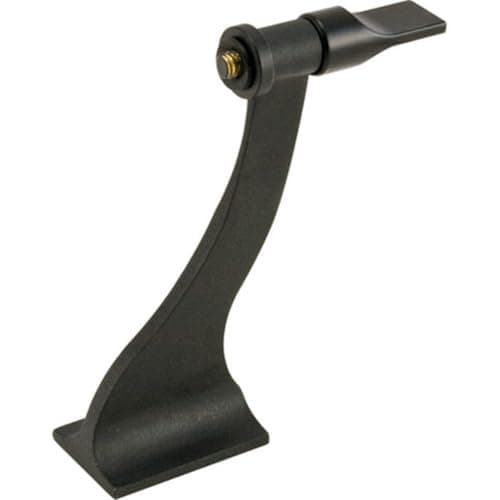 Celestron Binocular Tripod Adapter An L-bracket that screws into the binocular hinge and bolts onto any standard tripod head. | The part that actually solves the problem | |
| 2 | 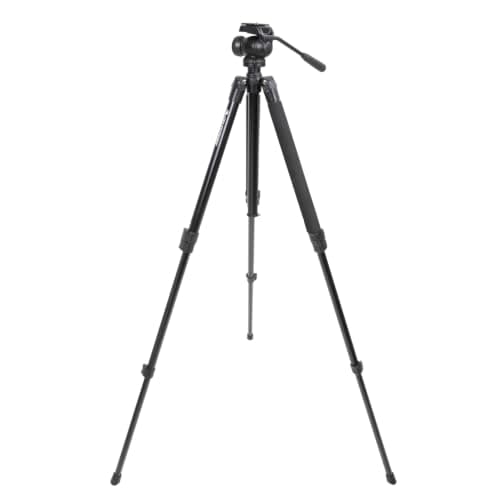 Celestron TrailSeeker Tripod 70.5 inches at full extension, 8.8 lbs of capacity, a fluid pan head and a case. | The tripod height that makes looking up bearable | |
| 3 | 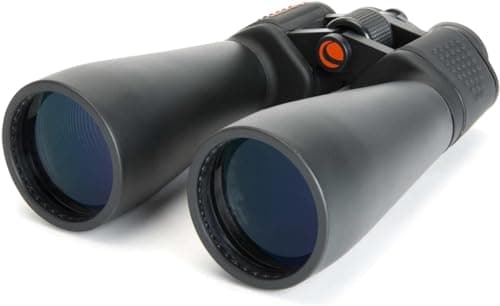 Celestron SkyMaster 15x70 70mm objectives at 15x — genuinely deep views, and genuinely impossible to hold still. | The binocular that is transformed by this purchase |
Rows link to the full write-up further down this page. Prices come from the live price layer only; where there is no live figure the button reads “Check price” rather than showing a number we remembered.
What this does not fix
- It does not add aperture. A mounted 10x50 still gathers exactly the light a 50mm objective gathers.
- It does not help a child aim. If anything, a mounted binocular is harder for a small child to point, because they cannot simply swing it toward the bright thing they saw.
- It does not replace a telescope. Mounted binoculars show star fields, clusters and the Moon beautifully; they do not show Saturn's rings. Our telescope, binoculars or projector page sets out where each one stops.
- It does not solve the zenith. Anything directly overhead is awkward on a photo tripod. The usual answers are a reclining chair and a target lower in the sky, not more equipment.
The cheap alternatives, honestly
A tripod is not the only way to stop the shaking, and for a child it is often not the best one.
- Lie down. Flat on your back on a rug with elbows on the ground is steadier than any hand-held stance, costs nothing and solves the overhead problem at the same time.
- Brace against something. A door frame, a fence post or a car roof removes most of the tremor at 10x.
- Sit and rest your elbows on your knees. The standard field technique, and it works.
- Buy less magnification instead. A 7x50 hand-held beats a 15x70 that never gets mounted, which is why our stargazing binoculars page leads with 7x and 10x rather than the biggest number available.
What we did and did not do
We have not tested this adapter or tripod. Their specifications were read from Celestron's published pages, linked below and checked on the date at the top of this page. The shake table is arithmetic, not a measurement, and it is shown so you can check it yourself.
No price appears in this prose. Live figures come only from our price feed with the date they were checked. Our full method is on the methodology page.
The picks in full
Pick 1
Celestron Binocular Tripod Adapter
The part that actually solves the problem
The arithmetic
The cheapest fix on this site for the most common binocular complaint. Hand shake is magnified exactly as much as the target: at 15x, a 1mm wobble at your eye is a 15mm wobble in the view. That is why a 15x70 looks disappointing hand-held and transforms on a tripod — nothing about the optics changed, only the shaking.
This is the cheapest thing on this site that changes what a child sees, and it is not optics at all.
It works by screwing into the threaded socket most full-size binoculars hide under a cap on the front hinge, then bolting to a standard tripod head. Celestron states it fits porro or roof prism binoculars with that socket.
Check before you buy: unscrew the small cap on the front of the center hinge. If there is a thread under it, this works. If the hinge is smooth, it does not, and the honest answer is a different binocular rather than a workaround.
Celestron does not publish dimensions, weight or materials for this item, so we do not state them. It is also only half the purchase — you still need something to bolt it to.
Skip it if
Your binoculars have no threaded socket behind the front hinge cover. Most compact roof-prism models do not, and no adapter can add one.
| Item number | 93524 |
|---|---|
| Fits | Porro or roof prism binoculars with a threaded center hinge |
| Mounts to | Standard photo tripod head |
| Warranty | 2 year |
| What the box does not do | It is a bracket, not a tripod — you need a tripod as well, and Celestron does not publish dimensions, weight or materials for this item, so we do not state them. It only works on binoculars with a threaded socket behind the front hinge cover; most compact roof models do not have one. |
Specifications from Celestron — Binocular Tripod Adapter. We have not handled this one — everything above is the published spec sheet plus our own arithmetic on it.
Pick 2
Celestron TrailSeeker Tripod
The tripod height that makes looking up bearable
The arithmetic
The specification that matters for astronomy is the one nobody checks: maximum height. At 70.5 inches this reaches above the eye level of most adults, which is what lets you look UP without crouching — the single most common reason a tripod gets abandoned for overhead targets. Its 8.8 lb capacity carries every binocular on this site with a wide margin; our heaviest, the SkyMaster 15x70, is well under half of it.
The specification that matters for astronomy is the one tripod reviews skip: maximum height. Looking at something 60 degrees up while the eyepieces sit at chest height means crouching, and crouching is why tripods get abandoned.
At a published 70.5 inches this reaches above most adults' eye level, which lets you stand under it rather than fold yourself around it. Its 8.8 lb capacity carries every binocular on this site several times over — our heaviest, the SkyMaster 15x70, is well under half.
Honest limitations: a two-way fluid pan head tilts and pans but still cannot point comfortably at the zenith, which is true of every photo tripod rather than this one in particular. And no binocular adapter is included — that is the bracket above.
Skip it if
You already own a camera tripod. Any tripod with a 1/4-20 screw and a stable head will hold a binocular; this is an upgrade, not a requirement.
| Item number | 82050 |
|---|---|
| Maximum height | 1790mm (70.5") |
| Maximum height, center column down | 1475mm (58") |
| Minimum height | 480mm (18.9") |
| Folded length | 610mm (24") |
| Load capacity | 8.8 lbs (4 kg) |
| Weight | 3.94 lbs (1.79 kg) |
| Legs | 4-section aluminum, 3 leg angles |
| Head | Two-way fluid pan head |
| Mounting screw | 1/4"-20 |
| Included | Case with shoulder strap |
| Warranty | 2 year |
| What the box does not do | No binocular adapter — that is a separate bracket. A two-way pan head tilts and pans but does not point comfortably at the zenith, which is a limitation of every photo tripod, not this one. At 3.94 lbs it is a carry-it-to-the-garden tripod, not a hike-all-day one. |
Specifications from Celestron — TrailSeeker Tripod specifications. We have not handled this one — everything above is the published spec sheet plus our own arithmetic on it.
Pick 3
Celestron SkyMaster 15x70
The binocular that is transformed by this purchase
The arithmetic
The counter-intuitive number: 70 / 15 = 4.7mm exit pupil, against 7.1mm for a 7x50. More objective glass, but spread across more magnification — so into a child's fully dark-adapted 7mm pupil this delivers roughly (4.7 / 7.1) squared, about 44 percent of the light the cheaper 7x50 does. The 70mm advantage is real only for an adult eye that no longer dilates past 5mm, or on a tripod where the extra reach pays. At 48 oz it is 1.76 times the weight of a 7x50 and 15x magnifies hand tremor fifteen times: this is a tripod instrument, not a handheld one.
Every complaint about big astronomy binoculars is really a complaint about shake, and shake is magnified by exactly the same factor as the target.
At 15x, a millimeter of hand tremor at your eye becomes fifteen millimeters of swim in the view. The optics are unchanged; the experience is completely different once the shake is removed. Owners who mount a 15x70 routinely describe it as a new instrument, and the arithmetic explains why.
The honest downside is unchanged from our review: this is heavy, it has no image stabilization, and mounted or not, a child will need help aiming it. Full review.
Skip it if
A child is the main user and there is no tripod. At 15x and 3 lbs this is a two-handed instrument that shakes in anyone's grip, which is exactly why it appears on this page.
| Magnification | 15x |
|---|---|
| Objective lens | 70mm (2.75") |
| Prism glass | BaK-4 |
| Lens coatings | Multi-coated |
| Angular field of view | 4.4 degrees |
| Linear field at 1000 yds | 231 ft (77 m) |
| Exit pupil | 4.7mm (.18") |
| Eye relief | 18mm (.71") |
| Close focus | 43 ft (13 m) |
| Weight | 48 oz (1361 g) |
| Tripod adaptable | Yes |
| Environmental | Water resistant |
| What the box does not do | No tripod and no tripod adapter in the box, and it genuinely needs both — 48 oz at 15x cannot be held steady by anyone, let alone a child. Water resistant, not waterproof. A 43 ft close focus rules out any daytime use in a garden. |
Specifications from Celestron — SkyMaster 15x70 specifications. We have not handled this one — everything above is the published spec sheet plus our own arithmetic on it.
Questions people actually ask
- How do you attach binoculars to a tripod?
- With an L-shaped tripod adapter. It screws into the threaded socket hidden under a cap on the front of the binocular's center hinge, then bolts to a standard tripod head using the same 1/4-20 screw a camera uses.
- Do all binoculars fit a tripod adapter?
- No. The binocular needs a threaded socket behind the front hinge cover. Most full-size porro and many roof-prism models have one; most compacts do not, and nothing can add it.
- At what magnification do binoculars need a tripod?
- Around 12x for most people and definitely by 15x. Hand tremor is magnified by exactly the same factor as the image, so a millimeter of movement at your eye becomes fifteen millimeters of swim at 15x.
- What size tripod do you need for binoculars?
- Look at maximum height before capacity. Astronomy means looking up, so eyepieces need to reach your standing eye level or you will crouch. Capacity is rarely the constraint — a 3 lb binocular sits well inside an 8.8 lb rating.
- Does mounting binoculars really show more stars?
- In practice, yes. The optics are unchanged, but a steady image lets your eye settle on faint points of light instead of tracking a moving field, and faint stars that were invisible hand-held become visible.
- Is there a free alternative to a binocular tripod?
- Lying flat on your back with your elbows on the ground is steadier than any standing position and solves overhead viewing at the same time. Bracing against a wall, fence or car roof is the next best thing.
Sources
Read next
Where to go from here
- Celestron SkyMaster 15x70 review
The big-binocular option, reviewed honestly: 70mm objectives that deliver less light to a dark-adapted child's eye than a 7x50, and 48 oz that demand a tripod.
- The best binoculars for stargazing with kids
The exit pupil calculation that decides which binoculars suit a child, and what a 7x50 actually shows on a first clear night.
- 7x50 versus 10x42: which for a child, and why
The exit pupil arithmetic that settles the classic binocular argument, and why the answer is different for a child than for an adult.
- 8x42 vs 10x42: the same binocular, one number apart
Celestron publishes both versions of the same binocular, so the comparison is unusually clean: 5.25mm exit pupil against 4.2mm, 388 ft of field against 304 ft, 17.5mm of eye relief against 14mm.
- What to buy a kid who already has a telescope
A telescope's real problems are dark adaptation, steadiness and knowing where to point it. None of them cost much to fix.
- The stargazing night kit
A red torch does more for what a child sees than doubling the aperture. The full kit, in order of how much it changes.
- Celestron SkyMaster 25x100 review
100mm per side puts this in telescope territory, and 8.75 lbs at 25x puts it permanently on a tripod. The arithmetic on what that buys, and what it costs.