Binoculars
Celestron SkyMaster 25x100 review
Two 100mm telescopes bolted together. Buy the mount before you buy the binocular.
By Scooter M. · published September 27, 2026
I'm not an astronomer and I don't have a lab. I'm someone who's genuinely into this — I read the manuals, compile the published specs, and do the arithmetic the box doesn't do for you. No lab coat. How we pick.
How this is funded. Lens & Lightyear earns a commission when you buy through a link on this page, at no extra cost to you. It does not change which products we pick or what we say about them — every card below carries a real reason to skip it. Prices are pulled live and were last verified October 18, 2026. Full disclosure.
The short answer
Buy it only if a sturdy tripod is part of the purchase. 100mm objectives per side gather serious light and the two-eyed view is genuinely special, but 8.75 lbs at 25x cannot be hand-held by anyone. If that sounds like too much equipment, the 20x80 or the 15x70 give most of the experience for far less weight — see which SkyMaster should you buy for the whole line on one page.
Giant binoculars occupy an odd place in this category: they cost telescope money, weigh telescope weight, and need telescope support — but they show you a wide, two-eyed view no telescope on this site can match.
How we judged
- Exit pupil, because it decides brightness under a real sky. Objective divided by magnification. 4mm here.
- Weight against magnification, because shake is multiplied by the magnification exactly. This is the pair's defining constraint.
- Field of view, because finding anything at 25x with no finder is the practical problem.
- Sealing and coatings, the specifications that separate the plain SkyMaster line from the Pro line.
The giant binocular family, compared
| SkyMaster 15x70 | SkyMaster Pro 20x80 | SkyMaster 25x100 | |
|---|---|---|---|
| Objectives | 70mm | 80mm | 100mm |
| Magnification | 15x | 20x | 25x |
| Exit pupil | 4.7mm | 4mm | 4mm |
| Angular field | Published by Celestron per model | 3.2 degrees | 3 degrees |
| Linear field at 1000 yds | — | 168 ft | 156 ft |
| Eye relief | — | 15.5mm | 15mm |
| Coatings | Multi-coated | Fully multi-coated, XLT | Multi-coated |
| Sealing | Water resistant | Waterproof, nitrogen | Water resistant |
| Weight | About 3 lbs | 5.4 lbs | 8.75 lbs |
| Finder rail | No | Yes, detachable RSR | No |
Celestron's published specifications for items 71017 and 72031 and for the 15x70, linked below. Bold marks the advantage in each row. Dashes are figures Celestron does not publish in the same form across the family.
Read down the weight row and the decision usually makes itself. The optical gain from 80mm to 100mm is about 56 percent more light; the weight gain is 62 percent. Whether that trade is worth it depends entirely on the mount you already own.
Quick picks
The 25x100 and the two sane alternatives
| # | Product | Best for | Price |
|---|---|---|---|
| 1 | 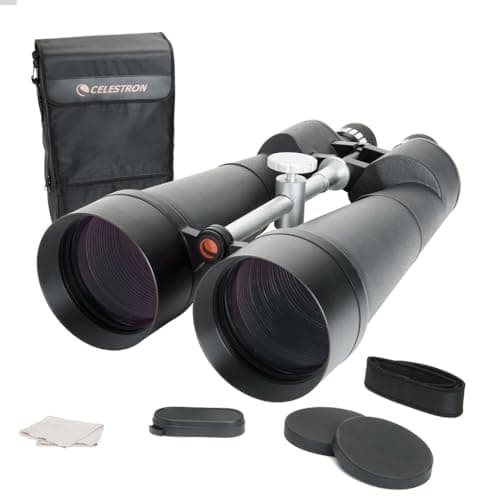 Celestron SkyMaster 25x100 100mm objectives, a 3 degree field and a 4mm exit pupil — mounted, always. | Deep-sky sweeping with both eyes, from a fixed observing spot | |
| 2 | 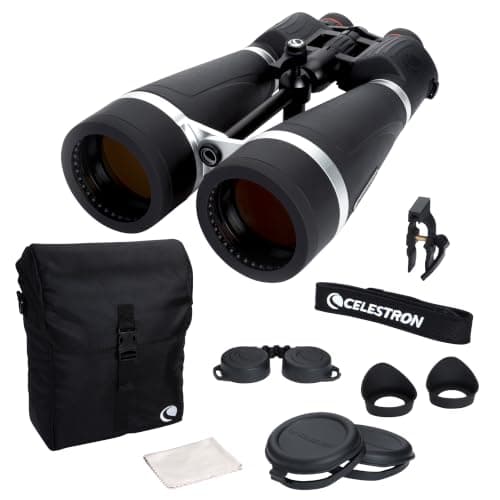 Celestron SkyMaster Pro 20x80 80mm objectives, the same 4mm exit pupil, waterproof, with a rail for a red dot finder. | Most of the aperture, 3.35 lbs less of it | |
| 3 | 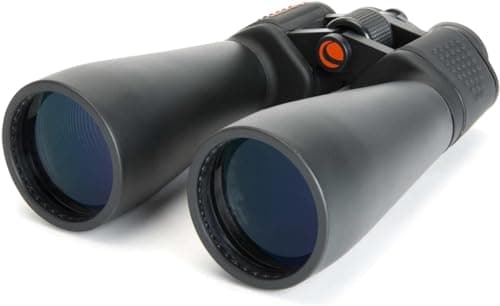 Celestron SkyMaster 15x70 70mm objectives at 15x — the lightest of the three and the one most people should start with. | The entry point to giant binoculars |
Rows link to the full write-up further down this page. Prices come from the live price layer only; where there is no live figure the button reads “Check price” rather than showing a number we remembered.
The arithmetic of holding 25x steady
We use this on every binocular page because it is the single most useful thing to understand before buying: magnification multiplies hand tremor exactly as it multiplies the image.
| Magnification | A 1mm tremor becomes | Hand-held verdict |
|---|---|---|
| 7x | 7mm | Comfortable for anyone |
| 10x | 10mm | Usable braced |
| 15x | 15mm | Mount it |
| 20x | 20mm | Mount it |
| 25x | 25mm | Mount it, and use a good mount |
Our arithmetic. At 25x with 8.75 lbs in your hands, the image does not wobble — it swims.
Which makes the tripod the real purchase decision. Our binocular tripod adapter guide covers the bracket and the height question; for this pair specifically, look at capacity first, because 8.75 lbs exceeds what several popular photo tripods will hold steady.
What 100mm binoculars actually show
- Open star clusters — the best target in the category. A 3 degree field frames clusters that a telescope cuts in half.
- The Milky Way — sweeping it at 25x with both eyes is the experience people buy these for, and no telescope here does it.
- Brighter galaxies and nebulae — visible as shapes under a dark sky, with more structure than a 70mm pair shows.
- The Moon — bright and detailed, though a telescope at higher magnification does better.
- Planets — poorly. 25x is not enough for Saturn's rings to resolve properly; that is telescope work, and our planets page covers it.
Who this is for
| Situation | Verdict |
|---|---|
| You own a heavy-duty tripod and observe from one spot | Buy it. The most light in this category. |
| You want giant binoculars but own a light tripod | The 20x80 Pro — 3.35 lbs lighter and waterproof. |
| First astronomy binocular | The 15x70, or a 7x50 hand-held. |
| A child is the user | No. See binoculars by age. |
| You wear glasses | 15mm of eye relief is tight — the Nature DX ED 8x42 gives 17.8mm. |
| Planets are the goal | A telescope. Start at to see planets. |
What we did and did not do
We have not handled these binoculars. Every specification above was read from Celestron's own published pages, linked below and checked on the date at the top of this page. The exit pupils, light ratios and the tremor table are arithmetic on those figures, shown so you can repeat them.
No price appears in this prose. Live figures come only from our price feed with the date they were checked. Our full method is on the methodology page.
The picks in full
Pick 1
Celestron SkyMaster 25x100
Deep-sky sweeping with both eyes, from a fixed observing spot
The arithmetic
100mm objectives put this in telescope territory: each side gathers about the same light as the 102mm refractors we review, and the pair gathers roughly twice what a 70mm telescope does. The arithmetic that decides whether you enjoy it is the weight against the magnification. 140 oz is 8.75 lbs, and at 25x every tremor in your hands is multiplied twenty-five times, so this is a tripod instrument in the same way a telescope is — not as a refinement, as a requirement. Objective divided by magnification gives a 4mm exit pupil, narrower than a dark-adapted adult eye, so it is less forgiving of a bright sky than a 7x50.
Each side of this binocular gathers about as much light as the 102mm refractors we review, and you get two of them, one per eye. That is genuinely why people love giant binoculars: the view is immersive in a way a single eyepiece is not.
The specification that decides your experience is not optical. 140 oz is 8.75 lbs, and at 25x every tremor is multiplied twenty-five times. This is a tripod instrument in the same way a telescope is — not as a refinement, as a requirement. Celestron builds in a tripod adapter rod for exactly that reason.
Objective divided by magnification gives a 4mm exit pupil, which is narrower than a dark-adapted adult eye can use. That makes it less forgiving under a bright sky than a 7x50, despite gathering four times the light.
Honest gaps: 15mm of eye relief is tight in glasses, the 80 ft close focus makes it useless for anything nearby, individual eyepiece focus means refocusing each side, and *water resistant* is not waterproof.
Skip it if
You do not already own a sturdy tripod. At 140 oz — 8.75 lbs — this is heavier than several telescopes we review, and many photo tripods will not hold it steady at full extension.
| Item number | 71017 |
|---|---|
| Magnification | 25x |
| Objective diameter | 100mm (3.94") |
| Prisms | BaK-4 porro |
| Coatings | Multi-coated |
| Angular field of view | 3 degrees |
| Linear field of view | 156 ft at 1000 yds (52 m) |
| Exit pupil | 4mm (.15") |
| Eye relief | 15mm (.59") |
| Close focus | 80 ft (24.4 m) |
| Focus | Individual eyepiece focus |
| Tripod adaptable | Yes, integrated tripod adapter rod |
| Weather sealing | Water resistant |
| Weight | 140 oz (3969 g) |
| Included | Nylon carrying case, rainguard, lens caps, neck strap |
| Warranty | Limited lifetime |
| What the box does not do | No tripod, and the one you own may not be enough — 8.75 lbs at full extension is more than many photo tripods will hold steady. The 80 ft close focus makes it useless for anything terrestrial nearby, individual eyepiece focus means refocusing each side when you change target distance, and water resistant is not waterproof. |
Specifications from Celestron — SkyMaster 25x100 specifications. We have not handled this one — everything above is the published spec sheet plus our own arithmetic on it.
Pick 2
Celestron SkyMaster Pro 20x80
Most of the aperture, 3.35 lbs less of it
The arithmetic
The interesting comparison is against the 25x100 above rather than against a hand-held binocular. This is 86.4 oz against 140 — 5.4 lbs against 8.75 — for 80mm objectives against 100mm, which by the square of the ratio is about 64 percent of the light. Both land on the same 4mm exit pupil, because dividing 80 by 20 and 100 by 25 gives the same answer. What the Pro adds over the bigger model is sealing and coatings that Celestron publishes as fully multi-coated with XLT, against plain multi-coated on the 25x100, plus a rail for a red dot finder — which matters more than it sounds, because aiming a 3.2 degree field at a faint object is genuinely hard.
The more sensible giant binocular for most people, and the one we would buy first.
At 86.4 oz it is 5.4 lbs against 8.75 — still a tripod instrument, but one a normal photo tripod can carry. Celestron publishes fully multi-coated XLT coatings here against plain multi-coated on the 25x100, and it is waterproof and nitrogen filled where the bigger model is only water resistant.
The detachable reflex sight rail is the feature nobody mentions and everybody needs: aiming a 3.2 degree field at a faint smudge is genuinely hard without a finder.
Skip it if
You want the deepest possible view and already have a heavy-duty mount. 80mm against 100mm is about 64 percent of the light.
| Item number | 72031 |
|---|---|
| Magnification | 20x |
| Objective diameter | 80mm (3.15") |
| Prisms | BaK-4 porro |
| Coatings | Fully multi-coated, XLT |
| Angular field of view | 3.2 degrees |
| Linear field of view | 168 ft at 1000 yds (56 m) |
| Exit pupil | 4mm (.15") |
| Eye relief | 15.5mm (.61") |
| Close focus | 66.2 ft (20.2 m) |
| Tripod adaptable | Yes |
| Weather sealing | Waterproof, nitrogen filled |
| Also included | Detachable reflex sight rail for an optional red dot finder |
| Weight | 86.4 oz (2449 g) |
| Warranty | Limited lifetime |
| What the box does not do | Still too heavy to hold: at 20x and 5.4 lbs this wants a tripod for anything longer than a glance, and no tripod is included. The 4mm exit pupil is narrower than a dark-adapted eye can use, and a 66 ft close focus rules out most daytime use. |
Specifications from Celestron — SkyMaster Pro 20x80 specifications. We have not handled this one — everything above is the published spec sheet plus our own arithmetic on it.
Pick 3
Celestron SkyMaster 15x70
The entry point to giant binoculars
The arithmetic
The counter-intuitive number: 70 / 15 = 4.7mm exit pupil, against 7.1mm for a 7x50. More objective glass, but spread across more magnification — so into a child's fully dark-adapted 7mm pupil this delivers roughly (4.7 / 7.1) squared, about 44 percent of the light the cheaper 7x50 does. The 70mm advantage is real only for an adult eye that no longer dilates past 5mm, or on a tripod where the extra reach pays. At 48 oz it is 1.76 times the weight of a 7x50 and 15x magnifies hand tremor fifteen times: this is a tripod instrument, not a handheld one.
If this page has convinced you that giant binoculars are interesting but the weight is alarming, start here.
At roughly 3 lbs it is the one pair in the family a person can briefly hold, and mounted it delivers most of what draws people to the category — wide star fields, the Milky Way, big open clusters.
It is also the cheapest way to find out whether you enjoy observing this way before spending on a 100mm pair and the mount it demands.
Skip it if
You want 100mm of aperture. This is the smallest of the family, and its 4.7mm exit pupil and lower magnification make it a different instrument.
| Magnification | 15x |
|---|---|
| Objective lens | 70mm (2.75") |
| Prism glass | BaK-4 |
| Lens coatings | Multi-coated |
| Angular field of view | 4.4 degrees |
| Linear field at 1000 yds | 231 ft (77 m) |
| Exit pupil | 4.7mm (.18") |
| Eye relief | 18mm (.71") |
| Close focus | 43 ft (13 m) |
| Weight | 48 oz (1361 g) |
| Tripod adaptable | Yes |
| Environmental | Water resistant |
| What the box does not do | No tripod and no tripod adapter in the box, and it genuinely needs both — 48 oz at 15x cannot be held steady by anyone, let alone a child. Water resistant, not waterproof. A 43 ft close focus rules out any daytime use in a garden. |
Specifications from Celestron — SkyMaster 15x70 specifications. We have not handled this one — everything above is the published spec sheet plus our own arithmetic on it.
Questions people actually ask
- Can you hold 25x100 binoculars by hand?
- No. They weigh 140 oz — 8.75 lbs — and at 25x every tremor in your hands is magnified twenty-five times. Celestron builds in a tripod adapter rod because a tripod is a requirement for this pair, not an upgrade.
- Are 25x100 binoculars better than a telescope?
- Different, not better. They show wider fields with both eyes, which is unmatched on star clusters and the Milky Way. A telescope reaches far higher magnification, which is what planets need. Each side of a 25x100 gathers roughly what a 102mm telescope does.
- What tripod do you need for SkyMaster 25x100 binoculars?
- One rated comfortably above 8.75 lbs and tall enough to use while looking up. Capacity is the binding constraint here — many photo tripods that handle a camera will not hold this pair steady at full extension.
- What is the difference between the SkyMaster 25x100 and the SkyMaster Pro 20x80?
- The 25x100 gathers about 56 percent more light; the Pro 20x80 is 3.35 lbs lighter, waterproof and nitrogen filled, carries fully multi-coated XLT coatings against plain multi-coated, and includes a rail for a red dot finder. Both have the same 4mm exit pupil.
- Is the exit pupil of 4mm a problem?
- It makes the view less forgiving than a 7x50's 7.1mm under a bright sky, because a dark-adapted adult pupil opens wider than 4mm. Under a genuinely dark sky the aperture advantage dominates and the pair shows far more than any 50mm binocular.
Sources
Read next
Where to go from here
- Celestron SkyMaster 15x70 review
The big-binocular option, reviewed honestly: 70mm objectives that deliver less light to a dark-adapted child's eye than a 7x50, and 48 oz that demand a tripod.
- Celestron SkyMaster Pro 20x80 review
80mm per side, waterproof and nitrogen filled, with XLT coatings and a detachable finder rail. Two-thirds the light of a 25x100 at 62 percent of the weight.
- Celestron SkyMaster Pro ED 20x80 review
Top of the SkyMaster line. Every published light figure matches the cheaper Pro 20x80 exactly, because it is the same 20x on the same 80mm — so what you are buying is color correction, for 43 percent more weight and no sight rail.
- Which Celestron SkyMaster should you buy?
12x60, 15x70, 25x70, 20x80, Pro 15x70, Pro 20x80 or 25x100? Compared on Celestron's own published figures, with the exit-pupil arithmetic that separates them.
- Putting binoculars on a tripod: adapter, tripod, and the height nobody checks
The cheapest fix for the most common binocular disappointment. Which binoculars accept an adapter, what tripod height actually matters for looking up, and what this will not fix.
- The best binoculars for stargazing with kids
The exit pupil calculation that decides which binoculars suit a child, and what a 7x50 actually shows on a first clear night.
- The best telescope for deep space
Galaxies and nebulae are won with aperture and dark skies, never magnification. What limiting magnitude means in practice, and the telescopes that reach deepest here.
- The best stargazing binoculars under $100
Three pairs under $100, judged on exit pupil, prism glass and steadiness rather than on magnification claims — plus the two corners this budget always cuts.