Telescopes
The best kids' telescope to see planets
Yes, they show planets. Here is exactly what that looks like.
By Scooter M. · published September 1, 2026
I'm not an astronomer and I don't have a lab. I'm someone who's genuinely into this — I read the manuals, compile the published specs, and do the arithmetic the box doesn't do for you. No lab coat. How we pick.
How this is funded. Lens & Lightyear earns a commission when you buy through a link on this page, at no extra cost to you. It does not change which products we pick or what we say about them — every card below carries a real reason to skip it. Prices are pulled live and were last verified October 18, 2026. Full disclosure.
The short answer
Yes, a kid's telescope shows planets — reliably. Jupiter appears as a small bright disc with up to four moons beside it, and Saturn's rings are unmistakable from about 50x, which every telescope here reaches. A slow refractor such as the f/13 AstroMaster 70AZ is the cheapest route to a clean, color-free planetary image. What no telescope at this price shows is the photograph on the box.
What each planet actually looks like
This is the section worth reading out loud to the child before the first night. Every description below is what a 70mm to 130mm telescope genuinely shows.
| Planet | What you will see | Magnification needed |
|---|---|---|
| Jupiter | A small bright disc with up to four moons in a line beside it. Two dark cloud belts on a steady night at 100x and up. | 50x for the moons, 100x+ for belts |
| Saturn | A small sharp oval with rings clearly separated from the planet. This is the one that makes people gasp. | 50x minimum, better at 100x |
| Venus | A brilliant white crescent or half-disc, like a tiny Moon. No surface detail — it is permanently cloud-covered. | 50x |
| Mars | A small orange dot most of the time. Near opposition, a tiny disc with a darker marking and sometimes a polar cap. | 100x+, and only when Mars is close |
| Uranus and Neptune | Faint bluish or greenish points that look like stars but do not twinkle. Finding them at all is the achievement. | Any, if you can locate them |
| Mercury | A small phase, low to the horizon in twilight, wobbling in the atmosphere. Hard, and worth trying. | 80x+ |
The magnification ceiling, and why the box lies about it
Planets are the one target where high magnification genuinely helps, which is exactly why the sub-$60 telescope shelf advertises magnification numbers in the hundreds. Understanding the real ceiling protects you from all of it.
A telescope's useful magnification is limited by its aperture, at roughly two times the aperture in millimeters. A 70mm objective tops out near 140x. Past that, you are enlarging a blurrier image, not revealing more detail — the physics of diffraction sets the limit, and no eyepiece defeats it.
There is a second, harder ceiling that has nothing to do with your telescope: the atmosphere. On a typical night, air turbulence limits any telescope anywhere to around 150x to 200x. On a poor night it is 80x. This is why experienced observers talk about *seeing* — and why a 130mm telescope on a steady night beats a 200mm telescope on a turbulent one.
Quick picks
Telescopes for seeing planets
| # | Product | Best for | Price |
|---|---|---|---|
| 1 | No image Celestron StarSense Explorer DX 102AZ 102mm refractor, 240x published ceiling, and no central obstruction to soften contrast. | The best planetary views on this site | |
| 2 | 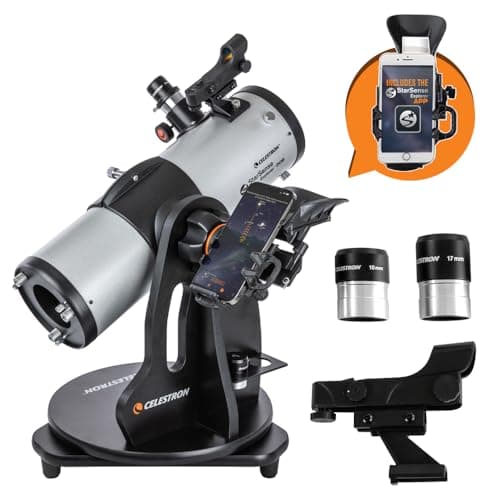 Celestron StarSense Explorer 114mm Tabletop Dobsonian 269x published ceiling on a parabolic mirror, and 12.8 limiting magnitude for the rest of the sky. | Planets plus everything else | |
| 3 | No image Celestron StarSense Explorer LT 70AZ f/10 optics that are forgiving on planets, and the Barlow reaches 140x in the box. | The affordable planetary starter | |
| 4 | 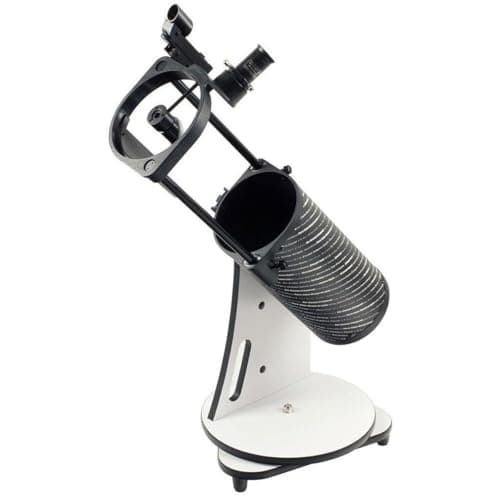 Sky-Watcher Heritage 130 Tabletop Dobsonian 130mm at f/5 — a lot of light, and a sensible ceiling near 260x by the aperture rule. | Most aperture per dollar, planets included |
Rows link to the full write-up further down this page. Prices come from the live price layer only; where there is no live figure the button reads “Check price” rather than showing a number we remembered.
Three free things that improve planetary views more than money does
- Wait for the planet to be high in the sky. Near the horizon you are looking through several times more atmosphere. The same planet at 60 degrees elevation is dramatically sharper than at 15 degrees. A free planetarium app will tell you when.
- Let the telescope cool down. A telescope brought from a warm house has air currents inside the tube that smear fine detail. Twenty to thirty minutes outside before you start makes a visible difference, and it costs nothing.
- Look for longer. Planetary detail arrives in flashes when the atmosphere steadies for a second. A child who glances for three seconds sees a blob; a child who watches for two minutes sees the belts. This is genuinely a learned skill and it is the biggest single improvement available.
Which planets are visible tonight?
This changes constantly, so we are not going to print a chart that will be wrong next month. Use a free planetarium app — point the phone at the sky and it labels what is up. That is a two-minute job and it is more reliable than any list we could publish. Our stargazing night kit covers what else belongs in the bag.
One rule of thumb that does not go stale: if it is very bright and it does not twinkle, it is a planet. Stars twinkle because they are point sources; planets show a tiny disc that averages out the turbulence. A child can learn that in one evening and use it forever.
The picks in full
Pick 1
Celestron StarSense Explorer DX 102AZ
The best planetary views on this site
The arithmetic
The jump from 70mm to 102mm is the biggest single upgrade on this site: light-gathering scales with the square of aperture, so a 102mm objective collects about 2.1 times what a 70mm does. The published limiting magnitude moves from 11.7 to 12.5 and the useful ceiling from 165x to 240x. The cost is 14.2 lbs — this is a two-hands, one-trip-to-the-garden telescope, not a carry-it-yourself one.
For planets specifically, a refractor has a real advantage that has nothing to do with aperture: there is no secondary mirror in the light path. A reflector's central obstruction scatters a little light and slightly softens fine contrast, which is precisely what planetary detail is made of.
At 102mm with a published 240x ceiling, this is the telescope here most likely to show Jupiter's cloud belts with structure in them and the Cassini division in Saturn's rings on a steady night.
The supplied 25mm and 10mm eyepieces give 26x and 66x. That is nowhere near the ceiling, and for planets it is the limiting factor rather than the optics. A single 6mm eyepiece takes you to 110x, and a 2x Barlow on the 10mm gives 132x. Budget for one of those.
Phone-guided finding is included, which for planets is less critical than for faint objects — Jupiter and Saturn are among the brightest things in the sky and easy to identify with a free app. It still saves time.
Skip it if
It has to be portable or a child has to carry it. 14.2 lbs assembled is the heaviest thing on this page, and the supplied eyepieces only reach 66x of a 240x ceiling — planetary work here needs a shorter eyepiece you buy separately.
| Optical design | Refractor |
|---|---|
| Aperture | 102mm (4.01") |
| Focal length | 660mm (25.98") |
| Focal ratio | f/6.5 |
| Eyepieces supplied | 25mm (26x) and 10mm (66x) |
| Finderscope | StarPointer red dot |
| Mount | Manual alt-azimuth |
| Tripod | 1244.6mm (49") max height |
| Highest useful magnification | 240x |
| Limiting stellar magnitude | 12.5 |
| Total kit weight | 14.2 lbs (6.44 kg) |
| What the box does not do | No Barlow in the box, so the supplied top magnification is 66x against a 240x ceiling — you will want a shorter eyepiece eventually. At 14.2 lbs assembled, a child under about ten will not be setting this up alone. |
Specifications from Celestron — StarSense Explorer DX 102AZ specifications. We have not handled this one — everything above is the published spec sheet plus our own arithmetic on it.
Pick 2
Celestron StarSense Explorer 114mm Tabletop Dobsonian
Planets plus everything else
The arithmetic
A parabolic mirror rather than the spherical one in cheaper reflectors, which is what keeps a fast f/4 sharp at the edges. 114mm gathers roughly 2.7 times the light of a 70mm refractor, and the published limiting magnitude of 12.8 is the deepest on this site. The supplied eyepieces only reach 45x against a 269x ceiling, so the box gives you wide, bright, easy views and leaves the high-power ones to buy later.
The all-rounder. 114mm gathers roughly 2.7 times the light of a 70mm, the mirror is parabolic rather than spherical, and Celestron publishes a 269x ceiling.
On planets that ceiling is theoretical rather than practical — the atmosphere rarely allows more than about 200x anywhere, and 150x is a good night in most gardens. But having headroom means the telescope is never the limiting factor.
The supplied 17mm and 10mm eyepieces give 26x and 45x. That is deliberately low, and it means the box as shipped is set up for star clusters and nebulae rather than planets. A 6mm eyepiece gives 75x and a Barlow on it gives 150x, which is where Jupiter starts showing belts.
12.8 limiting magnitude is the deepest published figure of anything we recommend. On the nights when planets are badly placed, that is what keeps the telescope worth carrying outside.
Skip it if
Planets are genuinely the only interest. A refractor of similar money will show slightly crisper planetary detail. This wins on everything that is not a planet, which for most children ends up mattering more.
| Optical design | Newtonian reflector, parabolic primary mirror |
|---|---|
| Aperture | 114mm (4.48") |
| Focal length | 450mm (17.71") |
| Focal ratio | f/4 |
| Eyepieces supplied | 17mm (26x) and 10mm (45x) |
| Finderscope | StarPointer red dot |
| Mount | Alt-azimuth tabletop Dobsonian base |
| Highest useful magnification | 269x |
| Limiting stellar magnitude | 12.8 |
| Total kit weight | 12.6 lbs (5.71 kg) |
| What the box does not do | No tripod — it is a tabletop instrument and needs a solid surface at the right height, which is a real planning problem in a garden. A reflector's mirror can drift out of alignment; expect to learn collimation eventually. |
Specifications from Celestron — StarSense Explorer 114mm Dobsonian specifications. We have not handled this one — everything above is the published spec sheet plus our own arithmetic on it.
Pick 3
Celestron StarSense Explorer LT 70AZ
The affordable planetary starter
The arithmetic
700mm over 25mm and 10mm gives 28x and 70x; the 2x Barlow doubles those to 56x and 140x. Celestron's published ceiling is 165x, so even the Barlowed 10mm stays legal — a rare box where every supplied combination is inside the optics' honest limit. At f/10 the images are contrasty and easy to focus, which is exactly what an inexperienced pair of hands needs.
The cheapest way to see planets properly, and it is genuinely adequate rather than a compromise.
f/10 is a slow focal ratio, which suits planetary work: high contrast, forgiving focus, and cheap eyepieces perform well. The 2x Barlow on the supplied 10mm gives 140x, inside the published 165x ceiling. That is enough magnification for Saturn's rings to be obvious and for Jupiter's disc to show as a disc rather than a dot.
What 70mm reliably delivers on planets: Jupiter as a small bright disc with four moons in a line, changing night to night; Saturn with its rings clearly separated from the planet; Venus showing phases like a tiny Moon; Mars as an orange dot that occasionally hints at a darker marking.
What it does not: fine cloud structure, the Great Red Spot, or polar caps on Mars except at opposition on an exceptional night. Manage that expectation up front.
Skip it if
You want to see cloud detail on Jupiter. At 70mm you will see the disc and the moons reliably, and the two main belts on a very good night, but the fine structure that older children start asking about needs more aperture.
| Optical design | Refractor |
|---|---|
| Aperture | 70mm (2.76") |
| Focal length | 700mm (27.56") |
| Focal ratio | f/10 |
| Eyepieces supplied | 25mm (28x) and 10mm (70x) |
| Barlow | 2x (1.25") |
| Finderscope | StarPointer red dot |
| Mount | Manual alt-azimuth |
| Tripod | Aluminum, 1320.8mm (52") max height |
| Highest useful magnification | 165x |
| Limiting stellar magnitude | 11.7 |
| Total kit weight | 7.4 lbs (3.35 kg) |
| Phone requirement | Android 12 and later; iOS 18 and newer, iPhone XR and newer |
| What the box does not do | The phone requirement is a real constraint, not fine print: Android 12+ or iOS 18+ on an iPhone XR or newer. An older hand-me-down phone will not run it, and without the app this is an ordinary 70mm refractor at the price of a guided one. |
Specifications from Celestron — StarSense Explorer LT 70AZ specifications. We have not handled this one — everything above is the published spec sheet plus our own arithmetic on it.
Pick 4
Sky-Watcher Heritage 130 Tabletop Dobsonian
Most aperture per dollar, planets included
The arithmetic
130mm of aperture collects roughly 3.4 times the light of a 70mm refractor — the single biggest jump available at anything like gift money. At 650mm focal length, a common 25mm eyepiece gives 26x and a 10mm gives 65x. The rule of thumb astronomers use for a maximum useful magnification is about 2x the aperture in millimeters, which puts a sensible ceiling near 260x on a genuinely steady night.
The value pick. 130mm of parabolic mirror gathers roughly 3.4 times a 70mm refractor, which shows up on planets as a brighter, higher-contrast image that stands up to more magnification.
At 650mm focal length, a 10mm eyepiece gives 65x and a 6mm gives 108x. The standard rule of thumb for maximum useful magnification — roughly twice the aperture in millimeters — puts a sensible ceiling near 260x. Sky-Watcher does not publish a figure of its own, so that is our arithmetic rather than their claim.
The trade-off against a refractor is real: the secondary mirror obstructs part of the aperture and slightly reduces contrast on fine planetary detail. In practice the extra light more than compensates for most of what a child will look at.
Collimation matters most on a fast reflector, and this is f/5. If the mirror drifts out of alignment, planetary views degrade noticeably before anything else does. Budget twenty minutes to learn it.
Skip it if
You want it working perfectly out of the box with no learning. A fast reflector is the most collimation-sensitive telescope here, and misaligned optics hurt planetary detail more than anything else. It is learnable, but it is a thing to learn.
| Optical design | Newtonian reflector, borosilicate parabolic primary mirror |
|---|---|
| Aperture | 130mm |
| Focal length | 650mm |
| Focal ratio | f/5 |
| Mirror coatings | Sky-Watcher Radiant Aluminum Quartz (RAQ) |
| Focuser | 1.25" helical |
| Mount | Tabletop Dobsonian base, Teflon bearings, altitude locking knob |
| Tube | Collapsible for storage, retains collimation |
| What the box does not do | Sky-Watcher's product page does not publish the supplied eyepieces, finderscope or assembled weight, so we do not state them. No tripod — this is a tabletop instrument. The collapsible tube is open to the air, so it collects dust and will need occasional mirror cleaning and collimation. |
Specifications from Sky-Watcher USA — Heritage 130 Tabletop Dobsonian. We have not handled this one — everything above is the published spec sheet plus our own arithmetic on it.
Questions people actually ask
- Can you see planets with a kid's telescope?
- Yes. Jupiter with up to four moons and Saturn with its rings are both comfortably within reach of a 70mm telescope at 50x. Venus shows phases and Mars shows a small orange disc when it is close.
- What is the best telescope for a kid to see Saturn?
- Any telescope on this page will show Saturn's rings. A 102mm refractor or a 114mm reflector will show them best, including a chance at the Cassini division on a steady night.
- How much magnification do you need to see planets?
- 50x shows Saturn's rings and Jupiter's moons. 100x to 150x shows Jupiter's cloud belts and more ring detail. Above about 200x the atmosphere, not the telescope, is usually the limit.
- Why does Jupiter look so small in my telescope?
- Because it genuinely is small in the eyepiece — that is normal, not a fault. What matters is that it is a disc rather than a point, with moons beside it. If it looks like a fuzzy blob rather than a sharp small disc, check focus and see why can't I see anything.
- Can a kid's telescope see the Great Red Spot?
- Rarely, and only at 130mm and up on an exceptional night with the spot facing us. Do not promise it. Jupiter's belts and moons are the reliable win.
Sources
Read next
Where to go from here
- The best telescope for deep space
Galaxies and nebulae are won with aperture and dark skies, never magnification. What limiting magnitude means in practice, and the telescopes that reach deepest here.
- What you can actually see with a kids' telescope
The honest target-by-target list for 70mm, 76mm and 114mm telescopes, so nobody is disappointed on night one.
- The best telescope for an 11 or 12 year old
At eleven and twelve the child is the limiting factor no longer. Picks chosen on aperture and on what they will not outgrow in a year.
- Toy telescopes versus real optics: how to tell in thirty seconds
The arithmetic that exposes a 525x claim on a 70mm box, worked through on a real product using its own manufacturer's published numbers.
- The best beginner telescopes under $200
Between $100 and $200 you can buy a steady mount, real aperture, or phone-guided finding. What each of those is worth, with the arithmetic.
- Your first night with a telescope
Do these eight things in this order and night one works. Most first nights fail on sequence, not on equipment.
- The stargazing night kit
A red torch does more for what a child sees than doubling the aperture. The full kit, in order of how much it changes.
- The best telescope for viewing planets and galaxies
Planets want magnification and contrast; galaxies want aperture and a wide field. The trade explained with published numbers, and the telescopes that split the difference honestly.
- Celestron AstroMaster 70AZ review
70mm at 900mm focal length — f/13, the slowest refractor on this site, with 45x and 90x in the box against a 165x ceiling. Excellent on the Moon, heavy for what it gathers.
- Celestron Inspire 100AZ review
100mm at 660mm f/6.5 with an integrated phone adapter, an erect image diagonal and a red flashlight in the box. The same optics as the DX 102AZ without the guidance app — and 1.8 lbs lighter.