Telescopes
Celestron AstroMaster 70AZ review
Same aperture as half the site, twice the tube. What f/13 buys, and what it costs to carry.

By Scooter M. · published September 26, 2026
I'm not an astronomer and I don't have a lab. I'm someone who's genuinely into this — I read the manuals, compile the published specs, and do the arithmetic the box doesn't do for you. No lab coat. How we pick.
How this is funded. Lens & Lightyear earns a commission when you buy through a link on this page, at no extra cost to you. It does not change which products we pick or what we say about them — every card below carries a real reason to skip it. Prices are pulled live and were last verified October 18, 2026. Full disclosure.
The short answer
Buy it if the Moon and planets are the target and an adult will carry it. At f/13 it is the most color-corrected refractor on this site, and its 45x and 90x sit comfortably inside its own ceiling. Skip it if portability matters — 10.8 lbs for 70mm is the worst aperture-per-pound ratio we list.
There are two Celestron telescopes called AstroMaster with a 70mm lens, they are not the same instrument, and the difference is not the badge. This page is about the 70AZ (item 21061), the 900mm one. Our review of its shorter sibling is on AstroMaster LT 70AZ.
Three 70mm telescopes, three focal lengths
| AstroMaster 70AZ | AstroMaster LT 70AZ | Travel Scope 70 | |
|---|---|---|---|
| Aperture | 70mm | 70mm | 70mm |
| Focal length | 900mm | 700mm | 400mm |
| Focal ratio | f/13 | f/10 | f/5.7 |
| Eyepieces supplied | 20mm + 10mm | 20mm + 10mm | 20mm + 10mm |
| What those give | 45x / 90x | 35x / 70x | 20x / 40x |
| Published ceiling | 165x | 165x | 168x |
| Share in the box | about 55% | about 42% | about 24% |
| Limiting magnitude | 11.7 | 11.7 | Not published |
| Kit weight | 10.8 lbs | 7.2 lbs | 3.3 lbs |
Our arithmetic on each model's published Celestron specifications: focal length divided by eyepiece focal length, against the maker's own stated ceiling. Identical lenses, three completely different telescopes.
Same glass diameter, same light grasp, same published limiting magnitude of 11.7 on the two AstroMasters — and yet they behave differently at the eyepiece, because focal length sets magnification and focal ratio sets color correction.
What f/13 actually buys
This is the telescope's real argument and it is rarely explained on a product page. An achromatic doublet focuses different colors at slightly different points; the error falls away as the lens is made slower, and the rule of thumb astronomers use is about f/3 per inch of aperture before the residual color becomes negligible.
- 2.76 inches times 3 is about f/8.3 — the point at which a 70mm achromat stops showing obvious false color.
- This telescope is f/13, comfortably past that line. By design, the Moon's limb should look clean and white rather than fringed.
- The [LT 80AZ](/telescopes/celestron-starsense-explorer-lt-80az) at f/11 is also past it, which is why we call that one color-corrected too.
- The [DX 102AZ](/telescopes/celestron-starsense-explorer-dx-102az) at f/6.5 is not, and its review says so — that is the trade for keeping a 102mm tube short.
How much of the telescope is in the box
The site's standing arithmetic: focal length divided by eyepiece focal length, set against the manufacturer's published highest useful magnification. Celestron's 165x here is the usual 60x per inch — 2.76 times 60 is 165.6.
| Combination | Magnification | Exit pupil | Share of the 165x ceiling |
|---|---|---|---|
| 20mm eyepiece | 45x | 1.56mm | about 27% |
| 10mm eyepiece | 90x | 0.78mm | about 55% |
| No Barlow supplied | — | — | — |
Exit pupil is aperture divided by magnification — the width of the light beam leaving the eyepiece. Our arithmetic on Celestron's published figures.
Fifty-five percent is a respectable share, and a rarer thing on this site than it should be: both DX models ship at about 21 to 28 percent, and the PowerSeeker 127EQ ships at 250 percent of its own ceiling. Nothing in this box is overselling itself, which is worth saying plainly about a budget telescope.
If you do add one eyepiece later, something around 6mm would give 150x here — just under the ceiling, and about the practical limit on a 70mm lens on a steady night. Our Barlow lens guide covers the alternative route.
Aperture per pound, where it finishes last
| Model | Aperture | Kit weight | Aperture per pound |
|---|---|---|---|
| Travel Scope 70 | 70mm | 3.3 lbs | about 21.2 mm/lb |
| StarSense LT 114AZ | 114mm | 10.4 lbs | about 11.0 mm/lb |
| LT 80AZ | 80mm | 9.2 lbs | about 8.7 mm/lb |
| DX 102AZ / DX 130AZ | 102mm / 130mm | 14.2 / 18 lbs | about 7.2 mm/lb |
| AstroMaster 70AZ | 70mm | 10.8 lbs | about 6.5 mm/lb |
Our arithmetic on published apertures and published total kit weights. A long tube and a full-height steel tripod are what put this telescope last.
This is the honest headline against it: you carry StarSense DX weight for Travel Scope aperture. What the pounds buy is steadiness and reach — a 32 to 51 inch steel tripod and a panning handle with a clutch, rather than the flexing aluminum legs that ruin cheap telescopes.
The long tube, in practice
- The eyepiece moves a long way. A 685mm tube tilting from horizon to overhead swings the eyepiece through a wide arc of heights. Set the tripod for the target, not for the room.
- Wind finds it. A long tube is a sail. On a breezy night this telescope will be less steady than a short one on the same mount.
- Storage is real. It does not fit in a backpack and it does not disappear into a cupboard. If that matters, the Travel Scope above exists for exactly this reason.
- Nothing needs aligning. It is a refractor: no collimation, ever, unlike every reflector we review.
Who this is for
| Situation | Verdict |
|---|---|
| The Moon and planets from a back garden | Buy it. f/13 is the cleanest lunar view we list at this aperture. |
| A child will carry and set it up alone | Not this one. 10.8 lbs and a 27-inch tube. See ages 9-10. |
| Faint objects, galaxies, nebulae | 70mm is not the tool. See telescopes for deep space. |
| Nobody in the house can find anything | The LT 80AZ — more aperture and an app that points for you. |
| It has to travel, or live in a bag | The Travel Scope 70 — a third of the weight, same lens diameter. |
| Daytime use matters too | A genuine strength. The erect-image diagonal is included, so the view is the right way up. |
A note on availability
Retail stock on this model comes and goes — at the time of writing it is listed as low rather than plentiful, which is why our button shows whatever the feed sees today rather than a number we typed. If it is unavailable when you click, the two alternatives above are both stocked and both reviewed here.
What we did and did not do
We have not handled this telescope. Every specification above was read from Celestron's own published page for item 21061, linked below and checked on the date at the top of this page; the magnifications, exit pupils, shares and ratios are arithmetic on those figures, shown so you can repeat them. The note on color correction is what the published focal ratio implies, not an observation we made.
No price appears in this prose. Live figures come only from our price feed with the date they were checked, and where there is no live figure the button reads *check price*. Our full method is on the methodology page.
The picks in full
Pick 1
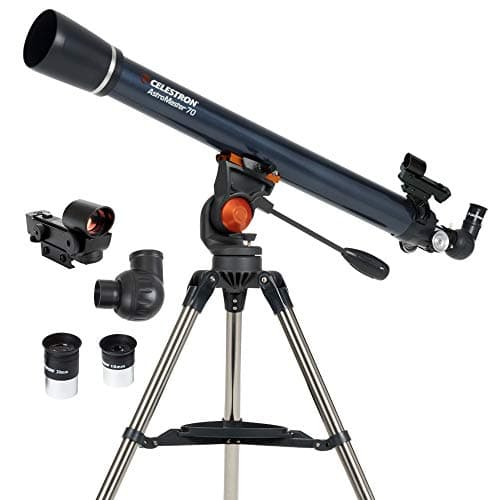
Celestron AstroMaster 70AZ
Lunar and planetary viewing where color purity matters more than light
The arithmetic
The number that separates this from every other 70mm on the site is the focal length: 900mm, where the AstroMaster LT 70AZ is 700mm and the Travel Scope 70 is 400mm. That makes it f/13 — the slowest, most color-corrected refractor we list. The supplied 20mm and 10mm give 45x and 90x, both inside Celestron's published 165x ceiling, so the box reaches about 55 percent of the telescope with no Barlow needed. The cost is carried in pounds: 10.8 lbs for 70mm of aperture works out to roughly 6.5mm per pound, the lowest ratio on this site.
The specification that defines this telescope is its focal length. 900mm on a 70mm lens is f/13, where the AstroMaster LT 70AZ is 700mm at f/10 and the Travel Scope 70 is 400mm at f/5.7.
That slowness is the whole point. A two-element achromat cannot bring every wavelength to one focus, and the residual color error shrinks as the lens gets slower — the conventional guideline being roughly f/3 per inch of aperture before it stops mattering. For a 2.76-inch lens that points at about f/8, and this telescope is f/13. By design, it should show essentially no false color on the Moon, where our f/6.5 DX 102AZ shows a violet edge.
The supplied eyepieces are sensibly matched for once: 45x and 90x, both inside the published 165x ceiling, so the box reaches about 55 percent of the telescope without needing a Barlow on day one.
An erect-image diagonal comes in the box, which most astronomy telescopes omit. The view is right way up and correct left to right, so it works on a distant treeline in daylight — genuinely useful for a child who unwraps it in the afternoon.
The honest costs: 10.8 lbs, a long tube that a breeze will find, and optics Celestron describes as *fully coated* rather than fully multi-coated — a single-layer coating that passes a little less light than its dearer models.
Skip it if
Anyone has to carry it far, or a child sets it up alone. At 10.8 lbs for 70mm of aperture this has the lowest aperture-per-pound ratio on the site, and the 685mm tube is awkward in small hands.
| Item number | 21061 |
|---|---|
| Optical design | Refractor |
| Aperture | 70mm (2.76") |
| Focal length | 900mm (35") |
| Focal ratio | f/13 |
| Optical tube length | 685mm (27") |
| Optical coatings | Fully coated |
| Eyepieces supplied | 20mm (45x) and 10mm (90x) |
| Barlow | Not included |
| Diagonal | Erect image 90 degree, 1.25" |
| Finderscope | StarPointer red dot |
| Mount | Manual alt-azimuth, panning handle with clutch |
| Tripod | 812.8mm-1295.4mm (32"-51") height range, 1.25" steel legs |
| Highest useful magnification | 165x |
| Lowest useful magnification | 10x |
| Limiting stellar magnitude | 11.7 |
| Light gathering power | 100x the human eye |
| Total kit weight | 10.8 lbs (4.9 kg) |
| What the box does not do | No Barlow, and the optics are "fully coated" rather than fully multi-coated — a single-layer coating that passes slightly less light than the multi-coated glass on Celestron's dearer models. The long 685mm tube catches wind and swings the eyepiece through a wide range of heights as it tilts, which a short child will feel. Being a refractor there is nothing to collimate, ever. |
Specifications from Celestron — AstroMaster 70AZ specifications. We have not handled this one — everything above is the published spec sheet plus our own arithmetic on it.
Pick 2
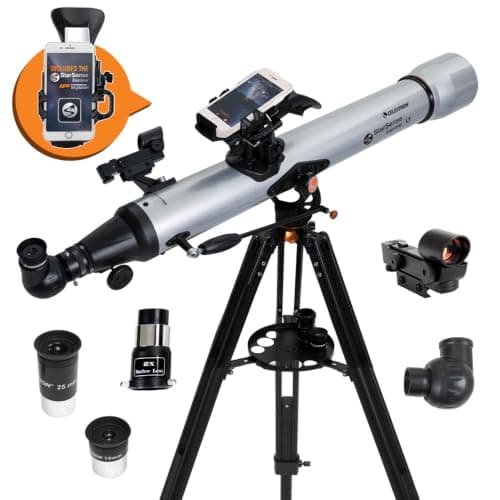
Celestron StarSense Explorer LT 80AZ
The same 900mm tube with more aperture, a Barlow and phone guidance
The arithmetic
900mm over the supplied 25mm and 10mm gives 36x and 90x, and the included 2x Barlow doubles those to 72x and 180x against a published 189x ceiling. That is about 95 percent of the telescope in the box — the highest share of any StarSense on this site, and unusual at any price. At f/11 this is among the slowest, most color-corrected refractors we list (only the f/13 AstroMaster 70AZ is slower): false color on a bright Moon is minimal and focus is forgiving. 80mm collects about 1.3 times the light of a 70mm. The cost is length and weight — 9.2 lbs and a long tube that a breeze will find.
This is the upgrade most 70AZ shoppers should look at, because it answers the same brief with more of everything that matters.
It shares the 900mm focal length, so it keeps most of the color correction (f/11 against f/13), and adds 80mm of aperture — about 1.3 times the light. It is also the most complete box on the site: 36x and 90x from the eyepieces, doubled to 72x and 180x by the included 2x Barlow, against a published 189x ceiling.
Then there is the app, which removes the single biggest cause of an abandoned first night: not being able to find anything.
It is 9.2 lbs — lighter than the 70AZ despite the larger lens — and costs meaningfully more. Full review.
Skip it if
There is no compatible phone — Android 12 or later, or iOS 18 on an iPhone XR or newer. Without one the dock is dead weight and you are paying a guided price for an unguided telescope.
| Optical design | Refractor |
|---|---|
| Aperture | 80mm (3.1") |
| Focal length | 900mm (35.43") |
| Focal ratio | f/11 |
| Eyepieces supplied | 25mm (36x) and 10mm (90x) |
| Barlow | 2x (1.25") |
| Finderscope | StarPointer red dot |
| Mount | Manual alt-azimuth with altitude slow-motion adjustment |
| Tripod | 1320.8mm (52") max height |
| Highest useful magnification | 189x |
| Limiting stellar magnitude | 12 |
| Total kit weight | 9.2 lbs (4.17 kg) |
| Phone requirement | Android 12 and later; iOS 18 and newer, iPhone XR and newer |
| What the box does not do | No case, and the tube's length makes it awkward for a small child to carry assembled. The phone requirement is a hard gate: Android 12+ or iOS 18+ on an iPhone XR or newer, and without the app this is an ordinary 80mm refractor bought at a guided price. |
Specifications from Celestron — StarSense Explorer LT 80AZ specifications. We have not handled this one — everything above is the published spec sheet plus our own arithmetic on it.
Pick 3
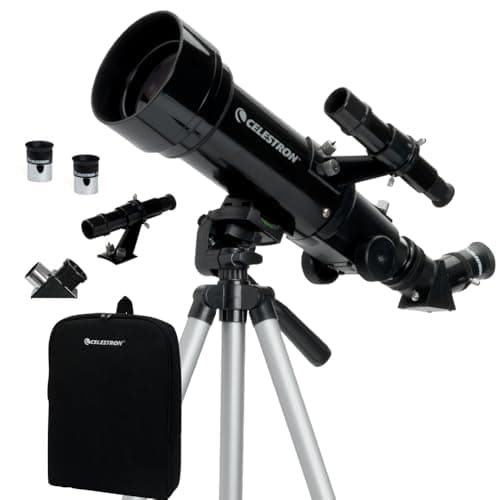
Celestron Travel Scope 70
The same aperture at a third of the weight
The arithmetic
400mm focal length over the two supplied eyepieces gives 20x and 40x. Celestron's published ceiling for a 70mm objective is 168x, so both eyepieces are comfortably inside it — the box is not overselling. The 3.3 lb total is the number that matters for a gift: a child can carry the whole kit themselves, which is most of why it gets used more than once.
The opposite answer to the same aperture question: instead of a long slow tube on a heavy tripod, a short fast one you can carry anywhere.
400mm against 900mm means the same 20mm eyepiece gives 20x here and 45x on the 70AZ. That makes the Travel Scope the better instrument for sweeping star fields and the weaker one for the Moon and planets.
At f/5.7 it gives up the color correction that is the 70AZ's main argument, and it will show more violet fringing on a bright limb.
What it wins on is the thing that decides whether a telescope gets used: 3.3 lbs including the tripod, in a bag. Full review.
Skip it if
You want magnification out of the box or a steady platform. Its short tube gives wide, low-power views, and the lightweight tripod is the weak point of the package.
| Optical design | Refractor |
|---|---|
| Aperture | 70mm (2.8") |
| Focal length | 400mm (15.74") |
| Focal ratio | f/5.7 |
| Eyepieces supplied | 20mm (20x) and 10mm (40x) |
| Finderscope | 5x24 |
| Diagonal | 45 degree erect image, 1.25" |
| Mount | Manual alt-azimuth on aluminum tripod |
| Highest useful magnification | 168x |
| Limiting stellar magnitude | 11.7 |
| Total kit weight | 3.3 lbs (1.5 kg), tripod 1.8 lbs (0.81 kg) |
| Included | Custom backpack, Starry Night Basic software, SkyPortal app access |
| What the box does not do | The tripod is the weak part. At 1.8 lbs it is light enough to carry and light enough to wobble, and a child nudging the eyepiece will lose the target. The 45 degree erect-image diagonal is built for daytime use and costs you a little light at night. |
Specifications from Celestron — Travel Scope 70 specifications. We have not handled this one — everything above is the published spec sheet plus our own arithmetic on it.
Questions people actually ask
- Is the Celestron AstroMaster 70AZ a good telescope?
- For the Moon and planets, yes. At f/13 it is the slowest and most color-corrected refractor on this site, and its supplied 45x and 90x both sit inside Celestron's published 165x ceiling. Its weakness is weight: 10.8 lbs for 70mm of aperture.
- What is the difference between the AstroMaster 70AZ and the AstroMaster LT 70AZ?
- Focal length. The 70AZ is 900mm at f/13 and gives 45x and 90x with its supplied eyepieces; the LT 70AZ is 700mm at f/10 and gives 35x and 70x. Same 70mm lens, same published 165x ceiling and 11.7 limiting magnitude, but the 70AZ is longer, slower and 3.6 lbs heavier.
- What magnification does the AstroMaster 70AZ give?
- 45x with the supplied 20mm eyepiece and 90x with the 10mm, from its 900mm focal length. Celestron publishes 165x as the highest useful magnification, so the box reaches about 55 percent of the telescope's stated limit with no Barlow required.
- Can you see Saturn's rings with a 70mm telescope?
- Yes, as a distinct oval rather than a detailed ring system — the rings separate from the disc at around 50x, and this telescope supplies 45x and 90x. Jupiter shows belts and up to four moons. Galaxies are beyond 70mm from most back gardens.
- Does the AstroMaster 70AZ show false color?
- Very little, by design. An achromatic lens needs roughly f/3 per inch of aperture before color error becomes negligible, which for a 2.76-inch lens is about f/8. This telescope is f/13, well past that point.
- Is the AstroMaster 70AZ good for a child?
- As a shared telescope with an adult doing the carrying, yes — and the erect-image diagonal makes it usable in daylight too. As a child's own telescope, no: 10.8 lbs and a 27-inch tube are more than most under-twelves will manage alone.
Sources
Read next
Where to go from here
- Celestron AstroMaster LT 70AZ review
Optically the same telescope as our phone-guided pick, without the app and on steel legs. When that is the smarter buy, and when it is not.
- Celestron StarSense Explorer LT 80AZ review
80mm of slow, color-corrected glass with phone-guided finding — and the supplied eyepieces reach 95 percent of its published ceiling, which nothing else here does.
- Is the Celestron Travel Scope 70 any good?
The most portable telescope we recommend, and the tripod that is the direct price of that portability. What it shows and who it suits.
- The best kids' telescope to see planets
Planets are the one thing every child asks about. Which telescopes show them properly, and what Jupiter and Saturn genuinely look like at this aperture.
- Refractor or reflector for a child?
Mirrors are cheaper per millimeter of aperture; lenses never need aligning. Which trade suits which child, with the arithmetic on both.
- The best beginner telescopes under $200
Between $100 and $200 you can buy a steady mount, real aperture, or phone-guided finding. What each of those is worth, with the arithmetic.
- Celestron Inspire 100AZ review
100mm at 660mm f/6.5 with an integrated phone adapter, an erect image diagonal and a red flashlight in the box. The same optics as the DX 102AZ without the guidance app — and 1.8 lbs lighter.