Telescopes
Is the Celestron Travel Scope 70 any good?
3.3 pounds, a backpack, and one specification that is a real compromise.
By Scooter M. · published September 1, 2026
I'm not an astronomer and I don't have a lab. I'm someone who's genuinely into this — I read the manuals, compile the published specs, and do the arithmetic the box doesn't do for you. No lab coat. How we pick.
How this is funded. Lens & Lightyear earns a commission when you buy through a link on this page, at no extra cost to you. It does not change which products we pick or what we say about them — every card below carries a real reason to skip it. Prices are pulled live and were last verified October 18, 2026. Full disclosure.
The short answer
Yes, with one honest caveat. The optics are sound and the specs are not oversold. The 1.8 lb tripod is the direct price of the portability that makes this telescope worth buying, and it does wobble. If the telescope never leaves your garden, buy something heavier instead.
The published specification
| Specification | Published figure | What it means in practice |
|---|---|---|
| Aperture | 70mm | Enough for lunar detail, Jupiter's moons and Saturn's rings. |
| Focal length | 400mm | Short, so the supplied eyepieces give low, wide, easy-to-aim views. |
| Focal ratio | f/5.7 | Fairly fast. Bright and wide, slightly less forgiving on focus than f/10. |
| Eyepieces | 20mm (20x) and 10mm (40x) | Both inside the ceiling. The 20mm is what gets used. |
| Highest useful magnification | 168x | The honest limit. The box does not claim past it. |
| Limiting stellar magnitude | 11.7 | Not a practical constraint for a beginner. |
| Finderscope | 5x24 | Adequate, and it must be aligned in daylight before first use. |
| Diagonal | 45 degree erect image, 1.25" | Daytime-friendly. Standard barrel size, so eyepieces upgrade freely. |
| Total kit weight | 3.3 lbs (tripod 1.8 lbs) | The reason to buy it, and the reason it wobbles. |
| Included | Backpack, Starry Night software, SkyPortal app | The backpack is a genuine part of the value. |
All figures are Celestron's published specification. The third column is our reading of them.
The arithmetic
400mm divided by the 20mm eyepiece gives 20x. Divided by the 10mm it gives 40x. Celestron's published ceiling for this 70mm aperture is 168x, and the aperture rule of thumb — 70 times two — puts the practical limit near 140x. Both supplied eyepieces are far below either number, which means this telescope has plenty of headroom and no marketing inflation.
Add a 6mm eyepiece and you get 67x. Add a 2x Barlow to the supplied 10mm and you get 80x. Either would be a sensible first upgrade if the child wants more on planets, and both stay inside the honest limit.
Quick picks
The Travel Scope 70 and its alternatives
| # | Product | Best for | Price |
|---|---|---|---|
| 1 | 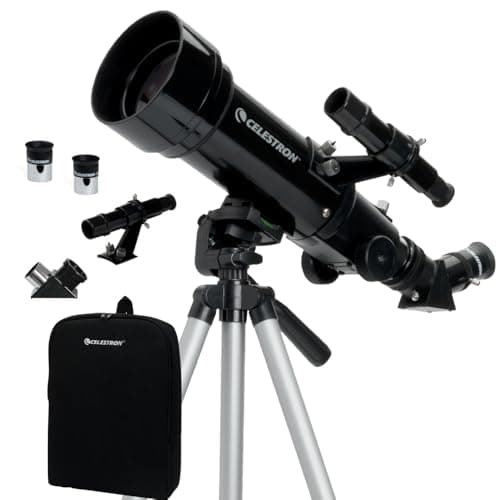 Celestron Travel Scope 70 3.3 lbs for the entire kit including tripod, in a backpack they can wear. | A telescope a child can carry themselves | |
| 2 | No image Celestron StarSense Explorer LT 70AZ 70mm f/10 with a 52 inch tripod and phone-guided targeting. | The same aperture, much steadier, and it finds things | |
| 3 | 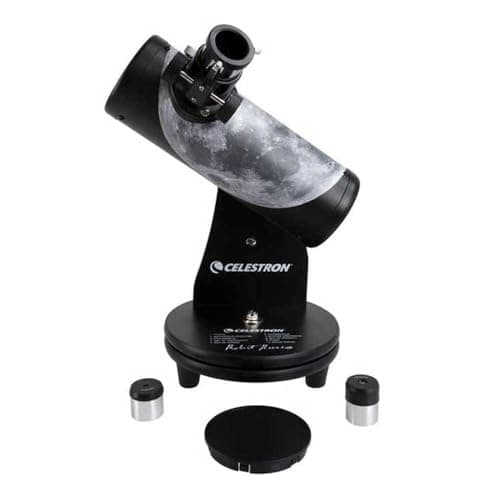 Celestron FirstScope 76mm Tabletop 76mm rather than 70mm, no assembly at all, and no tripod to wobble. | More aperture for less, if you have a table |
Rows link to the full write-up further down this page. Prices come from the live price layer only; where there is no live figure the button reads “Check price” rather than showing a number we remembered.
About that tripod
We are going to be specific rather than diplomatic, because this is the thing people are actually asking when they search whether this telescope is good.
The tripod weighs 1.8 lbs. It is short — designed to sit on a table or the ground rather than stand at adult eye height — and it is aluminum. When you touch the focuser, the image moves, and it takes a second or two to settle. On a windy night it never fully settles.
That is not a defect. It is arithmetic: you cannot have a 3.3 lb kit and a rigid mount, and Celestron chose portability, which is the whole point of the product. But it means the telescope is more frustrating in use than a heavier one, and a child will feel that.
Align the finder before the first night
The 5x24 finderscope arrives misaligned. Every finderscope on every telescope does — they get knocked in shipping and they are shipped unaligned anyway. This is the single most common reason a new telescope appears not to work.
The fix takes ten minutes, in daylight, on a distant fixed object like a chimney or a pylon. Point the main telescope at it using the lowest-power eyepiece, then adjust the finder's screws until the same object sits on the crosshairs. Our setup checklist walks through it step by step, and it is worth doing before the box is even wrapped.
What it will actually show
At 20x: the whole Moon with craters and dark plains clearly visible, big open clusters like the Pleiades filling the field, and enough sky in view that finding things is genuinely easy.
At 40x: individual lunar craters and mountain shadows, Jupiter as a small disc with up to four moons beside it, Saturn's rings visible as a distinct oval, and the Orion Nebula as a gray patch with the Trapezium stars in it.
In daylight, thanks to the erect-image diagonal: birds, distant hills, ships, aircraft. That dual use is a real part of the value for a child, and it is why this telescope gets picked up on ordinary afternoons.
The picks in full
Pick 1
Celestron Travel Scope 70
A telescope a child can carry themselves
The arithmetic
400mm focal length over the two supplied eyepieces gives 20x and 40x. Celestron's published ceiling for a 70mm objective is 168x, so both eyepieces are comfortably inside it — the box is not overselling. The 3.3 lb total is the number that matters for a gift: a child can carry the whole kit themselves, which is most of why it gets used more than once.
The specification that defines this telescope is not optical. It is 3.3 lbs for the optical tube, mount and tripod together, packed into a supplied backpack.
That matters more than it sounds for a child. A telescope they can pick up, carry to the end of the garden and set up alone gets used casually — on a school night, for fifteen minutes, because they felt like it. That is how a first telescope succeeds.
Optically it is a 70mm f/5.7 refractor at 400mm focal length. The 20mm eyepiece gives 20x and the 10mm gives 40x, both well inside Celestron's published 168x ceiling. Limiting stellar magnitude is 11.7.
The 45 degree erect-image diagonal is a daytime feature: it makes the view right-way-up and right-way-round, so this genuinely works on birds, hills and ships. That costs a little light at night, and it is a reasonable trade for a child who will use it in daylight more often than after dark.
Skip it if
It is going to live in one garden and never move. Portability is the entire premium here. If the telescope stays put, the same money buys a steadier mount or more aperture, and the light tripod becomes a pure downside.
| Optical design | Refractor |
|---|---|
| Aperture | 70mm (2.8") |
| Focal length | 400mm (15.74") |
| Focal ratio | f/5.7 |
| Eyepieces supplied | 20mm (20x) and 10mm (40x) |
| Finderscope | 5x24 |
| Diagonal | 45 degree erect image, 1.25" |
| Mount | Manual alt-azimuth on aluminum tripod |
| Highest useful magnification | 168x |
| Limiting stellar magnitude | 11.7 |
| Total kit weight | 3.3 lbs (1.5 kg), tripod 1.8 lbs (0.81 kg) |
| Included | Custom backpack, Starry Night Basic software, SkyPortal app access |
| What the box does not do | The tripod is the weak part. At 1.8 lbs it is light enough to carry and light enough to wobble, and a child nudging the eyepiece will lose the target. The 45 degree erect-image diagonal is built for daytime use and costs you a little light at night. |
Specifications from Celestron — Travel Scope 70 specifications. We have not handled this one — everything above is the published spec sheet plus our own arithmetic on it.
Pick 2
Celestron StarSense Explorer LT 70AZ
The same aperture, much steadier, and it finds things
The arithmetic
700mm over 25mm and 10mm gives 28x and 70x; the 2x Barlow doubles those to 56x and 140x. Celestron's published ceiling is 165x, so even the Barlowed 10mm stays legal — a rare box where every supplied combination is inside the optics' honest limit. At f/10 the images are contrasty and easy to focus, which is exactly what an inexperienced pair of hands needs.
If portability is not actually a requirement, this is the better telescope by a clear margin.
Same 70mm aperture but at f/10 rather than f/5.7, which gives higher contrast and more forgiving focus. The 25mm and 10mm eyepieces give 28x and 70x, and the supplied 2x Barlow takes those to 56x and 140x — against a published 165x ceiling, so all four are legitimate.
The tripod is a full 52 inch aluminum unit rather than a 1.8 lb tabletop-height one, which removes most of the wobble that is the Travel Scope's real weakness.
And it finds things for you. For a household where nobody knows the sky, that is worth more than any optical difference on this page.
Skip it if
You need to carry it. At 7.4 lbs this is more than twice the Travel Scope's weight, and it does not pack into a backpack. The phone requirement is also real: Android 12+ or iOS 18 on an iPhone XR or newer.
| Optical design | Refractor |
|---|---|
| Aperture | 70mm (2.76") |
| Focal length | 700mm (27.56") |
| Focal ratio | f/10 |
| Eyepieces supplied | 25mm (28x) and 10mm (70x) |
| Barlow | 2x (1.25") |
| Finderscope | StarPointer red dot |
| Mount | Manual alt-azimuth |
| Tripod | Aluminum, 1320.8mm (52") max height |
| Highest useful magnification | 165x |
| Limiting stellar magnitude | 11.7 |
| Total kit weight | 7.4 lbs (3.35 kg) |
| Phone requirement | Android 12 and later; iOS 18 and newer, iPhone XR and newer |
| What the box does not do | The phone requirement is a real constraint, not fine print: Android 12+ or iOS 18+ on an iPhone XR or newer. An older hand-me-down phone will not run it, and without the app this is an ordinary 70mm refractor at the price of a guided one. |
Specifications from Celestron — StarSense Explorer LT 70AZ specifications. We have not handled this one — everything above is the published spec sheet plus our own arithmetic on it.
Pick 3
Celestron FirstScope 76mm Tabletop
More aperture for less, if you have a table
The arithmetic
The 20mm eyepiece gives 300 / 20 = 15x, and the 4mm gives 300 / 4 = 75x. Celestron's own published ceiling is 180x, so the 4mm sits well inside what the optics support — unusual honesty at this price. There is no tripod: it needs a table, a wall, a car roof or a stack of books at roughly chest height for the child using it.
The other direction from the Travel Scope: give up the tripod entirely and put the money into aperture.
76mm against 70mm is about 15 percent more light. The 20mm eyepiece gives 15x — wider and easier to aim than the Travel Scope's 20x — and the 4mm gives 75x, against a published 180x ceiling.
Nothing to assemble, nothing to align, no finderscope to knock out of true. It is the lowest-friction telescope we recommend.
The trade is absolute: it needs a solid outdoor surface at chest height. If you have one, this is the better buy at the price. If you do not, it is not a telescope at all.
Skip it if
You have nowhere to stand it. A tabletop telescope with no solid surface is unusable, and that is a harder problem to solve than a slightly wobbly tripod.
| Optical design | Newtonian reflector, spherical primary mirror |
|---|---|
| Aperture | 76mm (2.99") |
| Focal length | 300mm (12") |
| Focal ratio | f/3.95 |
| Eyepieces supplied | 20mm (15x) and 4mm (75x) |
| Highest useful magnification | 180x |
| Lowest useful magnification | 11x |
| Limiting stellar magnitude | 11.9 |
| Light gathering vs the eye | 118x |
| Mount | Dobsonian-style tabletop base |
| What the box does not do | No tripod, no finderscope, and no way to track an object as the sky moves — you nudge the tube by hand. The 4mm eyepiece is usable but tight; most children get on better with the 20mm all evening. |
Specifications from Celestron — FirstScope specifications. We have not handled this one — everything above is the published spec sheet plus our own arithmetic on it.
Questions people actually ask
- Is the Celestron Travel Scope 70 good?
- Yes for portability — 3.3 lbs for the whole kit, with honest 70mm optics and no oversold magnification. The light tripod is the trade-off and it does wobble, so if the telescope will never move, buy something heavier.
- What can I see with a Celestron Travel Scope 70?
- Lunar craters and mountain shadows, Jupiter as a disc with up to four moons, Saturn's rings as a distinct oval, bright star clusters, and the Orion Nebula as a gray patch. In daylight it also works on birds and landscapes.
- What magnification is the Travel Scope 70?
- 20x with the supplied 20mm eyepiece and 40x with the 10mm, from a 400mm focal length. Celestron publishes a highest useful magnification of 168x, so there is a lot of headroom for a shorter eyepiece later.
- How do you set up the Celestron Travel Scope 70?
- Assemble it indoors in daylight, then align the 5x24 finderscope on a distant fixed object before dark. That alignment step is the one most people skip and the one that causes most first-night failures — see our setup checklist.
- How do you focus the Travel Scope 70?
- Fit the 20mm eyepiece, point at a bright distant object, and turn the focus knob slowly through the sharp point and back. If nothing comes into focus at all, check that the diagonal is fitted and the lens cap is off — both are common.
Sources
Read next
Where to go from here
- The best telescope for a 7 or 8 year old
Seven and eight is where independence starts. The picks here are chosen on carry weight and how easy it is to find something, not on aperture.
- The best kids' telescopes under $100
The sub-$100 shelf is where the 525x claims live. What that money genuinely buys, and the one telescope here we tell you not to buy.
- Is the Celestron FirstScope any good?
The most-bought first telescope in the category. What its published specs actually mean, and the one household constraint that decides whether it works.
- The telescope setup checklist
The indoor, daylight pre-flight that removes the common first-night failures before anyone goes outside.
- Your first night with a telescope
Do these eight things in this order and night one works. Most first nights fail on sequence, not on equipment.
- Why can't I see anything through my telescope?
The ranked causes of a telescope that shows nothing, most common first, each with a fix you can do tonight without tools.
- Celestron AstroMaster 70AZ review
70mm at 900mm focal length — f/13, the slowest refractor on this site, with 45x and 90x in the box against a 165x ceiling. Excellent on the Moon, heavy for what it gathers.