Telescopes
Barlow lens for a telescope: the arithmetic before the purchase
The cheapest way to double your eyepieces, and the fastest way to magnify a blur.

By Scooter M. · published September 21, 2026
I'm not an astronomer and I don't have a lab. I'm someone who's genuinely into this — I read the manuals, compile the published specs, and do the arithmetic the box doesn't do for you. No lab coat. How we pick.
How this is funded. Lens & Lightyear earns a commission when you buy through a link on this page, at no extra cost to you. It does not change which products we pick or what we say about them — every card below carries a real reason to skip it. Prices are pulled live and were last verified October 18, 2026. Full disclosure.
The short answer
Multiply your telescope's focal length divided by your shortest eyepiece by two. If the result is comfortably under the manufacturer's published highest useful magnification, a Barlow is the cheapest upgrade you can buy. If it lands past that number, buy a mid-range eyepiece instead.
A Barlow lens sits between the eyepiece and the telescope and multiplies the magnification of whatever you put in it. That is genuinely useful, and it is also how most beginner telescope boxes end up advertising magnifications their optics cannot deliver — which is why this page is arithmetic first and shopping second.
The one calculation that decides it
Three numbers, all published. Telescope focal length, eyepiece focal length, and the manufacturer's own highest useful magnification.
- Divide the telescope's focal length by your shortest eyepiece. A 650mm telescope with a 10mm eyepiece gives 65x.
- Multiply by the Barlow factor. 65x becomes 130x with a 2x.
- Compare against the published ceiling. Celestron publishes 307x for its 130mm models, so 130x is comfortably inside it — buy the Barlow.
- Sanity-check with the metric rule of thumb: about 2x the aperture in millimeters. For 130mm that is 260x, which is the number we would actually trust on a good night.
| Telescope | Shortest supplied eyepiece | With a 2x Barlow | Published ceiling | Verdict |
|---|---|---|---|---|
| StarSense DX 130AZ (650mm) | 10mm = 65x | 130x | 307x | Buy it — the box ships at 21% of the ceiling |
| StarSense DX 102AZ (660mm) | 10mm = 66x | 132x | 240x | Buy it — same gap, no Barlow included |
| AstroMaster 130EQ (650mm) | 10mm = 65x | 130x | 307x | Buy it |
| StarSense LT 114AZ (1000mm) | 10mm = 100x | 200x | 269x | Already included in the box |
| PowerSeeker 127EQ (1000mm) | 4mm = 250x | 750x | 300x | No — 250% of the maker's own limit |
Our arithmetic on each manufacturer's published focal length, supplied eyepieces and highest useful magnification. The last row is the pattern this site exists to name.
Quick picks
The two Barlows worth owning, and when neither is
| # | Product | Best for | Price |
|---|---|---|---|
| 1 | 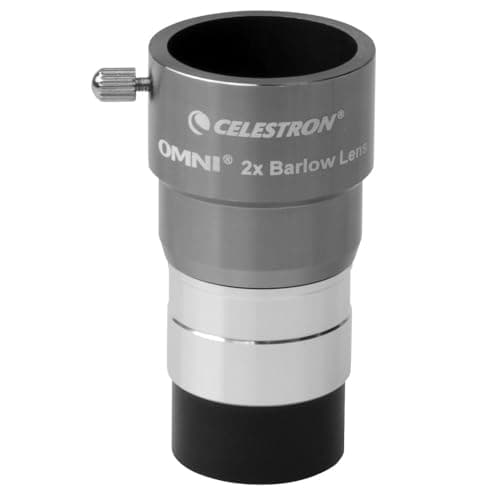 Celestron Omni 2x Barlow Lens Two fully multi-coated elements in a 1.25" barrel, at the price of a cheap eyepiece. | Most beginner telescopes, most of the time | $41.95 on Amazon #ad How we’re funded · price as of October 18, 2026 |
| 2 | 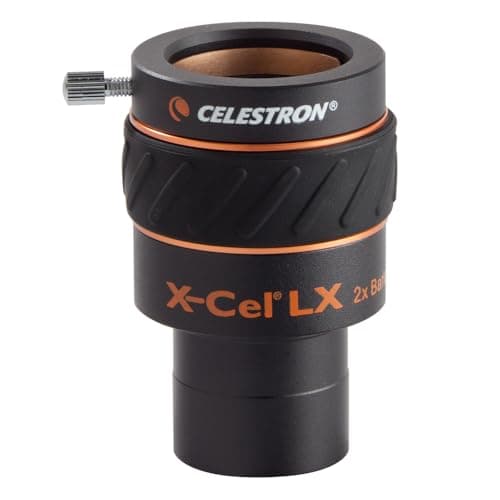 Celestron X-Cel LX 2x Barlow Lens Three apochromatic elements and a brass compression ring instead of a bare thumbscrew. | A telescope good enough to show the difference |
Rows link to the full write-up further down this page. Prices come from the live price layer only; where there is no live figure the button reads “Check price” rather than showing a number we remembered.
Barlow or a second eyepiece?
The fair comparison, because a Barlow is not always the right answer.
| A 2x Barlow | One mid-range eyepiece | |
|---|---|---|
| What you get | Doubles every eyepiece you own | One new magnification |
| Cost | About the price of a cheap eyepiece | More, for a good one |
| Optical purity | Adds elements to the light path | Fewer surfaces, slightly cleaner |
| Eye relief | Preserved — Celestron's stated benefit | Depends on the eyepiece design |
| Risk of overshooting the ceiling | Higher — it multiplies your shortest eyepiece too | Lower — you choose the exact number |
Both are legitimate. The Barlow wins on value when your box has two widely spaced eyepieces; the eyepiece wins when you already know the one magnification you keep wanting.
What a Barlow will not do
- It will not raise the telescope's ceiling. The limit is set by the aperture, not by what you screw into the focuser.
- It will not brighten anything. Doubling magnification spreads the same light over four times the area, which is why faint objects look worse, not better, through one.
- It will not fix a shaky mount. Every wobble is doubled along with the image. On a light tripod this is the first thing you notice.
- It will not help on deep-sky objects. Galaxies and nebulae want your longest eyepiece, not your shortest.
Which telescopes on this site already include one
Worth checking before you spend: the Celestron LT models all ship with a 2x Barlow already, and the DX models do not. That pattern is backwards from the price list and it is one of the odder facts in the range.
- Included: LT 70AZ, LT 80AZ, LT 114AZ.
- Not included: DX 102AZ, DX 130AZ, AstroMaster 130EQ, StarSense 114mm tabletop Dob.
- Included, and the reason we warn about it: PowerSeeker 127EQ — a 3x, which with the supplied 4mm eyepiece reaches 750x against a published 300x.
What we did and did not do
We have not tested these Barlows. Their specifications were read from Celestron's published pages, linked below and checked on the date at the top of this page, and every magnification figure here is arithmetic on published focal lengths, shown so you can repeat it with a calculator.
No price appears in this prose. Live figures come only from our price feed with the date they were checked. Our full method is on the methodology page.
The picks in full
Pick 1
Celestron Omni 2x Barlow Lens
Most beginner telescopes, most of the time
The arithmetic
A Barlow doubles the magnification of every eyepiece you own, which is why it is the cheapest way to fill the gap in a two-eyepiece box — a 25mm and a 10mm become 25, 12.5, 10 and 5mm equivalents. The arithmetic that matters is the one that stops you: multiply your shortest eyepiece by the Barlow and check the result against the telescope's published highest useful magnification. If it lands past that number, the combination is decoration.
This is the one to buy if the answer to the arithmetic is yes. Two elements, fully multi-coated, blackened lens edges, filter threads, 2.11 oz.
On a telescope supplied with 25mm and 10mm eyepieces, adding a 2x gives you the equivalent of 25, 12.5, 10 and 5mm — four magnifications from two eyepieces, which is exactly the gap most beginner boxes leave.
Honest downside: every Barlow adds air-glass surfaces to the light path, so a good eyepiece of the resulting focal length will always be a little cleaner. It is also possible on short focusers to run out of focus travel with a Barlow fitted.
Skip it if
Your shortest eyepiece already reaches the telescope's published ceiling — doubling it then buys nothing but a dimmer, softer image. Check the arithmetic below before ordering.
| Item number | 93326 |
|---|---|
| Barrel size | 31.75mm (1.25") |
| Magnification factor | 2x |
| Elements | 2 |
| Coatings | Fully multi-coated, blackened lens edges |
| Filter threads | Yes, 1.25" |
| Weight | 2.11 oz (60 g) |
| Dimensions | 74 x 39.5 x 39.5mm (2.91" x 1.55" x 1.55") |
| Warranty | 2 year |
| What the box does not do | It adds two air-glass surfaces to the light path, so it is never quite as clean as a good eyepiece of the same resulting focal length. It cannot rescue a telescope that is already at its ceiling, and on a short focuser it can push the eyepiece too far out to reach focus. |
Specifications from Celestron — Omni 2x Barlow Lens 1.25 inch. We have not handled this one — everything above is the published spec sheet plus our own arithmetic on it.
#ad How we’re funded · price as of October 18, 2026
Pick 2
Celestron X-Cel LX 2x Barlow Lens
A telescope good enough to show the difference
The arithmetic
Three elements against the Omni's two, and a brass compression ring instead of a thumbscrew pressing directly on the eyepiece barrel. Celestron's own claim for the design is images virtually free of false color; the compression ring is the part you will appreciate every night, because it grips without scarring the eyepiece.
The upgrade is real but narrow: three elements in two groups, which Celestron describes as producing images virtually free of false color, against the Omni's two.
The part you notice every session is mechanical rather than optical. A brass compression ring grips the eyepiece barrel evenly instead of a thumbscrew digging into it, so eyepieces come out unscarred and stay centered.
At 5.3 oz it is two and a half times the Omni's weight — worth knowing on a light focuser — and it costs several times as much, which is the whole reason the cheaper one leads this page.
Skip it if
The telescope cost less than the Barlow. On a 70mm beginner refractor this is money that buys more viewing as a better eyepiece or a darker sky.
| Item number | 93529 |
|---|---|
| Barrel size | 31.75mm (1.25") |
| Magnification factor | 2x |
| Elements | 3 elements in 2 groups, apochromatic |
| Coatings | Fully multi-coated |
| Retention | Brass compression ring with thumbscrew |
| Filter threads | Yes, 1.25" |
| Weight | 5.3 oz (150 g) |
| Dimensions | 76 x 56 x 56mm (2.99" x 2.20" x 2.20") |
| Warranty | 2 year |
| What the box does not do | It costs several times what the Omni does, which on a beginner telescope is money that usually buys more viewing as a better eyepiece instead. At 5.3 oz it is two and a half times the Omni's weight, and no Barlow at any price raises a telescope's published magnification ceiling. |
Specifications from Celestron — X-Cel LX 2x Barlow Lens 1.25 inch. We have not handled this one — everything above is the published spec sheet plus our own arithmetic on it.
Questions people actually ask
- Is a Barlow lens worth it?
- Usually yes, if the arithmetic works. Divide your telescope's focal length by your shortest eyepiece and double it; if the result is comfortably inside the manufacturer's published highest useful magnification, a Barlow doubles the usefulness of every eyepiece you own for the price of a cheap one.
- What does a 2x Barlow lens actually do?
- It doubles the magnification of whatever eyepiece you put in it, so a 25mm and a 10mm behave like 25, 12.5, 10 and 5mm. Celestron notes it does this while preserving the eye relief of your existing eyepieces.
- Can a Barlow lens make images worse?
- Yes, in three ways: it adds glass surfaces to the light path, it doubles every mount wobble along with the image, and if it pushes you past the telescope's useful magnification you get a dimmer, softer view of the same detail.
- Should I buy a Barlow or another eyepiece?
- A Barlow if your box has two widely spaced eyepieces and you want more options cheaply. A single mid-range eyepiece if you already know the magnification you keep reaching for, or if your shortest eyepiece is already near the telescope's ceiling.
- Does a Barlow work for galaxies and nebulae?
- Not usefully. Faint extended objects want low magnification and a wide field, because magnifying them spreads the same light over a larger area and dims it. A Barlow is a planetary and lunar accessory.
- Does my telescope already come with a Barlow?
- On this site, the Celestron StarSense Explorer LT models include a 2x. The DX models, the AstroMaster 130EQ and the StarSense 114mm tabletop Dobsonian do not, which is why those pages recommend budgeting for one.
Sources
Read next
Where to go from here
- What to buy a kid who already has a telescope
A telescope's real problems are dark adaptation, steadiness and knowing where to point it. None of them cost much to fix.
- Celestron StarSense Explorer DX 130AZ review
130mm f/5 parabolic optics with phone guidance and dual-axis slow-motion controls, at 18 lbs. The arithmetic on what the box reaches, and the two cheaper routes to the same mirror.
- Celestron PowerSeeker 127EQ review
The most aperture of any tripod telescope on this site, on an equatorial mount that needs balancing and polar alignment, with a Barlow that reaches two and a half times its own ceiling.
- The space gifts not to buy — and what to buy instead
The four ways the kids astronomy aisle disappoints, each with the arithmetic that exposes it and the honest alternative at the same money.
- How much should you spend on a telescope for a child?
Band by band, what the money buys and where it stops helping. The jump from $60 to $150 matters more than the one above it.
- Toy telescopes versus real optics: how to tell in thirty seconds
The arithmetic that exposes a 525x claim on a 70mm box, worked through on a real product using its own manufacturer's published numbers.