Gifts
What to buy a kid who already has a telescope
The cheap things that fix the expensive thing's actual problems.
By Scooter M. · published September 1, 2026
I'm not an astronomer and I don't have a lab. I'm someone who's genuinely into this — I read the manuals, compile the published specs, and do the arithmetic the box doesn't do for you. No lab coat. How we pick.
How this is funded. Lens & Lightyear earns a commission when you buy through a link on this page, at no extra cost to you. It does not change which products we pick or what we say about them — every card below carries a real reason to skip it. Prices are pulled live and were last verified October 18, 2026. Full disclosure.
The short answer
A telescope's real problems are not optical. They are dark adaptation, steadiness, comfort, and knowing where to point it. All four are fixable for a fraction of what the telescope cost, and fixing them improves the experience more than any optical upgrade would.
What actually limits a child's telescope
Ask someone what would improve their telescope and they will say a bigger one. In practice, on an ordinary night in an ordinary garden, these are the things holding it back.
| The limit | What it costs to fix | Why it matters |
|---|---|---|
| Dark adaptation destroyed by white light | A red torch | Eyes need 20-30 minutes to adapt. One phone screen resets it. This is the biggest invisible problem. |
| Not knowing where to point it | Free — a planetarium app | Point the phone at the sky and it labels what is there. Biggest capability jump available. |
| Shaky mount | Nothing — technique | Take your hands off after focusing and wait two seconds. The image settles and the target is still there. |
| Being cold and uncomfortable | A blanket, gloves, a flask | Comfort determines session length more than optics determine what is visible. |
| Only two eyepieces | One good short eyepiece | Most telescopes ship using less than half their magnification range. |
| Light pollution | Free — drive somewhere darker | Half an hour from streetlights transforms what is visible more than any purchase. |
Quick picks
Add-ons worth giving
| # | Product | Best for | Price |
|---|---|---|---|
| 1 | 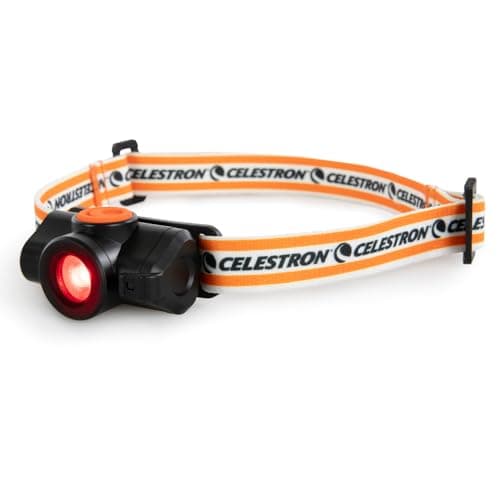 Celestron Night Vision Red Headlamp A 1-lumen red low beam, hands free, with 100 hours of battery life. | The single most useful cheap thing | |
| 2 | 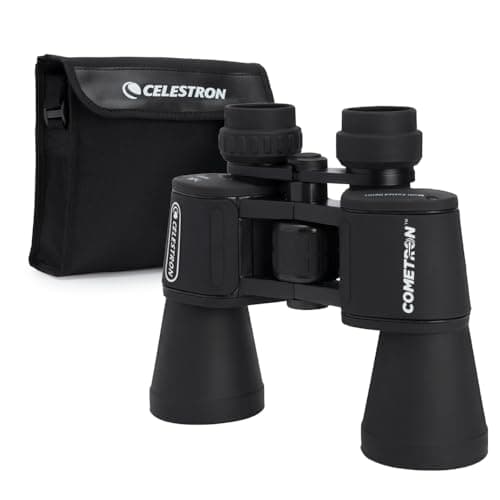 Celestron Cometron 7x50 A 6.6 degree field, for everything a telescope's tiny field cannot fit. | The instrument that gets used more than the telescope | |
| 3 | No image Celestron StarSense Explorer LT 70AZ Phone-guided finding, if the existing telescope has none. | When the problem is that they cannot find anything |
Rows link to the full write-up further down this page. Prices come from the live price layer only; where there is no live figure the button reads “Check price” rather than showing a number we remembered.
The eyepiece upgrade, done properly
This is the one optical purchase genuinely worth making, and it is easy to do badly.
Almost every beginner telescope ships with two eyepieces that use only part of its magnification range. A 114mm reflector with a published 269x ceiling might supply eyepieces reaching 45x. A 102mm refractor with a 240x ceiling might reach 66x. There is a large gap, and planets live in it.
Buy one good short eyepiece, not a set of ten cheap ones. A kit of ten eyepieces at the price of one decent eyepiece contains ten bad eyepieces. Work out the telescope's focal length, divide by the magnification you want, and buy that single eyepiece — or a 2x Barlow, which doubles everything you already own for the same money.
The free upgrades, which are better than most paid ones
- A planetarium app. Free, and it is the difference between wandering and observing. Point the phone at the sky and everything is labeled. Turn the brightness right down and use night mode.
- Letting the telescope cool. Twenty to thirty minutes outside before you start removes the air currents inside a warm tube that smear fine detail. It costs nothing and it visibly improves planetary views.
- Waiting after you touch the focuser. Take your hands off and count to two. The image settles, and the target is still there. Most people conclude their mount is broken because they never do this.
- Observing higher in the sky. Near the horizon you are looking through several times more atmosphere. The same object at 60 degrees elevation is dramatically sharper than at 15.
- Looking for longer. Detail arrives in flashes when the air steadies for a second. Three seconds shows a blob; two minutes shows the belts on Jupiter. This is a learned skill and it is the biggest improvement available at any price.
What we would not buy
- Eyepiece kits. Ten cheap eyepieces are worse than the two good ones already in the box.
- Color planetary filters. They do very little on a small aperture and add a thing to lose in the dark.
- Smartphone camera adapters. Photographing through a beginner telescope is genuinely difficult and produces disappointing results. The interest is real; the equipment to satisfy it honestly is not in this price range.
- A bigger telescope, immediately. If the current one is not being used, a bigger one will not be used either. Fix the reasons first.
The picks in full
Pick 1
Celestron Night Vision Red Headlamp
The single most useful cheap thing
The arithmetic
The cheapest thing on this site and the one that changes the most. Human eyes take 20 to 30 minutes to dark-adapt, and one glance at a white phone screen resets the clock — which is why so many first nights end with a child seeing almost nothing. Red light preserves that adaptation, and the number that matters here is the low setting: **1 lumen**. Most red lights sold for astronomy are far brighter than the job needs, and a red light that is too bright is only a slower way of destroying dark adaptation. The second number is 100 hours on that low beam, which is more clear nights than most families will use in a year.
Of everything on this site, this is the item with the highest ratio of improvement to price.
Human eyes take 20 to 30 minutes in darkness to reach full sensitivity, and one glance at a white phone screen resets that clock for everybody present. That is the most common invisible reason a first night underdelivers — nobody realizes the child is effectively half-blind.
Red light at low intensity preserves dark adaptation. The 1-lumen low beam is the specification worth paying for, because most red lights are far brighter than they need to be and a too-bright red light is barely better than a white one.
Hands free is the detail that becomes very important at 10pm, when a child is holding a chart in one hand and a focuser in the other. Headband included, two year warranty, item 93581 — the two AAA cells are not.
Skip it if
You need the present to feel substantial. It is a headlamp, and a child unwrapping only this will not be thrilled — however much it improves their next clear night.
| Item number | 93581 |
|---|---|
| Light source | Red LED |
| Output | 1 lumen on low, 4 lumens on high |
| Modes | Low beam, high beam, blinking, SOS |
| Battery life | 100 hours on low, 25 hours on high |
| Power | 2 x AAA alkaline or lithium, user supplied |
| Beam angle | 45 degree adjustable tilt |
| Weight | 62 g (2.15 oz) |
| Dimensions | 58 x 35 x 30mm (2.28" x 1.42" x 1.18") |
| Included | Headlamp, elastic headband with adjusting clips, quick setup guide |
| Warranty | 2 year |
| What the box does not do | Batteries. Celestron supplies the headband and the quick setup guide but not the 2 AAA cells, so buy them in the same order. There is no continuous dimmer — brightness is two fixed steps rather than a wheel you can creep down — and the blinking and SOS modes are camping features that do nothing for astronomy. Being head-mounted it also points wherever the wearer looks, which takes a little discipline around other observers. |
Specifications from Celestron — Night Vision Red Headlamp. We have not handled this one — everything above is the published spec sheet plus our own arithmetic on it.
Pick 2
Celestron Cometron 7x50
The instrument that gets used more than the telescope
The arithmetic
Exit pupil is objective divided by magnification: 50 / 7 = 7.1mm, which matches Celestron's published figure. That is the single most useful number here. A fully dark-adapted young pupil opens to around 7mm, so a child uses nearly all of that 7.1mm cone and the view is as bright as the optics can make it. An adult over about forty typically dilates to 5mm or less and simply cannot use the extra — this is one of the rare cases where a child gets more out of the hardware than the grown-up does.
Every experienced amateur astronomer owns binoculars, and they get used more nights than the telescope does. That is worth telling a child, because it is true and it is not what the hobby's marketing suggests.
A telescope at 40x shows about one degree of sky. Binoculars at 7x show 6.6 degrees — thirteen Moon widths. That makes them the right tool for everything a telescope's field cannot contain: the Pleiades, the Hyades, the sweep of the Milky Way, big open clusters, comets.
They are also the finding tool. Sweeping with binoculars to locate something and then swinging the telescope onto it is how experienced observers actually work, and it is a genuinely useful thing for a child to learn.
The 7.1mm exit pupil matches a dark-adapted young eye. 27.3 oz, tripod adaptable, water resistant.
Skip it if
They already have binoculars. In which case a tripod adapter for the pair they own is a better use of the money, and costs a fraction as much.
| Magnification | 7x |
|---|---|
| Objective lens | 50mm (1.97") |
| Prism glass | BK7 porro |
| Lens coatings | Multi-coated |
| Angular field of view | 6.6 degrees |
| Linear field at 1000 yds | 344 ft (105 m) |
| Exit pupil | 7.1mm (.28") |
| Eye relief | 13mm (.51") |
| Close focus | 26.2 ft (8 m) |
| Weight | 27.3 oz (774 g) |
| Tripod adaptable | Yes |
| Environmental | Water resistant |
| What the box does not do | 27.3 oz is heavy for small arms held up at the sky — plan on leaning against a wall or lying on a blanket, or add the tripod adapter. BK7 prisms are the cheaper glass and show slight softening at the edge of the field. Water resistant is not waterproof. |
Specifications from Celestron — Cometron 7x50mm specifications. We have not handled this one — everything above is the published spec sheet plus our own arithmetic on it.
Pick 3
Celestron StarSense Explorer LT 70AZ
When the problem is that they cannot find anything
The arithmetic
700mm over 25mm and 10mm gives 28x and 70x; the 2x Barlow doubles those to 56x and 140x. Celestron's published ceiling is 165x, so even the Barlowed 10mm stays legal — a rare box where every supplied combination is inside the optics' honest limit. At f/10 the images are contrasty and easy to focus, which is exactly what an inexperienced pair of hands needs.
Included with a caveat, because sometimes the honest answer to *what do I buy for a child who has a telescope* is that the telescope itself is the problem.
If they have a small scope with a misaligned finder and no way of locating anything, no accessory fixes that. What fixes it is either an adult who knows the sky, a free planetarium app plus some patience, or a telescope that finds things for you.
This one does: the app photographs the sky, matches the pattern, and guides you to the target with arrows. The optics are a 70mm f/10 refractor with 28x and 70x eyepieces plus a 2x Barlow, all inside a published 165x ceiling.
Check the phone requirement first — Android 12+ or iOS 18 on an iPhone XR or newer. And consider the free options before spending this much.
Skip it if
The existing telescope is perfectly good. This is a whole new telescope, not an accessory, and it is a lot of money to solve a problem that a free planetarium app plus one patient evening also solves.
| Optical design | Refractor |
|---|---|
| Aperture | 70mm (2.76") |
| Focal length | 700mm (27.56") |
| Focal ratio | f/10 |
| Eyepieces supplied | 25mm (28x) and 10mm (70x) |
| Barlow | 2x (1.25") |
| Finderscope | StarPointer red dot |
| Mount | Manual alt-azimuth |
| Tripod | Aluminum, 1320.8mm (52") max height |
| Highest useful magnification | 165x |
| Limiting stellar magnitude | 11.7 |
| Total kit weight | 7.4 lbs (3.35 kg) |
| Phone requirement | Android 12 and later; iOS 18 and newer, iPhone XR and newer |
| What the box does not do | The phone requirement is a real constraint, not fine print: Android 12+ or iOS 18+ on an iPhone XR or newer. An older hand-me-down phone will not run it, and without the app this is an ordinary 70mm refractor at the price of a guided one. |
Specifications from Celestron — StarSense Explorer LT 70AZ specifications. We have not handled this one — everything above is the published spec sheet plus our own arithmetic on it.
Questions people actually ask
- What do you buy someone who already has a telescope?
- A red torch, a pair of binoculars, and one good short eyepiece. All three cost a fraction of a telescope and each fixes a real limitation on how much a child actually sees.
- What accessories does a kid's telescope need?
- A red torch to preserve dark adaptation, a free planetarium app to know where to point, and eventually one shorter eyepiece to use more of the telescope's magnification range. Almost nothing else is necessary.
- Are eyepiece kits worth buying?
- No. A set of ten cheap eyepieces at the price of one good one contains ten cheap eyepieces. Buy a single quality short eyepiece, or a 2x Barlow that doubles what you already own.
- Why does a red flashlight matter for stargazing?
- Eyes take 20 to 30 minutes in darkness to reach full sensitivity, and any white light resets that. Red light at low intensity preserves it, which is the difference between seeing a dozen stars and seeing hundreds.
- Should I buy a bigger telescope as an upgrade?
- Only if the current one is genuinely being used and its aperture is the limit. If it is sitting unused, a bigger one will sit unused too — fix dark adaptation, finding things and comfort first.
Sources
Read next
Where to go from here
- The stargazing night kit
A red torch does more for what a child sees than doubling the aperture. The full kit, in order of how much it changes.
- Why can't I see anything through my telescope?
The ranked causes of a telescope that shows nothing, most common first, each with a fix you can do tonight without tools.
- The best binoculars for stargazing with kids
The exit pupil calculation that decides which binoculars suit a child, and what a 7x50 actually shows on a first clear night.
- Gifts for the kid who is obsessed with space
The one question that decides which space gift lands, and four picks split across the answer.
- Your first night with a telescope
Do these eight things in this order and night one works. Most first nights fail on sequence, not on equipment.
- The best telescope for an 11 or 12 year old
At eleven and twelve the child is the limiting factor no longer. Picks chosen on aperture and on what they will not outgrow in a year.
- Smartphone telescope adapters: which one fits, and what it will really photograph
Eyepiece clamp range is the spec that decides fit, and almost nobody checks it. The two Celestron adapters compared, plus an honest account of what a phone can and cannot capture.
- Barlow lens for a telescope: the arithmetic before the purchase
One number decides whether a Barlow helps or hurts: your shortest eyepiece, multiplied, against the telescope's published ceiling. Work it out first, then buy.
- Do you need a moon filter?
Transmission percentage against your aperture decides which filter to buy — or whether to skip it and observe a crescent instead. Three options, and the free alternative.