Guides
Do you need a moon filter?
The cheapest accessory that changes what a child sees — and the one most often bought in the wrong strength.
By Scooter M. · published September 21, 2026
I'm not an astronomer and I don't have a lab. I'm someone who's genuinely into this — I read the manuals, compile the published specs, and do the arithmetic the box doesn't do for you. No lab coat. How we pick.
How this is funded. Lens & Lightyear earns a commission when you buy through a link on this page, at no extra cost to you. It does not change which products we pick or what we say about them — every card below carries a real reason to skip it. Prices are pulled live and were last verified October 18, 2026. Full disclosure.
The short answer
For a telescope under 127mm, a basic 25 percent filter is worth the small price and makes a full Moon comfortable. For larger apertures, a 13 percent neutral density filter is the better match. For a crescent Moon, you need no filter at all — the phase does the work.
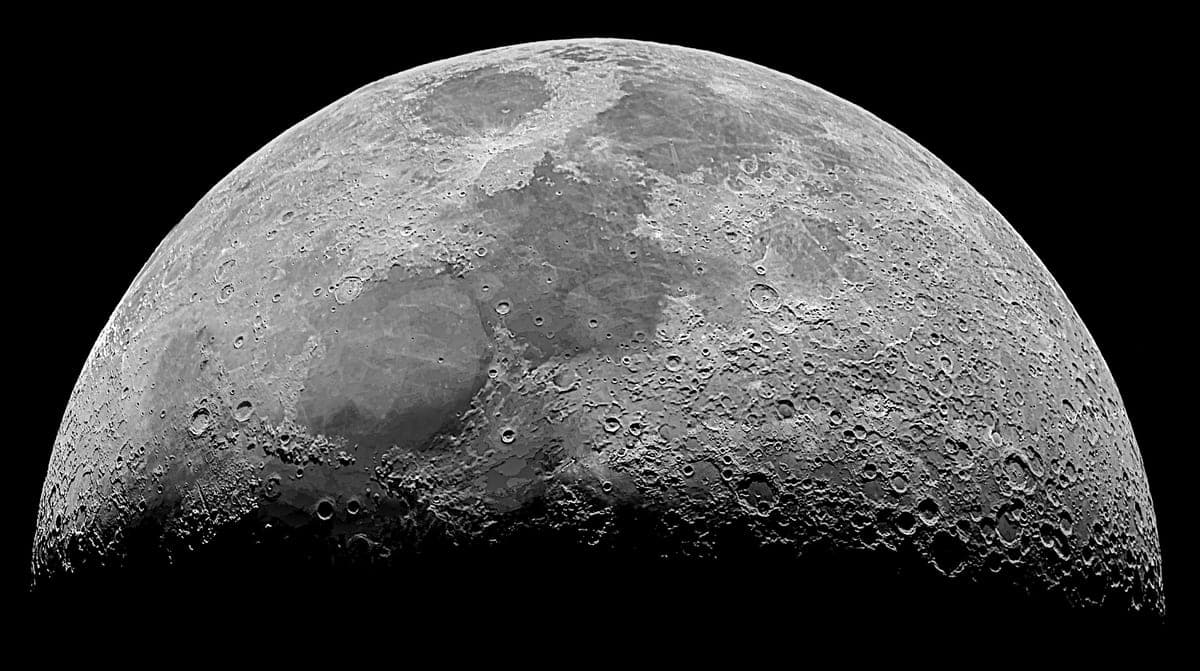
A full Moon through even a 70mm telescope is startlingly bright. It does not damage your eye, but it does wreck dark adaptation for the rest of the session, and an eye squinting against glare resolves less detail rather than more.
How to choose by transmission and aperture
| Your telescope | Full Moon without a filter | Sensible filter | Why |
|---|---|---|---|
| 70mm - 80mm | Bright but bearable | 25% green, or none | Small aperture collects little enough that heavy filtering leaves too little |
| 102mm - 114mm | Uncomfortable at full phase | 25% | Celestron's own recommendation caps this filter at 127mm |
| 127mm - 130mm | Genuinely dazzling | 13% neutral density | Twice the light of a 90mm objective needs roughly twice the cut |
| Any aperture, crescent Moon | Comfortable | None | A crescent shows the best crater shadows and is not bright |
| Binoculars | Bright, briefly | None available | Binocular objectives take no eyepiece filters |
Transmission figures are Celestron's published specifications. The aperture guidance follows Celestron's own recommendation for item 94119-A and our arithmetic on light gathering, which scales with the square of aperture.
Quick picks
Three filters, matched to aperture
| # | Product | Best for | Price |
|---|---|---|---|
| 1 | 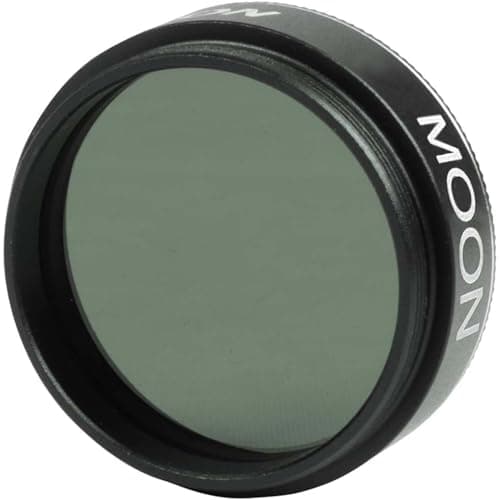 Celestron Moon Filter 25 percent transmission in #58 green glass, at the price of a takeaway coffee. | Telescopes under 127mm — which is every telescope we recommend for a child | |
| 2 | 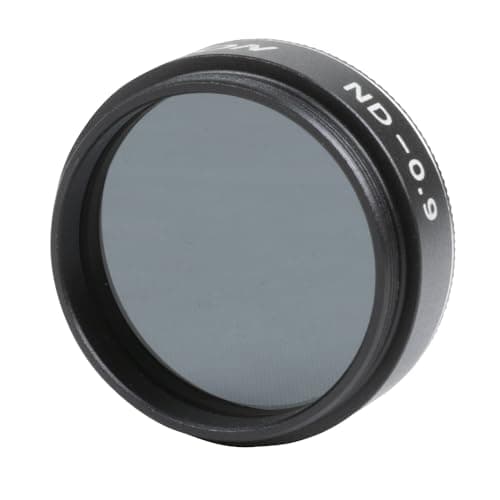 Celestron Neutral Density Moon Filter 13 percent transmission, neutral across the spectrum, threaded both sides so it stacks. | Larger telescopes, and anyone who wants the Moon to stay gray | $19.95 on Amazon #ad How we’re funded · price as of October 18, 2026 |
| 3 | 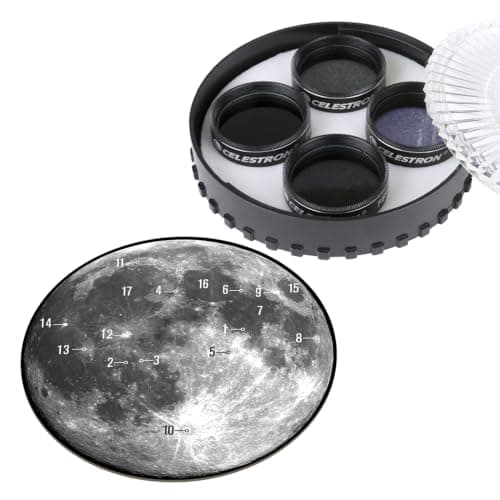 Celestron Moon Filter Set Three neutral densities at 50, 25 and 13 percent plus a Moon and Sky Glow filter, stackable. | Someone who observes the Moon through a whole cycle |
Rows link to the full write-up further down this page. Prices come from the live price layer only; where there is no live figure the button reads “Check price” rather than showing a number we remembered.
The free alternatives, which usually work
Before spending anything, three things change lunar viewing more than a filter does.
- Observe a crescent or half Moon instead. Craters near the terminator — the line between light and dark — throw long shadows and show far more relief than a flat, glaring full Moon. This is the single best lunar tip there is, and it costs nothing.
- Use more magnification. Spreading the same light over a larger image dims it. Going from 30x to 90x on the Moon is a filter of sorts, and it shows more detail at the same time.
- Keep one eye closed, or observe earlier. A Moon low in a twilight sky is far less punishing than the same Moon at midnight against full darkness.
Colored filters, and why we are not recommending a set of them
The accessory kits sold alongside beginner telescopes usually contain a rainbow of colored filters promising sharper planetary detail. On small telescopes their effect ranges from subtle to counterproductive, because each one blocks most of the light a small aperture worked to collect.
That is the same reasoning behind what not to buy: a case of ten accessories at the price of one good one usually contains ten mediocre accessories. A single moon filter is the exception worth making, because glare is a real problem with a cheap and certain solution.
Fitting and using it
- Thread it onto the eyepiece, not the telescope. The filter screws into the bottom of the eyepiece barrel, before the eyepiece goes into the focuser.
- Fit it indoors, in the light. These are small pieces of glass in a metal cell and they are easy to cross-thread or drop in the dark.
- Take it off for everything else. It is a lunar accessory; on a faint object it simply removes light you need.
- Check the phase first. If the Moon is a crescent, leave the filter in the case and enjoy the shadows.
What we did and did not do
We have not tested these filters. Every transmission figure, item number and recommendation here was read from Celestron's published product pages and its own knowledgebase comparison of the three filter types, linked below and checked on the date at the top of this page.
No price appears in this prose. Live figures come only from our price feed with the date they were checked. Our full method is on the methodology page.
The picks in full
Pick 1
Celestron Moon Filter
Telescopes under 127mm — which is every telescope we recommend for a child
The arithmetic
The cheapest accessory that changes what a child sees, because a full Moon through even a 70mm telescope is genuinely uncomfortable — and an eye squinting against glare resolves less detail, not more. Celestron caps its recommendation at 127mm of aperture for a reason: cut 75 percent of the light from a big mirror and you still have plenty; cut it from a small one and you may have too little. Every telescope we recommend for a child is inside that limit.
Celestron caps its own recommendation for this filter at telescopes under 127mm of aperture, which covers every telescope on this site that we would put in front of a child.
The arithmetic is simple: it passes 25 percent of the light, cutting brightness by 75 percent. On a 70mm to 114mm telescope that lands the full Moon somewhere comfortable rather than dazzling, without dimming it into uselessness.
The catch is the glass. #58 is a green filter, so it does tint the view green — noticeable side by side with a neutral filter, and invisible enough after a minute that most people stop caring.
Never use any eyepiece filter to look at the Sun. That is not what this is for and it is not safe for that.
Skip it if
Color accuracy matters to you. This is green glass, not neutral, so it tints the view — the honest trade for the price. It is also threaded on one side only, so it cannot be stacked.
| Item number | 94119-A |
|---|---|
| Filter size | 1.25" |
| Glass | #58 green |
| Light transmission | 25 percent — cuts brightness by 75 percent |
| Celestron's recommendation | Smaller telescopes, under 127mm of aperture |
| Threading | Threads onto most 1.25" eyepieces |
| Warranty | 2 year |
| What the box does not do | It is #58 green glass, not neutral, so it tints the view green — a real trade against the neutral density version. It is threaded on one side only, so it cannot be stacked with another filter, and it does nothing for planets or deep-sky objects. Never use any eyepiece filter to look at the Sun. |
Specifications from Celestron — Moon Filter 1.25 inch; Celestron — Moon filter, neutral density and variable polarizing compared. We have not handled this one — everything above is the published spec sheet plus our own arithmetic on it.
Pick 2
Celestron Neutral Density Moon Filter
Larger telescopes, and anyone who wants the Moon to stay gray
The arithmetic
The honest comparison with the cheaper green filter is two numbers: 13 percent transmission against 25 percent, and no color cast against a green one. It cuts almost twice as much light, which is what a larger telescope needs and what a 70mm one usually does not — on a small telescope, 13 percent can leave the Moon dimmer than you want.
Neutral density means it darkens every visible wavelength evenly, so the Moon stays gray instead of turning green. For anyone who cares what the Moon actually looks like, that is the upgrade.
At 13 percent transmission it cuts almost twice as much light as the green filter, which is what a 130mm mirror needs and what a 70mm refractor usually does not.
It threads on both sides, so it can be stacked with a color filter — a flexibility the cheaper filter does not offer.
Honest downside: it costs noticeably more for a job most small telescopes do not need done that hard.
Skip it if
Your telescope is small. Cutting 87 percent of the light from a 70mm objective can leave the Moon dimmer than you want, especially at a crescent phase.
| Item number | 94105 |
|---|---|
| Filter size | 31.75mm (1.25") |
| Light transmission | 13 percent — cuts brightness by 87 percent |
| Color shift | None; darkens all visible wavelengths evenly |
| Housing | Aluminum cell |
| Threading | Threaded both sides, stackable with color filters |
| Warranty | 2 year |
| What the box does not do | It costs noticeably more than the green filter for a job most small telescopes do not need doing that hard. Like every lunar filter it is useless on faint objects, and it must never be used to look at the Sun. |
Specifications from Celestron — Neutral Density Moon Filter 1.25 inch. We have not handled this one — everything above is the published spec sheet plus our own arithmetic on it.
#ad How we’re funded · price as of October 18, 2026
Pick 3
Celestron Moon Filter Set
Someone who observes the Moon through a whole cycle
The arithmetic
Three neutral densities at 50, 25 and 13 percent, and because they thread on both sides they can be stacked — 50 percent over 25 percent lands near 12.5. That is the set's real argument: the right amount of dimming changes with the Moon's phase and with your aperture, and one fixed filter is always a compromise between a thin crescent and a full Moon.
The argument for a set is that the right amount of dimming is not a constant. A thin crescent needs almost none; a full Moon at high altitude through a 130mm mirror needs a lot.
Because the cells are threaded top and bottom, the densities stack — 50 percent over 25 percent lands near 12.5 percent — so the set covers more of that range than its three filters suggest.
The included moon map is a genuinely nice thing to hand a child, and the carrying case keeps small glass from being lost in the dark, which is the most common way filters end.
It remains the wrong first purchase for most families. Buy the single filter, and buy this later only if the Moon becomes the thing they care about.
Skip it if
You own one small telescope and one child. This is four times the price of the single green filter and three of the four filters will sit unused most months.
| Item number | 94315 |
|---|---|
| Filter size | 31.75mm (1.25") |
| Included | ND96-0.9 (13%), ND96-0.6 (25%), ND96-0.3 (50%), Moon and Sky Glow filter |
| Housing | Aluminum cells, threaded top and bottom for stacking |
| Also included | Moon map with a legend of lunar features, plastic carrying case |
| Warranty | 2 year |
| What the box does not do | It is four times the price of the single green filter, which is hard to justify for one child and one small telescope. Three of the four filters will sit unused in most months, and the moon map is paper, not an instrument. |
Specifications from Celestron — Moon Filter Set 1.25 inch. We have not handled this one — everything above is the published spec sheet plus our own arithmetic on it.
Questions people actually ask
- Do you really need a moon filter?
- For a full Moon through a telescope of about 100mm or more, it makes the view considerably more comfortable. For a crescent Moon, or for a 70mm telescope, you often need nothing at all — the phase and the small aperture do the work.
- What percentage moon filter should I buy?
- Match it to aperture. Celestron recommends its 25 percent transmission filter for telescopes under 127mm. Larger apertures suit a 13 percent neutral density filter, which cuts 87 percent of the light.
- What is the difference between a moon filter and a neutral density filter?
- The basic Celestron moon filter is #58 green glass passing 25 percent of the light, so it tints the view. The neutral density filter passes 13 percent and darkens all colors evenly, leaving the Moon gray, and it threads on both sides so it can be stacked.
- Can a moon filter be used to look at the Sun?
- No. Never. Eyepiece filters are not solar filters, and using one to look at the Sun can destroy your eyesight instantly. Solar viewing requires a purpose-made filter fitted over the front of the telescope.
- Does a moon filter show more detail?
- Indirectly. It does not add resolution, but reducing glare lets your eye relax rather than squint, and a relaxed eye picks up more subtle contrast. Observing a crescent instead of a full Moon does far more for detail than any filter.
- Will a moon filter fit my telescope?
- These thread onto the bottom of standard 1.25-inch eyepieces rather than onto the telescope, so they fit almost any telescope using 1.25" eyepieces. Very cheap telescopes with 0.965-inch eyepieces are the exception.
Sources
Read next
Where to go from here
- What you can actually see with a kids' telescope
The honest target-by-target list for 70mm, 76mm and 114mm telescopes, so nobody is disappointed on night one.
- What to buy a kid who already has a telescope
A telescope's real problems are dark adaptation, steadiness and knowing where to point it. None of them cost much to fix.
- Barlow lens for a telescope: the arithmetic before the purchase
One number decides whether a Barlow helps or hurts: your shortest eyepiece, multiplied, against the telescope's published ceiling. Work it out first, then buy.
- Your first night with a telescope
Do these eight things in this order and night one works. Most first nights fail on sequence, not on equipment.
- The space gifts not to buy — and what to buy instead
The four ways the kids astronomy aisle disappoints, each with the arithmetic that exposes it and the honest alternative at the same money.
- The best kids' telescope to see planets
Planets are the one thing every child asks about. Which telescopes show them properly, and what Jupiter and Saturn genuinely look like at this aperture.